Sales teams already know coaching works. The question is how to make it happen more consistently without adding more responsibilities for your manager every time the team grows.
Sales tools powered by artificial intelligence can help by taking on parts of the coaching process that are difficult to scale manually, such as reviewing more conversations, identifying repeated performance gaps, and giving reps more opportunities to practice.
The real decision for sales leaders is knowing which of these AI sales coaching tools create enough value to justify the investment.
In this guide, we’ll compare the seven best sales coaching software options that use AI and look at where each one fits into a more efficient coaching operation.
The seven best tools for coaching sales reps with AI in 2026 are:
AI does not make manager-led coaching obsolete. It changes which parts of the coaching process need a manager’s time.
Traditional sales training and coaching depend heavily on observation. Managers listen to recorded calls, review performance, decide what needs attention, and work through those gaps with reps.
That model works when managers can see enough of what each rep is doing.
The limitation appears as team size and conversation volume grow. One manager might have hundreds of customer conversations happening under their team every week. The percentage they can personally review becomes small very quickly.
AI-powered coaching expands that observation layer.
Sales coaching software can evaluate larger volumes of conversations against the same criteria and identify patterns that are difficult to see from isolated reviews.
Area | Traditional Sales Coaching | AI-Powered Coaching |
Call review | Managers manually choose and review a lmited number of calls | AI can evaluate a muarger share of eligible conversations |
Feedback frequency | Depends on manager availability and coaching cadence | Feedback can be delivered after calls or practice sessions |
Practice | Usually requires a manager, trainer, or another rep | Reps can practice independently with AI buyers |
Evaluation | Varies by manager judgment and the calls selected | Defined scorecards can be applied consistently |
Skill-gap detection | Managers identify patterns from the activity they observe | AI can surface repeated patterns from a larger performance dataset |
Personalization | Manager determines what each rep should work on | Coaching can be tied to individual performance signals |
Manager role | Observation, evaluation, feedback, practice, and strategic coaching | More time can shift toward judgment, deal strategy, and higher-value intervention |
Measurement | Coaching activity is often easier to track than behavior change | Some platforms connect coaching data with subsequent rep performance |
The real question isn’t whether AI can replace sales coaching. It’s which parts of coaching should a manager still handle and which parts AI can now handle more efficiently.
Sales managers can only review so many calls and run so many practice sessions each week. AI can take on more of that repetitive work by analyzing conversations, identifying recurring performance gaps, and helping deliver targeted call evaluation feedback to reps.
That gives managers more time to focus on coaching that requires human judgment, such as understanding why a rep is struggling, working through complex sales situations, and deciding which performance issues deserve the most attention.
The scale advantage is particularly important when leaders need to understand performance beyond a small sample of calls.
Insight7’s analysis of 6,209 customer conversations found measurable differences between performance tiers that would be difficult to identify consistently through manual call reviews alone.
So AI-powered coaching isn’t simply a faster version of traditional coaching. It gives sales organizations more coaching capacity without requiring manager involvement at every stage of the process.
The platforms below all support AI-assisted sales coaching, but each one approaches it differently.
Platform | Key Features | Pricing |
Insight7 |
|
|
Hyperbound |
| No public pricing available |
Mindtickle |
| No public pricing available |
Gong |
| No public pricing available |
Second Nature |
| No public pricing available |
Highspot |
| No public pricing available |
Seismic |
| No public pricing available |
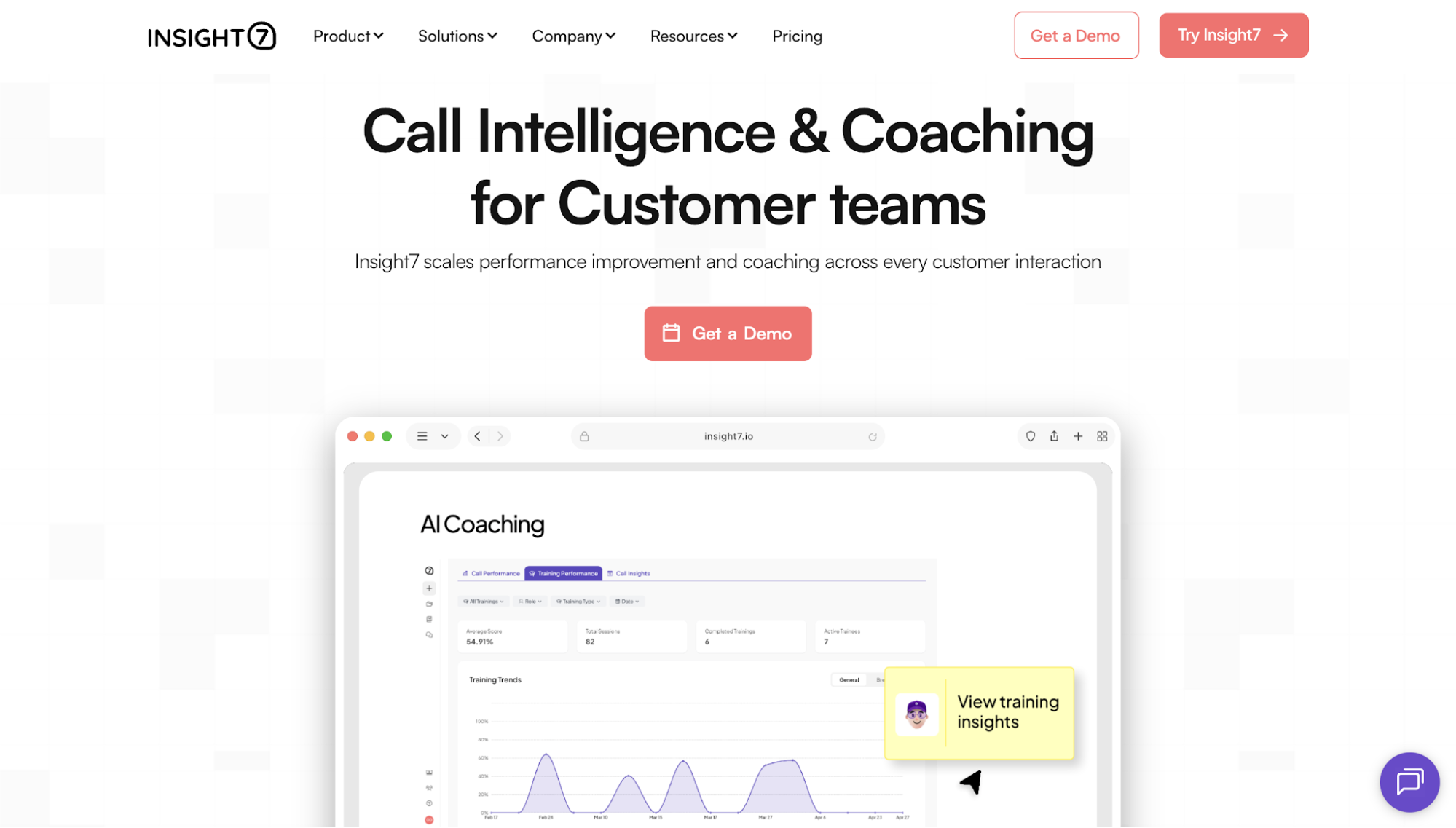
Insight7 is an AI call intelligence and coaching platform for customer-facing teams that analyzes sales calls to help teams understand how reps perform in real sales interactions and turn those findings into measurable improvement.
Its coaching model starts with rep performance. Calls are evaluated against customizable criteria, recurring skill gaps are identified, and those findings become actionable insights for personalized coaching and AI roleplay.
The same conversation data can continue measuring whether the targeted behavior improves over time.
Instead of relying solely on traditional training modules, Insight7 ties coaching directly to what is happening in actual sales conversations.
For example, if a rep is consistently missing key discovery questions, the platform can surface that pattern from their calls, pinpoint the exact moments it occurs, and build targeted practice around it.
The platform’s Coaching Autopilot goes further by generating roleplay training directly from call scorecard results. Once a low-performing area is identified, the system can create a practice session targeting that skill and assign it to the relevant team member.
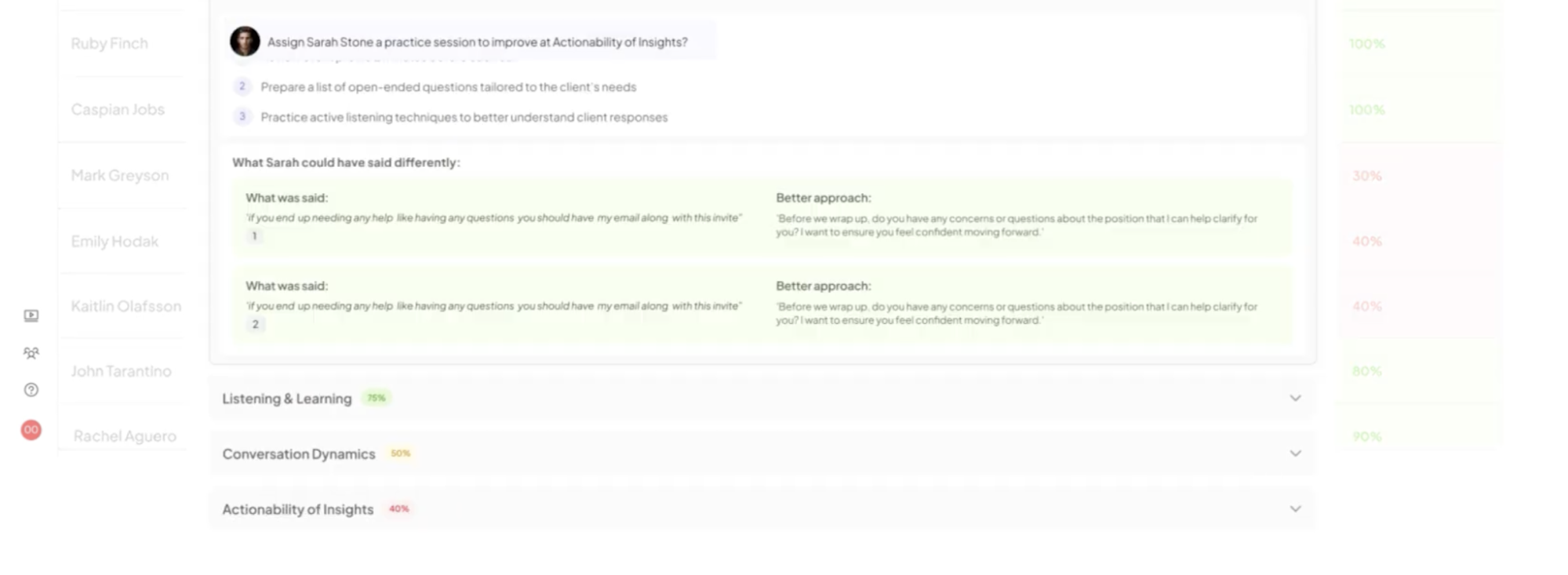
This creates a direct link between identifying a performance gap and reinforcing the right behavior through practice.
Insight7 is built around the idea that high-performing sales behavior already exists inside your conversations; it just needs to be surfaced and structured.
Its research into 6,209 real sales conversations revealed the winning behaviors that separated top performers from average reps. High performers consistently asked more questions, showed stronger empathy signals, and drove more actionable outcomes across their calls.
These patterns aren’t presented as rigid benchmarks, but as evidence that performance leaves measurable signals inside everyday conversations.
Insight7 turns those signals into something teams can actually use. Instead of relying on subjective call reviews, managers can identify what strong execution looks like within their own sales motion and translate it directly into coaching workflows.
At scale, this becomes even more impactful. Teams using Insight7 routinely analyze thousands of calls each month without increasing headcount.
Elise Dietrich, CPO at TripleTen, reports reviewing more than 6,000 monthly calls through the platform at a cost comparable to a single U.S.-based project manager.
This shifts the manager’s role from manual call reviewer to performance strategist. Rather than spending hours searching for coaching moments, managers focus on interpreting patterns and guiding rep development based on real conversation data.
Insight7 is currently rated 4.7/5 on G2, with users consistently highlighting its speed in surfacing insights, ease of use, and time savings.
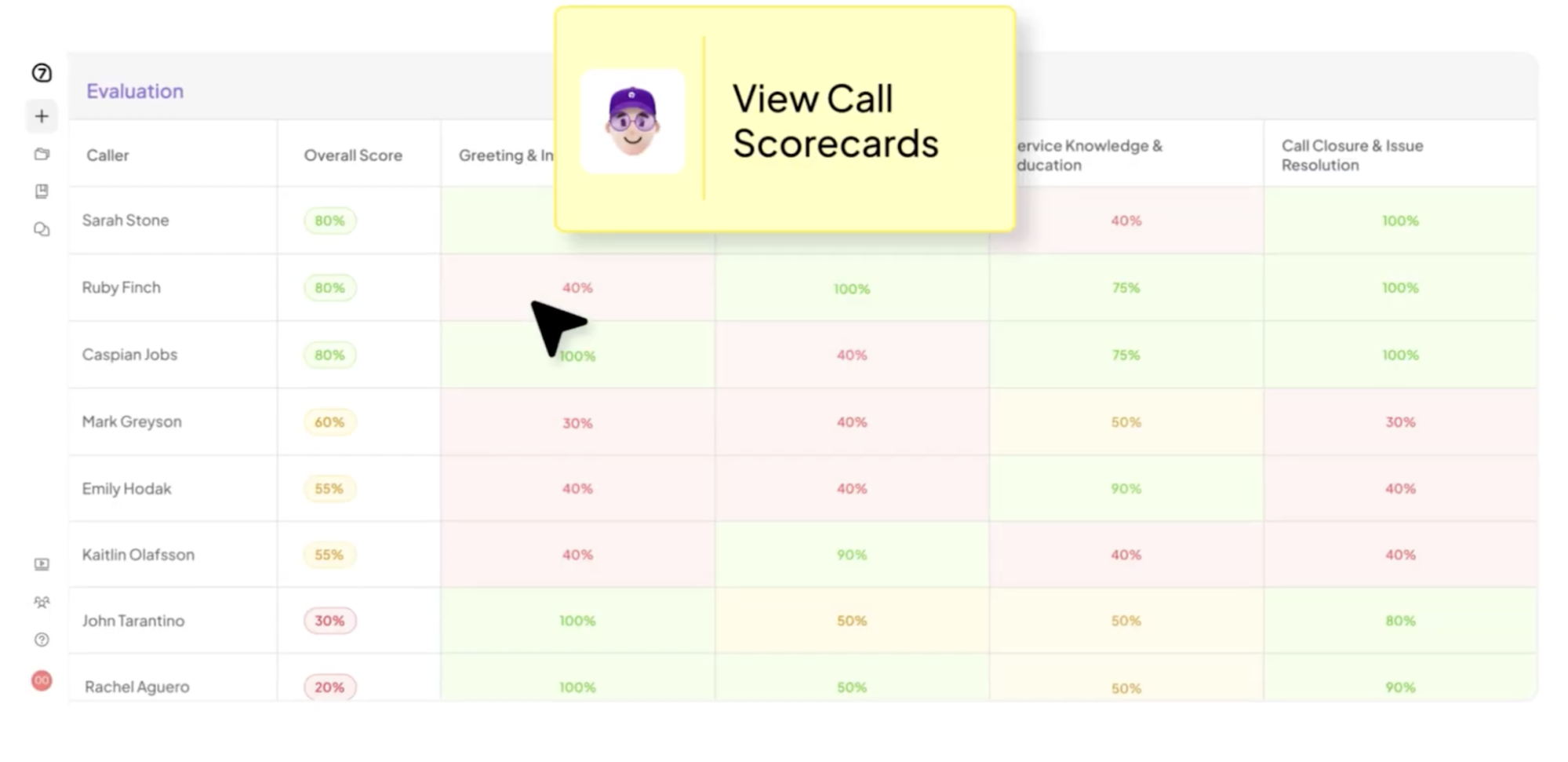
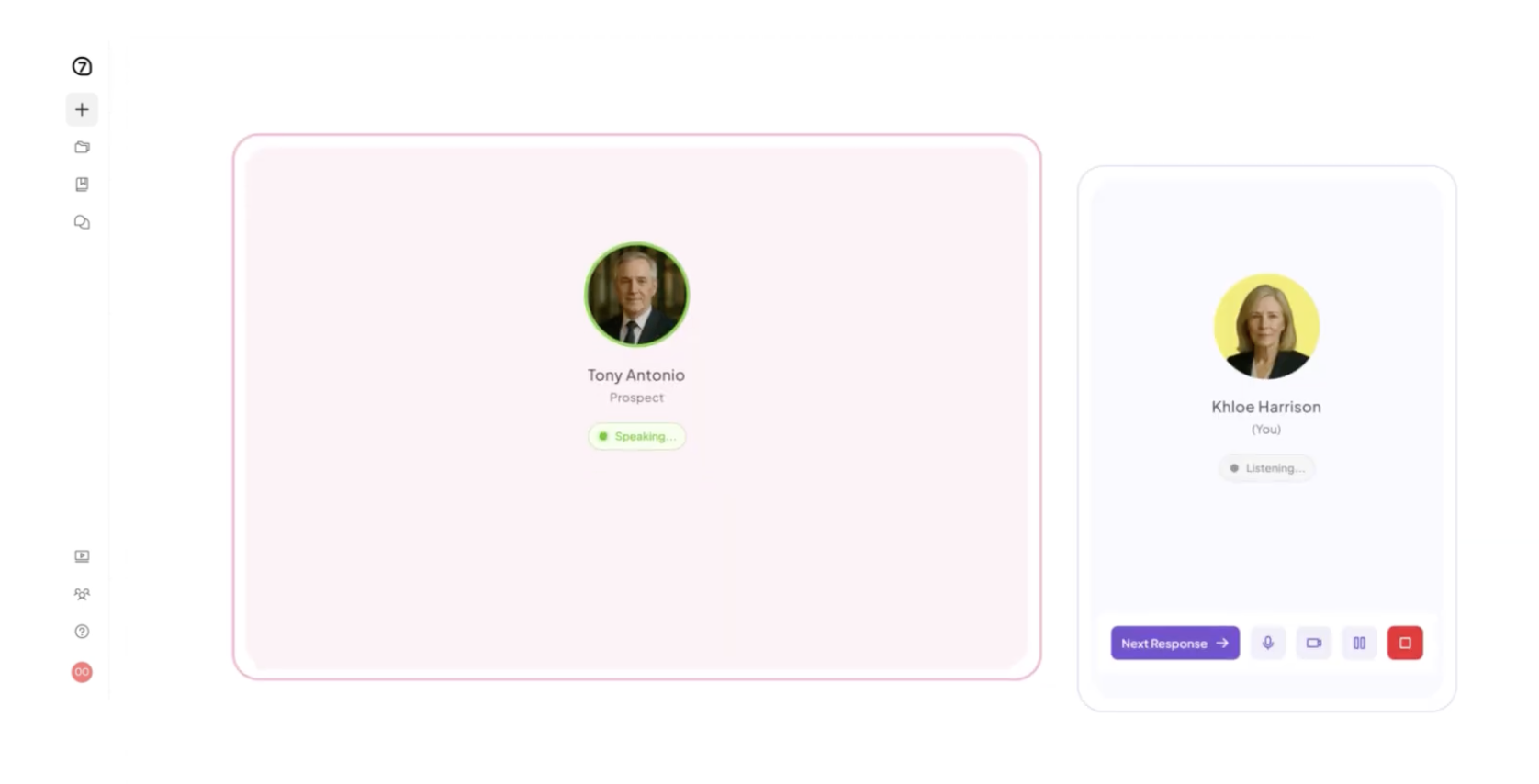
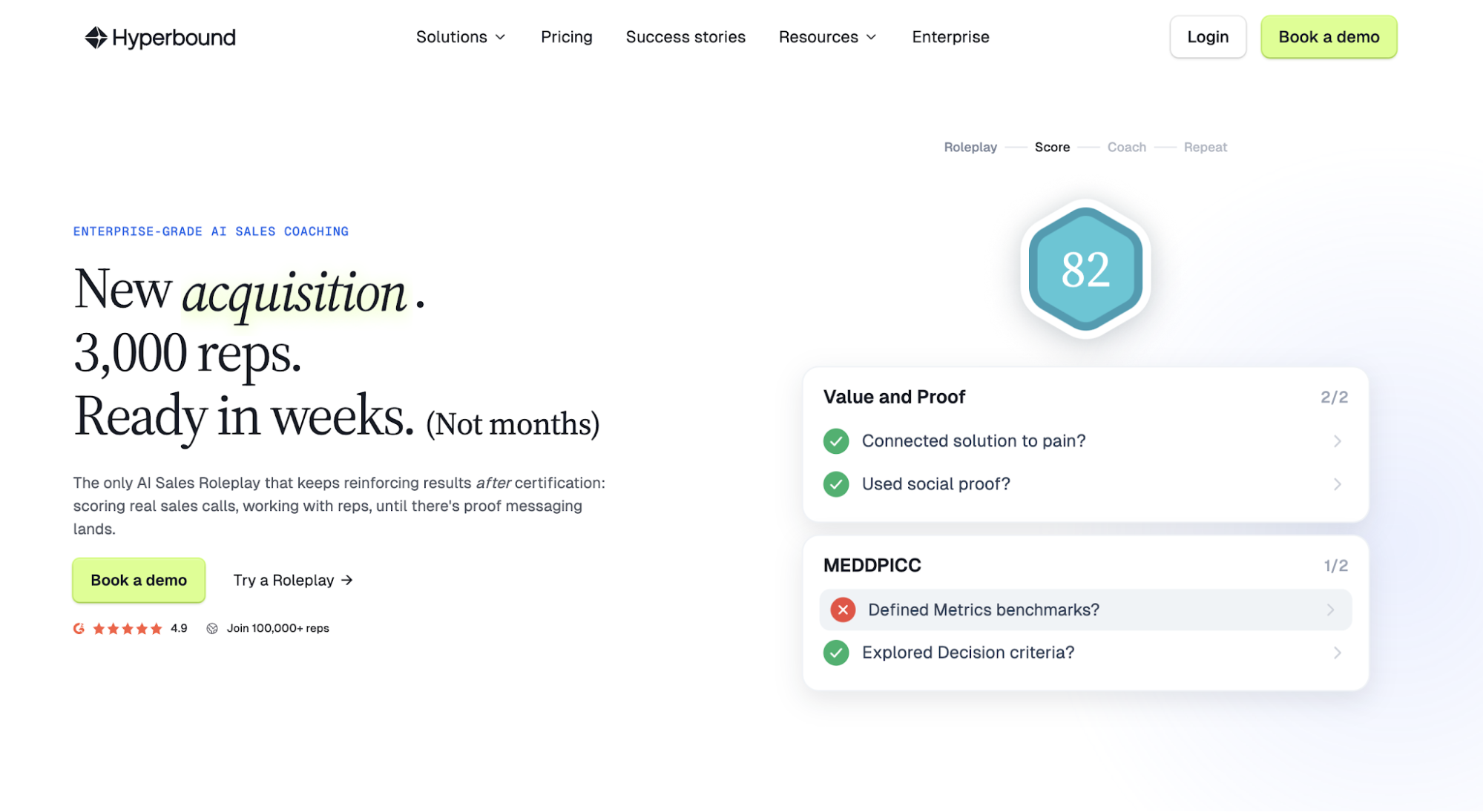
Image source: hyperbound.ai
Hyperbound is an AI sales coaching platform centered on roleplay and rep performance. It gives sales teams AI buyer simulations for practice and adds a real-call layer through Hyperbound Perform.
Its current product structure separates Practice from Perform. Practice focuses on AI roleplay, while Perform adds real-call scoring, conversation intelligence, and coaching workflows that connect calls back to practice.
That makes Hyperbound particularly relevant for sales enablement teams that want repeated roleplay without leaving real sales performance completely separate from the training environment.
Hyperbound doesn’t publish public pricing.
Image source: mindtickle.com
Mindtickle is a revenue enablement platform that brings sales coaching together with readiness, training, conversation intelligence, and AI roleplay.
Its coaching model is built around understanding whether reps have the skills required to execute in the field. Mindtickle combines call insights with readiness data and practice, giving revenue teams a structured view of where seller development needs attention.
Mindtickle does not publish public pricing.
Image source: gong.io
Gong is a revenue AI platform that captures customer conversations and turns them into data for sales execution, pipeline management, coaching, and enablement.
Its coaching capabilities have expanded considerably through Gong Enable. The product can identify skill gaps from real sales conversations, prescribe training, and create AI roleplay scenarios using previous customer interactions.
Gong does not publish fixed public pricing.
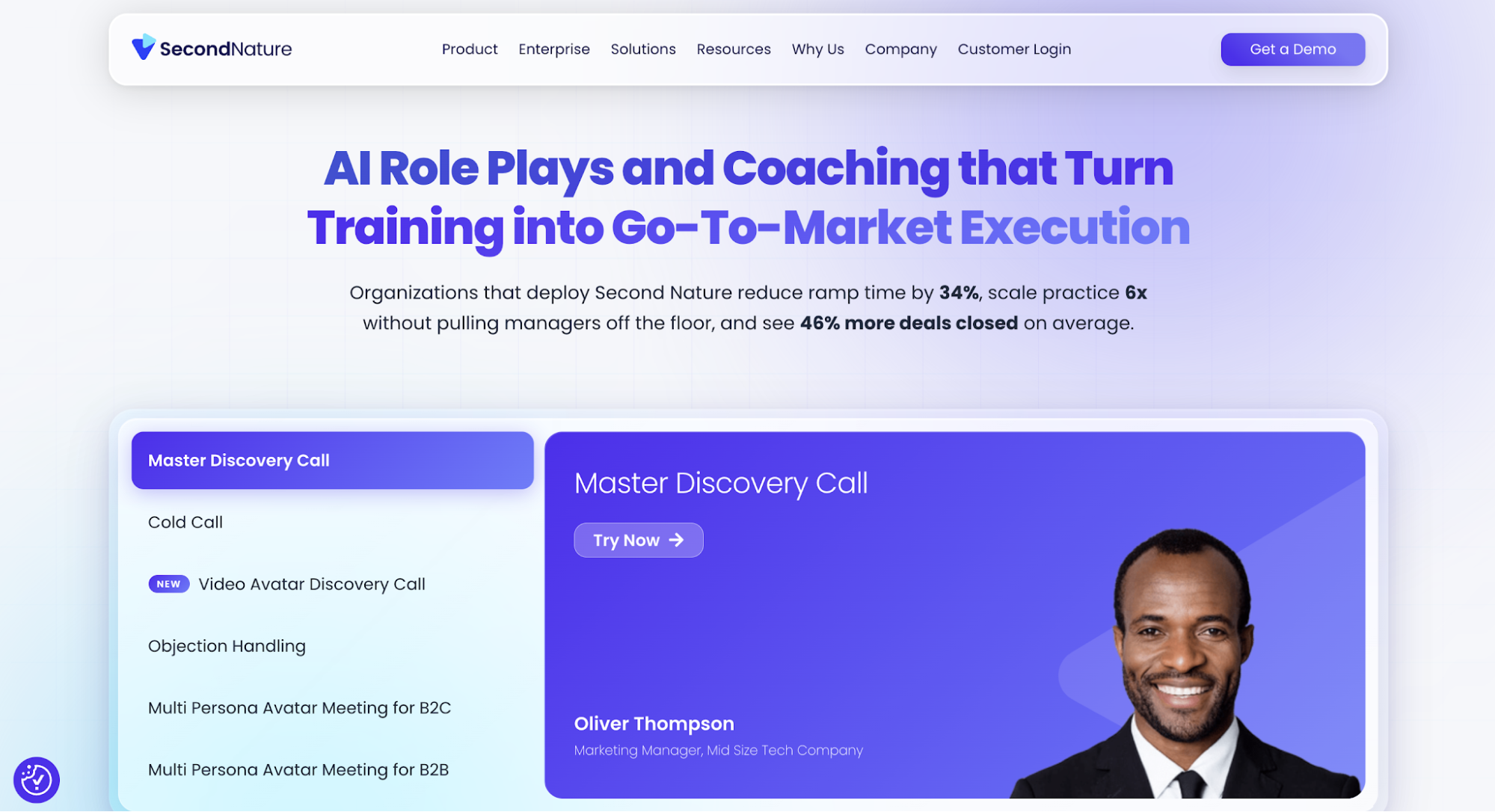
Image source: secondnature.ai
Second Nature is a focused AI roleplay platform designed for sales and customer-facing teams that need more opportunities to practice realistic conversations.
Its center of gravity is simulation. Teams can create AI buyer scenarios, give reps repeated practice, and evaluate performance after each session without requiring a manager to participate in every roleplay.
Second Nature does not publish public pricing.
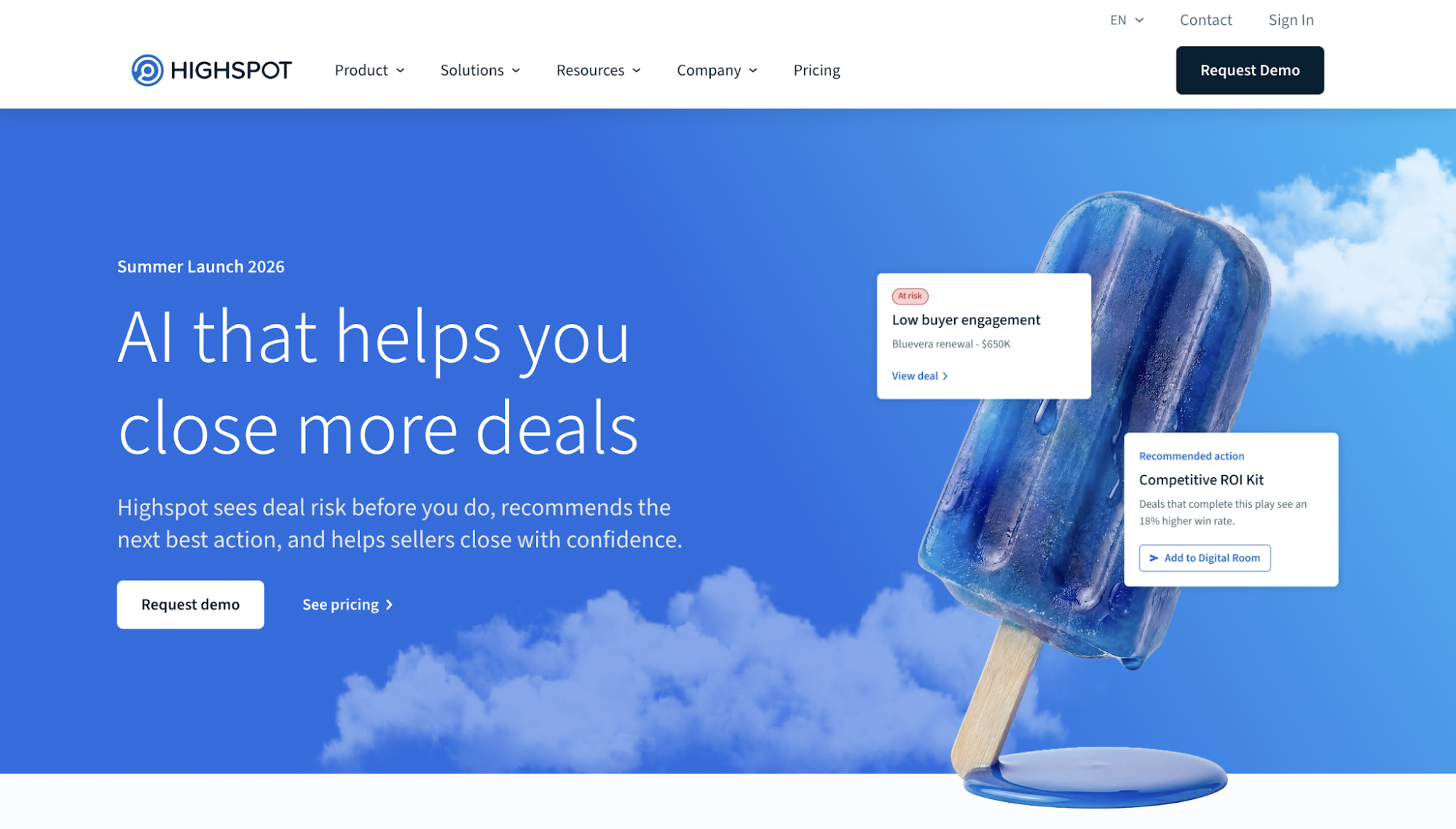
Image source: highspot.com
Highspot is an AI-powered sales enablement platform that combines content, training, coaching, deal intelligence, and seller performance data.
Its coaching capabilities sit inside that larger enablement environment. AI-powered assessments identify skill gaps, while Highspot Role Play gives sellers simulated conversations tied to their GTM motion and active deal context.
That approach is particularly relevant for enterprise sales teams that want coaching connected to the content, plays, and training sellers already use.
Second Nature does not publish public pricing.
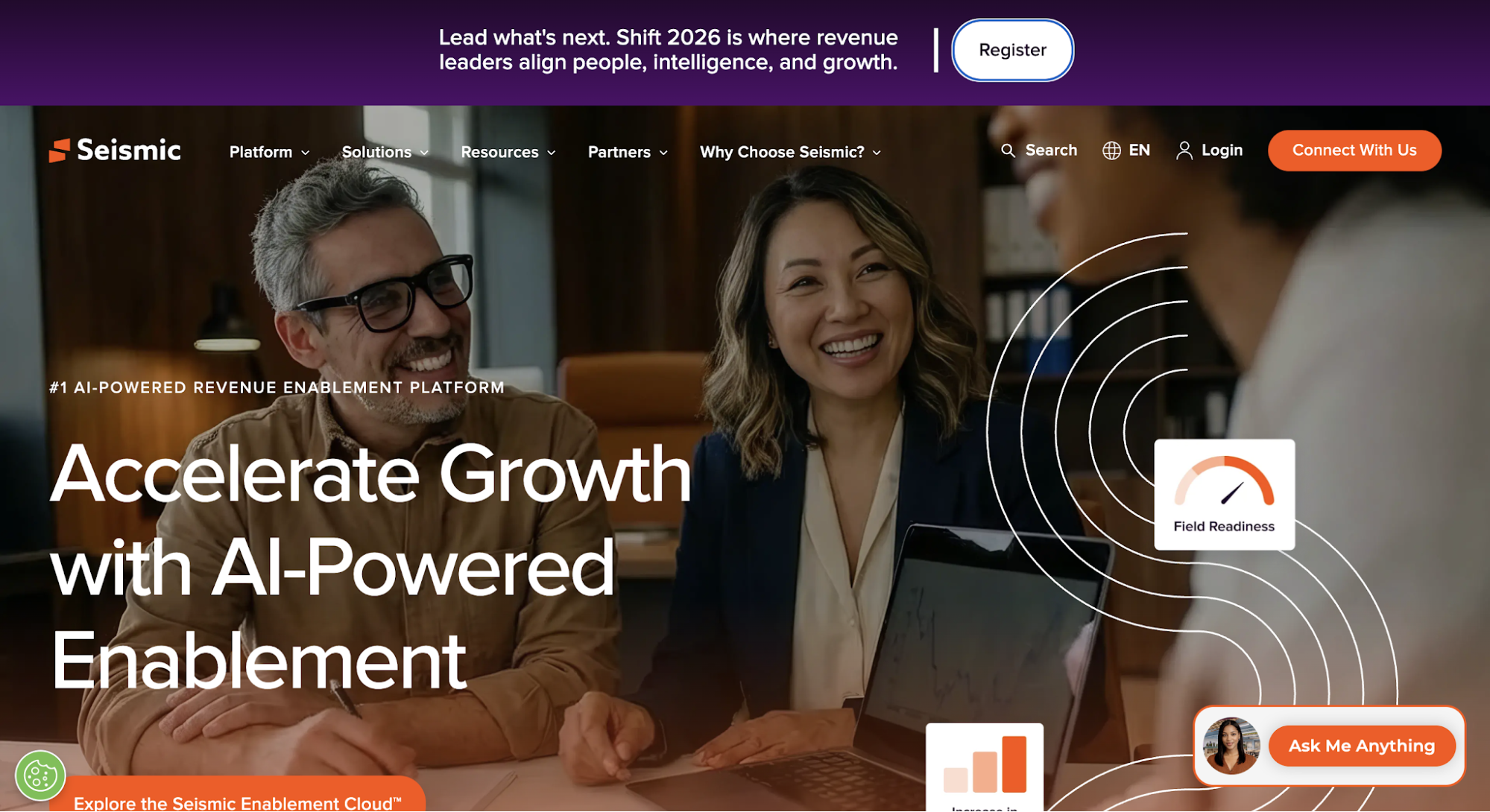
Image source: seismic.com
Seismic is an enterprise enablement platform that combines content management, learning, coaching, meeting intelligence, and buyer engagement.
Its sales training and coaching capabilities are delivered through Seismic Learning, where teams can evaluate skills, create personalized coaching plans, and use AI-powered practice to reinforce desired field behaviors.
Seismic does not publish public pricing.
We already know AI can make sales coaching more efficient. But how does that efficiency actually look once these AI sales tools are part of the coaching process?
As a sales team grows, the amount of coaching managers can personally provide doesn’t automatically grow with it.
A manager who supports eight reps has more time to review calls and work through individual performance issues than someone responsible for 20. Hiring more managers is one way to maintain that level of support, but it also increases the cost of scaling the team.
AI sales coaching tools like Insight7 give sales organizations another option.
They can handle more of the repeatable work involved in reviewing calls, scoring performance, and giving reps opportunities to practice. Managers can still step in when a rep needs deeper guidance, but they don’t have to personally handle every part of the coaching process.
In fact, we’re already seeing what that added capacity can look like in sales organizations. A 2026 Gartner survey of 210 sales leaders found that AI tools are saving sellers an average of 4.8 hours per week.
Organizations that achieved meaningful time savings and reinvested that capacity into higher-value sales activities were also 3.1 times more likely to exceed their lead-to-opportunity conversion goals.
The real value, then, isn’t simply the time AI saves. It’s what teams can do with the additional capacity, including giving managers more room to focus their attention on the reps and coaching situations where their involvement can make a bigger difference.
Finding a performance issue only creates value when the rep has a chance to work on it.
Without AI, there can be a delay between when a problem happens and when a manager has time to address it. Even after receiving feedback, the rep may need to wait for another coaching session before they can practice the situation.
AI shortens that process by giving reps more opportunities to correct their performance without having to wait for that insight to be made available to them.
If a rep struggles with objection handling, for example, they can receive real-time feedback, as Insight7 does on its platform, allowing sales reps to practice that skill through AI roleplay instead of waiting until the next scheduled coaching session.
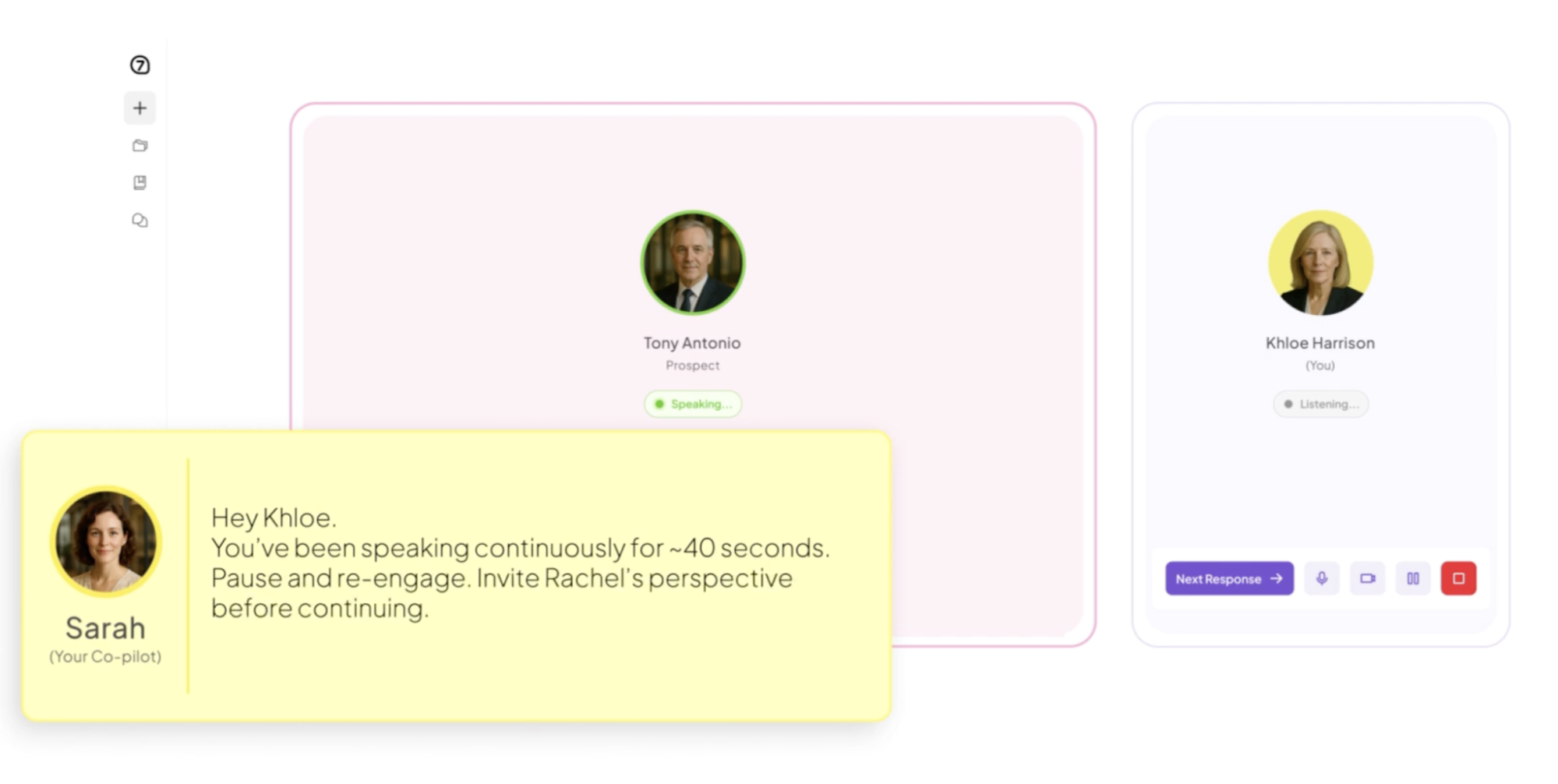
That way, reps can correct mistakes while the feedback is still fresh and avoid carrying the same issue into future sales conversations.
Another benefit of using AI-powered coaching tools is that they don’t just identify rep-level performance gaps at scale. They also help teams see where coaching is likely to deliver the highest return on investment.
Without that visibility, managers can easily spend the same amount of time coaching a rep who needs one specific adjustment and another who has several recurring performance issues.
AI gives leaders a clearer way to separate those cases and decide where deeper manager involvement is actually warranted.
It also helps distinguish an individual performance problem from a wider team problem.
If one rep consistently struggles with discovery, that points to targeted coaching. If the same issue appears throughout an entire team, the problem may sit in sales onboarding, messaging, or the sales process itself.
That changes coaching from a broad development activity into a more precise management decision. Leaders can direct managers’ time toward the gaps most likely to affect performance while using team-level patterns to decide when the organization itself needs to change.
The quality of coaching shouldn’t depend entirely on which manager a rep reports to.
Managers naturally have different experience and coaching styles. The problem comes when reps are being evaluated against different standards.
AI coaching tools can give the organization a shared baseline by evaluating conversations or practice sessions against the same QA scorecards and performance criteria.
Managers will still be the ones who’ll decide how to coach the person behind the score. The only difference is that everyone now starts with a clearer and more consistent view of what the organization expects from its reps.
AI-powered sales coaching tools also give teams a clearer view of whether the coaching they provide is actually paying off in the results reps generate.
If a rep is coached on discovery, for example, the platform can continue analyzing their future conversations to see whether they start asking the right questions more consistently.
The same approach can be applied to objection handling, closing, or whatever behaviors the organization has chosen to improve.
This gives teams something more meaningful to measure than how many coaching sessions or roleplays a rep completed. They can compare performance before and after coaching and see whether the targeted behavior is improving in actual customer conversations.
That also makes it easier to evaluate the investment itself. If coaching activity increases but the behaviors being coached remain unchanged, leaders have a clear signal that the current approach needs to be adjusted.
If those behaviors improve, teams can look at what contributed to that progress and apply the same approach to other reps facing similar performance gaps.
The value of using AI to coach sales reps ultimately depends on what the tool helps your team improve. More call analysis, coaching sessions, or roleplays mean little if reps continue making the same mistakes when they return to real customer conversations.
That’s why it makes sense to start with the conversations your reps are already having.
They give you a clearer picture of where each sales representative is struggling, which behaviors need coaching, and whether those behaviors improve after the rep receives feedback and practice.
If that’s how you want AI to support your sales coaching process, Insight7 is exactly what you need to bring those steps together in one platform.
It gives you everything you need to shape sales rep performance, from analyzing real sales conversations and identifying performance gaps to turning those findings into targeted coaching and continuous evaluation.
In this way, it becomes easier to set clear performance standards and apply a more consistent coaching process for both existing reps and new hires.
Look for an AI sales coaching platform that fits how your team already coaches reps and measures performance.
Prioritize capabilities that help managers identify individual skill gaps, provide targeted coaching and practice, evaluate real sales conversations, and track whether rep performance improves after coaching.
AI coaching software improves sales performance by helping teams identify where reps are struggling and address those gaps faster. Reps can receive more targeted feedback and practice specific skills, while managers can track whether those behaviors improve in future sales conversations.
Conversation intelligence gives managers real examples of how reps perform during customer conversations.
Platforms like Insight7 can analyze those conversations to identify recurring performance gaps and turn the findings into targeted coaching, giving managers clearer evidence of what each rep needs to work on.
Yes. AI coaching platforms can analyze recorded live calls to evaluate rep performance and identify behaviors that need improvement.
Tools like Insight7 can use those findings to guide personalized coaching and AI roleplay, then analyze future conversations to see whether the rep is applying what they learned.
Start by measuring whether the behaviors targeted through coaching improve over time, then compare those changes with relevant sales metrics.
Depending on the coaching goal, that could mean tracking conversion rates, win rates, deal progression, or other revenue outcomes that the targeted behavior is expected to influence.

