A rep finishes a discovery call and types four lines into the CRM. “Good conversation, budget confirmed, sending pricing Thursday.”
What actually happened was longer and more useful. The buyer mentioned a competitor twice, went quiet when integrations came up, and never named who signs off. None of that reaches the pipeline review, because nobody was writing it down.
AI call analysis closes that gap. It reads every captured sales call automatically and turns what was said into data a manager can act on.
This guide covers what it finds, how deal risk shows up in a conversation, which call analytics are worth tracking, and where the technology still falls short.
Get a demo with Insight7 and see what your sales calls are already telling you.
AI call analysis is the use of artificial intelligence to analyze live or recorded calls and extract insights from what was said.
For a sales team, that means the parts of a conversation that decide whether a deal moves. Pain points, objections, pricing reactions, competitors mentioned, and whatever each side committed to do next.
The same technology runs in contact centers as call center QA software, where quality monitoring and service quality are the goal rather than pipeline. Tools built for either use the same underlying process.
A transcript tells you what was said. Call analysis tells you what it means and what to do about it.
Every call becomes structured call data. Instead of a folder of audio files nobody opens, you get a searchable record showing which objections came up, how the buyer reacted, and where the conversation lost momentum.
The practical shift is away from manual review. A manager who once sampled a few customer calls a month now works from all of them.
The two terms overlap and often get used interchangeably. The practical difference is scope.
Conversation intelligence is the broader category that covers calls, meetings, and chat between customers and any customer-facing team. AI call analysis focuses on voice and video calls and, in a sales context, specifically on sales calls and meetings.
Sales call analysis is not looking for everything. It is looking for the handful of things that predict whether the deal closes.
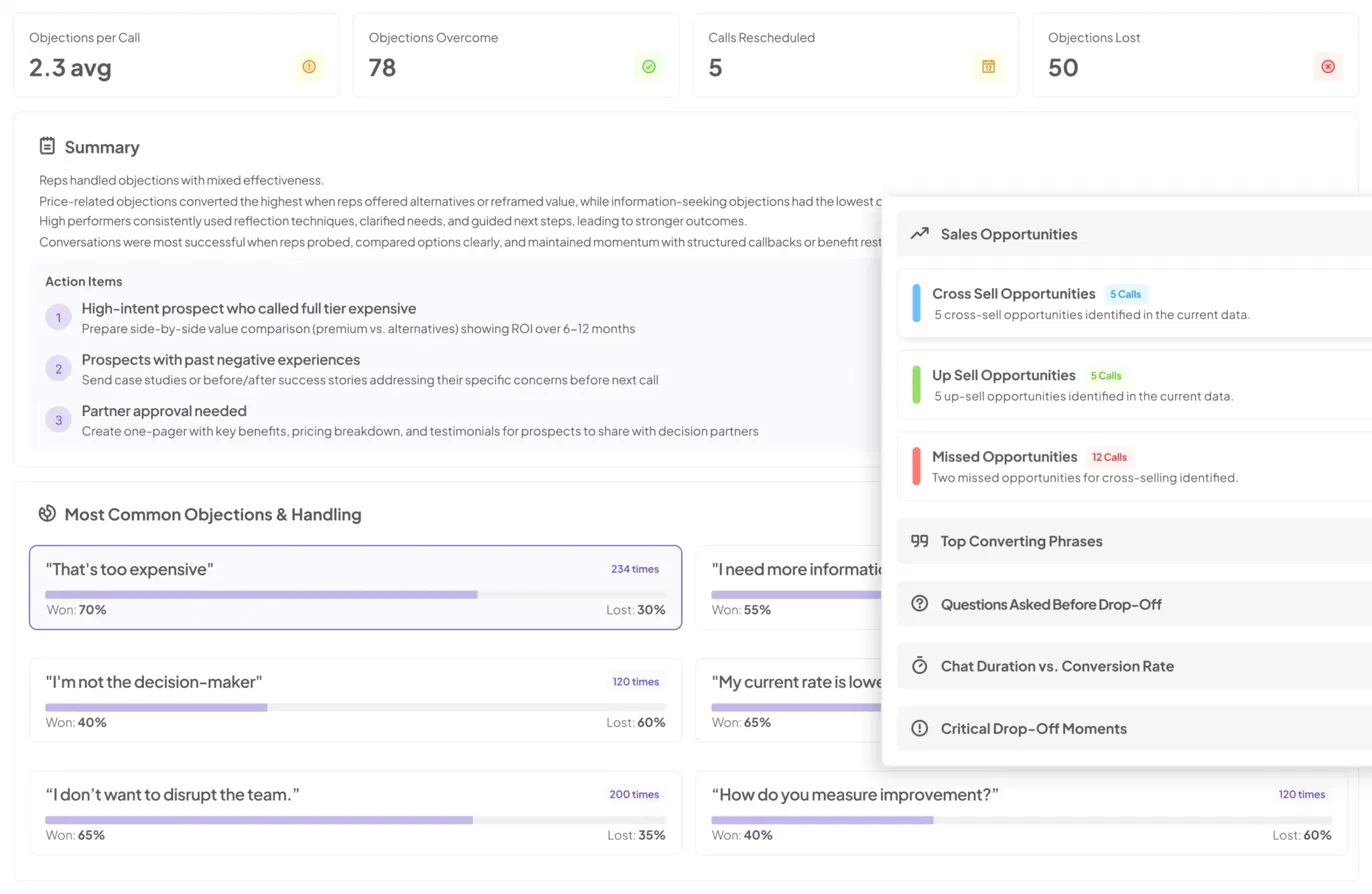
Objections repeat far more than any rep notices. AI call analysis tags every one, so you can see which come up most, which reps handle them well, and which responses correlate with deals that advance.
Objections show where your pitch and the buyer’s exact needs don’t align, making objection handling measurable. When you know price objections appear on 40% of calls and one rep clears them twice as often as the rest, you know exactly what to put in the next team session.
Insight7 ranks objections by how often they appear and shows the won-and-lost split for each one. A sales manager can see that the pricing objection is both the most common and the one most reps recover from, while the decision-maker objection comes up less often.
Buyers constantly name competitors, and reps rarely log them. Tracking competitors mentioned shows who you are really up against, how often, and at which stage of the sales cycle they surface.
Aggregated over a quarter, that is competitive intelligence nobody had to go looking for, and comparing mention context against outcomes shows which counter-arguments work.
How a buyer reacts to a number matters more than the number itself. AI can flag pricing discussions and surface the language around them, including hesitation, negotiation, and approval.
Buying signals work the same way. Questions about implementation, timelines, or contract terms can point to stronger intent, particularly when several appear together, and they surface long before they reach the forecast.
Most calls contain two or three moments that decide the outcome. AI call analysis surfaces those key moments, so a manager reviews the part that mattered rather than the whole 40 minutes.
Next steps get the same treatment. A call that should have advanced the deal but ended without a defined action is an early sign of weak momentum, and it is one of the easiest things to measure and fix.
See how Insight7 turns every sales call into coaching your reps can use. Book a demo now.
Pipeline reports tell you where a deal sits. They rarely tell you whether it will actually close.
Deal intelligence fills that gap by reading the conversations behind the opportunity rather than only the fields in the CRM. Call analysis provides what was said, while signals such as contact gaps, stakeholder engagement, and slipping close dates come from opportunity and activity data.
Risk shows up in patterns rather than announcements. A buyer who stops asking questions, a decision maker who never joins a call, an objection raised twice and answered neither time.
Long gaps between contact are another signal, as are calls where the rep does most of the talking. None are conclusive alone. Measured over a whole pipeline, they separate deals that are progressing from deals being politely managed toward nothing.
A sales manager reviewing a forecast is usually working from rep optimism and deal stage. Call analysis adds a third input that nobody had to self-report, and the big picture it produces is built from evidence rather than recollection.
The same signals carry past the close. Renewal conversations expose churn risk the way discovery calls expose deal risk.
That changes the pipeline review. Instead of asking how the call went, a manager arrives already knowing, and the conversation moves to what to do about the deals showing risk.
Post-call review is where the patterns live. One scored call is an anecdote, while several hundred show which behaviors correlate with closed deals.
This is the half that compounds. Real-time help improves one conversation, and post-call analysis improves every conversation after it.
Coaching calls based on scored patterns, rather than on whichever call a manager happened to hear, is what makes the difference measurable.
Most platforms will show you dozens of metrics. These are the ones that change decisions for a sales team, including:
Don’t track everything you come across. Key performance indicators (KPIs) only work when a team can hold them in their head. A dashboard of 20 metrics gets checked once and then gets ignored.
Many sales analytics tools report several of these, while others need CRM integrations first. The key data is whichever your team will actually check each week.
The clearest return is administrative. Salesforce’s State of Sales research puts the share of a rep’s week spent actually selling at under 30%, with deal management and data entry taking much of the rest.
Meeting summaries generated automatically remove much of that work. They are also more consistent than notes written from memory three hours later, though a rep should still check them before saving, since a summary can miss context that was never said aloud.
CRM updates follow the same logic. Better platforms write action items, next steps, and deal context directly into the record, improving data quality and giving reps their time back.
For managers, saving is different. Reviewing flagged moments covers far more calls than listening end-to-end, which is the difference between coaching weekly and coaching during a crisis.
Over a quarter the entire process shifts. Time that went into admin goes into selling instead, which is where any revenue effect would show up.
I’ve been manually reviewing Zoom recordings and using GPT, but a platform that does it simply and beautifully is perfect. Thanks for your help!
Sean Withford, Founder & Director, Eloquent
Get a demo and find out how much of the post-call admin Insight7 writes for your reps.
Analysis on its own changes nothing. The value appears when findings reach the rep in a form they can practice.
Not every gap is worth coaching. A rep who is one skill away from closing needs something different from a rep struggling with fundamentals, and treating both the same wastes everyone’s time.
Call analysis makes that triage possible. Seeing which behaviors consistently differ between a rep and your strongest performers gives coaching opportunities an evidence-based starting point rather than a guess.
Every team has calls showing excellent discovery or an objection handled cleanly. AI call analysis makes those findable, so agent training runs on real conversations rather than hypotheticals, which is the practical case for sales coaching software over a slide deck.
A new hire can search for the three most recent calls where a buyer pushed back on price and hear how the best rep answered. That single example used to take a manager an afternoon to assemble.
The technology is genuinely useful, but it’s not magical. Knowing where it struggles keeps expectations honest.
Transcription accuracy varies by accent, audio quality, industry vocabulary, and crosstalk. Every insight downstream inherits those errors, so a platform that looks excellent in a demo can perform worse on your actual calls.
Sentiment analysis is directional rather than definitive. It reads emotional tone reasonably well in aggregate and misses sarcasm, understatement, and cultural difference often enough that no single score should decide anything. How customers feel on one call is a prompt to look closer, not a conclusion.
The most valuable insights still tend to come from patterns rather than from any individual reading.
Context is the harder limit. AI can tell you a buyer went quiet after pricing. It cannot tell you they went quiet because their budget was cut that morning, which is something a rep would know, not an AI model.
Scores also need calibration, which is why better evaluation tools allow a manager to override a rating and feed the correction back. Treating the output as a first pass rather than a verdict is what keeps reps trusting it.
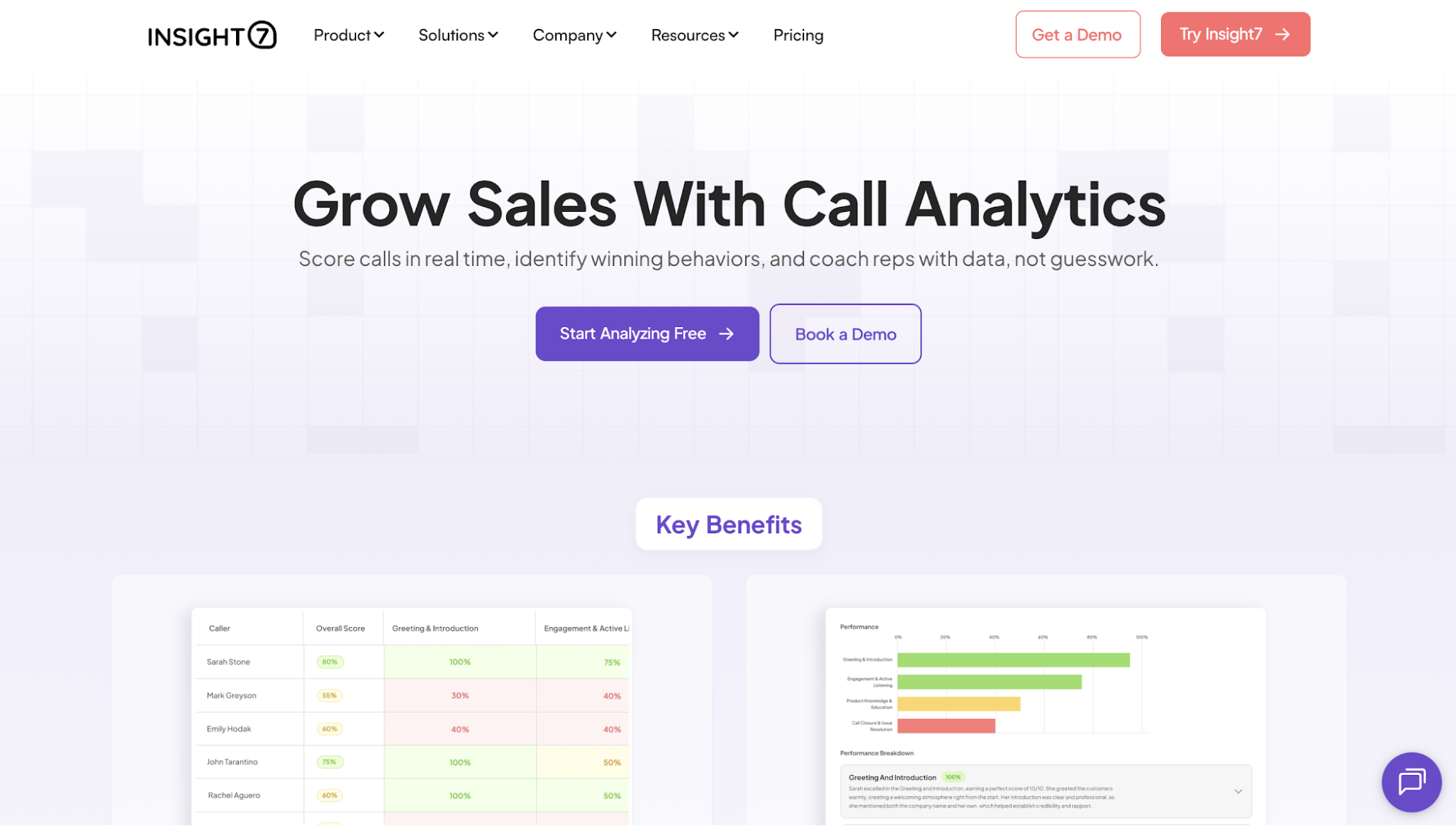
Insight7 scores 100% of your connected sales calls, identifies the behaviors that separate your strongest reps from everyone else, and then turns those findings into coaching through AI-powered roleplay and live assist.
It holds a 4.7 rating on G2, where reviewers describe the same move from spot-checking calls to working from complete scores.
Managers get specific priorities per rep instead of another dashboard to interpret. Reps get practice on the exact gap the calls revealed, rather than a generic training session.
Conversation data is handled to enterprise standards.
Insight7 is SOC 2 Type II-certified, HIPAA- and GDPR-compliant, redacts PII and PHI, and never trains models on your data. This makes it ideal for the mid-market sales, service, and success teams in financial services, healthcare, and manufacturing.

