Customer-facing reps improve with practice, but most teams cannot provide every rep with enough opportunities for realistic roleplay, especially as headcount grows.
Manager-led coaching takes time, schedules rarely align, and not every rep gets the repeatable practice they need before handling important customer conversations over the phone or on video calls.
In this guide, we’ll look at how AI roleplay software can help organizations train customer-facing reps more efficiently. We’ll also compare seven leading platforms to help you choose the right one for your team.
These are seven leading platforms worth considering based on your training goals:
AI roleplay software is a training tool that lets employees practice conversations with AI-generated personas. These personas can act as prospects, customers, patients, candidates, or team members depending on the scenario being practiced.
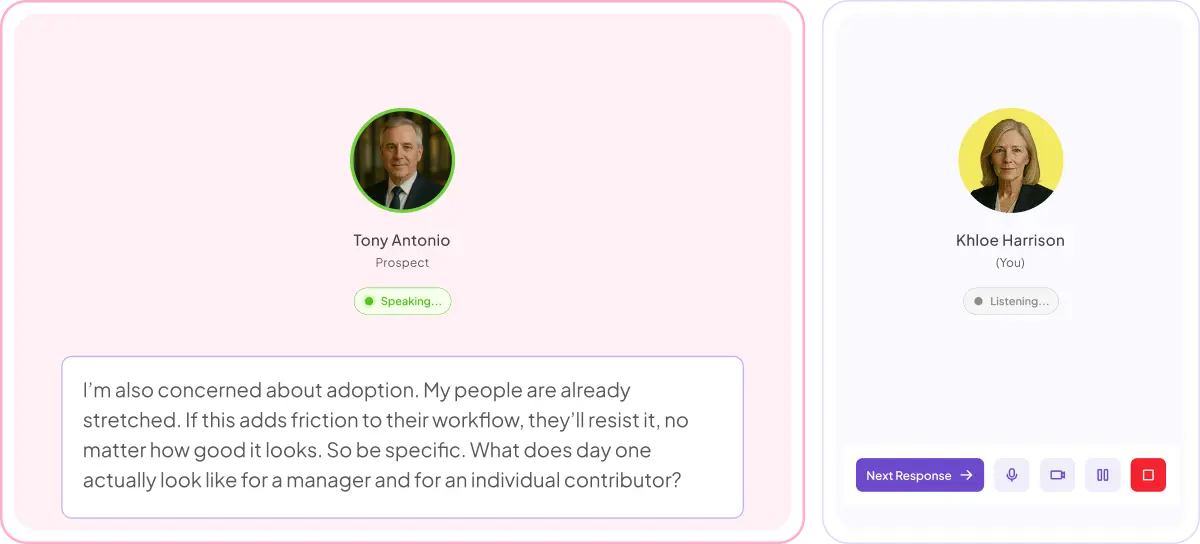
During a roleplay session, AI responses change based on what the employee says and how the conversation develops. This creates a more interactive experience than working through a fixed script or reading a basic roleplay scenario.
The software can be used to recreate situations such as discovery calls, objection handling, difficult customer conversations, or leadership discussions. Many platforms also record the session and provide feedback based on the employee’s responses.
Customer-facing teams handle conversations that can directly influence revenue growth, customer satisfaction, and compliance.
Whether it’s a sales rep handling objections, a customer service agent resolving a complaint, or a customer success manager navigating a difficult conversation, the quality of every interaction matters.
Preparing employees for those conversations has traditionally relied on manager-led coaching and roleplay sessions. While these methods are still valuable, they can be difficult to scale as teams grow.
Managers have limited time, and not every employee receives the repetition needed to build confidence before speaking with customers.
AI roleplay software gives customer-facing teams a way to practice realistic conversations more frequently while helping managers scale coaching without increasing their workload.
According to Forrester’s 2026 research, high-performing sales reps are 2.5 times more likely than underperforming reps to prefer automated AI scoring over manager judgment when preparing for buyer conversations.
The report also highlights how AI can reduce evaluator bias, save managers time, and provide more consistent coaching data for performance improvement.
Early research also suggests that the impact extends beyond convenience.
According to the University of Houston, AI roleplay training improved sales performance by 7% to 35% among specific groups of salespeople, particularly when coaching reinforced their learning and helped them apply those skills in real customer conversations.
We’ve selected seven of the best AI roleplay software platforms for customer-facing reps. Here’s a quick comparison table:
Platform | Best For | Key Strengths | Pros | Cons | Pricing |
Insight7 | Mid-market & enterprise customer-facing teams | Full conversation intelligence and coaching lifecycle |
|
| Free, Pro ($99/mo), Business ($299/mo), Enterprise |
Hyperbound | Sales enablement | AI sales roleplay + real call coaching |
|
| Free + Custom |
Second Nature | Enterprise sales training | AI roleplay with structured learning |
|
| Custom |
Quantified AI | Sales readiness & regulated industries | Readiness coaching and compliance |
|
| Custom |
TrainHQ | Revenue teams | Practice based on real sales calls |
|
| Custom |
PitchMonster | Sales coaching | Roleplay + call analysis |
|
| Custom |
Yoodli | Communication & leadership training | Communication coaching |
|
| Free, Pro ($11/mo), Advanced ($28/mo), Team & Enterprise |
Each platform was evaluated based on the capabilities that matter most to organizations, including the quality of its AI roleplay experience, coaching and feedback features, and the overall value these tools provide to customer-facing teams.
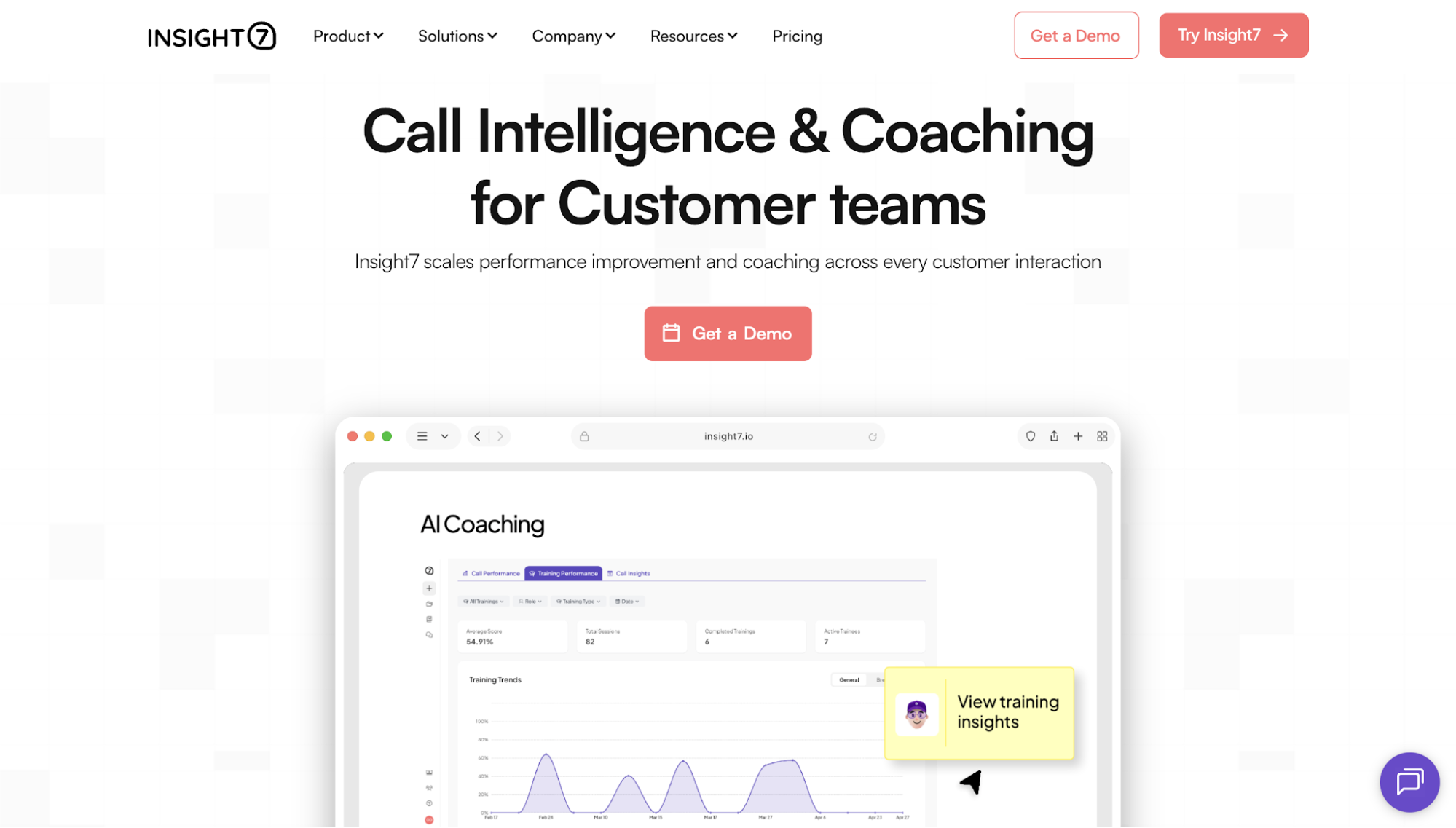
Insight7 is an AI-powered conversation intelligence and coaching platform built for customer-facing teams. It covers more of the rep performance lifecycle, from identifying skill gaps to measuring improvement in real customer interactions.
As part of that wider lifecycle, its roleplay feature works alongside conversation analysis and live support tools.
Managers can use AI call scoring, revenue intelligence, and practice data to see where reps need more guidance. Those insights can then shape targeted coaching and roleplay sessions based on the conversations their teams are already having.
Beyond coaching, Insight7 also supports customer-facing teams with AI voice and chat agents, Live Assist, and an AI-powered knowledge base. Managers can then review future calls to see whether the coaching led to better performance.
Mid-market and enterprise organizations seeking AI roleplay software that combines conversation intelligence, coaching, quality assurance, and performance management on a single platform.
Most platforms in this comparison start with practice and add analysis afterward. Insight7 starts with the real conversations and treats practice as the step that closes what those conversations reveal, which is why the same system that identifies the gap is the one that builds the scenario for it.
That matters for teams whose training budget has to justify itself. A roleplay program built from generic scenarios produces confident reps; one built from the objections your buyers actually raised produces reps prepared for the calls they will have next week.
It also handles conversation data to enterprise standards, with SOC 2 Type II certification, HIPAA and GDPR compliance, PII and PHI redaction, and no model training on customer data.
Insight7 offers the following pricing plans:
“It’s fast, accurate, and saves our team hundreds of hours every week, giving us confidence to keep scaling hiring without sacrificing quality or fairness”
Santiago Villaronga, Associate Director, Fresh Prints
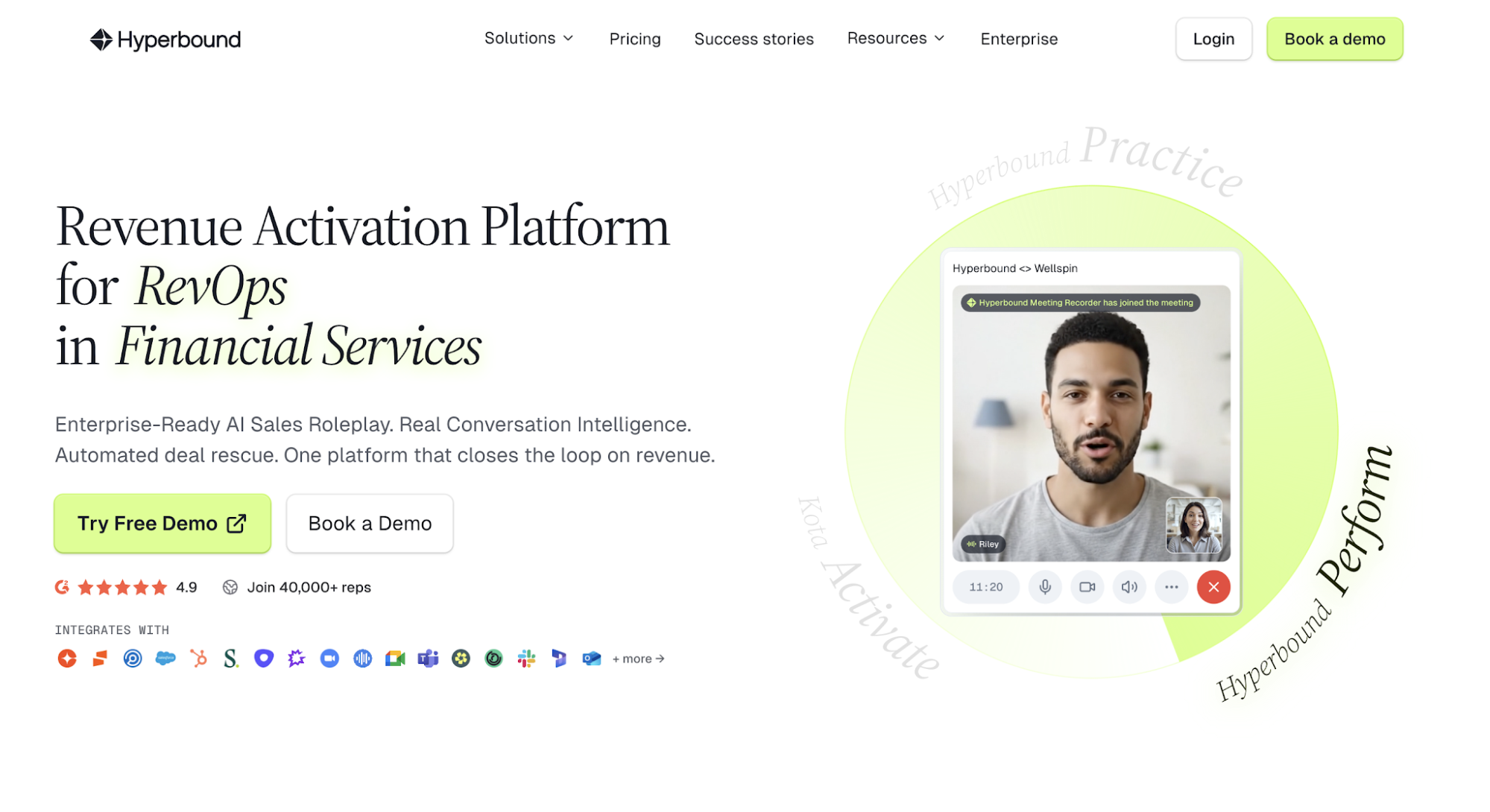
Image source: hyperbound.ai
Hyperbound is an AI-powered sales coaching platform that helps revenue teams improve sales performance through realistic AI roleplay, conversation insights, and coaching.
The platform is built around three core products: Hyperbound Practice for AI sales roleplays, Hyperbound Perform for analyzing real sales calls and deal execution, and Kota Activate, an AI agent that surfaces coaching opportunities and recommended actions from conversation data.
Hyperbound focuses on realism. Sales teams can create AI personas based on their ideal customer profile or messaging. They can also use real call recordings to shape practice scenarios.
From there, sales professionals can use unlimited practice sessions to prepare for cold and discovery calls before speaking with prospects. The platform also supports objection handling and product demos.
Hyperbound also provides AI scorecards and coaching feedback. This feature includes analytics and LMS integrations to support ongoing sales enablement programs.
Sales organizations and sales enablement teams looking for an AI sales roleplay platform that combines realistic buyer simulations with coaching insights.
Hyperbound doesn’t disclose its pricing publicly.
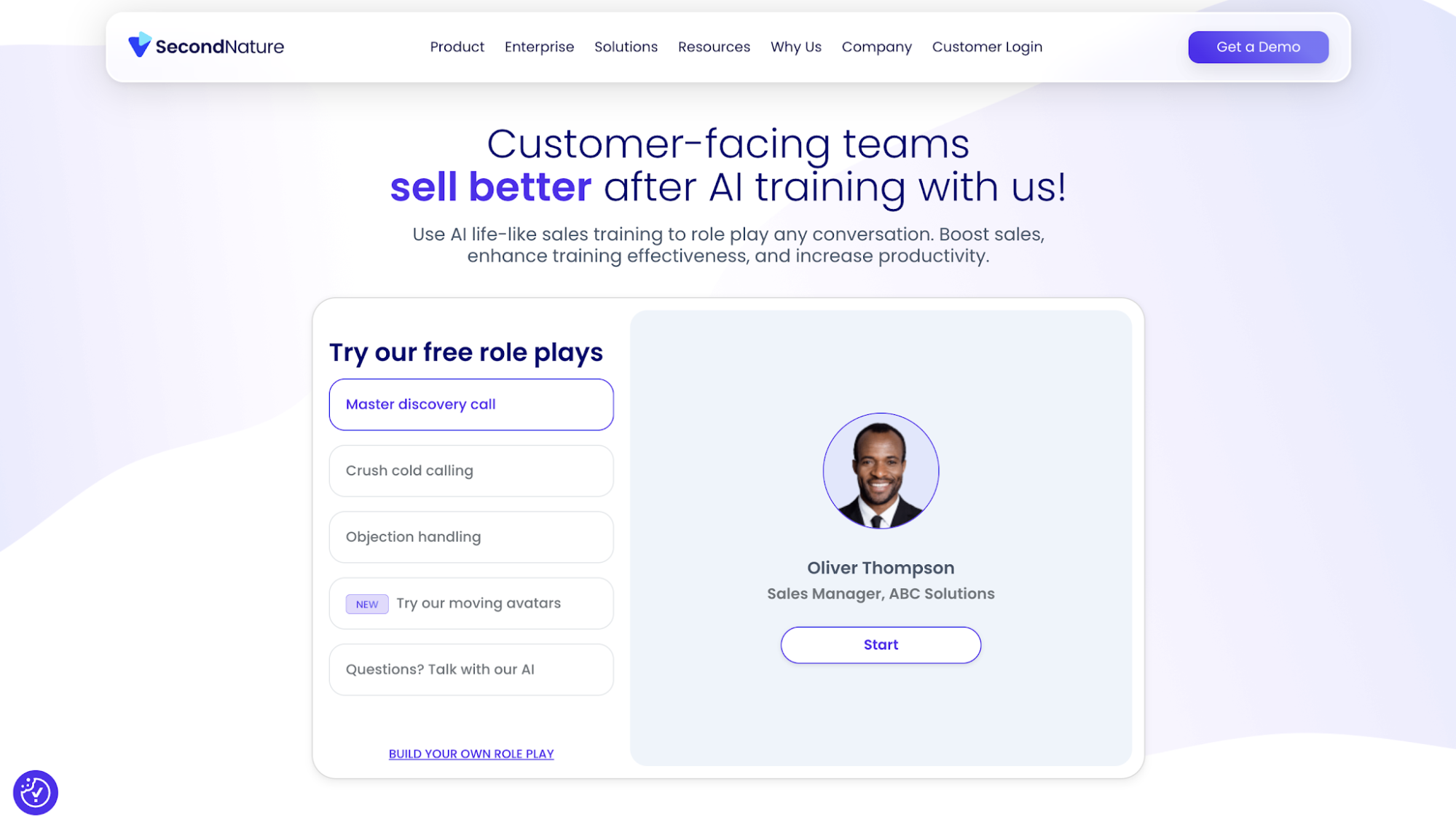
Image source: secondnature.ai
Built for enterprise sales training, Second Nature helps organizations prepare customer-facing teams through AI-powered roleplay and personalized coaching. The platform allows teams to create realistic scenarios where reps practice conversations with AI characters before speaking with actual customers.
Second Nature combines learning content with hands-on practice. Organizations can build roleplay scenarios from existing materials such as sales playbooks or recorded calls.
The platform can also generate new roleplays from simple prompts, making it easier to create training for different products, messaging, or customer situations.
Second Nature also evaluates performance and provides personalized feedback. Sales managers can then track performance through dashboards that highlight performance trends and knowledge gaps.
For enterprise organizations, the platform also supports LMS integrations, multilingual training, and enterprise-grade security to help scale learning among global teams.
Enterprise sales teams and learning & development leaders looking for AI roleplay software that combines structured training with personalized coaching and performance tracking.
Second Nature does not publicly list its pricing.
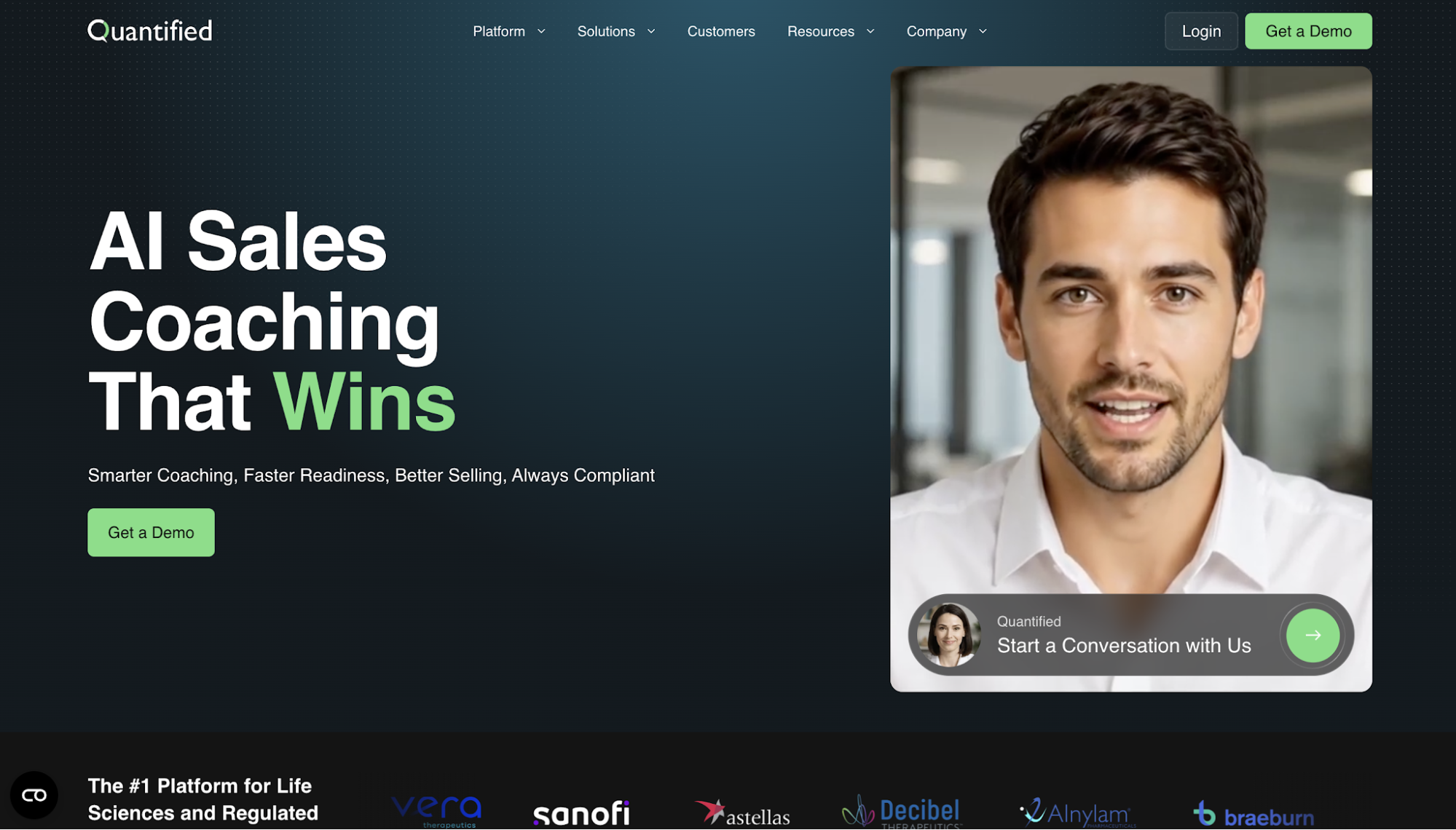
Image source: quantified.ai
Quantified AI is an AI-powered sales readiness platform designed to help organizations prepare employees for high-stakes customer conversations. The platform combines AI roleplay with personalized coaching to help teams build confidence before speaking with customers.
The platform is built around six AI agents that support different stages of training and performance. These include AI Roleplay for realistic conversation practice and AI Readiness Coach for onboarding and certification preparation.
Organizations can also use AI Field Coach to reinforce learning before and after customer interactions.
Quantified AI’s main focus is on continuous readiness. Instead of limiting coaching to practice sessions, the platform follows employees throughout onboarding, product launches, certification programs, and ongoing field coaching.
It also includes AI Insights that measure readiness and proficiency, helping managers identify coaching opportunities over time.
Enterprise teams looking for AI roleplay software that supports onboarding, certification programs, and continuous coaching for customer-facing teams.
Quantified AI does not publicly list its pricing.
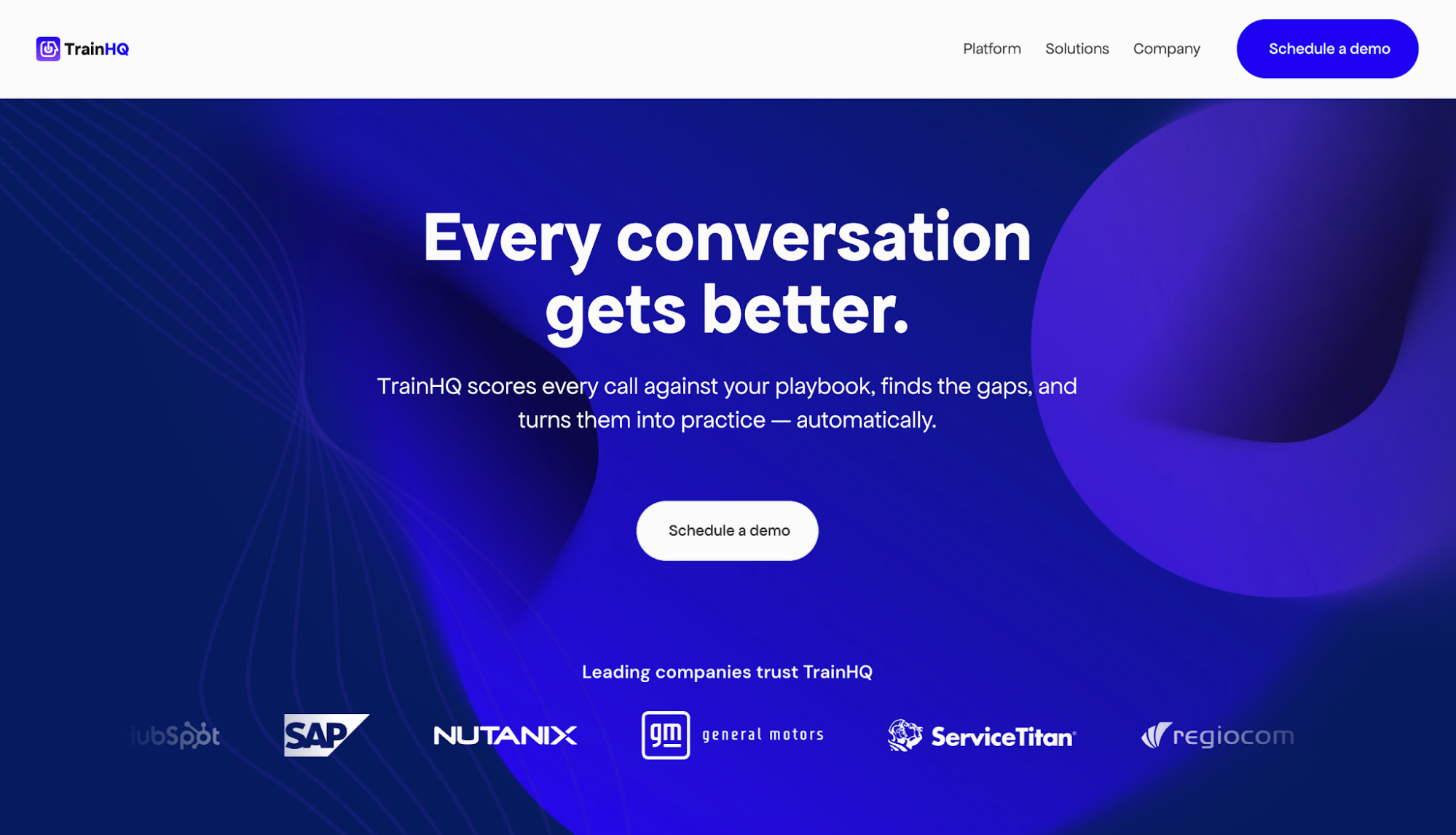
Image source: trainhq.ai
TrainHQ is an AI-powered sales readiness platform built to help organizations improve the way sales teams practice, coach, and prepare for customer conversations.
The platform combines AI roleplay with real call analysis, giving teams a way to reinforce learning before and after speaking with prospects.
Instead of pre-built practice scenarios, TrainHQ allows organizations to upload real sales calls and use them to generate AI roleplays. This gives reps an opportunity to practice conversations that closely reflect the situations they encounter during their own sales process.
Managers can also use AI call scoring and coaching insights to review both practice sessions and live customer conversations.
Sales organizations and revenue leaders looking for AI roleplay software that combines realistic practice with real-call coaching and performance insights.
TrainHQ does not publicly list its pricing.
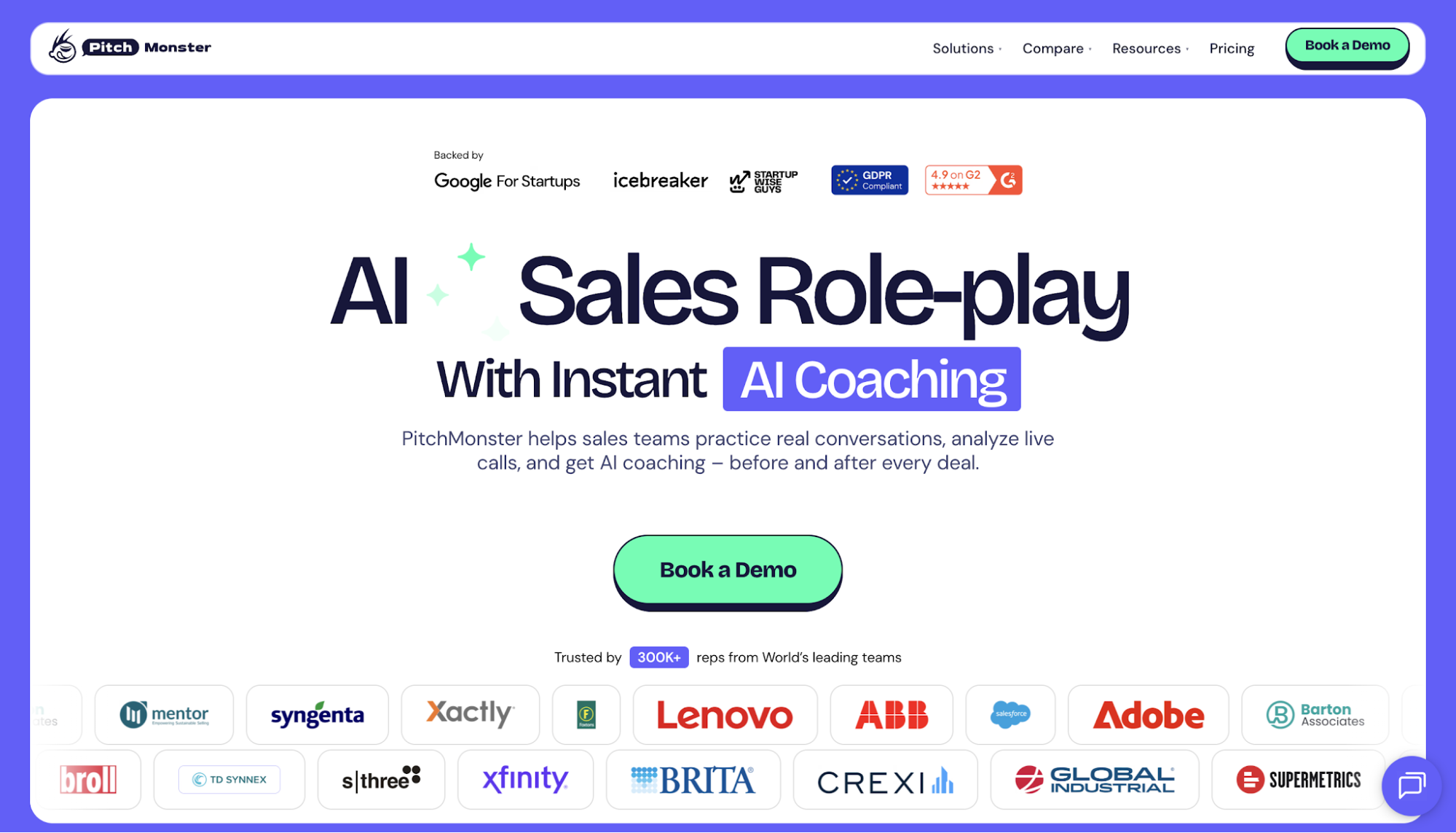
Image source: pitchmonster.io
PitchMonster is an AI sales coaching platform that helps organizations improve sales conversations through AI roleplay, call analysis, and personalized coaching.
The platform is designed to support sales teams throughout the entire coaching process, from practicing conversations to reviewing real customer interactions.
Organizations can create AI roleplay scenarios for cold calls, discovery meetings, and objection handling using customizable, lifelike AI buyers.
You can also upload recorded sales calls, allowing the platform to analyze conversations and recommend areas where reps need additional coaching or practice.
Beyond individual coaching sessions, PitchMonster gives sales leaders visibility into team performance through scorecards and analytics. This helps managers identify recurring skill gaps, reinforce coaching with targeted practice, and monitor improvement over time.
Sales organizations and sales enablement teams looking for AI roleplay software that combines conversation practice with ongoing coaching and call analysis.
PitchMonster doesn’t disclose its pricing publicly.
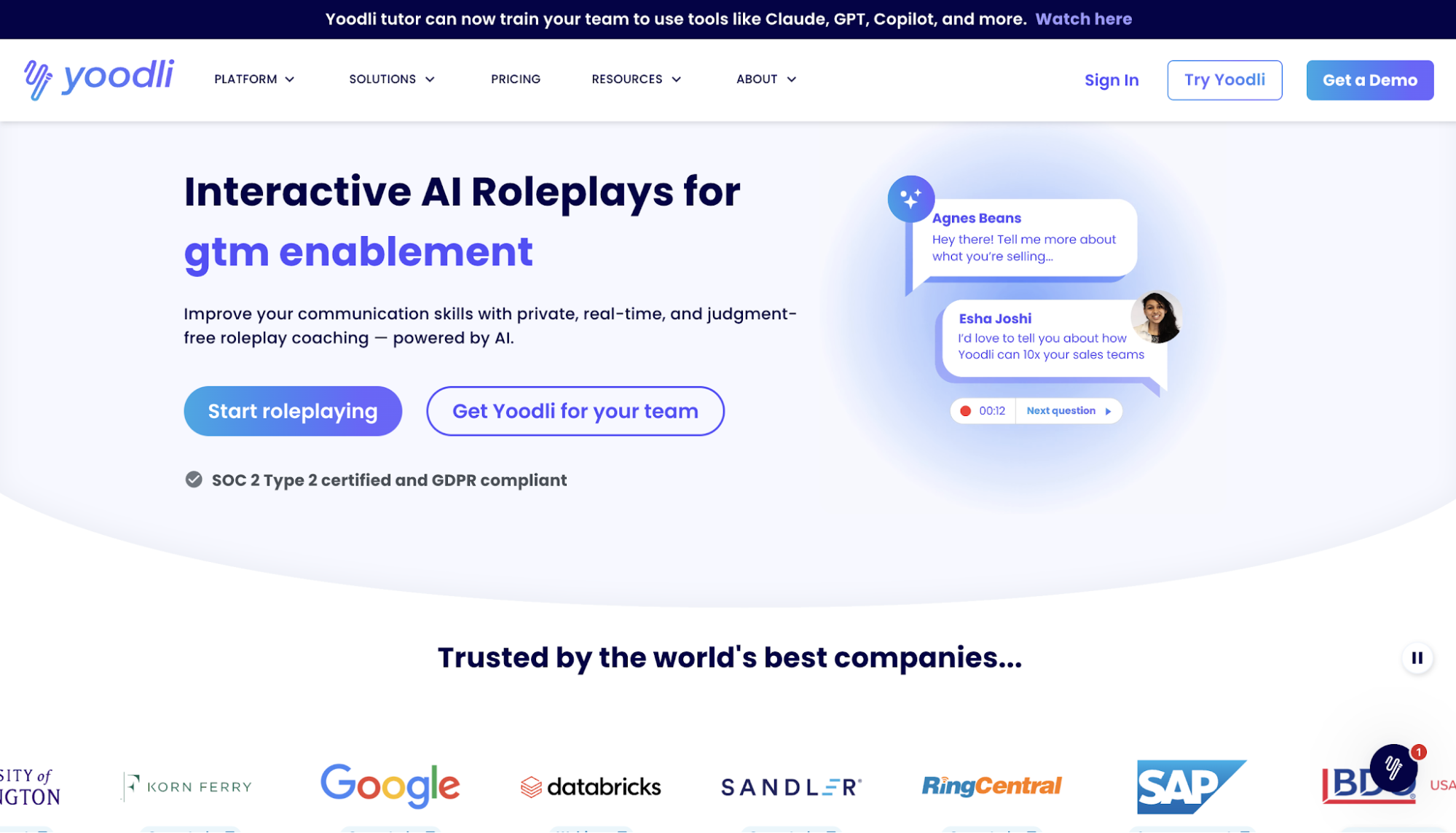
Image source: yoodli.ai
Yoodli takes a broader approach to AI roleplay by focusing on communication skills and body language, aside from sales training alone.
Organizations can use the platform to help employees practice conversations in a variety of settings, from customer support and onboarding to public speaking and interview preparation.
Its AI roleplay feature allows teams to create realistic practice scenarios that reflect different business situations. These roleplays work alongside AI tutoring and personalized coaching, giving employees real-time feedback while they practice instead of waiting until a session is complete.
Managers also have access to analytics and reporting that track participation and skill development over time. Combined with integrations for existing learning platforms, Yoodli gives learning and development teams a way to deliver AI-powered business training at scale across different departments.
Organizations looking for AI roleplay software that supports communication training across sales, customer support, learning and development, and executive coaching.
Yoodli offers four pricing options:
While there are plenty of AI roleplay platforms available, not all of them will fit the way your organization trains and supports customer-facing reps. Check out the key features to review when weighing your options.
The value of AI roleplay depends on how closely it reflects the conversations your teams have every day. Look for software that allows you to build scenarios around your products, customers, or sales process instead of relying only on pre-built templates.
The closer the practice is to real situations, the easier it becomes for reps to apply what they learn.
Tools like Insight7 build the personas from your own buyers rather than from a template library, using your ICP, your CRM records, and your past calls. A rep practising against the objection three of your accounts raised last month is preparing for a conversation they will actually have.
Conversation intelligence reviews real customer calls to show where reps are performing well and where they need more support. It can help managers spot weak objection handling, missed opportunities, or inconsistent responses during customer conversations.
This matters because roleplay works better when it reflects what reps are actually struggling with. With these insights, managers can then build more relevant practice scenarios and focus coaching on the skills that need the most attention.
This is where the two halves usually sit in separate tools. Insight7 keeps the analysis and the practice in one place, so a weak objection response found on Tuesday’s calls becomes Thursday’s roleplay scenario without anyone exporting anything.
The best AI roleplay software should provide feedback that helps reps understand what they need to improve after each practice session.
That feedback should align with the skills managers want to develop, which is the same principle behind good AI sales coaching: focused on named behaviors rather than general observations.
When coaching is personalized, reps know what to work on before their next roleplay. Managers can also spend less time manually reviewing every session and allot more time to coaching the areas that have the biggest impact.
One successful roleplay session rarely tells you whether a rep is improving. Performance needs to be tracked consistently before you can see whether your coaching efforts are producing results.
This is why performance tracking is an important feature to look for.
It helps you measure training effectiveness and understand whether your roleplay strategy is improving your team’s sales skills, which is also what separates useful sales coaching software from a library of recorded sessions.
With those insights, it’s much easier to invest time and resources where you’ll have the greatest impact instead of relying on guesswork.
AI roleplay software should work alongside the systems your teams already use. Keeping coaching and training connected to your existing workflow makes it easier to manage reps without adding unnecessary administrative work.
As your team grows, the platform should also scale without making coaching harder to manage. That way, organizations can maintain a consistent training experience even as more reps join the team.
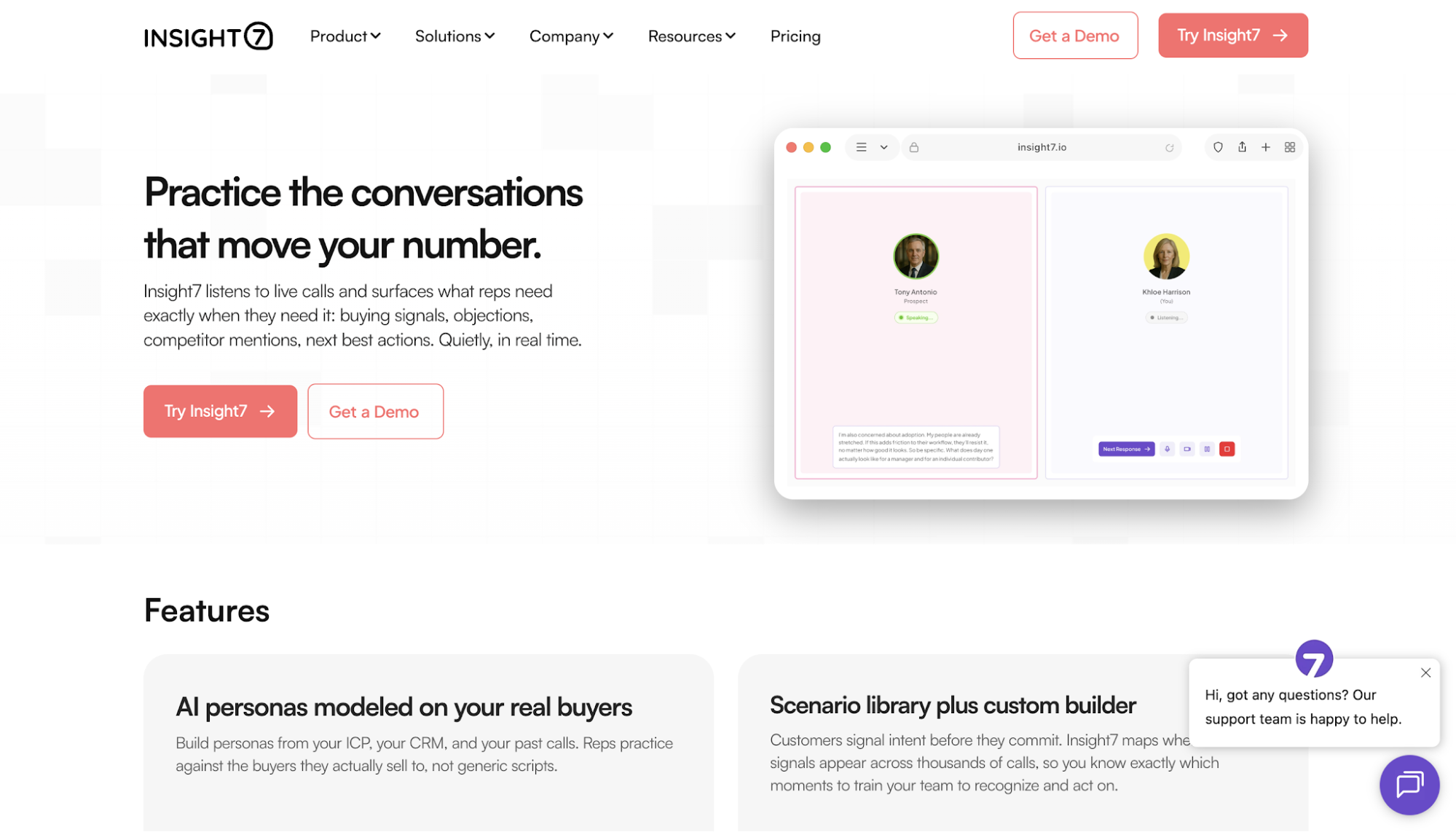
AI roleplay software can make training more consistent and easier to scale, but the best platform is one that fits how your organization develops customer-facing reps.
While some solutions focus on specific areas such as AI roleplay or coaching, others support a broader training process that continues long after a practice session ends. If your goal is simply to give reps more opportunities to practice, many of the platforms in this guide can help.
But if your organization is looking for a platform that helps customer-facing reps improve while maintaining consistency and quality as your workforce grows, Insight7 is what you need.
Insight7 helps organizations support the full lifecycle of customer-facing reps, so training does not stop once onboarding ends.
Managers can keep developing skills, reinforce coaching where it is needed most, and use AI practice to help reps perform more consistently in every customer conversation.
It holds a 4.7 rating on G2 and is built for mid-market teams in industries where conversation quality carries real consequences, including financial services, healthcare, and manufacturing.
Look for software that does more than create realistic practice scenarios. The best AI roleplay tools should help you identify skill gaps, deliver targeted coaching, measure improvement, and support the long-term development of customer-facing reps.
AI sales roleplay software gives reps more opportunities to practice before speaking with real prospects. It also provides instant feedback, helping managers reinforce coaching and improve sales performance more consistently.
No. AI roleplay tools are designed to complement traditional training and manager-led coaching, not replace them. They make practice more scalable while allowing managers to focus on targeted coaching and performance improvement.
Yes. Most AI roleplay platforms allow organizations to create custom scenarios based on their sales process, products, or customer conversations. Some also let teams build their own bots from call recordings or internal training materials.
Yes. AI roleplay can also be used for customer service, customer success, leadership development, and other customer-facing roles. Teams can practice communication skills and prepare for difficult conversations in a controlled environment before interacting with customers.

