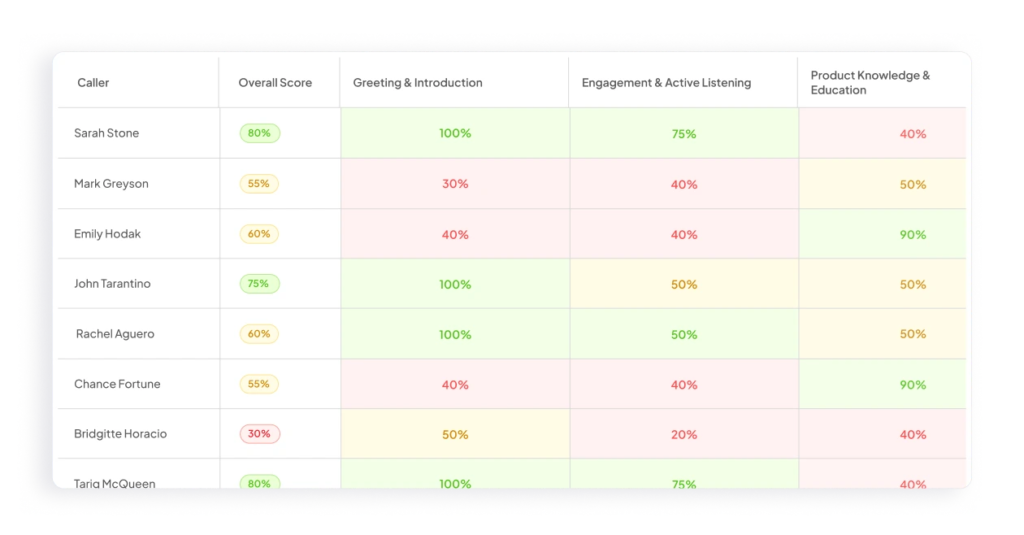
A complete sales scorecard covers four categories: results, activity, competency, and process adherence.
Scorecards tend to measure what is easy to count rather than what predicts revenue.
Insight7 scored 6,209 sales conversations and found three criteria doing most of the work: actionable outcomes, problem resolution, and goal achievemen. Discovery question count, near-equal talk ratio, and empathy scores followed close behind.
Insight7’s weighted scoring system applies exactly this kind of criteria. You set main criteria, sub-criteria, and a context column defining what each score level looks like, then every score links back to the transcript moment that produced it.
Your sales scorecard was probably built this way: a manager listed the things good reps seem to do, assigned each one a number out of five, and the team started using it. Nobody checked whether those criteria had any relationship to closed revenue.
That is the normal starting point, and it works well enough to be worth improving rather than scrapping. The problem shows up later, when a rep scores 4.5 on a scorecard and misses quota by 30%, and nobody can explain the contradiction.
This guide covers two things. First, what to put on a sales call scorecard, laid out by category so you can draft a working version from this page alone. Second, which of those criteria are validated against real outcomes, drawn from Insight7’s own dataset of 6,209 scored conversations.
We will also cover how to weight criteria for your sales motion, how to test the scorecard against your win rates, and what changes when every call gets scored instead of a handful.
What to put on a sales call scorecard: four criteria categories
A sales scorecard covers four categories.
Results tell you what happened, activity tells you what the rep did, competency tells you how well they did it, and process adherence tells you whether the work is repeatable.
1. Results metrics
These come from your CRM and cover outcomes rather than behaviour.
Win rate: closed-won divided by total qualified opportunities
Average deal size: useful for spotting reps who close often but small
Quota attainment: the number leadership already tracks
Sales cycle length: how long a deal takes from first meeting to signature
Results metrics tell you which reps need help and give you no information about what to help them with. A rep at 60% of quota could be losing on discovery, on pricing, or on never asking for the close.
2. Activity metrics
Calls made and connected
Meetings booked and held
Pipeline generated
Follow-up completion rate
Activity is the easiest category to populate, which is why so many salesperson scorecards over-index on it. A rep can hit every activity target while running conversations that go nowhere.
3. Competency metrics
This is where a sales rep scorecard earns its place, because these are the criteria you can coach.
Discovery quality: question count, open-ended share, whether qualifiers came before the pitch
Objection handling: whether objections were surfaced, addressed, and resolved rather than deflected
Value articulation: whether the rep connected the product to a business outcome the buyer named
Talk-to-listen ratio: how much of the call the buyer spent talking
Negotiation and pricing: whether pricing was framed before the number appeared
Neil Rackham’s research for SPIN Selling (McGraw-Hill, 1988), built on analysis of more than 35,000 sales calls, found that top performers ask questions in a sequence that builds the cost of the problem before proposing anything. A competency criterion measuring question depth rather than question count captures that difference.
Matthew Dixon and Brent Adamson make a related point in The Challenger Sale (Portfolio, 2011), arguing that buyers value reps who teach them about opportunities they had not considered rather than reps who uncover needs the buyer already knew about. If that describes your sales motion, add a criterion scoring whether the rep brought a commercial insight to the call.
4. Process adherence metrics
CRM hygiene: notes logged, fields completed, next steps recorded
Next-step clarity: whether the call ended with a named action, a date, and an owner
Methodology coverage: MEDDIC, BANT, or whatever framework your team runs
Compliance items: required disclosures for regulated products
Side note: A QA scorecard and a sales scorecard overlap without being the same thing. Quality assurance scorecards weight compliance and script adherence heavily because the cost of failure is regulatory. Sales scorecards weight competency heavily because the cost of failure is a lost deal.
Teams running both should keep them as separate rubrics.
Which sales scorecard criteria predict revenue?
Three criteria separated top performers from average ones more sharply than anything else in our dataset: actionable outcomes at 72.0%, problem resolution at 56.0%, and goal achievement at 53.8%.
Here are three observations worth building into your call evaluation criteria:
Outcome criteria beat delivery criteria: All three of the top differentiators describe what the conversation produced. A rep can be warm, articulate and well-liked and still land in the average tier if the call ends without a resolution or a next step.
Empathy is measurable and it matters more than expected: The 68% gap on empathy and rapport was the widest single behavioural difference in the dataset. Scoring it from the transcript removes the objection that soft skills are a personality trait.
Talk ratio predicts across every vertical we have studied: In our insurance sales research, top-tier agents generated 16.1 customer turns per conversation against 3.2 for the bottom tier, and closed at 65.4% while the bottom tier closed at 0% on identical leads.
In high-ticket wellness consultations, bottom-tier sessions ran 80%+ advisor talk time and enrolled 33% of patients where top-tier advisors enrolled 100%.
Odun Odubanjo, Insight7’s CEO, summarised the pattern when presenting the findings:
“The top reps don’t use questions to interrogate but to guide. They don’t dominate conversations, they balance those conversations.”
Want to see which criteria predict revenue on your own calls? Start scoring free
How to weight sales call scorecard criteria by sales motion
Weighting depends on where deals are won in your motion, and weights must sum to 100%.
A transactional inbound motion and a complex technical sale need different distributions. Our manufacturing research found top reps placing orders on 29% of calls where bottom reps placed none, with discovery run on 88% of calls against 20%. For that team, discovery and close execution carry the weight.
Empathy scoring matters less when the call runs eight minutes and the customer already knows the part number.
For a technical enterprise sale, the distribution shifts:
Criterion
Weight
Objection handling
30%
Business impact articulation
25%
Economic buyer’s success metric captured
25%
Technical architecture mapping
20%
Total
100%
Notice that architecture mapping carries the smallest weight despite being the most technically demanding part of the call. Reps at technical companies tend to over-invest there because it is the part they enjoy, and the deal turns on whether they connected it to a number the economic buyer cares about.
Insight7’s weighted criteria system handles this with three layers. You define main criteria, break each into sub-criteria, and fill a context column describing what each score level looks like in practice.
A “4 out of 5” on objection handling stops being a judgment call once the context column says the rep surfaced the objection, addressed it with evidence, and confirmed resolution before moving on.
Assign weights from your own win data rather than by feel. If objection handling carries 30% of the score, your closed-won calls should show materially better objection handling than your closed-lost ones.
How to validate a sales scorecard against real win rates
Run one test: your highest-scoring rep should also be your highest-closing rep. When those two lists disagree, the scorecard is measuring something other than revenue.
Here is how to check dimension by dimension:
Export 40 to 60 scored calls with known outcomes, split between closed-won and closed-lost.
Compare average scores per criterion across the two groups.
Flag any criterion where the two groups score the same. A criterion that cannot tell a win from a loss is not earning its weight.
Reweight or cut. Move that weight onto a criterion showing genuine separation.
For a sales manager scoring their own team, half the variance in the scorecard may be describing the manager.
Our own calibration data lands in the same territory. Two trained reviewers scoring the same call disagree on 20 to 30 percentage points of criteria. On a five-call sample, that variance can move a rep’s monthly score more than their performance did.
T3 Body ran into this directly. Subjective manager scoring made it difficult to identify which behaviours drove conversion across their sales teams.
After deploying automated call scoring, they replaced manager judgment with objective performance indicators tied to specific conversation moments, which surfaced the behaviours that correlated with close rates and let managers coach to them.
Ready to turn your scorecard into a coaching plan? Book a demo
Free sales call scorecard template
Most downloadable QA scorecard templates hand you a blank framework and leave the criteria to you, which puts you back where you started.
Insight7’s Sales Call Scorecard Generator works from the other direction. Upload recordings of calls that closed, or describe your ideal sales framework, and it extracts the behaviours, milestones and conversational patterns those calls have in common. Y
ou get a structured scorecard built from what already works on your team rather than from a generic best-practice list.
The template covers criteria, sub-criteria, scoring levels, and the context definitions for each level. You can refine it as your motion changes, and reuse it to evaluate future calls.
For support and compliance teams, the Call QA Scorecard Builder does the same for script adherence and regulatory criteria.
How AI scores 100% of sales calls against your scorecard
A scorecard applied to five calls a month per rep produces anecdotes. Automated scoring applies the same rubric to every conversation, which is what turns the scorecard into data.
Here is how the workflow runs in Insight7:
Configure your criteria. Sales calls get scored on discovery, objection handling and next steps. Customer success calls get their own template covering issue understanding, solution proposition, case management and product knowledge. The platform routes each recording to the right rubric, so a renewal call is never marked down for a discovery sequence that did not apply.
Every call gets scored against the configured criteria, with participants identified automatically.
Each score links to its evidence. You can open the transcript passage behind any criterion score, which is what lets a rep inspect and argue with a rating rather than absorbing it.
Scores become coaching plans. Low criterion scores generate targeted feedback and AI roleplay scenarios built on that specific gap.
TripleTen hit the manual ceiling trying to evaluate soft skills consistently across a large support team.
After integrating Zoom with Insight7 in one week, they were scoring over 6,000 coaching calls a month for roughly the cost of one project manager, applying a standardised evaluation framework to every call rather than the handful a supervisor could reach.
The evidence link is the part that decides adoption. Reps accept a score they can trace to something they said.
Build your sales scorecard on validated criteria with Insight7
Draft your first-pass scorecard from the four categories above, weight it toward the outcome criteria our data shows doing the heaviest lifting, then test it against 40 closed deals before anyone’s compensation depends on it.
Insight7’s AI Call Scoring applies whatever rubric you build to every conversation your team has, with each score anchored to the transcript moment behind it.
Upload your first calls for free and compare what the scoring surfaces against what your current scorecard captures. If they disagree, the calls are the more reliable record.
FAQs
What criteria should be on a sales call scorecard?
A complete sales scorecard covers results (win rate, deal size, quota attainment), activity (calls, meetings booked), competency (discovery quality, objection handling, value articulation, talk ratio), and process adherence (CRM hygiene, next-step clarity, methodology coverage).
How do you weight sales scorecard criteria?
Weights must total 100% and should reflect where deals are won in your motion. A technical enterprise sale might run objection handling at 30%, business impact at 25%, economic buyer success metric at 25%, and architecture mapping at 20%. Set the distribution from your own win data rather than assigning it by feel.
What is the difference between a sales scorecard and a QA scorecard?
A quality assurance scorecard weights compliance, script adherence and disclosure requirements most heavily, since the cost of failure is regulatory exposure. A sales scorecard weights conversation competency most heavily, since the cost of failure is a lost deal. Teams running both should maintain them as separate rubrics rather than merging them.
How do you know if your scorecard criteria predict revenue?
Compare average scores per criterion across closed-won and closed-lost calls. Any criterion scoring roughly the same in both groups is not predicting anything and should be reweighted or removed. Your highest-scoring rep should also be your highest-closing rep, and when those lists disagree the scorecard needs work.
Can AI score every sales call against a custom scorecard?
Yes. Insight7 applies your configured criteria to 100% of imported conversations, links each score to the transcript passage that produced it, and generates coaching plans from low-scoring criteria. TripleTen scores over 6,000 calls monthly this way after a one-week Zoom integration.