


An inside sales manager running three branches can see order volume by rep, branch, month, yet none of it may explain why one rep converts inbound quote requests and another doesn’t.
Our team here at Insight7 scored hundreds of real inbound calls at a building materials manufacturer to find the answer inside the conversations:
Top-tier reps placed orders on 29% of calls, bottom-tier reps on 0%, and the five dimensions we scored show exactly where the second group loses the order
Methodology
- Sample: hundreds of real inbound sales calls at a building materials manufacturer, scored on Insight7’s conversation intelligence platform. Calls involved customers inquiring about metal roofing panels, accessories, and related building materials across multiple branch locations.
- Scoring: each call graded 1 to 10 across five dimensions, mapped to whether a quote call converted to a paid order. The dimensions are Conversion and Close Execution, Discovery and Needs Assessment, Product Knowledge and Communication, Customer Experience and Rapport, and Value Maximization and Efficiency.
- Tiers: calls grouped by weighted composite score into Top 25%, Middle 54%, and Bottom 21%.
- What this measures: whether the rep executed the behavioural sequence that converts, rather than whether specific words appeared in a script. Every score reflects a real call.
The headline numbers
| Behaviour | Top-tier reps | Bottom-tier reps |
|---|---|---|
| Placed an order | 29% of calls | 0% of calls |
| Quoted pricing on the call | 33% of calls | 0% of calls |
| Ran project discovery | 88% of calls | 20% of calls |
Conversion and close execution produced a 77% gap between tiers, the widest of the five dimensions scored and the strongest predictor of revenue per call.
The zero is the number that stops people. Bottom-tier reps did not convert at a lower rate than their colleagues, they converted nothing at all, on identical inbound demand for identical products at identical prices. Whatever separates the two groups happens inside the conversation.
43% of callers asked for a price; only 26% got one
Across the whole dataset, 43% of calls were explicit quote inquiries. Of those, only 26% received an actual price while the customer was still on the phone.
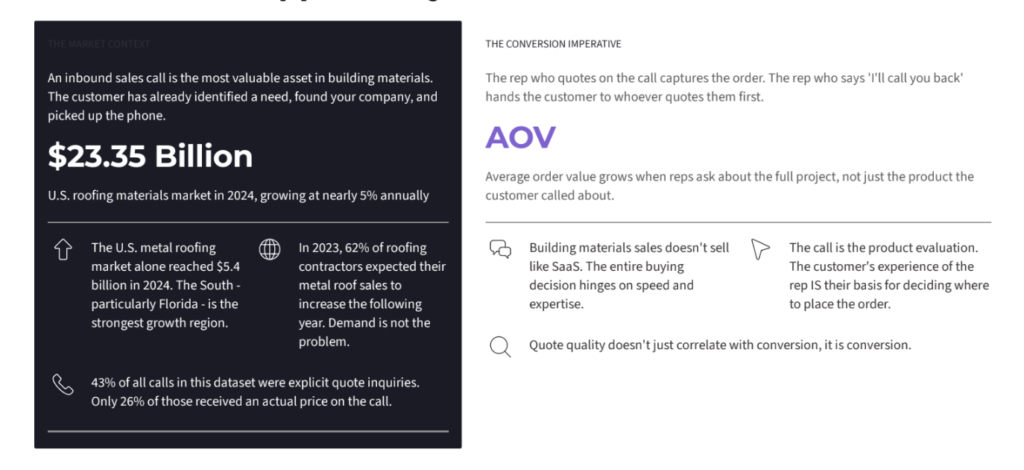
An inbound call in building materials is the most qualified lead the business will handle that day. The customer has identified a need, measured a job, found the company, and dialled. Nothing in the funnel is cheaper to convert, and roughly three quarters of those requests ended without the number the customer called to get.
The market context makes that harder to absorb.
The US roofing materials market reached $23.35 billion in 2024 and is growing at close to 5% annually, with metal roofing alone accounting for $5.4 billion of it.
The South, and Florida in particular, is the strongest growth region. In 2023, 62% of roofing contractors expected their metal roof sales to increase over the following year.
Demand is not the constraint. For an inside sales manager running two or three branches, the pipeline problem is happening after the phone rings, on calls the business has already paid to generate.
Speed matters here in a way that generalises beyond building materials. Research published in Harvard Business Review audited 2,241 US companies with test web leads and found the average first response took 42 hours, while 23% never responded at all.
Firms that made contact within an hour were nearly seven times more likely to qualify the lead than those that waited longer.
A quote call collapses that timeline to zero, because the customer is already on the line. Sending them away to wait for a callback reintroduces the delay the inbound channel was supposed to eliminate.
The five dimensions, ranked by gap
| Dimension | Gap between tiers | What separates top from bottom |
|---|---|---|
| Conversion and Close Execution | 77% | Top reps quote pricing on the call and move toward an order. Bottom reps never quoted pricing once. |
| Discovery and Needs Assessment | 47% | Top reps confirm specs before quoting. Bottom reps quote blind or never get far enough to ask. |
| Product Knowledge and Communication | 24% | Top reps speak fluently about panel profiles, gauge differences and accessories. Bottom reps put customers on hold or defer to callbacks. |
| Customer Experience and Rapport | 14% | Top reps greet warmly, use the customer’s name and project competence. Bottom reps open with “Hello?” and sound unprepared. |
| Value Maximization and Efficiency | 7% | Only 14% of all calls included a cross-sell suggestion. |
The ranking is the useful part. Product knowledge, which is where most inside sales training budget goes, produced a 24% gap.
Conversion execution produced 77%. Reps in the bottom tier were not losing orders because they did not understand the product catalogue, and a rep who knows every panel profile in the line will still lose the order if the call ends without a price.
What the top tier does differently
1. They quote while the customer is on the phone
Top reps gave a price during the call on 33% of their conversations. Bottom reps did so on none.
The phrase that shows up repeatedly in bottom-tier recordings is some version of “let me get that together and call you back.” By the time that callback happens, a contractor who needed a number that morning has usually received one from somewhere else.
Building materials buyers are rarely comparing vendors on relationship depth when a job is measured and waiting, and the first credible quote tends to win.
For an inside sales manager, this is the highest-leverage habit on the list because it requires no new product training and no new system. You need a rep to treat the price as something to produce on the call rather than as homework.
2. They confirm specs before naming a number
Top reps ran project discovery on 88% of calls against 20% for the bottom tier, a 47% gap on the discovery dimension.
Six specifications determine whether a metal roofing quote is accurate:
- Gauge: panel thickness, which changes both price and suitability
- Profile: the panel style, which has to match what the job requires
- Colour: availability and lead time vary by finish
- Length: cut-to-length orders cannot be corrected after fabrication
- Quantity: affects pricing tiers and delivery scheduling
- Application: residential, agricultural or commercial changes the recommendation entirely
Quoting without confirming these produces a number that may be wrong, and a wrong number in building materials does more damage than a lost order.
Panels cut to the wrong length come back as returns and recuts, which carries a freight cost, a fabrication cost, and a contractor who now schedules his next job around a different supplier. The 47% discovery gap means bottom-tier reps were quoting blind on the minority of calls where they quoted at all.
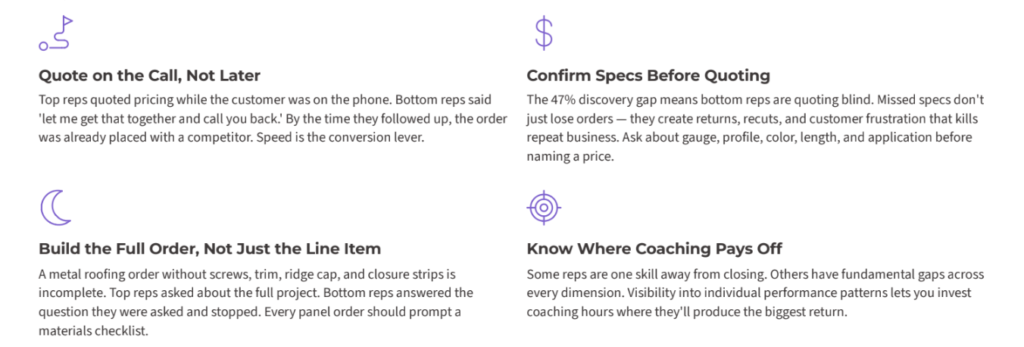
3. They build the whole order rather than the line item
A metal roofing order without screws, trim, ridge cap and closure strips is incomplete, and the contractor will buy those items from whoever prompts him first.
Only 14% of all calls in the dataset included a cross-sell suggestion. Top-tier reps attempted it on 17% of calls. Bottom-tier reps attempted it on none.
This is the one finding where the whole team underperformed rather than the bottom tier alone, which makes it the clearest revenue opportunity in the study.
A 17% attempt rate among your best reps means even they are answering the question they were asked and stopping on more than four calls in five. Average order value moves when the rep asks about the project instead of the product.
4. They sound prepared from the first sentence
Customer experience and rapport produced the smallest meaningful gap at 14%, and the behaviours behind it are almost mechanical. Top reps opened with a branded greeting that named the company, the branch and themselves. Bottom reps answered with “Hello?”
A contractor who hears “Hello?” on a supplier’s sales line has already formed a view about how the rest of the call will go. The fix costs nothing and can be audited on every recording, which makes it the easiest item on any scorecard to bring to 100%.
The coaching playbook
Here are the enchmarks drawn from the top-performing tier, with the current team average alongside each one.
| Metric | Target | Average now | What to coach |
|---|---|---|---|
| Conversion score | 7.5 or above out of 10 | 5.90 | Pricing on the call or a quote sent within the hour. Every call ends with a defined next step. |
| Discovery score | 7.5 or above out of 10 | 6.32 | Confirm gauge, profile, colour, length, quantity and application before quoting. |
| Product knowledge | 7.0 or above out of 10 | 6.60 | Reps quote common panels, accessories and delivery options without checking. |
| Cross-sell rate | 50% or more of quote calls | 14% | A standard accessory prompt on every quote: “Do you need screws, trim and ridge cap for this?” |
| Branded greeting | 100% of calls | Varies | “Thank you for calling [Company] [Branch], this is [Name], how can I help you?” |
| Next step defined | 100% of calls | Varies | No call ends without an action: order placed, quote sent, follow-up scheduled, or visit confirmed. |
| Call-to-quote time | Same call, or under an hour | Varies | The first quote a customer receives is usually the one they buy from. |
Three of these need no product expertise at all. Branded greeting, defined next step and the accessory prompt are process items a rep can hit on their first week, and together they cover the conversion, cross-sell and experience dimensions.
Pro tip: Start with conversion execution. An rep who never quotes on the call cannot be coached on objection handling, because no objection ever surfaces. Fix the quoting habit first and the downstream skills become teachable.
Why this stayed invisible
Inside sales managers at building materials manufacturers manually review under 2% of calls. The other 98% pass through unscored and uncorrected, whatever happened on them.
A 77% conversion gap, an 88% against 20% discovery rate, and a 33% against 0% pricing rate are patterns that emerge across hundreds of calls.
No manager listening to a handful of recordings a week can track them, and the wider industry constraint is the same. McKinsey’s research found most contact centres review fewer than 5% of conversations manually.
Manual review also catches the wrong things. A manager spot-checking calls will notice an obvious error, a rude exchange, or a compliance slip. What that review misses is the rep who was pleasant, knowledgeable, helpful, and ended 100% of his quote calls without giving anyone a price.
Distributor and manufacturer inside sales teams sit on an unusual advantage here, because the calls are already recorded and the outcome of each one is already in the ERP. Connecting the two is what turns a recording archive into performance data.
Three things to do this week
You can act on this study before buying anything:
- Count the quote calls that ended without a price: Pull twenty recent recordings where the customer asked for pricing and mark which ones produced a number on the call. If your rate looks anything like 26%, you have located your revenue leak and it took an afternoon.
- Add the accessory prompt to every quote: One sentence, asked on every panel order, moves a team-wide 14% cross-sell rate faster than any other single change. Make it a checklist item rather than a suggestion
- Audit your greetings: Listen to the first ten seconds of thirty calls. Score each on whether the company, branch and rep name were given. This is the fastest score on the board to move and it tells you something about how prepared the floor is generally.
Scoring every call rather than a handful is where the sample size stops limiting what you can see, which is the point at which coaching stops being guesswork.
Download the full report or start scoring your own calls for free today.
Cite this research: Insight7. Manufacturing Sales: The Quote-to-Close Gap. Call Analytics Index, 2026. https://insight7.io/manufacturing-inbound-sales-benchmarks/
Frequently asked questions
What is a good inbound sales call conversion rate in manufacturing?
In Insight7’s study of a building materials manufacturer, top-tier reps placed orders on 29% of calls while bottom-tier reps placed orders on 0%. The team-wide coaching target for the conversion dimension is 7.5 or above out of 10, against a current average of 5.90.
How many inbound quote calls result in an actual price?
Across the calls scored, 43% were explicit quote inquiries and only 26% of those received a price while the customer was on the phone.
Should reps quote on the call or send pricing afterwards?
Top-tier reps quoted on the call on 33% of conversations and bottom-tier reps on none. Research found firms contacting a lead within an hour were nearly seven times more likely to qualify it, and a quote call removes that delay entirely because the customer is already on the line.
What should a rep confirm before quoting building materials?
Gauge, profile, colour, length, quantity and application. Quoting without these produces returns and recuts rather than orders, and the discovery gap between top and bottom tiers was 47%.
How much do inside sales teams lose to missed cross-sell?
Only 14% of all calls in the study included a cross-sell suggestion, with top reps at 17% and bottom reps at 0%, against a recommended target of 50% of quote calls.








