



Patients evaluating a $15,000 precision health protocol have spent the week reading conflicting things about it, which is one reason Edelman found confidence in making health decisions falling 10 points in a single year. By the time the patient reaches the consultation, the advisor is the thing being evaluated.
We scored hundreds of high-ticket health and wellness consultations across five dimensions. Advisors in the top 30% enrolled at 100% while the bottom 15% enrolled at 33%, on identical programs and pricing. The behaviours behind that spread are all measurable from a recording, and every one of them is below.
Methodology
Sample: hundreds of real health and wellness consultations, scored on Insight7’s conversation intelligence software. All calls involved patients discussing cellular regeneration programs, bloodwork review services, or precision health protocols.
Scoring: each consultation scored 1 to 10 across five dimensions, mapped to whether the patient enrolled or walked away. The dimensions are Conversion and Close Execution, Emotional Connection and Trust, Discovery and Health Understanding, Conversation Balance and Engagement, and Compliance and Process Excellence.
Tiers: consultations grouped by weighted composite score into Top 30%, Middle 55%, and Bottom 15%.
What this measures: whether the advisor executed the behavioural sequence that converts, rather than whether specific words appeared in a script. Every score reflects a real consultation.
Where the 48% gap sits
| Dimension | Gap between top and bottom tiers | Team average (out of 10) |
|---|---|---|
| Conversion and Close Execution | 48% | 5.90 |
| Compliance and Process Excellence | 40% | 6.20 |
| Emotional Connection and Trust | 36% | 6.57 |
| Discovery and Health Understanding | 23% | 7.03 |
| Conversation Balance and Engagement | 23% | Varies |
Conversion and Close Execution produced the widest gap at 48%, making it the strongest single predictor of revenue per consultation. Top advisors introduced pricing clearly, walked through payment options, and made an explicit enrollment ask on every call.
Bottom-tier advisors delivered a thorough clinical explanation and then let the conversation end without ever asking the patient to enroll.
Compliance and Process Excellence came second at 40%, which tends to surprise practice owners who treat compliance as a brake on selling.
Advisors who walked patients through program structure, timeline, HIPAA handling, and the payment process enrolled at higher rates than advisors who skipped ahead. Thoroughness gave patients the confidence to commit to a protocol they could not evaluate any other way.
The team average tells a second story.
On the highest-impact dimension, the practice sits 2.6 points below the top-tier benchmark of 8.5. On the lowest-impact dimension it sits 1.47 points below. The distance from target lines up almost exactly with the size of the gap, which means the coaching priority order is already written into the data.
Patients arrive less certain than they used to
Precision health programs do not sell the way software or insurance does, because the patient cannot test the product before committing. The consultation is the evaluation and the advisor is what the patient is evaluating.
The market context makes that harder each year. The Global Wellness Institute put the wellness economy at $6.8 trillion in 2024, growing 7.9% from the previous year and projected to expand at 7.6% annually through 2029. Complementary and alternative medicine reached $178.5 billion globally, with the US market at $36.65 billion
and expanding at 23% a year. Regenerative medicine is projected to pass $400 billion by 2032. Every one of those numbers describes more competitors making similar claims to the same patients.
Patient confidence is moving in the other direction. Edelman’s 2026 Trust Barometer Special Report on Trust and Health, based on 16,006 interviews across 16 countries, found that confidence in making health decisions fell 10 points year on year, while 70% of people believe at least one of six contested health claims about foods, vaccines, or medicines.
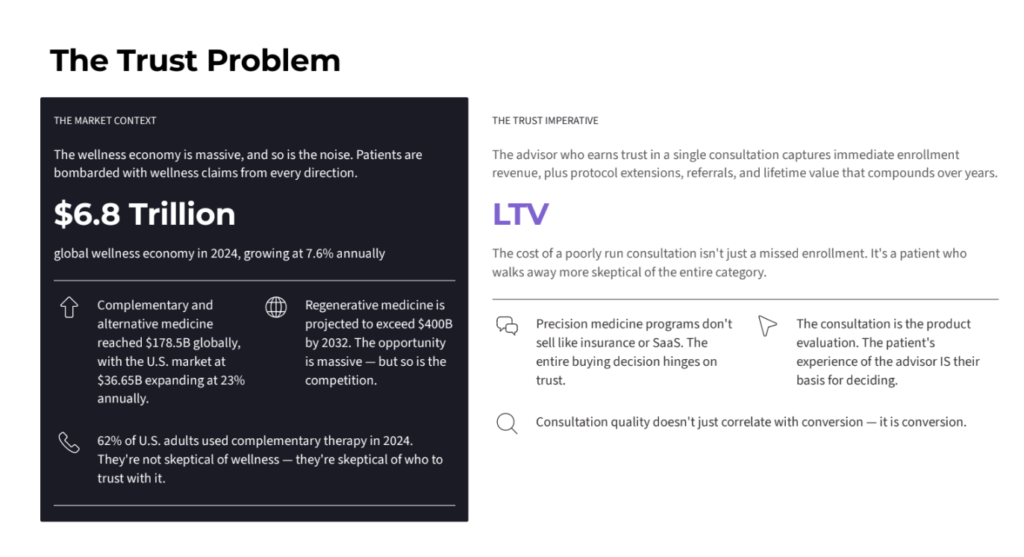
Edelman’s own conclusion for providers is that clinical expertise alone no longer wins influence, and that practitioners now earn it through partnership and by helping patients navigate a decision rather than delivering a verdict.
For a practice selling $15,000 protocols, that shift shows up in the consultation room as a patient who has read conflicting things all week and needs the advisor to make sense of them. An advisor who opens with the science and closes with the price has the sequence backwards for that patient.
The behavioural data below shows what the top tier does instead.
Four patterns that separated the top tier
Emotion first, logic follows
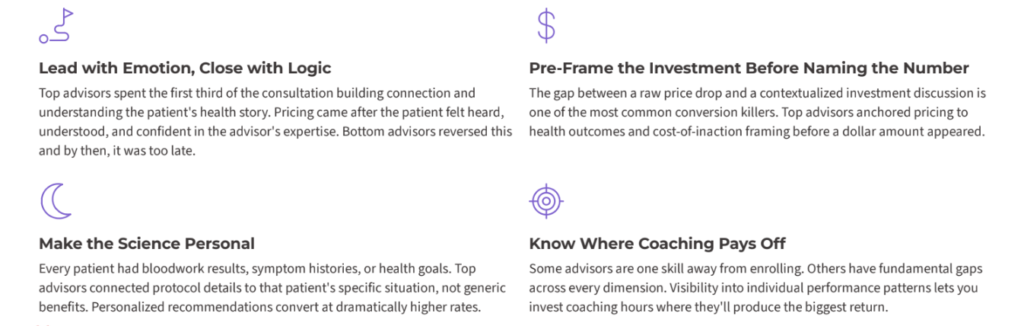
Advisors in the top tier spent the first third of the consultation building connection and understanding the patient’s health story. Pricing came only after the patient felt heard and confident in the advisor’s expertise.
Bottom-tier advisors reversed that order, opening with protocol detail and arriving at the emotional groundwork after the patient had already decided.
Sequencing matters more here than in most sales conversations because the patient is buying a judgment about their own body. A recommendation that arrives before the advisor has demonstrated any grasp of the patient’s symptom history reads as generic, whatever the clinical merit behind it.
The investment gets framed before the number appears
Naming a price into silence is one of the most common conversion killers in the dataset. Top advisors anchored pricing to health outcomes and to the cost of doing nothing before any dollar amount entered the conversation.
A patient who hears “$18,000” with no frame around it compares that figure against every other thing $18,000 could buy. A patient who has just spent twenty minutes discussing what another two years of the same symptoms would cost her compares it against something else entirely.
Clinical facts get connected to this specific patient
Every patient in the sample arrived with bloodwork results, a symptom history, or a stated health goal. Top advisors tied protocol details back to that specific material rather than describing generic benefits, and personalised recommendations converted at dramatically higher rates.
This is where the discovery dimension earns its 23% gap despite being the narrowest of the five. Top advisors asked fewer questions than you might expect, but the questions were sharper and open-ended enough that patients told their own story rather than answering a checklist.
The report’s coaching target is three or more open-ended health history questions inside the first five minutes.
Anyone reading across the Call Analytics Index will notice this runs counter to what we found in general sales conversations, where top performers asked 37% more questions than average.
In consultative health settings the volume matters less than whether the questions opened space for the patient to talk. Different call types reward different discovery patterns, and a rubric built for one will mislead you about the other.
Coaching hours have very different returns per advisor
Some advisors in the sample were one skill away from enrolling consistently. Others scored low across all five dimensions. A practice that spreads coaching time evenly across both groups gets very little back from either.
Individual dimension scores make that allocation obvious. An advisor scoring 8.1 on discovery and 4.2 on conversion needs one conversation about making an explicit ask. An advisor sitting near 5 across the board needs a different intervention entirely.
The monologue problem
Bottom-tier consultations ran at 80% or more advisor talk time with minimal patient engagement. Top-tier consultations maintained balanced dialogue, generating roughly five times more patient turns across the same conversation.
Enrollment rates rise when the patient talks for 35% or more of the consultation, which gives practices a threshold they can hold advisors to. The report’s target is advisor talk time at or below 65%, with a turn balance ratio at or under 1.2.
A patient who has spoken for a third of the consultation has stated her own concerns out loud, and the advisor has heard which of the protocol’s benefits she cares about. A patient who has listened for fifty minutes has given the advisor nothing to personalise around, so the close has to be generic.
The report’s coaching prompt is a single question after each clinical explanation: “How does that land for you?”
It costs eight seconds and it converts a presentation back into a consultation.
Energy decay in the final fifteen minutes
Sustained enthusiasm appears in the coaching playbook as its own metric, and the reason is specific.
Energy decay during the close was the most common pattern in bottom-tier consultations across the sample.
Advisors open strong, work through the clinical material with genuine engagement, and then flatten out at exactly the point where the patient is deciding. The final fifteen minutes carry the enrollment ask, the pricing conversation, and whatever hesitation the patient has been holding since minute ten.
For a practice manager reviewing recordings, this is the highest-yield place to start listening. Skip the opening. Play the last fifteen minutes of six consultations, three that enrolled and three that did not, and the pattern usually declares itself inside twenty minutes of review time.
Why practices have not been able to see any of this
Most practices manually review under 2% of consultations. The remaining 98% pass through unscored and uncoached, whatever happened inside them.
That review rate is consistent with what larger operations report.
In Peru, Entel Connect Center handles over 600,000 inbound calls a month and could review fewer than 1% of them before automating analysis, leaving supervisors coaching on intuition.
Working with McKinsey, QuantumBlack and Google Cloud, the operation moved to daily analysis of every interaction and saw inbound service sales rise 40% within ten weeks.
At a 2% sample, a 48% conversion gap and a 5x participation gap are invisible. A practice owner listening to two consultations a month per advisor has an impression of who is performing well, and impressions correlate more with how confident an advisor sounds than with whether patients enroll.
Manual review also tends to catch the wrong things. A human reviewer picks up obvious compliance violations and clear errors, which matters, while the subtle behavioural gaps compounding into a 33% close rate go unremarked because no single consultation looks bad enough to flag.
The coaching playbook
Here are the benchmarks drawn from the top-performing tier, ordered by impact:
| Metric | Target | Team average now | What to coach |
|---|---|---|---|
| Conversion score | 8.5 or above | 5.90 | Every consultation includes explicit pricing, payment options, and a clear enrollment ask. No call ends without a close attempt. |
| Compliance score | 8.5 or above | 6.20 | Walk through program structure, timeline, HIPAA, and payment process. Thoroughness builds confidence. |
| Emotional connection | 8.5 or above | 6.57 | Deploy empathy at friction points: cost concerns, health anxieties, prior treatment frustrations. Acknowledge before solving. |
| Discovery score | 8.5 or above | 7.03 | Three or more open-ended health history questions in the first five minutes. Personalise every recommendation. |
| Turn balance | 1.2 ratio or below | Varies | Pause after every clinical explanation. Keep it a consultation rather than a presentation. |
| Advisor talk time | 65% or below | Varies | Patient participation above 35% correlates with higher enrollment. |
| Enthusiasm consistency | Sustained | Varies | Record and review the final 15 minutes specifically. |
Pro tip: Coach conversion first: An advisor who never makes a clear close attempt cannot be coached on objection handling, because no objection ever surfaces. Fixing the ask has to come before anything downstream of it.
Three things any practice can do this week
None of the following requires a platform and all three come directly out of the findings above:
- Listen to six closes: Three consultations that enrolled and three that did not, final fifteen minutes only. Score each one on whether an explicit enrollment ask was made, with pricing and payment options stated.
- Time the talking on one recording: Take a consultation from your strongest advisor and rough out how much of it the patient spoke. If it lands well under a third, you have found something to work on before you buy anything.
- Move the pricing conversation later by ten minutes: For two weeks, have advisors hold the number until after they have discussed what the patient’s current situation is costing her. The pre-framing pattern was consistent enough across the top tier to be treated as a default rather than a technique.
Scoring every consultation rather than six is where the sample size stops limiting what you can see. Insight7’s AI call scoring covers all of them against criteria a practice defines itself, and the gaps it finds feed into AI coaching rather than a report nobody reads.
The complete High-Ticket Health and Wellness Sales report covers all five dimensions, the tier methodology, and the full coaching playbook: Download the report here or upload five consultations and see how they score.
Cite this research: Insight7. High-Ticket Health and Wellness Sales: The Conversation Behaviors That Drive Revenue. Call Analytics Index, 2026. https://insight7.io/health-wellness-consultation-benchmarks/
Frequently asked questions
What is a good conversion rate for a health coaching consultation?
In Insight7’s study of high-ticket health and wellness consultations, advisors in the top 30% enrolled at 100% while the bottom 15% enrolled at 33%, working the same programs, pricing, and patient pipeline.
How much should an advisor talk during a wellness consultation?
The benchmark from the top-performing tier is 65% or less advisor talk time. Enrollment rates increase when the patient speaks for 35% or more of the consultation. Bottom-tier consultations ran at 80% or more advisor talk time.
When should pricing come up in a high-ticket wellness consultation?
Top-tier advisors anchored pricing to health outcomes and the cost of inaction before naming a figure. Bottom-tier advisors introduced the number earlier, without a frame around it, which was one of the most common conversion killers in the dataset.
How many discovery questions should a consultation include?
The coaching target is three or more open-ended health history questions within the first five minutes. Top advisors asked fewer but sharper questions than lower tiers, prioritising open prompts that let the patient tell their own story.








