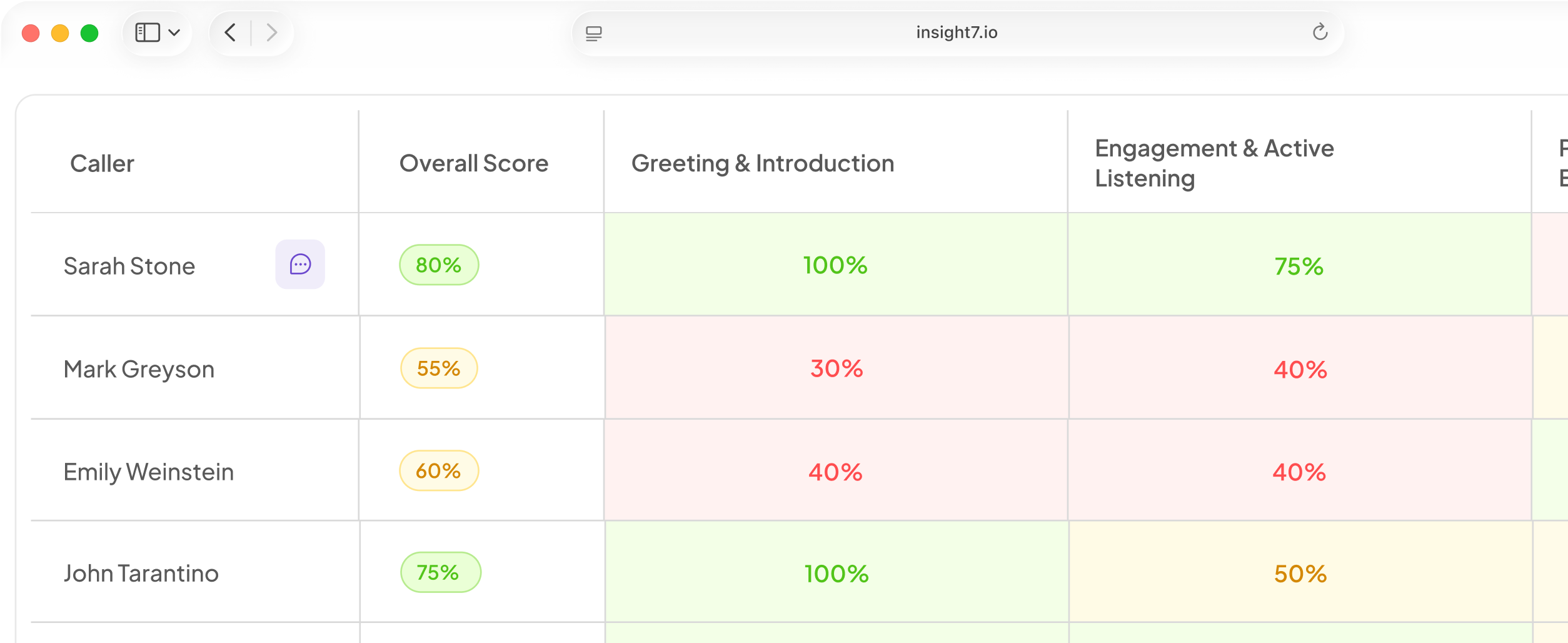

Should you move your NPS and CSAT surveys from email forms to AI phone calls? The answer depends on who you call, how many questions a caller will answer, and whether low scores reach a human.
Design three questions a caller can answer
Ask three questions: an NPS score, a reason, and one CSAT rating. Listeners cannot scan a scale the way readers can. Every extra question or answer option costs you completed calls.
Question 1: the NPS score. Ask it the standard way: "How likely are you to recommend us to a friend or colleague, from 0 to 10?" Scores of 9 or 10 are promoters, 7 or 8 are passives, and 0 to 6 are detractors. NPS is the percent of promoters minus the percent of detractors.
Question 2: the reason. Follow the score with "What is the main reason for that score?" Ask it second, never first, so the reason cannot bend the number. The agent records the answer as a transcript, and you code it into themes later.
Question 3: the CSAT rating. Tie it to one event: "How satisfied were you with your installation, from 1 to 5?" CSAT is the share of 4s and 5s among all answers. Five points are easy to say aloud.
Use these read-aloud rules for every question:
- One idea per question. "How was the speed and friendliness of the agent?" is two questions.
- Say the scale once, with both ends. For example: "1 means very unhappy, 5 means very happy."
- Use short sentences and name the event. A caller who hears "your delivery on Tuesday" knows what to rate.
- Stop at three. Our advice is that voice suits short asks that need a response and a few details.
In Insight7's survey-type campaign, which is in beta, you set the campaign goal and then add the questions the voice agent should ask.
Sample by moment, not by whole customer list
Call people soon after a real event, and pick one trigger per survey. Transactional CSAT fits right after an installation, a closed ticket or a delivery, while the memory is fresh. Relationship NPS fits a recurring cadence, such as once a quarter.
Then pick the sample inside each segment:
- Draw at random within each segment, such as product, region or plan.
- Leave out customers with an open complaint or a recent survey.
- Cap how often any one person is called.
Size the sample per segment. As a general approximation, the 95% margin of error for a share is about 1 divided by the square root of completed calls. With 100 completed calls, that is about 10 points either way. With 400 calls, it is about 5. NPS swings wider than a single share, so treat these as best-case figures. To read three segments separately, you need that many completed calls in each one.
Watch who answers. Pollsters call it nonresponse bias. It happens when the people you do not reach differ systematically from the people you do. Track response rate by segment every wave. A segment that stops answering is a warning.
In Insight7's survey campaigns, which are in beta, you add contacts by CSV upload or type names and numbers in directly. For each new wave, you duplicate the campaign with its contacts. People added to the do-not-contact list since the original are left out of the copy.
A clean NPS number can sit on top of conversations full of objections that never show in the average. Keep the transcripts next to the score.
Set calling hours, retries and consent
Set the delivery rules before you launch, because they decide who picks up. In Insight7's survey campaigns, which are in beta, a campaign has consent marking, calling hours, retry rules, a do-not-call list and a test call to your own phone. Confirm the current settings in the app before launch.
- Calling window: pick hours when your customers can talk, not when your team is free.
- Retry rules: decide how many redials you allow and how far apart.
- Consent and do-not-contact: mark consent, and honour every opt-out.
- Test call: ring your own phone and listen for pace, wording and the scale.
A carrier's temporary refusal does not use up one of the contact's retry attempts.
Score every call and read the reasons
Pull the score from the transcript, then confirm it with the caller. In Insight7's voice campaigns, which are in beta, a dashboard shows calls in progress. A reviewer can read each transcript when the call ends, and answers and outcomes are pulled from the transcript. Have the agent repeat the number back, such as "I heard an eight, is that right?" This catches mishearings.
Set rules for messy answers before launch:
- "About an eight": ask the caller to pick one number.
- Unclear audio or no answer: mark the survey incomplete. Never guess.
- Partial surveys: keep the reason text, but leave them out of the score.
Insight7 does not count calls where only the AI spoke as reached. Compute NPS and CSAT from completed calls only. Show the response rate and margin of error next to every score.
Code the "why" into themes. Tag each reason, such as wait time, billing or staff attitude. Then link each theme to the score. A cluster of 0 to 6 scores around "billing" tells you where to look.
Score the call itself too. A weighted scorecard your team owns can grade every call, not a sample. Check whether the agent read the script and made no critical error. One critical error should fail the whole call, and a perfect checklist can still leave a customer angry.
Calibrate by listening. Each week, play a sample of calls and compare them with the extracted score. Insight7's call scoring has built-in calibration, so managers can review, override and fine-tune AI ratings.
Call back detractors within a day
Set a rule that any NPS score of 0 to 6, or any CSAT of 1 or 2, opens a ticket and a human callback. A target such as 24 hours is a suggestion, so fit it to your team's capacity.
Alert the right person at once. Insight7 alerts can watch for keywords and low scores and notify by email or Slack. Route each ticket by reason theme. Billing complaints go to billing, and staff complaints go to the team lead.
Design the handover before launch. Buyers raise it unprompted: is it polite, what happens with a disputed amount, and does anyone chase a handover nobody picked up? Use a warm transfer. Show the human the score and the transcript, and send sensitive issues and disputes straight to a person. Gartner found that 87% of 3,566 customers say a company using GenAI for service must offer a way to reach a human.
Then close the loop:
- Detractors: tell them what changed, and check their next score.
- Promoters: ask for a referral or a review.
- Passives: ask what would make it a 9.
Measurement matters here. Gartner analysed 432 AI customer-service use cases. A quarter showed positive ROI, a quarter negative, and 42% could not be measured. Tracking detractor scores before and after a callback gives you a number you can defend.
Last, fix the cause. In Insight7, a weak score on a real call can become a practice session, hidden from the learner until a manager approves it. Training aimed at the gap your surveys reveal is easier to prove changed behaviour.
Related reading: Contact Center Intelligence Explained for CX and Operations Leaders, How to Run Customer Research Interviews at Scale With AI Voice Agents and How to Personalize AI Outbound Calls With CRM and Product Usage Data.
Questions people also ask
How to run an NPS survey by phone?
Choose a trigger and a random sample. Write three read-aloud questions and set consent, calling hours and retries. Test the agent, then score completed calls only. Send every 0 to 6 score to a human for a callback.
What is a good NPS survey best practice for calls?
Keep the wording, scale and timing the same every wave. Then a score change reflects your customers, not your survey. Report the response rate and top reasons next to the number.
Can an AI voice agent run a CSAT survey?
Yes. The agent can ask a 1 to 5 question after a service event, repeat the number back and ask for the reason. Insight7 has a customer survey campaign type, in beta. A person should review low scores.
What is the difference between NPS and CSAT?
CSAT rates one recent experience, such as a delivery. NPS measures overall loyalty through likelihood to recommend. Use CSAT right after events and NPS on a regular cadence.
How many questions should a phone survey have?
Three, which a caller can usually answer in a minute or two. Ask the NPS score first, because it is the number you most need. A hang-up after question one still leaves you a usable score.
Do I have to tell customers an AI is calling them?
Often, yes. EU AI Act Article 50 has applied since 2 August 2026 and requires AI that talks to people, including phone systems, to say so from the first interaction. US AI-voice calls already need consent under the FCC's 2024 ruling. Colorado's disclosure rule starts 1 January 2027. Check your local rules.
How do you follow up with NPS detractors?
Thank them and let them explain before you offer fixes. Log what you promised and who owns it. Re-survey the same people next wave to see whether their score moved.
Run the survey, then act on the reason
A score only matters if someone acts on the reason behind it. Insight7's survey campaigns, in beta, include a campaign scorecard when the campaign ends. Who owns the callback when a detractor says 3?