


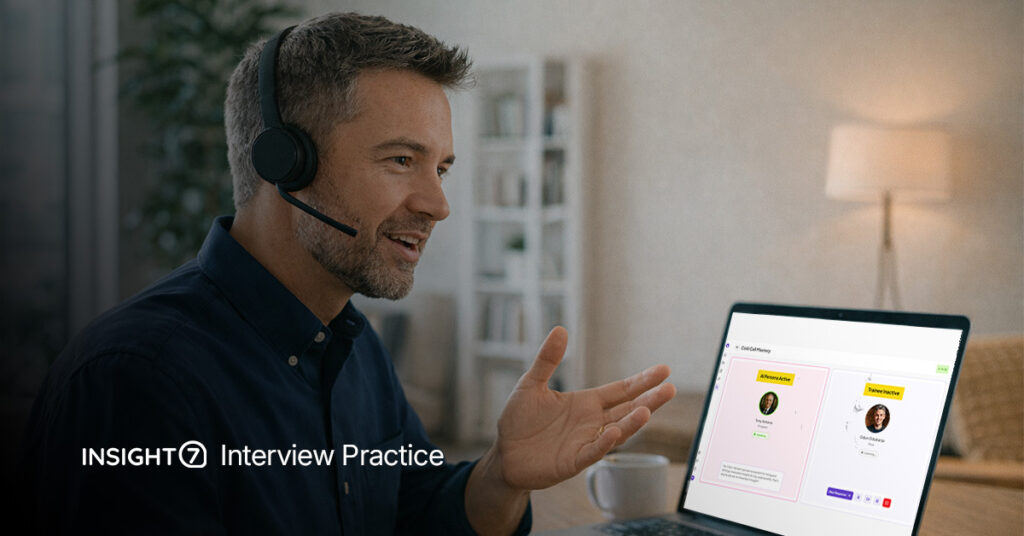
Cigna Leadership interviews test whether you lead with a mission-driven, people-investment orientation that builds capable, engaged teams in the complex and high-pressure environment of managed healthcare, whether you model the intellectual humility to learn from leadership failures, and whether you create the psychological safety that enables your team to navigate clinical, operational, and regulatory complexity without fear of making mistakes. Interviewers specifically evaluate whether your leadership creates learn-it-all conditions rather than know-it-all hierarchies in an industry where continuous learning is a clinical and operational necessity.
Start your free Cigna Leadership practice session.
What interviewers actually evaluate
Mission-Driven Leadership, Team Development & Healthcare Complexity Navigation
Cigna Leadership interviews evaluate whether you develop teams with genuine curiosity and coaching investment, model the health mission alignment that Cigna's culture expects from its leaders, and build the psychological safety that allows clinical, operational, and cross-functional teams to raise concerns and innovate in a regulated environment. Interviewers assess your ability to deliver business results through people development and your capacity to lead through the ambiguity inherent in managed healthcare's evolving regulatory and competitive landscape.
Mission-aligned leadership, Team capability development, Healthcare complexity navigation, Psychological safety, Coaching over directing, Results through people
What gets scored in every session
Specific, sentence-level feedback.
| Dimension | What it measures | How to answer |
|---|---|---|
| Mission Alignment | Does your leadership story reflect Cigna's health mission and your team's contribution to member health outcomes? We flag leadership stories where mission is absent and pure performance metrics define success. | Health mission dimension named, team contribution to member outcome |
| Team Development | Did you coach your team's capability through genuine development, or manage their performance? We score deliberateness: development action taken, individual growth demonstrated. | Coaching action named, capability built, individual growth described |
| Psychological Safety | Did your leadership create conditions where your team could raise clinical or operational concerns without fear? We flag stories where safety is assumed rather than actively created. | Safety-building action named, team behavior changed |
| Business Impact | What was measurably different because of your leadership? We look for a team, operational, or health outcome attributable to your specific leadership approach. | Outcome specificity, before/after framing, leadership causation demonstrated |
How a session works
Step 1: Get your Cigna Leadership question
You are assigned questions based on where candidates for this role typically struggle most, which for Cigna Leadership means demonstrating mission-aligned team development and psychological safety creation rather than authority and performance management. Each session starts fresh with a new question targeting a different evaluation dimension.
Step 2: Answer by voice
Speak your answer as you would in a real interview. The AI listens for STAR structure and evaluation signal alignment, specifically whether your leadership reflects Cigna's health mission, your development actions are specific and individual, and your Result includes a team or health outcome you can attribute to your leadership.
Step 3: Get scored dimension by dimension
Instant scores across all four rubric dimensions. Each gets a score, a flagged weakness, and a specific sentence-level fix. Cigna Leadership interviewers probe for leaders who describe authority and performance management as primary leadership qualities and for team development stories where the leader solved the problem rather than growing the team's capability to solve it.
Step 4: Re-answer and track improvement
Revise based on feedback and answer again. See the before/after score change across Mission Alignment, Team Development, Psychological Safety, and Business Impact. Your weakness profile updates across sessions so if you consistently underdemonstrate coaching investment in favor of individual performance management, that becomes the focus of your next question assignment.
Frequently Asked Questions
What type of questions are asked in a leadership interview at Cigna?
Cigna Leadership interviews are behavioral and probe mission-aligned team development and psychological safety in healthcare contexts. Common questions include: "Tell me about a time you developed a team member whose capability was struggling by investing in their growth rather than managing their performance," "Describe a situation where you had to build psychological safety in a team navigating regulatory or clinical complexity," "Walk me through a leadership failure you owned and what you changed in your approach afterward," and "Tell me about how your leadership created a team environment that directly contributed to a health or business outcome."
What are the 5 C's of interviewing for Cigna Leadership?
In Cigna Leadership interview contexts, the 5 C's map to: Curiosity (the learning orientation you bring to leadership challenges and to each team member's development), Coaching (the specific development actions you took and how they built individual capability in a healthcare context), Culture (how you actively built psychological safety and mission alignment in your team), Consequence (the team, operational, or health outcome your leadership produced), and Change (what you learned from a leadership situation that did not go as expected and how it made you a different leader). For Cigna Leadership interviews, Coaching and Change are most often underdeveloped.
What are the 5 hardest interview questions for Cigna Leadership?
The most challenging Cigna Leadership questions require you to demonstrate mission alignment and team development sophistication simultaneously. They typically include: a leadership failure where you were the primary contributor and what you changed in your approach; a team member whose capability you grew through coaching that was specific to their healthcare context and different from your default approach; a situation where your leadership created or failed to create psychological safety and what the impact was on the team's clinical or operational performance; a cross-functional influence story where your curiosity about a clinical or compliance partner's perspective changed your own leadership decision; and a team development story where the member grew beyond the role you initially envisioned for them.
What are the most common interview questions for Cigna Leadership behavioral rounds?
Cigna Leadership behavioral rounds specifically probe mission-aligned team development and psychological safety in managed care contexts. Common questions include: "Tell me about a time you learned something important from a team member who challenged your clinical or operational assumption," "Describe a situation where your team's psychological safety directly affected a health outcome or compliance result," "Walk me through how you coached a team member through a performance challenge rather than managing them through a disciplinary process," and "Tell me about a leadership decision you made with incomplete information in a rapidly evolving healthcare regulatory environment and what you would do differently." These questions probe mission alignment, coaching, and safety simultaneously.
What are the most common failure modes in Cigna Leadership interviews?
The most consistent failures are:
- Leadership stories that describe performance management or direction-giving without a genuine development investment: coaching and capability building are distinct from managing performance and giving instructions
- Team development stories where the leader fixed the problem rather than growing the team member's capability to fix it
- No health mission dimension: Cigna leadership candidates are expected to connect their team's work to member health outcomes, not just operational metrics
- Psychological safety described as a value rather than as a specific behavior the leader took that changed how the team raises concerns or innovates
- No leadership failure story, or a failure story where the team's performance was the issue rather than the leader's approach, investment choices, or cultural decisions
Also practice
All nine Cigna role interview practice pages.
- Sales
- Customer Service
- Product Management
- Marketing
- Finance
- Operations
- People & HR
- Legal & Compliance
One full session free. No account required. Real, specific feedback.








