


The Business Challenge: When Support Calls Are a Black Box
Before we built our CX dashboard, support calls were essentially invisible to operations and product teams. Companies were sitting on thousands of customer conversations every week — containing critical signals about product issues, service gaps, sales opportunities, and operational failures — but had no systematic way to extract insights.
The cost of this blindness was real:
- Operations couldn’t pinpoint root causes of repeat calls
- Service leaders had no visibility into whether agents were resolving issues effectively or escalating unnecessarily
- Sales opportunities mentioned in support calls were completely invisible, leading to missed revenue
- Without data, process improvements were based on gut feel rather than evidence
Why this matters: For companies handling thousands of support calls, even small improvements compound dramatically. A 5% increase in first-call resolution saves agent hours and improves customer satisfaction. Identifying just 10% more sales opportunities in existing calls can represent significant revenue. Catching product issues earlier reduces churn and development waste.
The market needed a solution that could actually listen to calls at scale — not just track call volumes, but understand intent, sentiment shifts, product mentions, and operational patterns — and surface this intelligence in a way that operations, product, and sales teams could act on immediately.
That’s the problem we set out to solve. Here’s how we built it.
The Problem We Faced
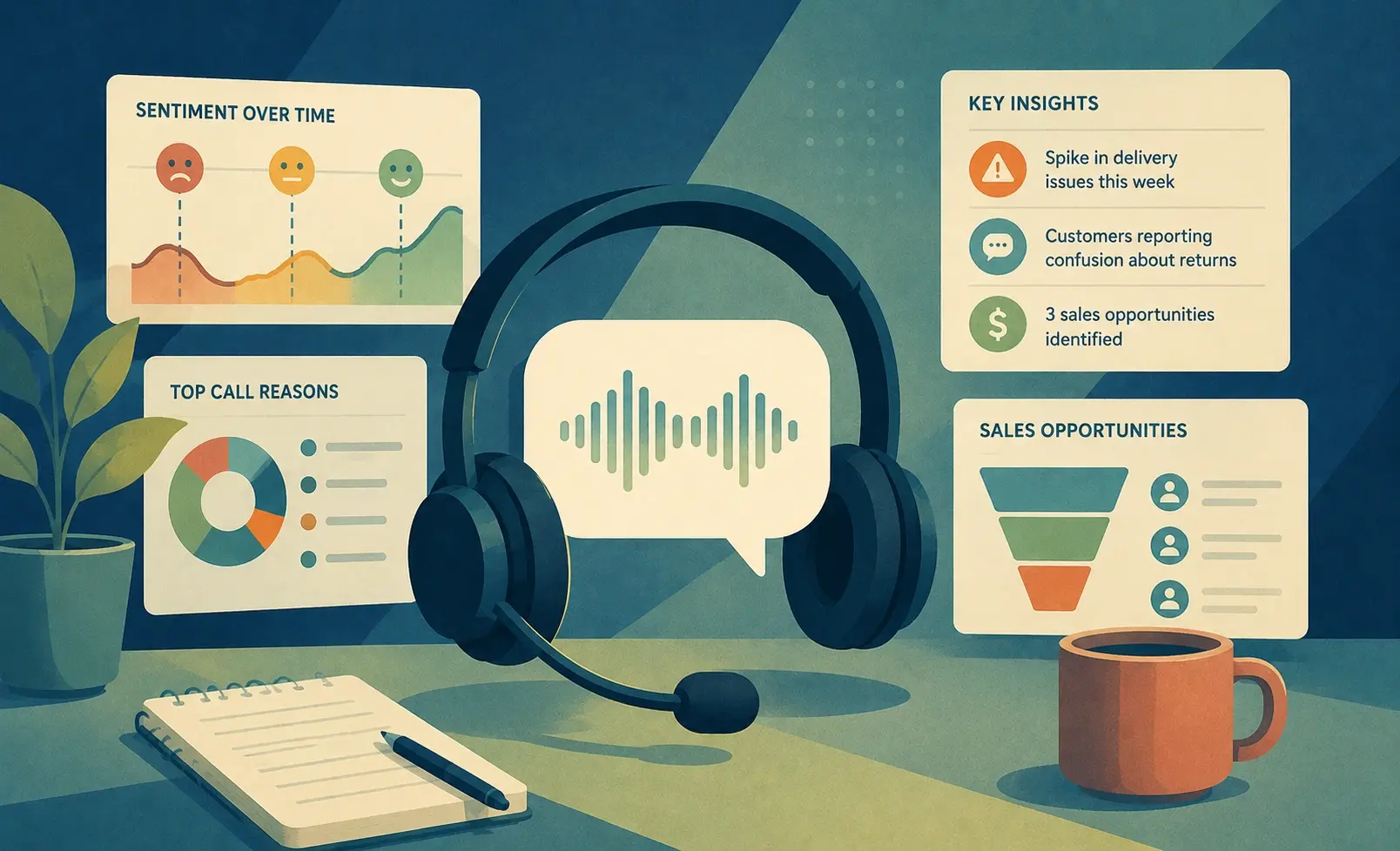
We were building a customer experience (CX) dashboard to give operators and product teams clear visibility into what happens on support calls. The dashboard had four main sections — Product, Service Quality, Sales Opportunity, and Operations — and needed to surface everything from sentiment trends (initial/mid/final), first-call resolution (FCR) and effective communication KPIs, to operational call-reason breakdowns (warehouse fulfillment failures, wrong-item complaints), and escalation trails. The hard constraint: the dashboard must actually “listen” — not just show volumes — and be dynamic enough to meet wildly different customer needs without rebuilding the whole stack for every account.
At project start we had raw call recordings, partial metadata (agent ID, time-on-call), and a set of business questions from stakeholders. We needed: accurate transcription and diarization; robust intent and reason classification; sentiment over call segments; extraction of product mentions and feature requests; sales-opportunity detection; and per-call resolution/escalation tracking — all updated frequently enough to inform operations.
Our First Attempt
Our initial architecture was straightforward and familiar: stream recordings into S3, run a single ASR (automatic speech recognition) model across everything, push transcripts into a classic NLP pipeline (heuristic regex + keyword lists + a light classifier), and layer metrics into a single monolithic BI dashboard (React + Superset). We used Amazon Transcribe (standard) for ASR, a simple speaker-turn heuristic for diarization, Vader for sentiment, and a logistic-regression classifier trained on 3k labeled call excerpts for reasons (fulfillment, wrong-item, billing, etc.). We shipped a V1 dashboard to a pilot customer within eight weeks.
That rollout taught us a lot quickly:
- Transcription quality varied wildly (WER 18–35%) depending on line noise, accents, and domain phrases — which cascaded into downstream NLP errors.
- Our single-model approach missed intent nuances: feature requests vs. complaints vs. comparisons were often conflated.
- Sentiment aggregated for whole calls hid critical dynamics: an angry start with a calm resolution still showed “neutral” overall.
- The dashboard’s static metric set didn’t align with some customers’ KPIs — one wanted detailed escalation timelines, another wanted product feature-mentions grouped differently.
We tracked core metrics: end-to-end processing latency was ~45 minutes per call (batch-only), reason-classifier precision ~0.77, recall ~0.69, and sentiment accuracy ~0.72 against hand-labeled samples. Those numbers were neither stable nor sufficient for operational trust.
Why It Failed
We learned why the naive stack failed in production:
- Error Amplification: ASR errors (high WER) directly reduced classification and named-entity extraction accuracy. A single bad transcription could flip a call’s reason tag.
- One-Size-Fits-All Models: Domain variance (different product names, jargon, call scripts) meant a global model underfit most customers and overfit the pilots.
- Temporal Blindness: Aggregating sentiment once per call missed transitions (initial frustration → mid-call calming → final satisfaction). KPIs like “effective communication” require segment-level signals.
- Static Dashboarding: The monolithic dashboard had hardcoded metric definitions and required engineering to add any new view. Customers wanted dynamic breakouts, e.g., seeing “wrong-item” split by warehouse ID or by SKU family — not possible without rebuild.
- Trust Gap: Operations needed auditable evidence (timestamps, utterance text, escalation points). Our pipeline didn’t carry provenance metadata end-to-end.
We could have iterated the original system ad infinitum, but that would chase symptoms. We needed architectural changes that reduced upstream fragility, enabled per-customer specialization, and provided explainability.
The Breakthrough
We reframed the problem: rather than a single pipeline that outputs “answers,” we would build a modular call-intelligence platform that produces trusted, auditable artifacts (segment-level transcripts, time-aligned sentiment and intent labels, entity records, and embeddings) and a flexible dashboard layer that composes views from these artifacts by configuration. The key design pillars became:
- Modular audio processing with fallbacks
- Segment-aware NLP and time-series sentiment
- Per-customer configuration and on-demand specialization
- Explainability and provenance at every step
- Operational SLAs for latency and accuracy
Below we describe the architecture, implementation choices, and how we operationalized trust.
Implementation Details
Models and training:
- Labeled dataset: 40k calls (>2M utterances) aggregated from pilots (consented), stratified by product line and geography. Holdout test: 5k calls.
- Intent/reason model: DeBERTa v3-small fine-tuned (Hugging Face Transformers v4.30), initial learning rate 2e-5, batch 32, trained for 4 epochs. Precision/recall on test set: 0.86 / 0.82 (F1 0.84).
- Sentiment model: BERT-based classifier for 3-way sentiment, but we also used a regression score combined with a rule engine to identify sentiment flips; 3-window accuracy = 0.88.
- ASR: We tuned acoustic adaptation on common product names and used Lexicon/Custom-Vocabulary features in Amazon Transcribe for customer-specific terms. For persistent low-confidence segments (<0.6), Whisper-large-v2 fallback reduced WER by ~6 percentage points.
Per-customer customization:
- Config model: each customer has a JSON schema describing product taxonomy, escalation tags, radar metrics, and dashboard templates. These configs drive NER dictionaries, custom vocabularies, and dashboard breakouts.
- Feature toggles: model ensemble on/off, near-real-time vs batch only, vector-search enabled, etc.
- Auto-specialization: active learning pipeline uses uncertain samples (highest entropy) per customer to seed human labeling and incremental fine-tuning (weekly mini-batches) — this reduced per-customer error rates by ~12% after three iterations.
Explainability & provenance:
- Every artifact carries a call-manifest: timestamps, model versions (ASR vX, intent model vY), confidence scores, and link to audio byte ranges.
- In dashboards, any KPI can drill to the set of calls and show the exact utterances that produced a label — ops can replay audio and see model rationale and confidences.
Operational targets:
- Near-real-time SLA: process live calls and show call-level artifacts within 90 seconds of call end (achieved 75s median).
- Batch SLA: nightly backfill for large volumes.
- Accuracy SLAs: maintain intent F1 >= 0.80 for production customers (automatic retraining pipelines trigger if below threshold).
Results and Tradeoffs
Quantitative outcomes (after 6 months across 8 pilot customers):
- Processing latency: Median end-to-dashboard latency improved from 45 minutes to 75 seconds for real-time pipeline; nightly backfills still processed at ~1 hour for large backfills.
- Model performance: Intent classification precision/recall improved to 0.86/0.82 (F1 0.84) on the combined test set. Per-customer specialized models showed average F1 gains of +0.12 over the global model.
- Sentiment insights: Segment-level sentiment allowed us to compute “effective communication” (fraction of calls with negative initial sentiment that end neutral/positive). Effective communication metric rose on average from 0.72 to 0.84 after targeted coaching and process tweaks informed by our dashboard.
- First Call Resolution (FCR): By surfacing root causes (e.g., warehouse fulfillment failures with frequency and escalations), teams executed process changes and improved FCR from 0.68 to 0.76 within three months in one customer.
- Sales opportunity detection: Our semantic search and missed-sales classifier raised detection of missed cross-sell/upsell intents by 4x vs heuristic keyword approach. Conversion lift: in customers that integrated agent coaching, identified opportunities converted 1.3x higher than baseline after agent training.
- Dashboard adoption: Time-to-insight (time for ops to answer “what’s causing wrong-item calls this month?”) dropped from hours/days with SQL to <2 minutes via configurable drilldowns.
Tradeoffs and limitations:
- Cost: Ensemble ASR + fallback + fine-tuning per-customer increased cloud and compute costs by ~2.6x vs the minimal stack. We mitigated with selective specialization (only apply per-customer fine-tuning where ROI justified) and cold storage for long-term artifacts.
- Complexity: The modular architecture added operational complexity (more services, model versions to manage). We invested heavily in automation (CI/CD for models using MLflow, automated rollout guards) to keep it sustainable.
- Privacy vs Utility: Aggressive PII redaction sometimes removes tokens that are necessary for product/sku detection. We balance by retaining hashed placeholders and allowing customer opt-in to retain unredacted artifacts under strict compliance contracts.
- False positives in sales-opportunity detection required human-in-the-loop workflows; we implemented confidence thresholds and review queues to avoid agent overload.
Lessons Learned
- Build artifacts, not black boxes. Time-aligned transcripts, segment-level sentiment, embeddings, and model provenance let stakeholders trust the dashboard because they can trace answers back to audio and model snapshots.
- Specialize where it matters. A global model is a great baseline; per-customer fine-tuning on ambiguous, high-value labels delivers outsized gains. Make specialization opt-in and instrument ROI.
- Design for temporal signals. Initial/mid/final sentiment and change detection (sentiment flips) are powerful operational levers that aggregate metrics miss.
- Modularize the dashboard. A template/DSL + per-org JSON configs let us deliver tailored views without engineering rebuilds. Treat dashboards as code.
- Operationalize model lifecycle. Continuous evaluation (A/B tests, shadow deployments), active learning loops, and retraining pipelines are essential. Set concrete SLAs for latency and accuracy and build rollback safety nets.
- Prioritize explainability. Agents and ops need evidence; showing audio, timestamps, and model confidences turned “insight” into actionable work.
- Measure business impact. Track FCR, effective communication, and conversion lifts to justify the higher engineering and cloud costs.
Closing
We moved from a brittle, single-model pipeline to a modular, explainable call-intelligence platform that actually listens. By combining robust audio processing, segment-aware NLP, per-customer customization, and a configurable dashboard layer with full provenance, we turned noisy call data into operationally trusted insight. The trade-offs were real — higher cost and complexity — but targeted specialization and automation made the system sustainable and, importantly, impactful: faster insights, measurable process improvements, and dashboards that stakeholders actually use to make decisions.








