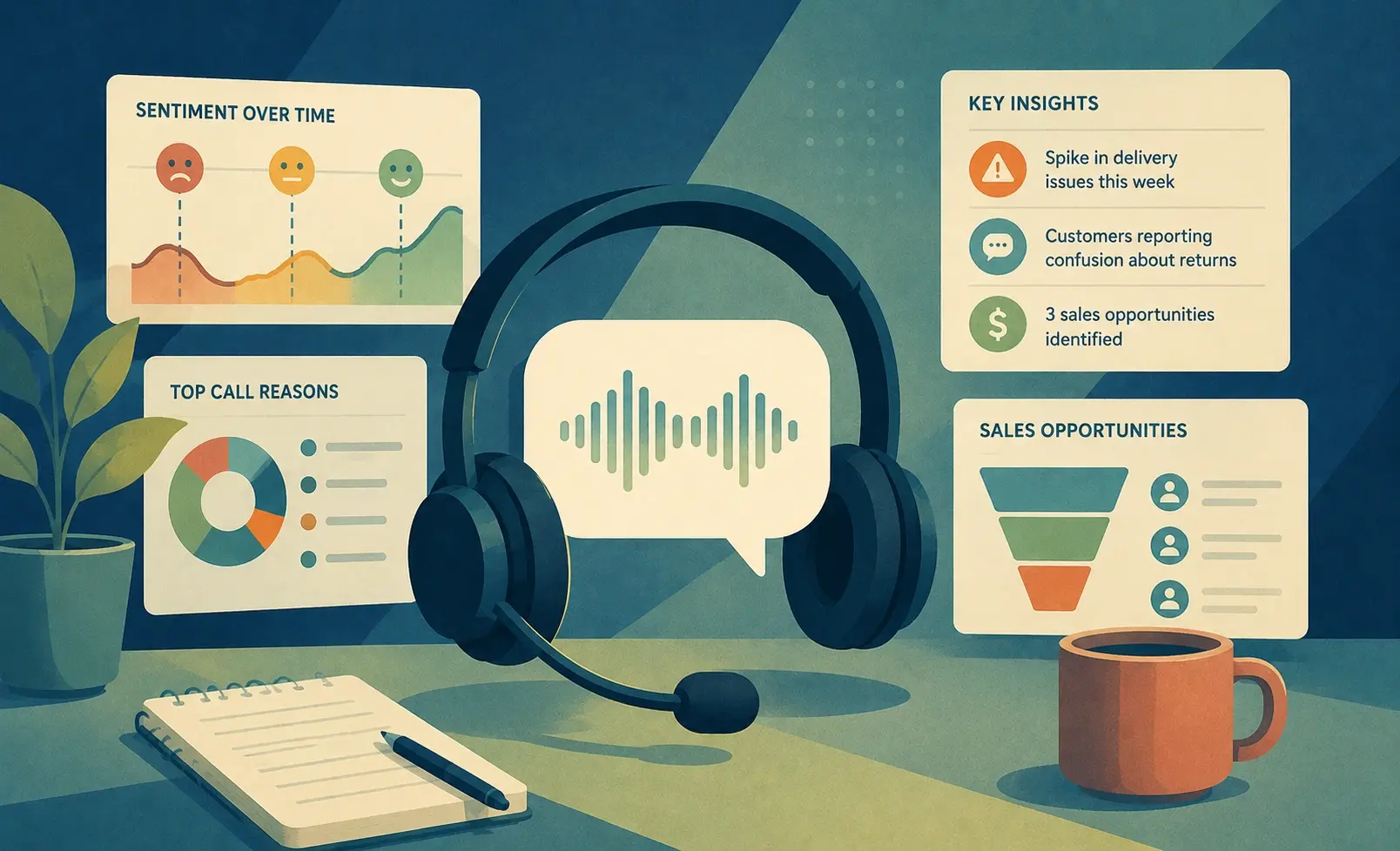
Call center operations managers trying to improve agent performance face a specific problem: most performance conversations rely on averages across a small sample of reviewed calls, and the metrics tracked rarely reflect what actually drives customer satisfaction or resolution. Voice analytics platforms address this by extracting behavioral and operational metrics from 100% of recorded calls, replacing sample-dependent averages with complete-population data.
This comparison covers five platforms on the metrics that matter most for agent performance management in 2026.
Methodology
Platforms were selected for distinct approaches to metric extraction, scoring configuration, and manager workflow. Evaluation dimensions: which metrics are extracted automatically versus configured, how metrics connect to agent scorecards, how alerts are triggered, and how findings connect to coaching actions.
| Platform | Coverage | Metric Depth | Scoring Config |
|---|---|---|---|
| Insight7 | 100% of calls | High | Fully configurable |
| Tethr | 100% of calls | High | Semi-configurable |
| Scorebuddy | Sampled or full | QA-focused | Template-based |
| Qualtrics XM | Survey + voice | CX survey-primary | Limited |
| Avoma | Full | Meeting-focused | Light |
Insight7
Insight7 extracts talk ratio, sentiment, compliance rate, handle time, escalation signals, and first call resolution indicators from every recorded call, scored against configurable weighted criteria. The platform's approach to metric extraction differs from standard voice analytics in one key dimension: every score links back to the exact transcript quote and timestamp that generated it. Managers do not need to listen to the full call to verify a metric, they click through to the evidence directly.
The weighted criteria system allows operations managers to configure which behaviors contribute to which metrics and at what weight. Compliance items can be set to exact-match (was the required disclosure spoken verbatim?), while behavioral items like empathy demonstration or objection handling can be set to intent-based evaluation. A single call produces a multi-dimensional scorecard where each criterion is independently weighted and evidenced.
Insight7 is best suited for call centers that need configurable behavioral criteria tied directly to performance scoring, not just aggregate metric extraction.
A contact center processing 30,000 or more calls per month ran a 1,000-call pilot where Insight7 correctly identified compliance violations with tier-based severity alerts and generated per-agent scorecards (Insight7 customer data, 2025).
Honest con: First-run scoring without company-specific behavioral context definitions can diverge significantly from human QA judgment. Calibration takes 4 to 6 weeks. The "what great and poor looks like" context is loaded by the Insight7 team, not directly editable in the main UI by customers.
Avoid this common mistake: activating automated scoring before completing calibration. AI scores applied to agent performance reviews before alignment with human QA judgment produce credibility problems with managers and agents that are difficult to recover from.
What metrics can AI call analytics extract to measure agent performance?
AI call analytics platforms extract six categories from recorded calls: talk ratio (percentage of call where agent versus customer spoke, with high agent ratio signaling poor listening), sentiment (customer and agent tone including shifts during escalation), compliance rate (disclosures and scripts completed), handle time (by call type and outcome), first call resolution rate (inferred from transcript signals), and escalation rate (supervisor transfers or repeat contacts). According to ICMI research on contact center performance benchmarking, contact centers tracking agent-level metrics across all six categories identify coaching-ready agents 3 times faster than those relying on aggregate team averages.
Tethr
Tethr focuses on conversation intelligence for enterprise contact centers, with an emphasis on effort scoring, customer friction detection, and compliance monitoring. The platform scores calls across a pre-built effort index and allows configuration of custom categories. Metric output is strong for customer experience signals, with automatic detection of customer effort, confusion, and dissatisfaction indicators.
Tethr is best suited for enterprise contact centers where reducing customer effort is the primary performance objective and a pre-built effort scoring model provides a useful starting point.
The reporting layer is deep, but direct coaching workflow integration is limited. Metric findings surface in dashboards and exports rather than triggering automated coaching assignments.
Honest con: Custom configuration beyond the pre-built model requires professional services engagement. Teams expecting plug-and-play metric extraction against company-specific criteria will need implementation support.
Scorebuddy
Scorebuddy is a QA-focused platform that combines manual and automated call scoring with agent development tools. The platform supports form-based evaluation templates that QA teams configure, with automated scoring available as an add-on. The core strength is the QA workflow: scoring, calibration tracking, and agent feedback delivery are tightly integrated.
Scorebuddy is best suited for QA teams that need structured workflow management for manual and semi-automated scoring, where human reviewer oversight is the primary quality assurance model.
Full-volume automated metric extraction is more limited compared to platforms built on 100% AI coverage. The platform is well-suited for teams making a gradual transition from manual QA to augmented AI scoring.
Honest con: Teams that want 100% automated coverage and complex behavioral scoring criteria will find Scorebuddy's automation depth less extensive than purpose-built AI platforms.
Qualtrics XM
Qualtrics XM excels at connecting voice of customer survey data to call metrics. The platform captures post-call survey responses, correlates them with operational metrics, and identifies which call-level behaviors drive CSAT and NPS outcomes. For organizations where customer satisfaction measurement is the primary analytics objective, Qualtrics XM provides strong cross-channel measurement.
Qualtrics XM is best suited for organizations where connecting post-call survey data to call-level operational metrics is the primary performance measurement requirement.
Voice analytics in Qualtrics XM supplements rather than anchors the platform. Teams that need deep agent behavioral scoring from call audio will find the voice analytics layer thinner than platforms purpose-built for call QA.
Honest con: Pricing is enterprise-scale and the platform's primary investment requirement is the survey and experience management infrastructure, not the call analytics layer. Teams whose primary need is call scoring will pay for capabilities they do not use.
Avoma
Avoma focuses on meeting intelligence for customer-facing teams, extracting topics, action items, sentiment, and talk ratio from recorded video and audio meetings. The platform is oriented toward account executives and customer success managers running structured sales and success conversations rather than high-volume contact center environments.
Avoma is best suited for customer-facing revenue teams handling a moderate volume of structured sales or success meetings where meeting summaries, action items, and talk ratio insights drive follow-up quality.
For contact centers running hundreds or thousands of calls per week, Avoma's meeting-oriented design does not match the volume-level QA and compliance monitoring requirements.
Honest con: Teams running 10,000 or more calls per month will find Avoma under-built for their volume and compliance requirements.
How do you connect voice analytics metrics to agent coaching?
The connection between metric extraction and coaching is the gap most voice analytics deployments fail to close. Insight7 closes it by automating the path from low QA score to coaching assignment: when a rep consistently scores below threshold on a criterion, the platform generates a targeted practice scenario queued for supervisor approval. Platforms that surface metrics in reporting dashboards but stop there require managers to manually translate findings into coaching actions, which is the step most commonly skipped.
If/Then Framework
If you need configurable behavioral criteria tied directly to scoring and automated coaching assignment, then use Insight7.
If you want a pre-built customer effort scoring model with enterprise compliance monitoring, then use Tethr.
If your team is transitioning gradually from manual QA to AI-augmented scoring with strong workflow management, then use Scorebuddy.
If your primary objective is connecting post-call CSAT surveys to call-level operational metrics, then use Qualtrics XM.
If your team runs structured sales or customer success meetings rather than high-volume contact center calls, then use Avoma.
FAQ
What are the 5 key CX metrics tracked by voice analytics platforms?
The five most commonly tracked CX metrics in voice analytics deployments are: First Call Resolution (FCR), Customer Satisfaction Score (CSAT), Average Handle Time (AHT), Agent Quality Score, and Escalation Rate. Voice analytics platforms extract each of these from call recordings rather than relying on post-call surveys or manual review. According to SQM Group benchmarking research on contact center quality, FCR is the strongest single predictor of customer satisfaction, with every 1% improvement in FCR producing approximately a 1% improvement in CSAT (SQM Group benchmarking data).
How accurate are AI voice analytics platforms at extracting compliance metrics?
Accuracy depends on evaluation mode. Required disclosures with scripted language are best evaluated with exact-match checking. Behavioral criteria like empathy or active listening are better evaluated with intent-based scoring. Insight7 supports both modes per criterion, allowing compliance and quality criteria to coexist in a single scoring framework without conflation.
How many calls do you need to get reliable performance benchmarks from voice analytics?
Agent-level benchmarks require at least 20 to 30 calls per agent per period. Team-level benchmarks are reliable with smaller per-agent samples when aggregated. The advantage of 100% coverage platforms is that agent-level reliability improves automatically as volume increases. ICMI benchmarks recommend a minimum of 10 to 15 scored calls per agent per month for individual performance conversations to be statistically defensible.
Want configurable scoring criteria tied to automated coaching assignments for your contact center? See how Insight7 extracts and acts on agent performance metrics.