


Key points
- Reps in the top 6.9% of 6,209 scored sales conversations asked 14.3 questions per call, against 10.4 for average performers, a difference of 37%.
- Question density separated them further: 1.2 questions per minute against 0.6, so top reps asked twice as often across the same stretch of conversation.
- Volume alone did not explain the gap: Top-tier conversations held a near-equal 1:1 speaker ratio while the poorest ran at 1:8
- Insight7’s automated QA scoring automatically tracks question density and speaker balance across 100% of your calls, so managers can coach them toward top-performer benchmarks.
Ten discovery questions feels thorough but isn’t twenty a deposition? Reps trading notes land somewhere between the two and hedge, because the honest answer has always depended on whose call you happened to listen to.
So, we scored 6,209 real sales conversations across 12 performance dimensions to replace that instinct with a measured figure.
Top-tier reps asked 14.3 questions per call against 10.4 for average performers, at twice the density. What follows is where that number came from, what it looks like inside a balanced conversation, and the threshold to set for your own team.
How many discovery questions do top sales reps ask?
In our sales rep performance research, top-performing reps asked 14.3 questions per call. Average performers asked 10.4, and the coaching floor we drew from the data is 12 or more per call.
Here is what the scoring showed across the 6,209 conversations:
| Metric | Excellent tier | Average tier | Difference |
|---|---|---|---|
| Questions per call | 14.3 | 10.4 | +37% |
| Question density (per minute) | 1.2 | 0.6 | 2x |
A 37% gap in question count sounds modest until you translate it into a quarter.
A rep running 40 discovery calls a month is asking roughly 150 fewer questions than a top performer over the same period, which means 150 fewer chances to hear the budget constraint, the competing vendor, or the internal politics that decides the deal.
The benchmark moves with the call type
Applying one number to every conversation your team runs will penalise somebody unfairly. Insight7’s vertical studies show how wide the spread gets.
| Call type | Top tier | Bottom tier | Benchmark |
|---|---|---|---|
| B2B sales and CS (6,209 calls) | 14.3 questions | 10.4 (average) | 12+ per call |
| Insurance quote calls | 7 questions, nearly 2 open-ended | 3 questions, under 1 open-ended | 7+, 2 open-ended |
| Wellness consultations | Fewer questions, sharper | Generic or absent discovery | 3+ open-ended in first 5 minutes |
| Inbound manufacturing | Discovery on 88% of calls | Discovery on 20% of calls | 6 specs confirmed before quoting |
Insurance sits at half the B2B benchmark because an inbound quote call runs shorter and the customer already knows what they want. The top-tier insurance agents in that study still opened a far wider conversation, generating 16.1 customer turns per call against 3.2 for the bottom tier.
Note: A 5x participation gap is what separates a discovery call from a presentation with pauses. If your reps are averaging three or four customer turns, the buyer stopped contributing early and the rest of the call was a monologue.
Sometimes the count is zero
At a building materials manufacturer Insight7 studied, top reps ran project discovery on 88% of calls while bottom reps managed 20%. On four out of five calls, the bottom tier quoted or deferred without asking anything.
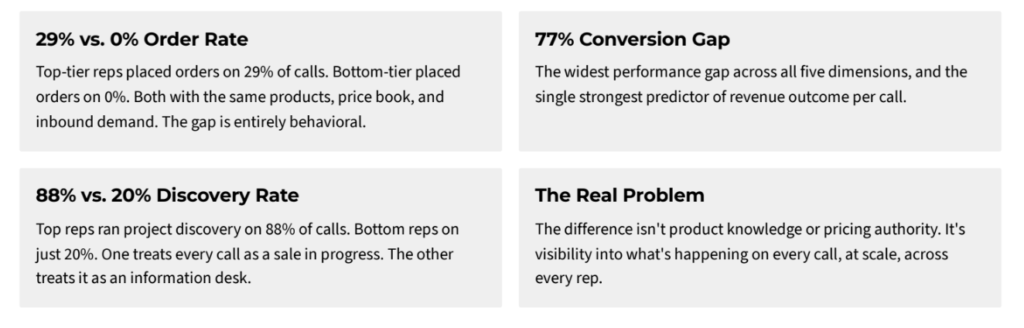
The cost landed downstream. Quoting without confirming specifications produces returns, recuts and callbacks, so a skipped question generated work for the branch weeks later. Top reps confirmed six things before naming a price:
- Gauge: thickness of the material
- Profile: panel type and shape
- Colour: finish and coating
- Length: measured, never estimated
- Quantity: total and per delivery
- Application: the job the material is going onto
None of that is difficult. It went uncoached because manual review at that manufacturer covered under 2% of calls, so nobody could see which reps were skipping it.
Discovery question pacing and talk-to-listen ratio in top-performing calls
Question density predicts call quality better than raw count, because it captures when the questions arrived rather than how many were asked.
Top performers asked 1.2 questions per minute. Average performers asked 0.6. Twice the frequency across the same stretch of conversation changes what a rep learns and when.
Say two reps are on a 30-minute discovery call and both ask 14 questions. The first works through a qualification list in the opening four minutes, then presents for 26. The second spreads questions across the full call, so the answer at minute 22 can still redirect the recommendation.
That first rep simply locked in her pitch before the buyer mentioned the compliance requirement that kills the deal.
Where talk-to-listen ratio comes in
Question pacing and speaker balance move together. Excellent conversations in the study held a 1:1 speaker dominance ratio, close to equal. Poor conversations ran at 1:8, with the rep doing nearly all the talking.
On Turn Balance Score, which measures how evenly speakers trade turns, Excellent calls scored 0.4 against 1.2 for Poor. Anything above 1.2 has stopped being a two-way conversation.
Insight7’s wellness study found the same failure in sharper form. Bottom-tier consultations degenerated into 80%+ advisor talk time, and those advisors enrolled 33% of patients while top-tier advisors enrolled 100%. Same programmes and pricing, same patient pipeline.
Odun Odubanjo, Insight7’s CEO, explained the pattern best:
“The top reps don’t use questions to interrogate but to guide. They don’t dominate conversations, they balance those conversations. When reps dominate, they miss what matters. When they listen, they are able to lead the conversations better.”
For a QA manager running a 40-agent insurance floor, this is the practical value of pacing data. Talk ratio is measurable on every recording without a human listening, which means you can spot the agent drifting toward 8:1 in week two rather than in the quarterly review.
Why asking more discovery questions doesn’t always win the call
More questions improve outcomes up to a point, and the type of question decides where that point sits.
Neil Rackham and the Huthwaite research team’s analysis of more than 35,000 sales calls over 12 years makes this concrete.
They found an inverse relationship between basic fact-finding questions and success, and recommended capping those at 3 to 5 per call. Top performers spent their question budget elsewhere, on implication and need-payoff questions that made the buyer articulate the cost of the problem.
Background questions have a ceiling because the buyer gets nothing back for answering them. A rep asking how many seats you have, what your renewal date is, and who else is evaluating is collecting CRM fields. But one asking what happens to the quarter if the migration slips helps the buyer think.
Harvard points the same direction on which questions carry weight when they identified four question types and found follow-ups the most powerful, because they signal that the asker heard the previous answer.
Follow-ups are the first casualty of a prepared list. A rep working through 14 scripted questions in order can hit the count while examining none of the answers, which produces a respectable scorecard and a call with no new information in it.
The wellness data shows what the alternative looks like.
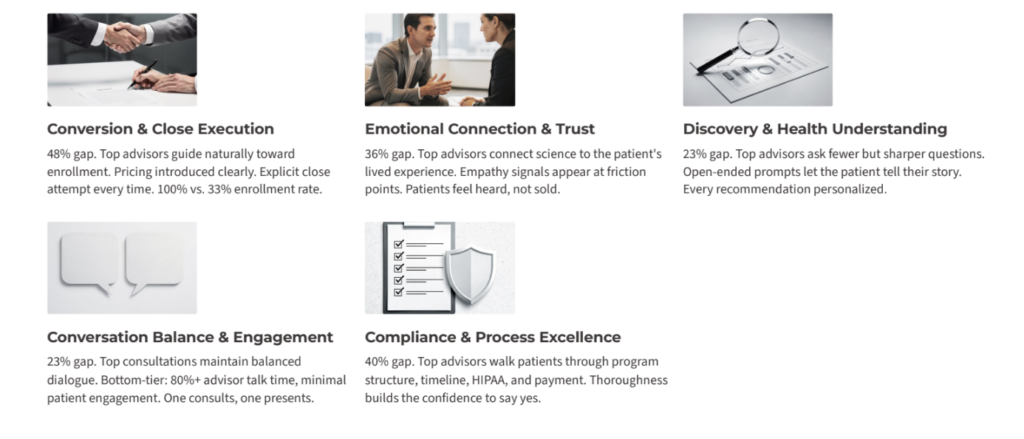
Top advisors there asked fewer questions than their peers, opening with 3 or more open-ended health history prompts in the first five minutes and then following the patient’s answers wherever they led.
Their recommendations referenced the patient’s own bloodwork rather than the programme brochure, which produced a 36% higher emotional connection score.
Side note: Counting questions treats “what’s driving the timeline?” and “is Thursday okay?” as equivalent. Track the open-ended share alongside the total or reps will hit the target by adding closed confirmations.
Turning discovery question data into a sales coaching benchmark
A benchmark only works once it reaches the rep as something specific to change. Here are three steps make that happen.
1. Set the floor by call type, not team
Discovery, renewal, inbound quote and support calls each need their own target. An enablement lead at a 250-person SaaS company running one number across all four will produce a metric that fits nobody, and reps stop chasing targets they consider unfair.
Insight7 handles this with evaluation criteria templates per call type.
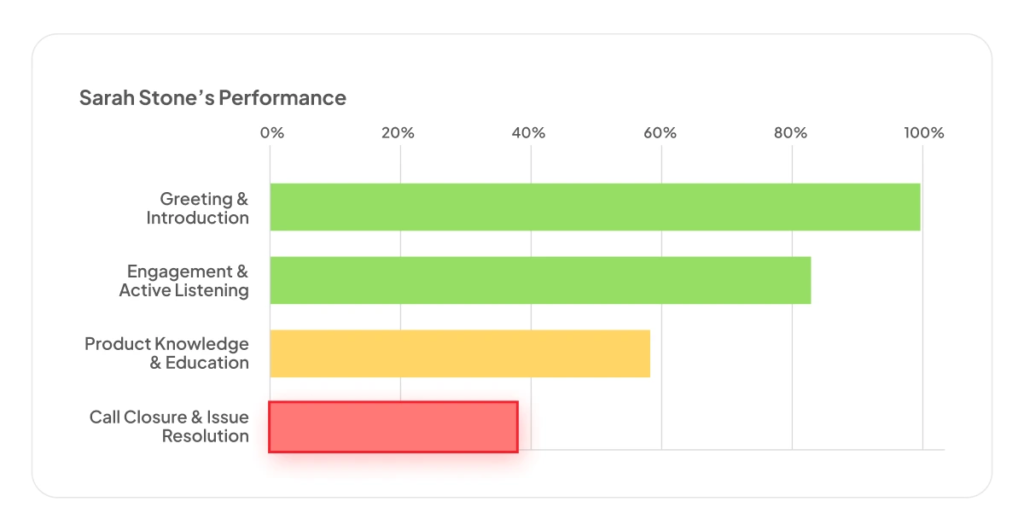
Sales calls get scored on discovery depth and next steps. Support calls get scored on resolution. The system routes each recording to the right rubric automatically, so a renewal call is never marked down for missing a discovery sequence that did not apply.
2. Score every call, not a sample
Manual QA runs at under 2% coverage in most operations, which is a sample far too thin to detect a 37% difference in question count or attribute it to the right person. A manager who has heard four of a rep’s calls this quarter has an impression, and impressions track how much the manager likes the rep.
TripleTen hit this ceiling with a large customer support team. After connecting Zoom to Insight7’s AI call scoring within a week, they were processing over 6,000 coaching calls a month for roughly the cost of one project manager.
The value was a standardised soft skills framework applied to every call rather than the handful a supervisor could reach.
3. Track four numbers weekly and tie them to deal movement
| Metric | Target | Why this number |
|---|---|---|
| Questions per call | 12+ | Below this, reps are presenting rather than discovering |
| Turn Balance Score | Under 1.2 | Above 1.2 the call has become a monologue |
| Open-ended share | 2+ per call | Keeps the count honest |
| Actionability score | Above 4.5 | Every call ends with a defined next step |
Reviewed quarterly, these are a report. Reviewed weekly against real recordings, they are a coaching programme.
The reason weekly works is traceability. When a rep disputes a low discovery score, a manager using Insight7’s AI coaching can open the exact transcript moment where the discovery should have happened, then generate a roleplay scenario built on that gap so the rep practises against an AI buyer before the next live call.
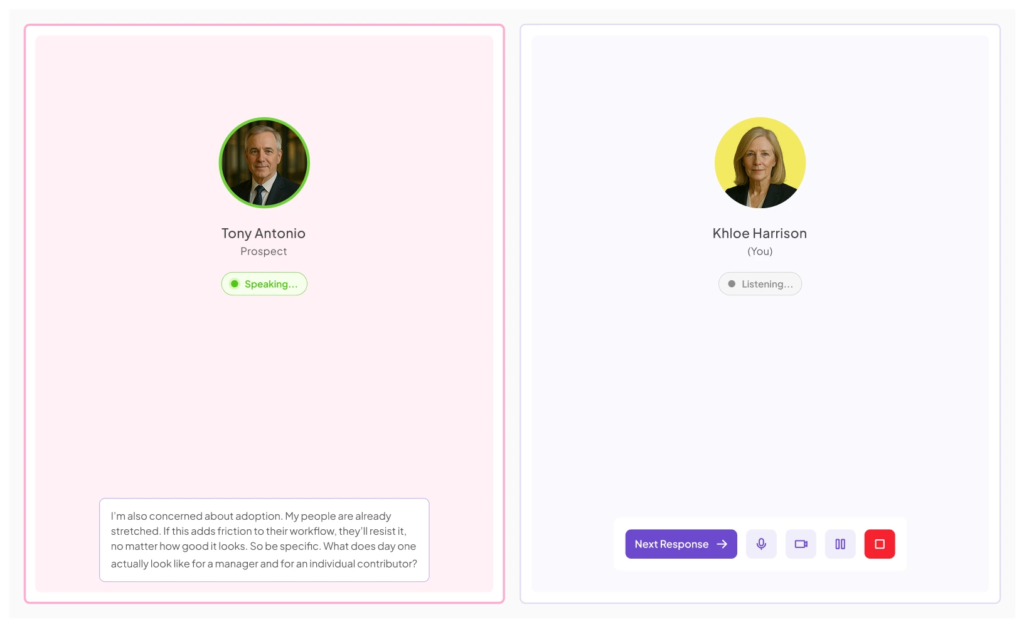
Calibration tools let managers override the AI rating where context justifies it, which matters for adoption. Reps accept a score they can argue with.
Pro tip: Build the rubric from your own top performers rather than a generic template. Use our free Sales Call Scorecard Generator extracts the winning behaviours from recordings of your best calls and turns them into a reusable scorecard.
What to do with this
For longer B2B discovery calls, 12 or more questions at a density near 1.2 per minute matches what the top 6.9% were doing. For inbound and transactional calls, 7 with 2 open-ended is the benchmark from the insurance data.
For consultations where trust decides the sale, 3 or more open-ended questions in the first five minutes matters more than the total.
Before setting any target, find out where your team sits now. Pull one call from your strongest rep and one from your weakest and count the questions in each. If the gap looks like 14.3 against 10.4, you have found your first coaching target in twenty minutes.
Upload five calls to Insight7 and see the count, the density and the talk ratio scored automatically.
FAQs
How many discovery questions should a sales rep ask?
Reps in the top tier of Insight7’s 6,209-conversation study asked 14.3 questions per call, against 10.4 for average performers. The coaching floor drawn from that data is 12 or more per call for longer discovery conversations, dropping to around 7 for shorter inbound calls.
Can a rep ask too many discovery questions?
Yes, when the questions are basic fact-finding. Neil Rackham’s analysis of more than 35,000 sales calls recommended capping background questions at 3 to 5 per call, since asking more correlated with worse outcomes. Volume works when it goes into questions that make the buyer think, rather than questions that fill in CRM fields.
What is a good talk-to-listen ratio on a discovery call?
Excellent conversations in Insight7’s study held a near-equal 1:1 speaker ratio, while Poor conversations ran at 1:8. On Turn Balance Score, the coaching threshold is below 1.2. Bottom-tier wellness consultations averaged over 80% advisor talk time and enrolled a third of the patients that top-tier advisors did.
What are good sales discovery questions to ask?
The best sales discovery questions are open-ended and follow the buyer’s previous answer. Harvard research by Brooks and John found follow-up questions the most powerful of four question types, because they signal that the rep was listening. In inbound manufacturing calls, discovery question examples that predicted orders covered gauge, profile, colour, length, quantity and application before any price was named.
How do I measure discovery questions across my team?
Manual review covers under 2% of calls in most operations, which is too small a sample to detect a 37% difference or attribute it fairly. AI call scoring evaluates every conversation against a rubric you define, tracks questions per call and talk ratio automatically, and links each score to the transcript moment behind it.








