Ask five sales managers what separates their strongest rep from their weakest, and you will usually get five different answers. Each one is drawn from the handful of calls that manager happened to hear.
The conversations themselves hold a better answer, but nobody has the hours to sit through them. Conversation intelligence closes that gap by reading every conversation automatically and reporting on what actually happened inside it.
This guide covers what the technology is, how it works, what it measures, who uses it, and how to judge whether your team needs it.
Get a demo with Insight7 and see what your own customer calls are already telling you.
Conversation intelligence is technology that uses artificial intelligence to analyze customer conversations and extract insights teams can act on.
It goes further than call recording. A recording preserves the audio, but someone still has to sit through it and decide what mattered.
Conversation intelligence platforms capture customer communications from calls, meetings, and chats, transcribe the spoken ones, then apply natural language processing to identify what was said, who said it, and how the customer responded.
The output is a set of measurable signals rather than a folder of audio files. What was locked inside the audio becomes actionable data you can compare between reps, teams, and time periods. Call summaries capture the key points automatically, so a manager can scan a week of activity in minutes.
The shift is from evidence you have to go looking for to evidence that arrives on its own. Key insights that once depended on who had time to listen now surface from every customer call.
Three terms circulate in this category, and they do not describe the same thing.
Conversation intelligence analyzes conversations between people. Most of that work happens once a call has ended, though a growing number of platforms also surface guidance while a call is still running, usually called live assistance. The purpose is to find the patterns worth coaching against.
Conversational AI participates in the conversation itself. Chatbots, AI voice agents, and virtual assistants belong here, and their task is to handle the interaction rather than study it. The short version: conversational AI interacts, conversation intelligence interprets.
Conversational intelligence is used interchangeably with conversation intelligence in sales and customer experience software, and most vendors treat the two as the same category.
The word travels further than that, though. Outside this space, it can also describe human-to-machine interaction, or communication skills training with no software involved at all.
Most platforms run the same four stages. What separates them is how much of your data survives each one.
The platform connects to wherever conversations happen, whether that is your dialer, your contact center, a CRM, or Microsoft Teams calls and video meetings.
Capture looks like a formality and is anything but. If an integration misses one channel, every conversation on that channel stays invisible to everything downstream, no matter how strong the analysis is.
This is why integration count is worth checking before feature depth.
Insight7 connects to more than 50 systems, including dialers, contact center platforms, CRMs, and meeting tools, so a team running voice through one vendor and video through another does not end up with two separate pictures of the same customer.
Audio becomes text, and the system works out who spoke and when through a process called diarization.
Speaker separation matters more than raw transcription accuracy for most use cases, since talk ratio, turn balance, and question attribution all depend on knowing which words belonged to the rep.
Chat and email skip this stage entirely, which is one reason platform quality varies so sharply by channel.
Language coverage belongs in the same check. Insight7 transcribes in more than 60 languages, which matters for any operation running support or sales outside a single market.
Natural language processing and machine learning read the transcript. This is the stage where text becomes conversation intelligence data.
The system identifies topics, questions, objections, competitor mentions, and customer sentiment. It also tracks structural signals such as how often the speakers alternated and where engagement began to fade.
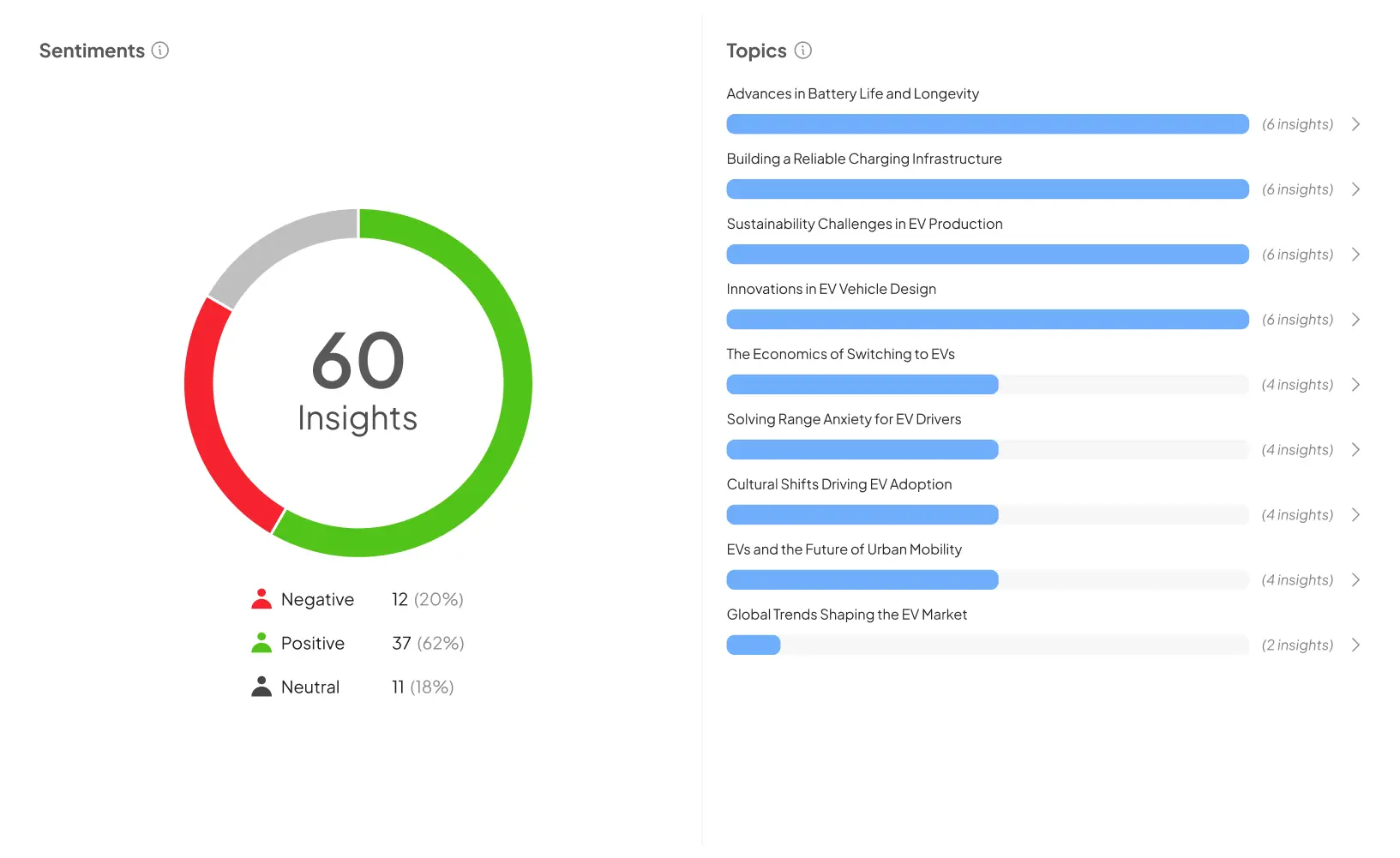
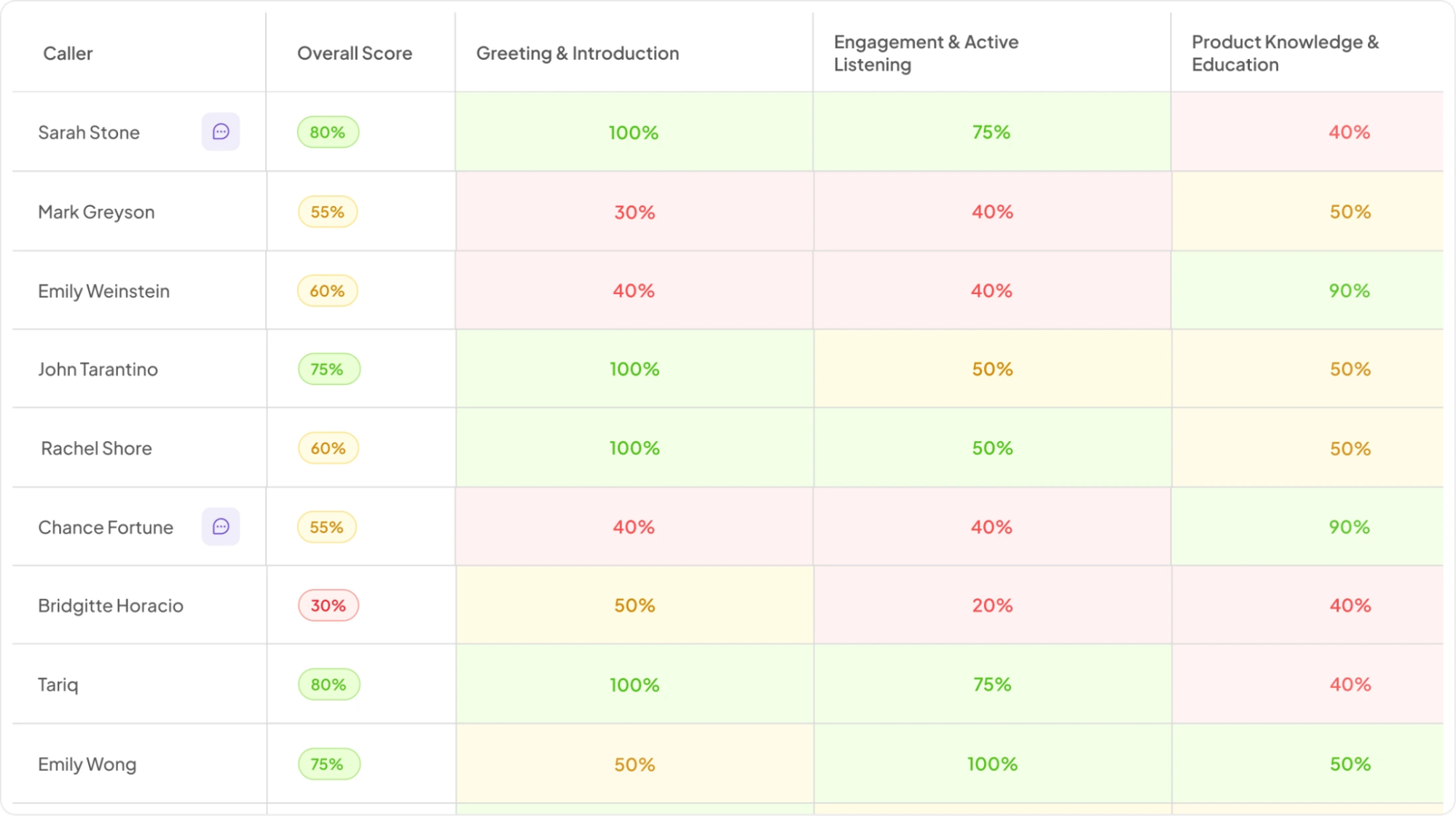
Each conversation is scored against criteria you set, whether that is a QA scorecard, a compliance checklist, or your own sales methodology.
Those scores roll up into views a sales manager can use. Patterns by rep, team performance over time, and the specific moments worth reviewing.
The gap between platforms shows up here rather than at capture.
Insight7 scores every connected conversation against criteria you write yourself, so a healthcare support team can score consent language and a sales team can score discovery depth from the same pipeline, without either one inheriting a generic framework built for the other.
Feature lists rarely explain what the software is watching for, or which signals produce genuinely valuable insights. These are the signals that appear on almost every platform:
Signals need reading in context. A single sentiment score is noisier than a pattern spread over hundreds of calls, though on an escalation or a cancellation call the customer’s emotion is the whole point.
Measuring conversations is the method. These are the results teams are actually buying:
It is most associated with sales professionals, but it now reaches every team that talks to customers for a living.
Sales leaders use it to see the sales pipeline as it is rather than as the CRM describes it. Deal notes are written afterward by the person with the most reason to be optimistic, while call data is not.
For a sales manager, call insights answer the daily question of which conversations never reached a close attempt and why. Coaching becomes diagnosis rather than opinion, and sales reps get concrete feedback instead of general encouragement.
Service teams use it to score every interaction against consistent criteria rather than sampling a handful per agent each month, which is the core promise of modern call center QA software.
In regulated industries, the same scoring covers required disclosures and consent language, which makes compliance continuous rather than periodic.
A lender that has to confirm a specific disclosure on every servicing call learns about a gap the week it starts rather than at the next audit.
Customer success managers use it to catch churn signals early. Frustration usually appears in conversation well before it shows up in a renewal forecast or a customer satisfaction score.
Repeated unresolved issues and fading engagement often surface before usage data moves, which makes them useful alongside a health score rather than after it.
A CSM covering 60 accounts cannot listen to every renewal conversation, so the pattern of three accounts raising the same integration complaint only becomes visible once something reads all of them.
Enablement teams build training on real calls rather than hypotheticals, using a library of conversations that show strong discovery and clean closes. That library is also what makes AI sales coaching practical, since the practice scenarios come from situations reps actually face.
Marketing teams pull customer insights from the same conversations.
Recurring objections and feature requests are customer feedback arriving in volume, and the same material doubles as voice-of-customer research that shapes messaging and communication strategies while the market is still moving.
See how Insight7 turns call insights into coaching your team will actually use. Book a demo.
Most quality programs review a sample, usually a small number of calls per agent each month. Insight7’s own analysis of customer teams puts manual review at under 2% of conversations.
Sampling gives you a rough sense of quality, but it fails at finding patterns. A rep who mishandles pricing on one call in eight looks fine in a five-call review, then shows a clear and coachable pattern once you analyze sales calls at full volume.
The problem is arithmetic. The behaviors that cost the most money tend to appear least often, so a smaller sample makes it harder to see just what is draining revenue.
Sampling also skews what gets examined, since managers naturally pull the calls that were escalated or ran long, while ordinary conversations go unreviewed.
This is why coverage deserves to be the first question you ask a vendor. Complete scores turn scattered observations into conversation intelligence insights you can trust, and that deeper understanding of how your team operates is what makes data-driven decisions possible rather than aspirational.
Evaluates over 6000 calls every month
“…honestly it’s been amazing. For the cost of a project manager, in the United States, we cover over 6000 calls on Insight7 every month”
Demos start to look identical after the third one. These questions separate platforms faster than a feature matrix will:
That last point gets skipped in most evaluations and causes the most trouble later. For enterprise teams in financial services or healthcare, it belongs at the start of the process rather than the end.
The technology is rarely what makes an implementation fail. Adoption is.
Start with one question you actually want answered. Not whether calls are going well, but something specific, such as why quotes stall or where service calls run long.
Score a single team first, since one team generates enough conversation data to reveal patterns while keeping early mistakes small. Set two or three targets rather than twelve, and pick structural ones like question count and turn balance that are easy to explain and directly coachable.
Then tell your reps what is being measured and why. A platform introduced as monitoring gets resisted, while the same platform introduced as evidence for what actually closes more deals gets used.
Review the data monthly and connect it to something real, whether that is deal movement, resolution rates, or customer experience scores.
Sales efforts improve when the feedback loop is short enough that reps can feel it working, and the sales process itself gets sharper as the same gaps keep surfacing.
Seeing a gap and closing it are two different jobs. A rep who skips discovery questions needs practice, not a report confirming they skipped them.
Insight7 is built to close that loop. It scores 100% of your connected calls, identifies which behaviors separate your strongest performers from everyone else, then turns those findings into targeted coaching through AI-powered roleplay and live assist.
Managers get coaching priorities per rep instead of raw conversation insights to interpret alone. Business leaders get to see conversation quality alongside revenue numbers, with the specific calls behind each pattern one click away.
Insight7 holds a 4.7 rating on G2, where reviewers describe the same shift from spot-checking calls to working from complete scores.
Your conversations are also handled to enterprise standards. Insight7 is SOC 2 Type II-certified, HIPAA- and GDPR-compliant, redacts PII and PHI, and never trains models on your data, which matters for the regulated industries it serves most: financial services, healthcare, and manufacturing.

Schedule a demo with Insight7 and find out exactly where your revenue is leaking.
In sales and customer experience software, the two are used interchangeably, and most vendors treat them as the same category: technology that analyzes conversations between people and surfaces patterns worth coaching against.
Conversational intelligence carries wider meanings outside this space, where it can also describe human-to-machine interaction or communication skills training, so it is worth checking which sense a vendor means.
The category is crowded, and most platforms are built to do one job well. Some focus on B2B deal analysis, others on contact center quality assurance, and most stop at reporting once the scoring is done.
For mid-market teams that need full coverage and a way to act on what it finds, Insight7 is the strongest option, since it scores every conversation and turns those findings into coaching in the same platform.
Yes, but that is conversational AI rather than conversation intelligence. Chatbots and AI voice agents hold live conversations, while conversation intelligence analyzes conversations that already took place.
It shows which behaviors appear in the deals that close and which appear in the ones that stall, so sales strategies rest on evidence rather than instinct.
That is a pattern rather than proof of cause, but it is a far better starting point for coaching than a manager’s recollection, and one fix applied to the pattern reaches every rep instead of depending on individual talent.
It scores every interaction against the same criteria, covering quality assurance, compliance monitoring, and recurring issue detection. Service teams use it to improve operational efficiency and to understand customer needs earlier, since repeated call drivers usually point to a gap in documentation or self-service.
