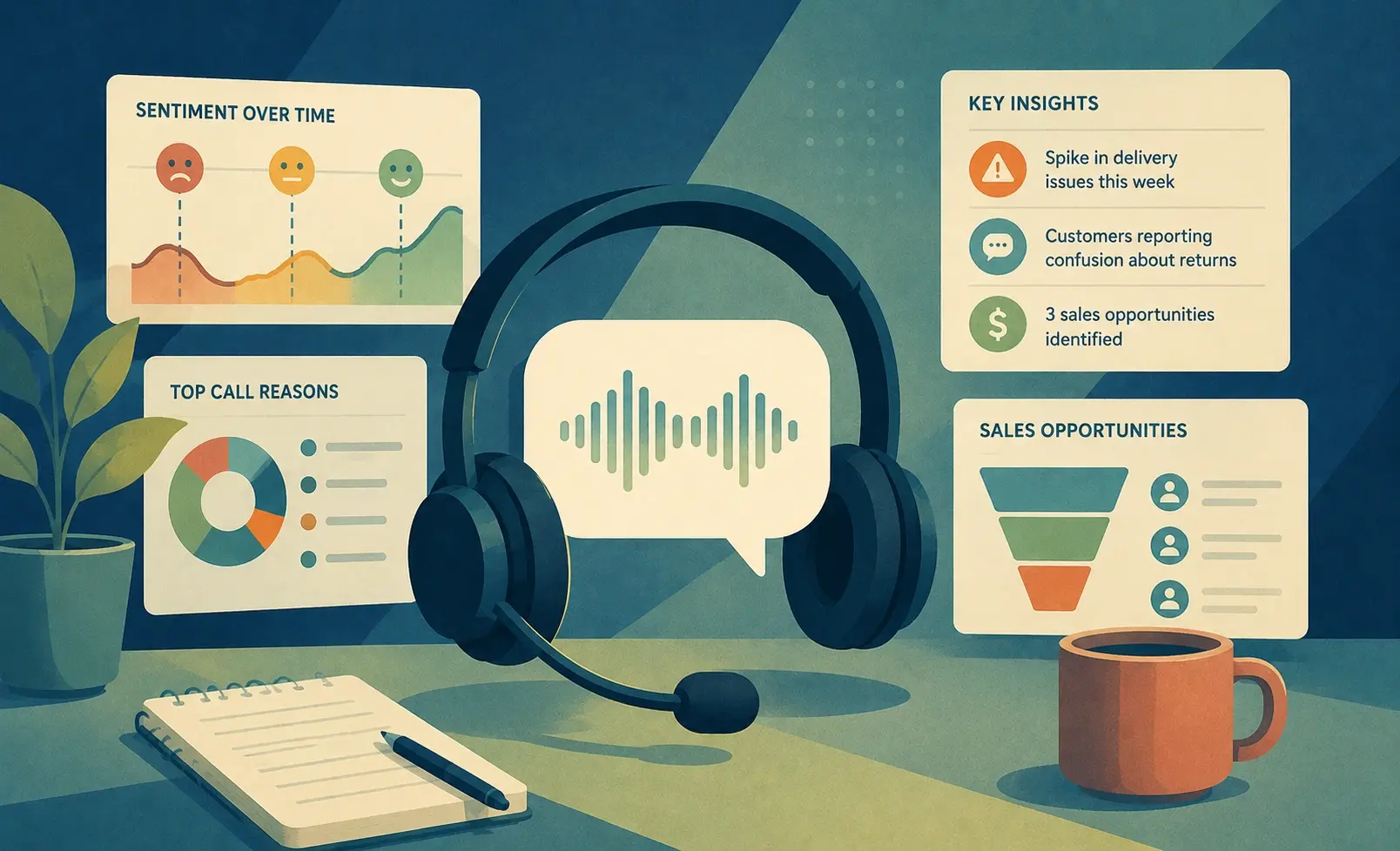
The best call quality assurance software for 2026 does more than record and score calls. It applies consistent criteria across 100% of interactions, surfaces agent-level patterns rather than call-level snapshots, and connects QA scores to coaching actions. This guide evaluates the leading platforms for call centers and sales teams that need customizable scorecards and scalable QA coverage.
What to Look for in Call QA Software
The evaluation criteria that separate functional QA tools from ones that actually improve performance:
Scorecard customization. Can you define your own criteria with weighted scoring, sub-criteria, and context for what good and poor look like? Generic out-of-the-box scorecards measure what the vendor thinks matters, not what your operation requires.
Coverage percentage. Manual QA typically covers 3-10% of calls. AI-powered QA can cover 100% of calls at consistent criteria. The difference in pattern detection is significant because rare but important behaviors only appear in large samples.
Evidence-backed scoring. Does every score link back to a specific quote or moment in the transcript? Scores without evidence cannot be used in coaching conversations.
Agent-level reporting. QA tools that only report call-level scores miss the point. You need per-agent scorecards that aggregate performance across multiple calls to identify development patterns.
What is the best call quality assurance software with customizable scorecards?
The platforms with the deepest scorecard customization are those built specifically for QA teams rather than general call recording tools with QA features added later. The key differentiator is whether you can define weighted criteria, set sub-criteria, and specify behavioral context for each score level.
Top Call Center QA Software for 2026
The platforms below represent the strongest options for customizable QA scoring at scale.
1. Insight7
Insight7's QA platform enables 100% automated call coverage with fully customizable weighted scorecards. Each criterion supports main criteria, sub-criteria, and a context column that defines what good and poor performance looks like, reducing reviewer inconsistency.
The platform automatically detects call type (sales, support, onboarding) and routes the appropriate scorecard, supporting 150+ scenario types. Evidence backing links every score to the exact transcript quote, so coaching conversations reference specific moments rather than generalized feedback.
TripleTen, an AI education company, processes over 6,000 learning coach calls per month through Insight7 for the cost of one US-based project manager, with the full Zoom integration going live within one week of setup.
2. EvaluAgent
EvaluAgent is a dedicated QA platform built for contact centers, with customizable scorecards, automated scoring workflows, and agent feedback tools. The platform supports both manual and AI-assisted scoring with calibration features to align reviewer judgment.
Strong reporting includes agent score trends, team comparisons, and scorecard category breakdowns. Integration with common telephony platforms and CRMs makes it a practical choice for established contact center stacks.
3. MaestroQA
MaestroQA focuses on quality management workflows for customer support and sales teams. Scorecards are fully customizable with weighted criteria, and the platform includes a calibration module for aligning reviewer scores before rolling out new criteria.
The coaching layer connects QA scores to training assignments, with manager-to-rep feedback workflows and session tracking. It integrates with Zendesk, Salesforce, and most major CRMs.
4. Scorebuddy
Scorebuddy offers customizable scorecard templates for call center QA, with support for multiple scorecard types across different interaction categories including calls, chats, and emails. The platform focuses on manual review workflows with reporting and trend analysis.
It is a practical option for teams that need structured QA workflows without AI-powered automation, and its pricing is accessible for mid-market contact centers.
5. Talkdesk Quality Management
Talkdesk's quality management module is part of its broader contact center platform. For teams already on Talkdesk, the integration advantage reduces the complexity of connecting QA data to operational metrics.
Scorecard customization is available but less flexible than dedicated QA platforms. The strength is native integration with the broader Talkdesk contact center suite.
Evaluation Table
| Criteria | Insight7 | EvaluAgent | MaestroQA |
|---|---|---|---|
| Custom weighted scorecards | Yes | Yes | Yes |
| Automated 100% coverage | Yes | Partial | Partial |
| Evidence-backed scores | Yes | Yes | Yes |
If/Then Decision Framework
If your team needs 100% automated call coverage with custom weighted criteria, then AI-powered platforms like Insight7 are required. Manual QA tools cannot achieve full coverage at consistent quality.
If you are already on Talkdesk and want QA without adding a vendor, then Talkdesk Quality Management avoids integration complexity, though scorecard customization is more limited.
If you need a dedicated QA workflow platform with strong calibration tools for teams with multiple reviewers, then EvaluAgent or MaestroQA are both strong choices.
If you want to connect QA scores directly to AI coaching scenario assignments, then Insight7 provides this routing natively, so gaps identified in QA automatically generate practice scenarios.
If you process high call volumes across multiple call types and need dynamic scorecard routing, then Insight7 automatically detects call type and applies the appropriate scorecard for each interaction.
What makes a QA scorecard customizable enough to be useful?
A truly customizable scorecard lets you define criteria specific to your operation, weight each criterion by business importance, set sub-criteria for nuanced scoring, and specify behavioral context for what distinguishes each score level. Scorecards that only let you add criteria names without defining what each score level means produce inconsistent results across reviewers.
According to ICMI's contact center research, the most common QA implementation failure is deploying scorecards without defined behavioral standards, leading to high inter-rater variability that undermines the data's usefulness for coaching decisions.
A Forrester analysis of contact center operations found that automated QA at high coverage rates produces coaching insights that manual sampling misses, particularly for low-frequency but high-impact behaviors.
FAQ
What is the best call quality assurance software with customizable scorecards in 2026?
For teams that need full automation with deep customization, Insight7 combines 100% call coverage, weighted criteria with behavioral context, evidence-backed scoring, and integrated AI coaching. For teams that want strong manual QA workflows with calibration features, EvaluAgent and MaestroQA are both well-regarded options. According to G2's quality assurance category, customizable scorecards and reporting depth are the highest-rated evaluation criteria for QA platform buyers.
What is the 80/20 rule in call center QA?
The 80/20 rule in call center QA suggests that a small subset of scoring criteria accounts for most of the performance variation that matters. In practice, this means identifying the criteria most predictive of your key outcomes (CSAT, resolution rate, close rate) and weighting those heavily in your scorecard, rather than building a long scorecard where every criterion has equal weight. QA platforms that support criterion weighting make it possible to apply this principle systematically.
Call QA software that enables customizable scorecards and full coverage gives you the data to coach on patterns rather than exceptions. Insight7 provides both, along with automated coaching assignment so QA findings convert directly into skill development.