


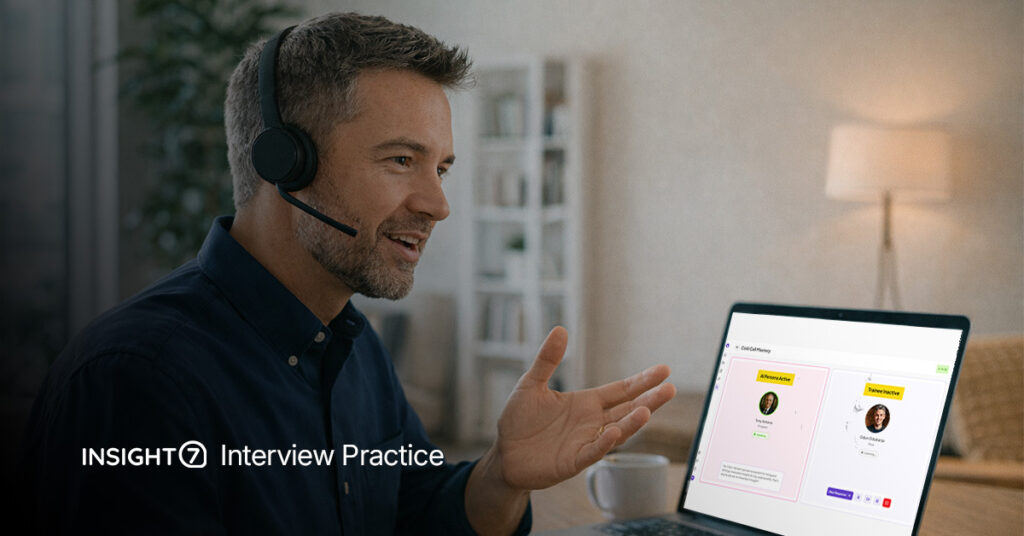
Target Leadership interviews evaluate whether your leadership judgment translates into decisions that reflect Fast Fun Friendly team culture and guest-first retail mindset. Candidates for Target, a major US discount retailer known for the Expect More, Pay Less brand promise, are expected to show specificity, structured thinking, and a measurable outcome on every story. Generalizations and team-level framing fail fast against Target's specificity bar.
Start your free Target Leadership practice session.
What interviewers actually evaluate
Strategy, People Leadership & Execution
Target Leadership interviews test whether your day-to-day leadership work reflects Fast Fun Friendly team culture and guest-first retail mindset: specific decisions, defended trade-offs, and outcomes that moved a business metric. What separates strong candidates is how they frame the problem, name the decision they personally made, and quantify what changed across owned brands like Good & Gather and Cat & Jack, store-as-fulfillment-hub strategy, Drive Up and Order Pickup, Target Circle loyalty, and Fast Fun Friendly service culture.
Strategic clarity, Trade-off defense, People decisions, Execution cadence, Enterprise impact, Culture leadership
What gets scored in every session
Specific, sentence-level feedback.
| Dimension | What it measures | How to answer |
|---|---|---|
| Strategic Clarity | Did you name the bet and the trade-off? "We pursued growth" without choice scores low. | Strategic choice, trade-off |
| People Leadership | Did you develop, move, or confront talent with specifics? Generic leadership scores low. | Specific people decisions |
| Execution Discipline | Did you drive results through cadence, accountability, and unblocking? Vague delivery scores low. | Operating cadence, accountability |
| Enterprise Impact | What did your leadership move at scale? Team wins without enterprise lift score low. | Enterprise metric, durable change |
How a session works
Step 1: Get your Target Leadership question
You are assigned questions based on where candidates for this role typically struggle most, which for Target Leadership means specificity and stories that end in a measurable outcome rather than activity. Each session starts fresh with a new question targeting a different evaluation dimension.
Step 2: Answer by voice
Speak your answer as you would in a real interview. The AI listens for STAR structure and evaluation signal alignment, specifically whether your decisions are named, your trade-offs are defended, and your Result includes a leadership outcome that was different because of your work.
Step 3: Get scored dimension by dimension
Instant scores across all four rubric dimensions. Each gets a score, a flagged weakness, and a specific sentence-level fix. Target Leadership interviewers probe for stories described by activity rather than decision, and for conclusions that summarize without a measurable business outcome.
Step 4: Re-answer and track improvement
Revise based on feedback and answer again. See the before/after score change across Strategic Clarity, People Leadership, Execution Discipline, Enterprise Impact. Your weakness profile updates across sessions so if you consistently end stories without a measurable outcome, that becomes the focus of your next question assignment.
Frequently Asked Questions
What are the 5 Target interview questions?
Target Leadership interviews are behaviorally structured. Common questions include:
- "Tell me about a leadership outcome you drove at Target's scale or equivalent"
- "Describe a situation where you had to make a tough leadership trade-off"
- "Walk me through how you handled a stakeholder who pushed back on your approach"
- "Tell me about a time your leadership judgment was tested and what you decided"
Each question tests depth, specificity, and alignment with Fast Fun Friendly team culture and guest-first retail mindset.
What are the 5 C's of interviewing for Target Leadership?
In Target Leadership interview contexts, the 5 C's map to Context (the business or customer situation), Complexity (the challenge or constraint you faced), Criteria (the key decisions and trade-offs you weighed), Choice (the position you took and defended), and Consequence (the outcome the business saw). For Target Leadership interviews, Criteria and Consequence are most often underdeveloped by candidates who describe activity without defending decisions or reporting measurable impact.
How much does an TL at Target make an hour?
For Target Leadership interviews, the strongest answers to this question are specific, structured, and tied to a measurable outcome. Interviewers are listening for evidence of Fast Fun Friendly team culture and guest-first retail mindset, a clear decision you personally made, and what changed in the business because of it. Generalizations and team-level framing score low.
What are the 5 hardest interview questions?
The hardest Target Leadership questions tend to probe failures, conflict, and judgment under ambiguity. Expect prompts like: a time your recommendation was wrong, a time you had to challenge a senior stakeholder, a decision you made with incomplete data, a situation where Fast Fun Friendly team culture and guest-first retail mindset was tested, and a case where you had to choose between two bad options. Weak candidates generalize. Strong candidates name the specific decision and defend it.
What are the most common failure modes in Target Leadership interviews?
The most consistent failures are:
- Ending a story with activity rather than a measurable leadership outcome
- Describing work at the team level without claiming individual ownership, which fails Target's specificity bar
- No story prepared for a time the candidate was wrong or the decision was challenged
- Answers that ignore Fast Fun Friendly team culture and guest-first retail mindset and focus only on generic best practice
- Vague stakeholder language ("we aligned") without naming the friction or how it was resolved
Also practice
All eight Target role interview practice pages.
- Sales
- Customer Service
- Product Management
- Marketing
- Finance
- Operations
- People & HR
- Legal & Compliance
One full session free. No account required. Real, specific feedback.








