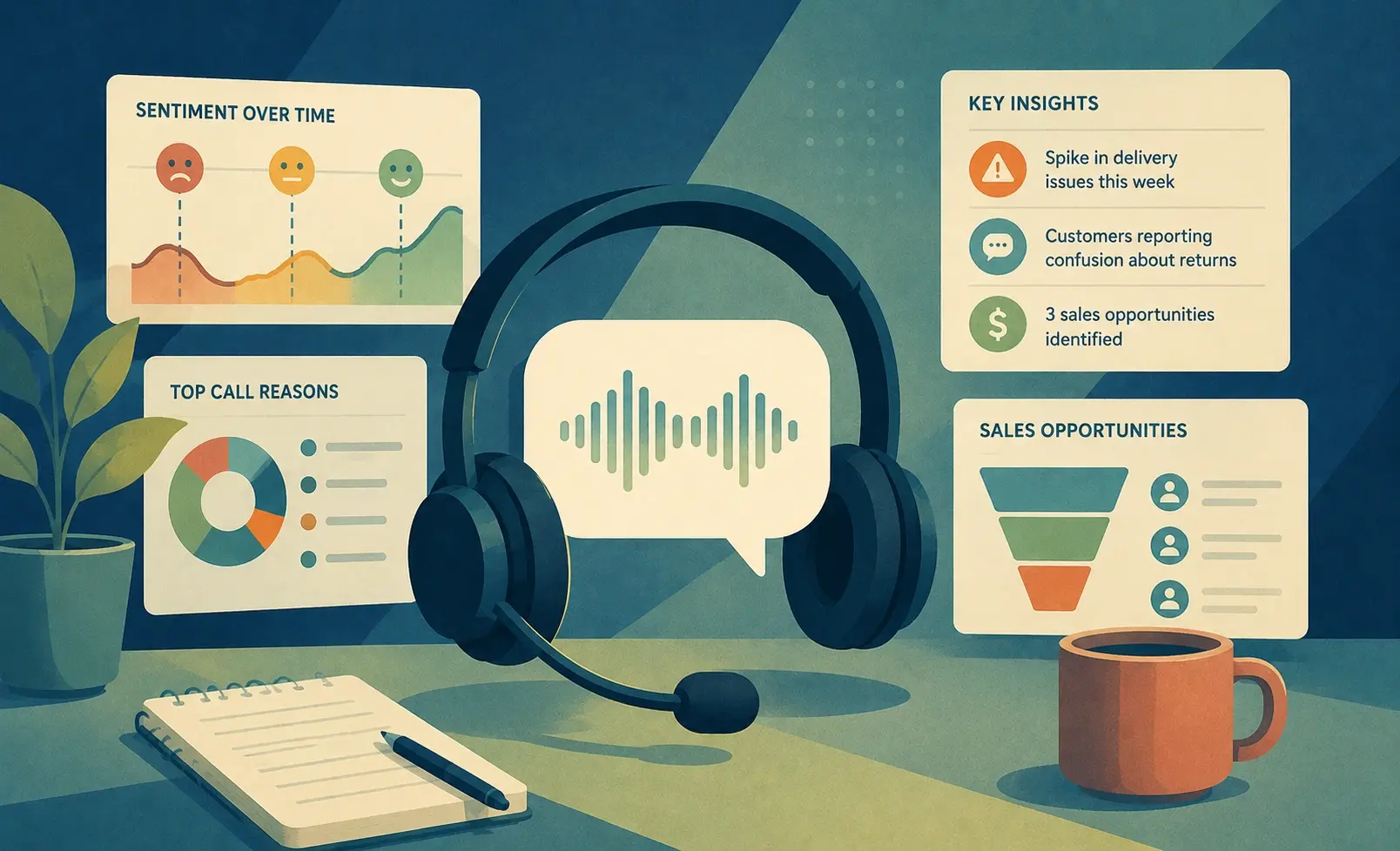
Contact center supervisors who rely on manager intuition to evaluate coaching call quality end up with inconsistent feedback, contested scores, and agents who do not know what to work on. Scoring coaching calls systematically for verbal effectiveness creates an objective baseline that connects practice performance to live call improvement.
This guide covers how to score coaching calls for verbal effectiveness, which criteria matter most for customer service agents, and how to use those scores to build a sustainable coaching cycle.
Why Scoring Verbal Effectiveness Matters for Customer Service Agents
Verbal effectiveness in customer service covers the behaviors that determine whether a customer feels heard and helped: empathy acknowledgment, clear explanation of next steps, confidence under pressure, and de-escalation language. These are scoreable. They are not inherently subjective, but they are treated as subjective when teams lack a defined rubric.
Insight7 evaluates verbal behaviors through both intent-based and script-based criteria, depending on what the team defines as "good." An empathy check can be evaluated on whether the agent said the exact phrase, or on whether the intent of the phrase was achieved in the conversation. This distinction matters because verbatim compliance scoring penalizes agents who use natural language that achieves the same result.
How to effectively coach call center agents?
Effective call center coaching follows a four-step loop: score calls using defined criteria, identify the one to two behaviors each agent needs to improve, assign targeted practice scenarios built from real failing calls, and re-score live calls after training to confirm the behavior changed. The most common error is coaching from aggregate scores rather than criterion-level breakdowns. An agent at 69% overall could be performing at 85% on compliance and 45% on empathy. A general coaching session does nothing for them. A targeted empathy scenario built from their specific failing calls does. Insight7 delivers criterion-level scoring tied to transcript evidence for every call.
What is the 70-30 rule in coaching?
The 70-30 coaching principle suggests that the person being coached should do 70% of the talking while the coach does 30%. In call center coaching, this translates to asking the agent to diagnose their own call before the coach provides feedback. "What do you think happened at the 3-minute mark?" produces more durable learning than "at the 3-minute mark, you should have acknowledged the customer's concern before moving to the resolution." Evidence-based scoring supports this approach: when a score is linked to a specific transcript quote, the agent can see exactly what the score is evaluating, making self-diagnosis accurate rather than defensive.
Steps for Scoring Coaching Calls for Verbal Effectiveness
Step 1: Define your verbal effectiveness criteria with behavioral anchors. Generic criteria produce generic scores. Define each criterion with a specific behavioral anchor: what does "good" empathy sound like in your context, what does "poor" empathy sound like. Empathy without anchors will be scored inconsistently across raters and across time. Anchors for empathy might include: good = agent names the customer's specific concern before offering a solution; poor = agent moves to resolution without acknowledging the stated concern. Insight7 stores these anchors in a "context" column per criterion. Calibration typically takes 4-6 weeks to align automated scoring with human judgment.
Step 2: Score 100% of coaching sessions, not a sample. Common mistake: treating coaching call scoring as optional or sampling-based. If you score 1 in 5 coaching sessions, you cannot detect whether a rep is improving or whether a particular scenario type is too easy. Full coverage gives you a reliable trend line. Insight7 processes roleplay sessions automatically after completion, generating a per-session scorecard that shows performance on each criterion and flags improvement or regression.
Step 3: Compare coaching session scores to live call scores on the same criteria. This is the validation step most teams skip. A rep can score 82% on an empathy criterion in a roleplay scenario and still score 58% on the same criterion in live calls. The gap between coaching performance and live performance tells you two things: (1) whether the scenario is realistic enough to transfer, and (2) whether the rep is applying the learned behavior under real pressure. Pull the same criteria from live call scoring and coaching session scoring for a side-by-side comparison. Insight7's per-agent scorecard shows both views in one dashboard.
Step 4: Set a passing threshold before each session, not after. A threshold defined after the fact is not a standard, it is a rationalization. Before assigning a coaching scenario, define: this rep must score 75 or above on empathy criteria in three consecutive sessions before we consider the behavior embedded. Reps who know the threshold can track their own progress. ATD research on deliberate practice shows that learners who know their target score before a practice session improve significantly faster than those who receive scores without context.
Step 5: Use failing verbal effectiveness calls as scenario source material. The most effective roleplay scenarios come from the calls where verbal effectiveness failed most clearly: the escalation call where the agent skipped empathy and went straight to policy recitation, the complaint call where tone became clipped under pressure. Insight7's AI coaching module converts real call transcripts into scenarios with configurable personas that replicate the emotional tone and communication style of the original interaction. Agents practice the specific situation they struggled with, not a generic difficult customer scenario. Decision point: if no specific failing calls exist, use top-performer calls as positive models rather than invented scenarios.
If/Then Decision Framework
If agent scores vary widely call to call → then the criteria need behavioral anchors before scoring is reliable.
If coaching session scores are high but live call scores are not improving → then the scenarios need to be made harder to match real call pressure.
If multiple agents fail on the same verbal effectiveness criterion → then the issue is systemic and needs a team training session before individual coaching.
If a rep plateaus after five coaching sessions with no improvement → then escalate to a live coaching conversation rather than continuing solo roleplay.
Verbal Effectiveness Scoring Criteria
| Criterion | What "Good" Looks Like | What "Poor" Looks Like |
|---|---|---|
| Empathy acknowledgment | Names the customer's concern before moving to resolution | Jumps to solution without acknowledging the stated issue |
| Tone under pressure | Maintains even pace and warmth on escalation calls | Becomes clipped or terse when challenged |
| Clarity of next steps | States what happens next, by when, with confirmation | Vague close with no next action committed |
FAQ
How can real-time management help optimize customer service levels?
Real-time management addresses in-call behavior; post-call analysis addresses patterns across calls. For verbal effectiveness coaching, post-call scoring is more useful because it gives managers a scored, evidenced dataset they can build training from, rather than live prompts an agent may not process during an active conversation. Insight7 handles post-call analysis and coaching assignment. Real-time agent assist tools handle live in-call guidance. Most teams benefit from both, with post-call scoring driving coaching design and real-time tools reinforcing the trained behaviors during live calls.
What are the 5 C's in coaching?
The 5 C's framework, as used in contact center coaching, covers: Clarity (clear criteria for what success looks like), Consistency (same standards applied across all agents and calls), Context (situational awareness of what the agent was facing on the call), Constructiveness (feedback focuses on behavior change, not personal criticism), and Continuity (coaching is tracked over time, not a one-off session). Evidence-based scoring tools like Insight7 support all five by providing criteria-linked transcript evidence that makes coaching conversations specific, consistent, and trackable.
Ready to score coaching calls for verbal effectiveness at scale? See how Insight7 connects roleplay scoring to live call performance.