


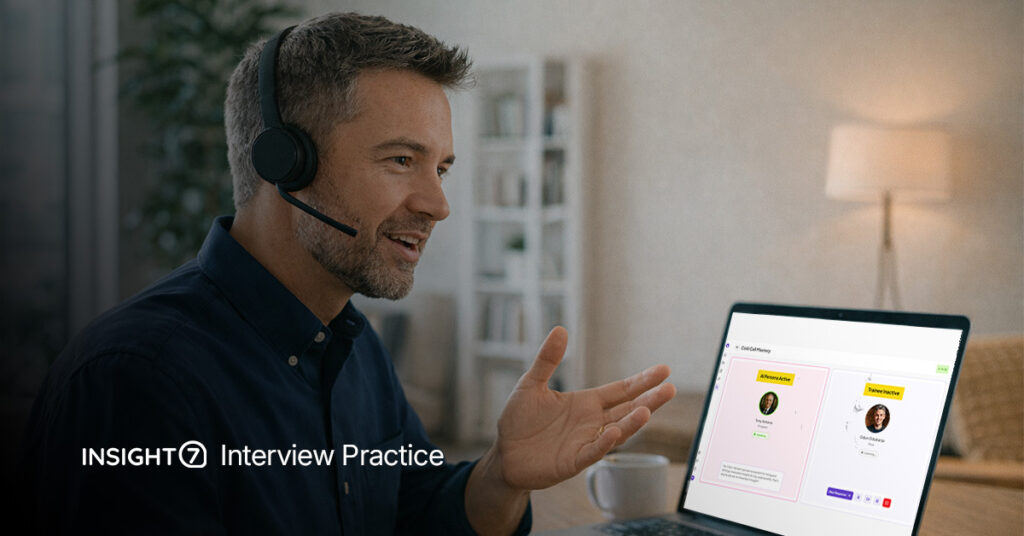
Amazon Sales interviews are structured around real-world selling scenarios, past quota performance, and the quality of your diagnostic questions, not product knowledge. Every round is anchored to Amazon's 16 Leadership Principles, with Customer Obsession, Deliver Results, Earn Trust, and Bias for Action pre-assigned to interviewers for Sales roles. The Bar Raiser is an independent interviewer with veto power who is not part of the hiring panel, evaluating the Leadership Principles most likely to be missed.
Start your free Amazon Sales practice session.
What interviewers actually evaluate
Discovery, Objection Handling & Closing
Amazon Sales interviews are built around behavioral evidence tied to Leadership Principles, not product pitches or general selling knowledge. Interviewers are assigned 2-3 LPs per round and probe until they find concrete evidence for each one. What separates strong candidates is the combination of rigorous STAR-format delivery and explicit LP signal: Customer Obsession in discovery, Deliver Results in outcomes, Earn Trust in objection handling, and Bias for Action when deals stall.
Customer Obsession, Deliver Results, Earn Trust, Bias for Action, Pipeline specificity, Bar Raiser readiness
What gets scored in every session
Specific, sentence-level feedback.
| Dimension | What it measures | How to answer |
|---|---|---|
| Discovery Depth | Do you start with customer pain or product pitch? We score how far into diagnosis you go before presenting a solution, and whether your questions ladder toward a Customer Obsession LP signal. | Question sequencing, pain-first framing, LP-linked diagnosis |
| Objection Handling | We detect acknowledgment, reframe, and evidence patterns, not just "I listened carefully." Earn Trust LP signals require you to demonstrate that you registered the concern before addressing it. | Acknowledge, reframe, evidence structure |
| Pipeline Metrics | Results without numbers fail at Amazon. We flag answers without quota %, deal size, conversion rate, or revenue attribution. Deliver Results LP demands specificity. | %, $, ratio, or growth delta in Result |
| Personal Attribution | What did you specifically do, not the team? Overusing "we" without establishing personal contribution first is the most common failure mode at Amazon. We flag it and surface where you need to claim ownership. | "I" ownership, "we" overuse, action specificity |
How a session works
Step 1: Get your Amazon Sales question
You are assigned questions based on where candidates for this role typically struggle most, which for Amazon Sales means discovery sequencing and results quantification. Each session starts fresh with a new question targeting a different evaluation dimension and Leadership Principle.
Step 2: Answer by voice
Speak your answer as you would in a real interview. The AI listens for STAR structure and LP signal alignment, specifically whether your Situation is concise (under 20% of the answer), your Action is specific and first-person, and your Result includes a metric.
Step 3: Get scored dimension by dimension
Instant scores across all four rubric dimensions. Each gets a score, a flagged weakness, and a specific sentence-level fix. Amazon interviewers are trained to probe for missing STAR components, and this is the same standard applied to your practice answers.
Step 4: Re-answer and track improvement
Revise based on feedback and answer again. See the before/after score change across Discovery Depth, Objection Handling, Pipeline Metrics, and Personal Attribution. Your LP weakness profile updates across sessions so if you consistently underdevelop Earn Trust signals, that becomes the focus of your next question assignment.
Frequently Asked Questions
What questions does Amazon ask for Sales interviews?
Amazon Sales interviews are behaviorally structured around Leadership Principles. Common questions include:
- "Tell me about a time you lost a deal and what you did differently afterward"
- "Describe a situation where you had to close without full authority"
- "Walk me through your highest-value deal from first call to close"
- "Tell me about a time you moved a deal forward without waiting for direction"
Each question is pre-mapped to 2-3 Leadership Principles, most commonly Customer Obsession, Deliver Results, and Earn Trust.
How hard is the Amazon Sales interview?
Amazon rates 3.1 out of 5 in interview difficulty on Glassdoor. The challenge is not the questions themselves but the precision required. Interviewers probe for missing STAR components, reject vague results, and flag overuse of "we." Candidates who prepare LP-mapped STAR stories with metrics in every Result pass at a significantly higher rate.
Does Amazon use a Bar Raiser in Sales interviews?
Yes. Every Amazon interview loop includes a Bar Raiser: an independent interviewer with veto power who is not part of the hiring team. Their LP assignments are kept secret from the panel, and they score independently in writing before the debrief call. You will not know which interviewer is the Bar Raiser, so every round needs to hold up.
What are the most common failure modes in Amazon Sales interviews?
The five most consistent failures are:
- No metric in the Result ("the launch went well" without a number)
- Overusing "we" without establishing personal contribution first
- Spending more than 20% of the answer on Situation setup
- Answering with what you would do instead of a specific past example
- Having no candid failure story prepared
Amazon interviewers expect a failure story and probe until they find it.
What if my quota results are strong but I cannot share exact numbers?
Amazon accepts percentage-based framing as readily as absolute figures: 140% of quota, reduced ramp time by 30%, improved conversion rate by 18 points. These score identically to dollar amounts. The key is that a number is present. "Strong results" without a metric fails the Deliver Results LP standard.
Also practice
All eight Amazon role interview practice pages.
- Customer Service
- Product Management
- Marketing
- Finance
- Operations
- People & HR
- Leadership
- Legal & Compliance
One full session free. No account required. Real, specific feedback.








