


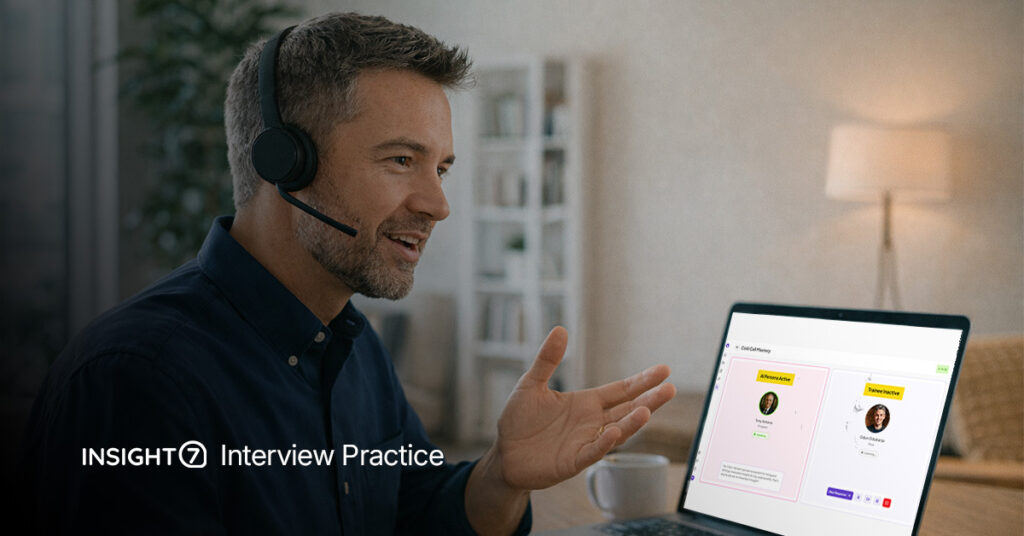
Johnson & Johnson People & HR interviews evaluate operating judgment alongside role craft, meaning interviewers assess whether you can perform the people & hr job inside Johnson & Johnson's specific context: Innovative Medicine and MedTech post-Kenvue, Our Credo with patients first, R&D investment, FDA and EMA regulatory rigor, and science-based culture. Candidates are expected to bring specific stories, name the decisions they owned, defend the tradeoffs, and connect each story to a measured business outcome.
Start your free Johnson & Johnson People & HR practice session.
What interviewers actually evaluate
Talent, Culture & Business-Linked HR Outcomes
Johnson & Johnson People & HR interviews test whether you can connect HR programs to business outcomes, navigate sensitive employee situations with judgment, and balance employee and company interests with integrity. What separates strong candidates is a clear business linkage, a named framework, a measured outcome, and an honest case where the call was hard, plus an answer style that fits Johnson & Johnson's operating culture.
Business linkage, Employee relations judgment, Program rigor, Stakeholder navigation, Measured outcome, Ethical clarity
What gets scored in every session
Specific, sentence-level feedback.
| Dimension | What it measures | How to answer |
|---|---|---|
| Business Linkage | Did the program tie to a business metric? We flag HR work described in HR-only terms. | Business metric, linkage logic |
| Judgment Under Pressure | How did you handle the hardest moment? We probe for the specific decision and tradeoff. | Specific decision, tradeoff named |
| Program Rigor | Was the program designed with measurement in mind? We score baseline and follow-through. | Baseline, follow-through plan |
| Outcome Measurement | What changed for employees and the business? We look for retention, engagement, or productivity. | Retention, engagement, productivity |
How a session works
Step 1: Get your Johnson & Johnson People & HR question
You are assigned questions based on where candidates for this role typically struggle most, which for Johnson & Johnson People & HR means stories that lack a named decision or a measured outcome. Each session starts fresh with a new question targeting a different evaluation dimension.
Step 2: Answer by voice
Speak your answer as you would in a real interview. The AI listens for STAR structure and rubric alignment, specifically whether your decision is explicit, your tradeoff is named, and your Result includes a business outcome tied to Johnson & Johnson's operating context.
Step 3: Get scored dimension by dimension
Instant scores across all four rubric dimensions. Each gets a score, a flagged weakness, and a specific sentence-level fix. Johnson & Johnson People & HR interviewers probe for stories described in activity language rather than decision language and for outcomes that summarize without a measured result.
Step 4: Re-answer and track improvement
Revise based on feedback and answer again. See the before and after score change across Business Linkage, Judgment Under Pressure, Program Rigor, and Outcome Measurement. Your weakness profile updates across sessions so the next question targets your weakest dimension.
Frequently Asked Questions
How to prepare for a Johnson and Johnson interview?
Prepare four to six STAR stories that map to Johnson & Johnson People & HR rubric dimensions. For each story, name the decision, the tradeoff you accepted, and the measured outcome. Rehearse against Johnson & Johnson's specific operating context: Innovative Medicine and MedTech post-Kenvue, Our Credo with patients first, R&D investment, FDA and EMA regulatory rigor, and science-based culture. Practice out loud against a scoring rubric, and prepare a postmortem story where the result was negative.
What questions are usually asked in an HR interview?
Johnson & Johnson People & HR interviews are behaviorally structured. Common questions include a time you delivered a measurable result, a time you made a hard tradeoff, a time you worked across functions, a time a stakeholder pushed back, and a time something went wrong and what you changed. Each question tests rigor, judgment, and ownership tied to Johnson & Johnson's operating context.
What are the 5 C's of interviewing?
In Johnson & Johnson People & HR interview contexts, the 5 C's map to Context (the situation), Complexity (what made it hard at Johnson & Johnson's scale), Criteria (what you used to decide), Choice (the decision you owned), and Consequence (the measured outcome). For Johnson & Johnson People & HR interviews, Criteria and Consequence are most often underdeveloped by candidates who describe activity without naming the decision logic or the business result.
What is the 30-60-90 question in an interview?
The 30-60-90 question asks what you would focus on in your first 30, 60, and 90 days. A strong Johnson & Johnson People & HR answer covers days 1-30 understanding the people & hr operating model and key stakeholders, days 31-60 identifying the highest-value gap and proposing a first move, and days 61-90 delivering an early result that earns the right to take on more. The evaluation is on listening discipline, prioritization, and a bias to action.
What are the most common failure modes in Johnson & Johnson People & HR interviews?
The most consistent failures are:
- Stories described at the team level without establishing personal ownership
- Outcomes framed as well-received without a measurable business result
- No prepared answer for a case where the work failed or had to be redone
- Generic answers that do not reflect Johnson & Johnson's specific operating context around Innovative Medicine and MedTech post-Kenvue
- Skipping the tradeoff and pretending every option was a clear win
Also practice
All nine Johnson & Johnson role interview practice pages.
- Sales
- Customer Service
- Product Management
- Marketing
- Finance
- Operations
- Leadership
- Legal & Compliance
One full session free. No account required. Real, specific feedback.








