


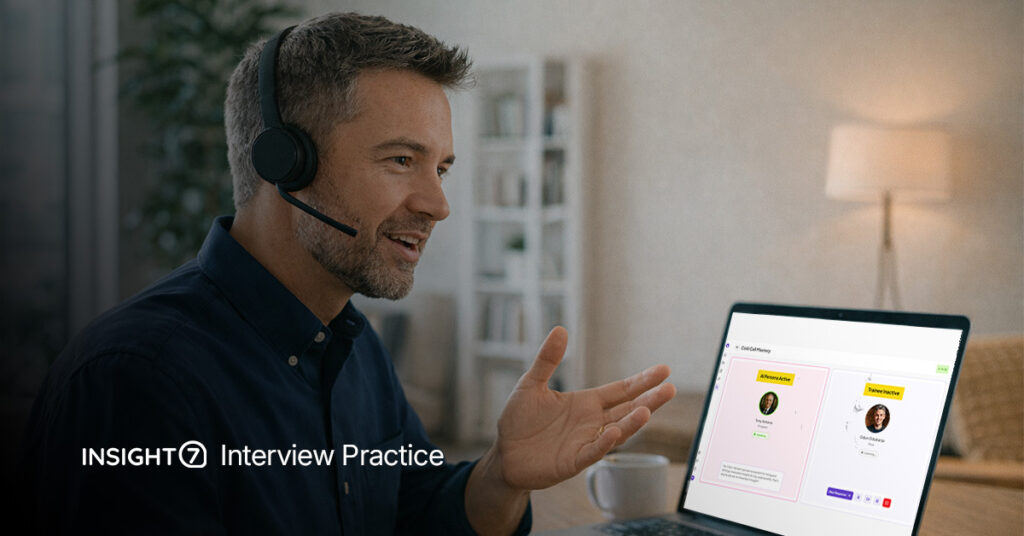
Alphabet Leadership interviews evaluate Googleyness alongside strategic thinking, cross-functional influence, and team development. Each interview round covers a specific competency, independent written feedback is submitted before any debrief, and a hiring committee makes the final decision. Candidates are expected to demonstrate vision clarity grounded in data, influence through intellectual credibility rather than authority, and team development evidence tied to measurable organizational outcomes.
Start your free Alphabet Leadership practice session.
What interviewers actually evaluate
Decision-Making, Team Development & Strategic Thinking
Alphabet Leadership interviews test whether your strategic thinking is analytically grounded and Googleyness-aligned, and whether your cross-functional influence operates through persuasion and intellectual credibility rather than hierarchy. The hiring committee's independent review means every leadership claim must stand on its own without context from a sponsoring interviewer. What separates strong candidates is explicit decision logic, influence described through specific behavior, team development evidence with measurable outcomes, and vision language concrete enough to drive execution.
Googleyness, Vision clarity, Influence without authority, Team development, Decision framework, Accountability signal
What gets scored in every session
Specific, sentence-level feedback.
| Dimension | What it measures | How to answer |
|---|---|---|
| Decision Framework | Do you articulate how you made the decision, not just what you decided? We score clarity of reasoning, criteria used, and how you handled conflicting inputs. | Explicit criteria, trade-off acknowledgment |
| Accountability Signal | Do you own outcomes, including failures? We flag answers that attribute success to the team without claiming personal strategic contribution. | Personal ownership of decision and outcome |
| Influence Architecture | How did you move people who did not report to you? We evaluate whether you relied on authority or persuasion and intellectual credibility. | Cross-functional alignment, non-authority-based influence |
| Vision Clarity | Can you articulate a future state clearly enough that someone else could execute it? We score whether strategic thinking is concrete or abstract. | Concrete vision language, measurable direction |
How a session works
Step 1: Get your Alphabet Leadership question
You are assigned questions based on where candidates for this role typically struggle most, which for Alphabet Leadership means Googleyness-aligned strategic framing and cross-functional influence through intellectual credibility rather than authority. Each session starts fresh with a new question targeting a different evaluation dimension.
Step 2: Answer by voice
Speak your answer as you would in a real interview. The AI listens for STAR structure and evaluation signal alignment, specifically whether your decision logic is explicit, your influence is described through specific actions, and your Result includes a team or business-level outcome.
Step 3: Get scored dimension by dimension
Instant scores across all four rubric dimensions. Each gets a score, a flagged weakness, and a specific sentence-level fix. Alphabet Leadership interviewers probe for execution-level stories dressed as strategic ones and for influence described by title or access rather than by specific persuasion behavior.
Step 4: Re-answer and track improvement
Revise based on feedback and answer again. See the before/after score change across Decision Framework, Accountability Signal, Influence Architecture, and Vision Clarity. Your weakness profile updates across sessions so if you consistently default to operational stories, that becomes the focus of your next question assignment.
Frequently Asked Questions
What are the 5 C's of interviewing for Alphabet Leadership?
In Alphabet Leadership interview contexts, the 5 C's map to: Context (the strategic situation), Complexity (what made the decision or influence difficult, especially in a hiring-committee-reviewed environment), Criteria (how you decided what to do and how to move people with data and intellectual credibility), Change (the specific strategic actions you took), and Consequence (the team or business outcome). For Alphabet Leadership interviews, Criteria and Consequence are most often underdeveloped.
What type of questions are asked in an Alphabet Leadership interview?
Alphabet Leadership interviews are behaviorally structured. Common questions include:
- "Tell me about a time you had to change the direction of an initiative against significant organizational momentum"
- "Describe a decision you made under major ambiguity and how you built alignment around it"
- "Walk me through a time you developed someone who went on to take on significantly greater responsibility"
- "Tell me about a time you influenced a decision at a senior level without relying on your title"
Each question tests whether your leadership is strategic, data-informed, and Googleyness-aligned.
What are the 5 hardest Alphabet Leadership interview questions?
The most challenging questions are:
- "Tell me about a strategic decision you made that was wrong and what the organization learned"
- "Describe a time you had to change a team's direction when the data supported multiple paths"
- "Walk me through how you influenced a VP-level decision without using your positional authority"
- "Tell me about a time you had to choose between moving fast and maintaining organizational quality"
- "Describe a leadership failure that you are still learning from and what you changed"
What is the 30-60-90 question in an Alphabet Leadership interview?
The 30-60-90 question asks what you would focus on in your first 30, 60, and 90 days. A strong Alphabet Leadership answer covers: days 1-30 focused on understanding the organizational context, key data about team performance, and critical cross-functional relationships; days 31-60 focused on identifying the highest-leverage strategic opportunity and beginning to build alignment with key stakeholders through data and intellectual credibility; days 61-90 focused on driving a first strategic decision with a clear measurement plan and demonstrating the leadership approach you will sustain. The evaluation is on Googleyness: bias toward data, intellectual humility about what you do not yet know, and collaborative alignment-building.
What are the most common failure modes in Alphabet Leadership interviews?
The most consistent failures are:
- Framing an operational execution story as a strategic leadership story without an initiative-level scope
- Influence stories that describe what you asked people to do rather than how you changed their perspective through data and reasoning
- Failure stories that end with the fix rather than what the failure taught the organization
- Vision language that is aspirational but unmeasurable: "I wanted to build a culture of innovation"
- No Googleyness signal: certainty without data, individual heroics without team collaboration, or arrogance about decisions rather than intellectual humility about trade-offs
Also practice
All eight Alphabet role interview practice pages.
- Sales
- Customer Service
- Product Management
- Marketing
- Finance
- Operations
- People & HR
- Legal & Compliance
One full session free. No account required. Real, specific feedback.








