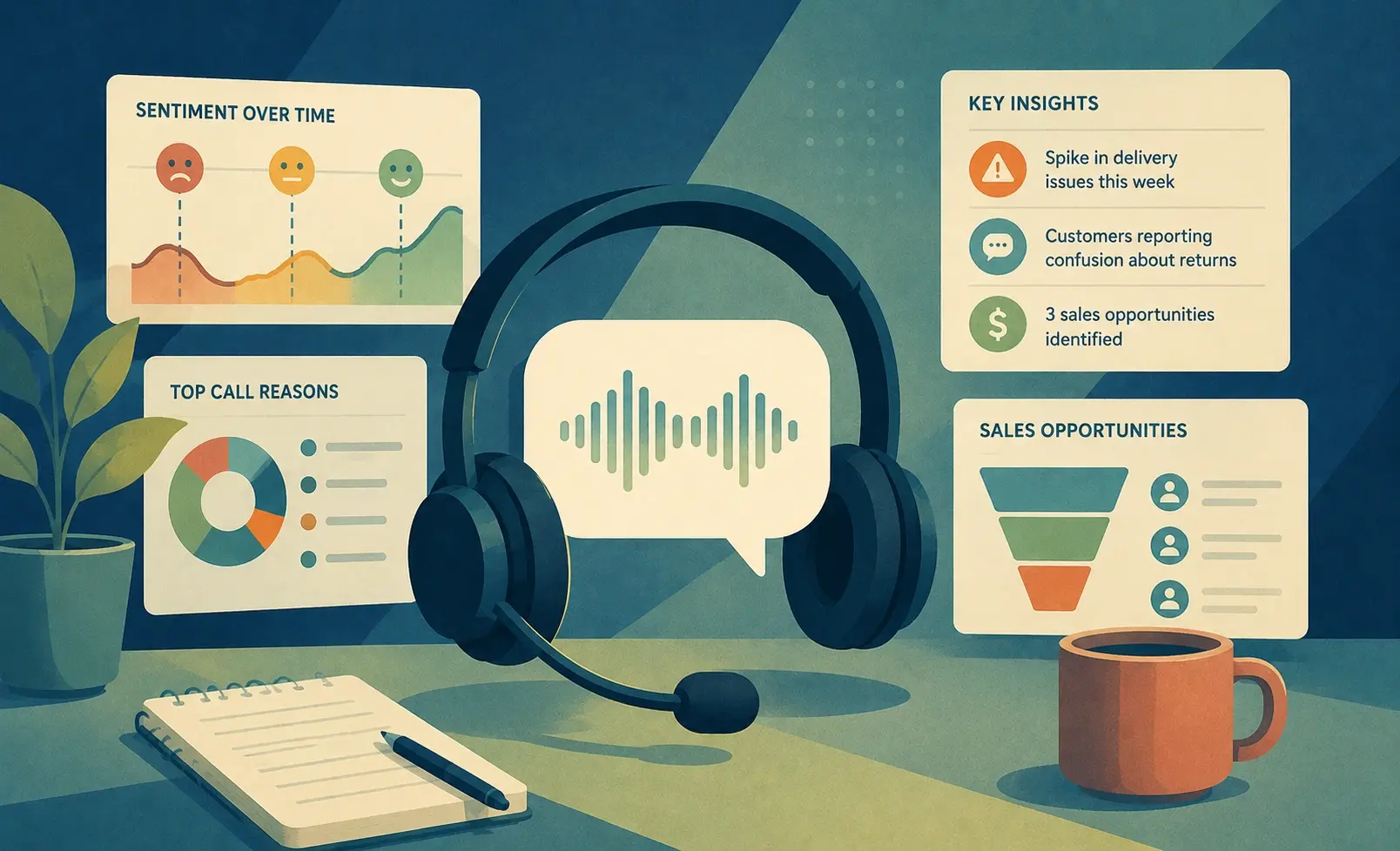
HR leaders and contact center managers looking for AI tools to analyze employee feedback face a fragmented market: most platforms are built for survey data collected on a quarterly cycle, while the most actionable employee feedback in contact centers and sales environments exists in daily call recordings that never get analyzed at scale. The six platforms below serve different feedback sources and organizational contexts, and the right choice depends primarily on where your employee feedback actually lives.
Methodology
This comparison evaluated six AI tools on their ability to analyze employee feedback for coaching purposes across HR and contact center environments. Criteria included feedback source flexibility, coaching integration, analysis depth, scalability, and deployment complexity. Platforms were assessed using publicly available documentation, G2 category reviews, and Insight7's analysis of employee feedback programs in high-volume call environments. According to ICMI research on contact center quality programs, manual QA processes cover only 3 to 10% of calls, leaving most employee performance data unanalyzed. Insight7 ranked highest for contact center and inside sales environments where call recordings are the primary source of employee performance feedback.
What is the difference between survey-based and call-based employee feedback analysis?
Survey-based feedback is self-reported and periodic. Employees answer structured questions about their experience on a monthly or quarterly basis. The data is useful for organizational health tracking but is limited by response bias, low completion rates, and the gap between the survey cycle and the moment when feedback would have been most useful.
Call-based feedback analysis extracts performance signals from actual customer interactions continuously. In contact centers, this means every call becomes a data point. Managers receive feedback about rep behavior based on what actually happened in conversations, not what reps report about themselves. The two data sources answer different questions: surveys tell you how employees feel; call analysis tells you what employees do.
| Platform | Primary feedback source | Best environment | Coaching integration |
|---|---|---|---|
| Insight7 | Call recordings and transcripts | Contact center, inside sales | QA-to-coaching loop |
| Culture Amp | Employee surveys and reviews | HR-led engagement programs | Manager development modules |
| Qualtrics XM | Multi-source survey and listening | Enterprise HR and CX combined | Program management |
| 15Five | Structured check-ins and OKRs | People managers and team leads | Weekly feedback cadence |
| Leapsome | Performance reviews and surveys | Mid-market HR teams | Learning path integration |
| Lattice | HR performance management | People operations teams | Review cycle automation |
Insight7
Insight7 analyzes employee feedback where it is most abundant and least reviewed in contact centers: recorded calls. Every call scored by the platform becomes a structured feedback data point about that employee's performance. Managers see where each rep is performing well or falling short against defined criteria, with evidence linked to the exact call moment rather than a generalized rating.
The platform processes 100% of recorded call volume automatically. Manual QA processes in contact centers typically cover only 3 to 10% of calls, which means most employee performance data is never analyzed. Insight7 closes that gap with automated scoring across every call, per-rep scorecards, and trend tracking over time.
Contact centers piloting Insight7 against existing calibration sets have confirmed that AI scores align with human QA judgment on compliance criteria and surfaced specific coaching priorities that manual review had not caught (Insight7 customer data, 2025).
Best suited for: HR leaders and QA managers in contact centers or inside sales environments where the primary employee feedback source is call recordings and coaching decisions need to be grounded in evidence from actual customer interactions.
Insight7 pricing starts at approximately $699 per month on a minutes-based model for call analytics. AI coaching add-on pricing starts at approximately $9 to $39 per user per month.
Avoid this common mistake: running employee feedback programs in contact centers that rely exclusively on survey data while ignoring the call recording library. Survey data tells you agents are dissatisfied with their coaching; call data tells you what specific behaviors need to change and provides the evidence for each coaching conversation.
Culture Amp
Culture Amp is an employee experience platform designed for HR teams running engagement surveys, performance reviews, and manager effectiveness programs. Its AI capabilities include sentiment analysis across survey responses, thematic clustering of open-text feedback, and trend tracking across survey cycles.
Culture Amp's feedback analysis is grounded in structured survey instruments. The platform is well-suited for organizations where employee feedback is collected through formal survey programs and HR wants to analyze themes across large employee populations. Its coaching integration is focused on manager development: using aggregate team feedback to help managers understand how their reports perceive them and identify development areas.
Best suited for: HR leaders at mid-to-large organizations running structured engagement survey programs who need AI analysis of survey sentiment and themes across large employee populations.
Culture Amp pricing is per-employee and requires a custom quote for most plans.
Qualtrics XM
Qualtrics XM for Employee Experience covers the full employee listening spectrum: pulse surveys, onboarding feedback, exit interviews, and 360-degree reviews. The platform's iQ analysis layer uses AI to detect sentiment, surface emerging themes, and predict attrition risk from survey data patterns.
Qualtrics is enterprise-grade and built for large organizations running multiple simultaneous listening programs. Its integration with Qualtrics CX means organizations that use Qualtrics for both employee and customer feedback can analyze them in the same environment. The platform requires significant configuration and is most effective when HR has dedicated resources to manage listening programs.
What is the best way to structure employee feedback analysis for coaching purposes?
The most effective coaching feedback programs connect performance observation data to development action. That means moving beyond satisfaction ratings to behavioral evidence: not "your score was 3.2 out of 5" but "on 12 of your last 30 calls, you did not confirm next steps before closing." Behavioral evidence makes feedback actionable because it gives the employee something specific to change rather than a score to react to.
Best suited for: enterprise HR and people operations teams managing large-scale employee listening programs across multiple feedback channels, particularly in organizations already using Qualtrics for CX.
Qualtrics pricing is enterprise-scale and requires a custom quote.
15Five
15Five builds employee feedback programs around weekly structured check-ins, OKR tracking, and manager one-on-one preparation. The platform uses AI to analyze patterns in check-in responses, surface engagement risk signals, and generate coaching prompts for managers before their scheduled one-on-one sessions.
15Five is designed for people managers who want a structured weekly feedback cadence with small teams of eight to 15 reports. It is less suited for contact center environments where supervisors oversee 20 to 40 high-volume agents.
Best suited for: people managers at companies with weekly one-on-one cultures who need structured feedback prompts and OKR alignment, primarily in knowledge work or professional services environments.
15Five pricing starts at approximately $4 per user per month for the Engage plan, with more comprehensive plans at higher tiers.
Leapsome
Leapsome combines performance reviews, engagement surveys, and learning paths in a single platform. Its AI layer analyzes review and survey text to surface themes, flag outliers, and suggest development focus areas. The platform integrates coaching focus areas with structured learning paths, so feedback about a skill gap can trigger an assigned learning module.
Leapsome's coaching integration connects performance review feedback to structured learning programs. The platform handles the full performance cycle from goal setting through review to development planning in one workflow.
Best suited for: mid-market HR and people operations teams that want performance review, feedback, and learning program management in a single platform with AI-assisted theme analysis.
Leapsome pricing starts at approximately $8 per user per month for core modules.
Lattice
Lattice is a comprehensive people management platform covering performance reviews, goal tracking, engagement surveys, compensation management, and career development planning. Its AI analysis capabilities focus on review cycle efficiency: summarizing manager and peer feedback, detecting sentiment patterns, and flagging inconsistencies in rating distributions.
Lattice is built for people operations teams managing the full employee lifecycle. Its strength is the breadth of people management workflows it supports rather than depth of any single analysis capability.
Best suited for: people operations leaders at companies with formal HR programs covering the full employee lifecycle, from goal setting through compensation and career development.
Lattice pricing starts at approximately $11 per user per month for core HR features, with analytics modules at higher tiers.
If/Then Framework
If your employee feedback lives in call recordings and you need QA-driven coaching evidence at scale, then use Insight7.
If your HR team runs structured engagement survey programs and needs AI sentiment analysis across large employee populations, then use Culture Amp.
If your organization runs multiple employee listening channels and needs enterprise-grade survey analysis integrated with CX data, then use Qualtrics XM.
If your managers need a structured weekly feedback and OKR check-in workflow with small team sizes, then use 15Five.
If your mid-market HR team wants performance reviews, feedback, and learning paths in one platform, then use Leapsome.
If your people operations team manages the full HR lifecycle and needs comprehensive process automation with AI-assisted review analysis, then use Lattice.
FAQ
Can AI tools analyze unstructured employee feedback from open-text fields?
Yes, most modern platforms use natural language processing to cluster themes and detect sentiment in open-text responses. The quality of that analysis varies by platform: some produce only sentiment labels (positive, neutral, negative), while others extract specific themes and surface representative quotes. For HR programs where qualitative feedback is as important as ratings, evaluate platforms on the specificity of their theme extraction rather than just sentiment classification.
How do contact center managers use AI feedback analysis differently from HR managers?
Contact center managers need feedback that is evidence-linked and behaviorally specific because coaching sessions happen weekly or more frequently. An HR manager reviewing annual engagement survey themes can work at the program level. A contact center supervisor coaching an agent on Thursday needs a specific call where the behavior occurred, a score, and a suggested practice focus. The feedback cadence and evidence requirements are fundamentally different, which is why contact center environments benefit most from call-based analysis rather than survey-based analysis. According to Gartner research on contact center coaching technology, managers who coach from behavioral evidence rather than aggregate scores see faster performance improvement.
What employee feedback data sources produce the most actionable coaching insights?
The most actionable feedback data is the closest to actual behavior. Call recordings outperform surveys for behavioral coaching because they capture what the employee did rather than how they or their peers report on performance. Peer reviews outperform self-assessments for 360-degree feedback. Structured one-on-one check-in data outperforms annual review data for identifying development needs while there is still time to act on them. Layer these sources by immediacy to build a complete coaching picture.