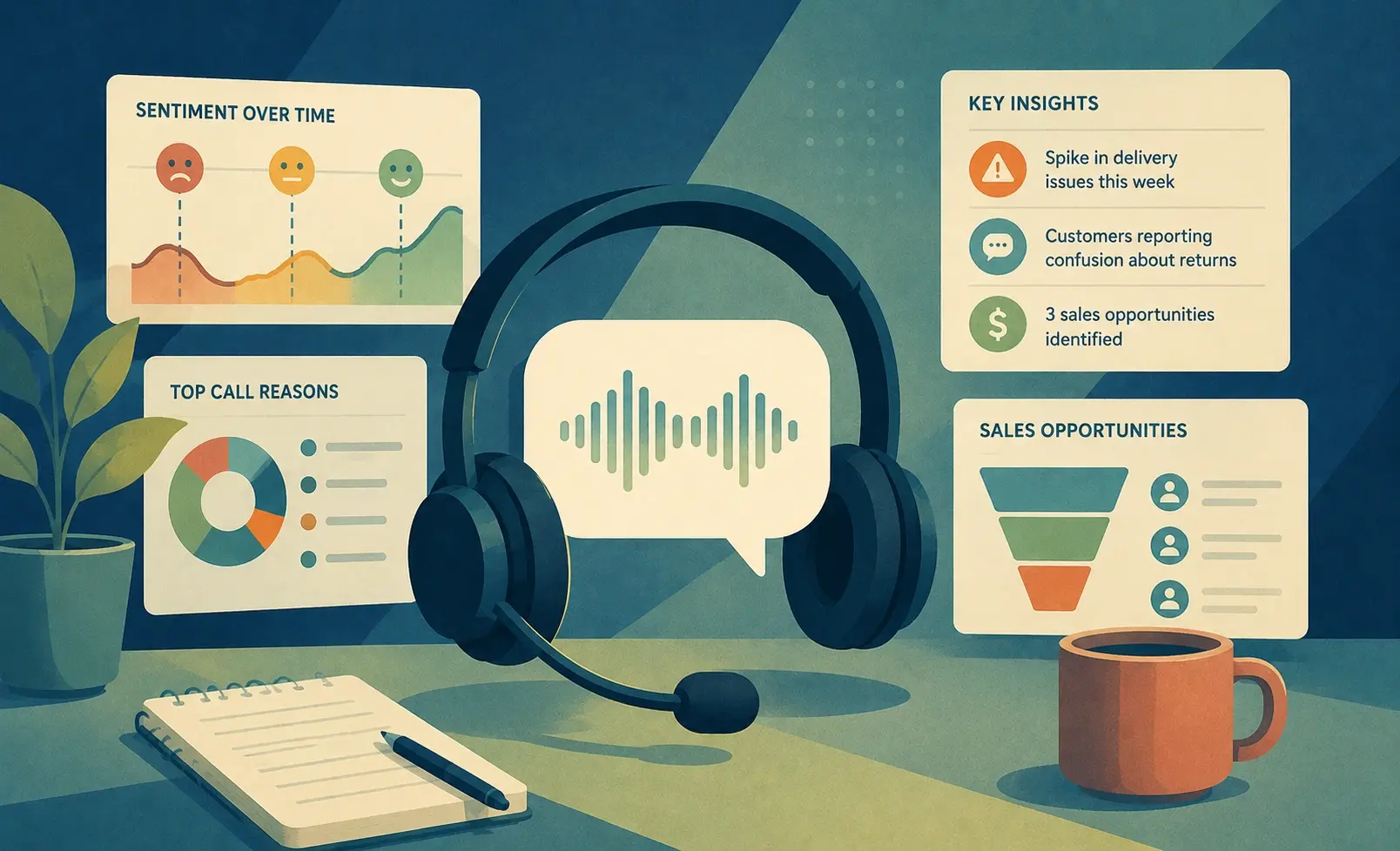
Deploying AI coaching tools across both sales and support teams sounds straightforward until you discover that most platforms are built for one or the other. Sales-focused tools optimize for conversion coaching and pipeline behavior. Support tools focus on resolution time and compliance. Teams trying to run a single coaching platform across both functions usually end up with one team using a workaround. This guide covers AI coaching platforms that genuinely serve both functions, and how B2B sales tools support coaching and skill development across customer-facing teams.
What is B2B coaching?
B2B coaching for sales and support teams is a systematic process of identifying specific behavioral gaps from recorded customer interactions, providing targeted feedback tied to those gaps, and measuring whether behavior changes over subsequent interactions. The distinguishing feature of effective B2B coaching, versus general professional development, is that it is grounded in what actually happens in customer conversations rather than classroom simulations or abstract competency frameworks. Insight7 automates the evidence-gathering step by scoring 100% of recorded calls and generating coaching scenarios from the behavioral gaps identified.
Which skills are important for B2B sales roles?
The core skills that B2B sales coaching targets are objection handling, discovery questioning, next-step commitment, and competitive positioning. For support teams operating in the same organization, the parallel skill set includes empathy in difficult conversations, resolution ownership, and compliance with service commitments. The challenge for shared coaching platforms is that these skill sets require different evaluation criteria while sharing the same underlying infrastructure: call recording, transcription, scoring, and practice scenario generation.
AI Coaching Platforms That Work Across Sales and Support
Platforms were evaluated on four criteria: shared infrastructure (one admin console for both teams), scenario configurability (can you build both objection-handling and empathy coaching in the same tool), automated QA depth across different call types, and evidence of use across both sales and support contexts.
1. Insight7
Insight7 is the strongest option for teams that need automated QA and AI coaching across both sales and support without deploying two separate platforms.
The platform supports 150+ scenario types across dynamic call types: it auto-detects whether a call is a sales conversation, a support interaction, or an onboarding session and routes the appropriate evaluation criteria. Weighted criteria are fully configurable per call type, so sales calls score on discovery question quality and next-step commitment while support calls score on empathy acknowledgment and resolution ownership.
Coaching scenarios are generated from real call transcripts for both functions. A support agent who consistently mishandles escalation moments gets a scenario built from actual escalation calls. A sales rep who collapses under price pressure gets a scenario from calls where that objection appeared. Both run in the same platform with the same admin workflow.
Fresh Prints used Insight7 across QA and coaching functions: "When I give them a thing to work on, they can actually practice it right away rather than wait for the next week's call."
Best for: Organizations with combined sales and support teams, or those running both functions and wanting a single QA and coaching infrastructure.
2. Mindtickle
Mindtickle combines sales readiness with call recording and coaching. It scores calls and assigns training based on performance data. The primary use case is B2B sales enablement, with limited native support for contact center QA workflows.
Best for: Pure B2B sales coaching where support QA is handled separately.
Limitation: Support and compliance QA use cases are not the primary design target; configuring for both functions requires workarounds.
3. Seismic Learning
Seismic Learning (formerly Lessonly) provides an LMS with coaching delivery. It supports both sales and service team content and has documented use across both functions. It does not include native call analytics, so automated QA scoring requires a separate platform.
Best for: Teams with existing QA platforms that need structured learning delivery across sales and support functions.
4. Scorebuddy
Scorebuddy is a quality management platform designed for contact centers with support for both sales and service QA. It provides scorecard creation, calibration, and reporting but does not include AI roleplay coaching. Teams using Scorebuddy typically pair it with a separate coaching platform.
Best for: Support-forward contact centers that need structured QA with separate coaching delivery.
If/Then Decision Framework
| If your cross-team coaching situation is… | Then use this approach |
|---|---|
| Sales and support teams share agents or management | Deploy a single platform with configurable criteria per call type (Insight7) |
| Sales coaching only, no support QA needed | Mindtickle or a sales-specific platform |
| Strong LMS already in place, need QA integration | Seismic Learning plus an analytics platform |
| Support QA only, coaching is separate | Scorebuddy plus a roleplay tool |
How B2B Sales Tools Support Skill Development
The skill development pathway in B2B sales coaching follows a consistent pattern when the toolchain works correctly:
Call data identifies the behavioral gap at the individual level. Automated scoring across 100% of calls surfaces which reps miss which behaviors, which is more actionable than aggregate team scores that hide rep-level variation.
Coaching scenarios are built from that gap specifically. A scenario built from a real objection that appeared 30 times in last quarter's calls is more recognizable to reps than a generic "handling price objections" module.
Practice scores are tracked over time. Insight7 tracks rep improvement trajectories across unlimited retakes, showing whether coached behaviors improve in actual call scores in subsequent weeks.
According to Gartner research on sales enablement technology, organizations that tightly integrate coaching tools with performance data see significantly higher win rate improvement than those with disconnected training and analytics systems.
FAQ
What is the 3-3-3 rule in sales?
The 3-3-3 rule in sales coaching is a structure for call review: spend 3 minutes reviewing the call, identify 3 specific behaviors, and provide 3 minutes of coaching on the most important one. It is a simplification framework for managers who need to scale coaching across large teams without spending an hour per agent per week. The limitation is that it relies on a manager reviewing a call sample. Automated scoring across 100% of calls replaces the 3-minute review with a comprehensive scorecard, leaving the 3-minute coaching interaction as the human-value-add component rather than the bottleneck.
How do B2B sales tools support coaching and skill development specifically?
B2B sales tools support coaching by connecting call data to development actions. The strongest tools, including Insight7, do this in a closed loop: automated scoring identifies gaps, the platform suggests targeted practice, managers approve and assign, and scores on coached behaviors are tracked over subsequent calls. This replaces the common pattern where call data lives in analytics dashboards while coaching happens in a separate LMS with no connection between the two.
AI coaching tools that work across sales and support functions save significant infrastructure overhead and produce more consistent coaching quality when both teams operate under the same evaluation standards. Insight7 supports that cross-functional deployment natively, with configurable criteria per call type and a single coaching interface for both functions.