
Most conversation intelligence rollouts fail before the software gets a fair chance, because the platform was built for a different kind of conversation.
A tool designed for 40-minute discovery calls gets pointed at four-minute support calls, produces nothing useful, and the team concludes the category does not work.
The category has quietly split. Some platforms are built for revenue teams running long B2B sales conversations, others for contact centers handling thousands of short customer calls, and a third group leads with coaching rather than analytics.
Most buying mistakes in this space are type-related rather than vendor-related. This guide compares the seven best conversation intelligence software platforms for 2026 and, more importantly, which kind of team each one is actually built for.
Run a week of your own calls through Insight7 and see which patterns surface first.
These are the seven best conversation intelligence software platforms for 2026:
Conversation intelligence software analyzes customer conversations and turns them into structured, actionable insights.
It captures calls and meetings to automatically transcribe conversations, then applies natural language processing to identify topics, questions, customer sentiment, competitor mentions, and key moments that determine outcomes.
The output is conversation data a team can compare and act on rather than a folder of recordings. Rep performance, recurring objections, and deal risks become visible in aggregate instead of depending on which calls a manager had time to hear.
Before comparing vendors, decide which branch of the category you are actually shopping in, because the platforms below are not interchangeable.
Revenue-side platforms are tuned for long, scheduled sales conversations. They connect what was said to deal stage, pipeline, and forecast, and their conversation insights are built for sales leaders and revenue operations rather than service managers.
Contact center platforms are tuned for volume. They analyze calls by the thousand, score them against QA and compliance criteria, and support agents in real time, which is a different engineering problem from dissecting a discovery call.
Coaching-led platforms sit between the two, organized around developing reps rather than reporting on them. Platforms like Insight7 are built to cover all three aspects in one system, which is worth knowing before assuming you have to pick a branch and lose the rest.
Starting with the wrong branch is still how most teams end up concluding the category failed them.
The table gives the short version.
Platform | Best For | Key Strengths |
Insight7 | Scoring connected to coaching, roleplay, and live assistance | Automated call scoring, AI coaching, AI roleplay, Live Assist, knowledge base, revenue intelligence |
Gong | Enterprise revenue teams wanting conversation, deal, and pipeline intelligence together | Deal insights, revenue analytics, coaching, forecasting signals |
Chorus by ZoomInfo | Teams already using the ZoomInfo ecosystem | Call analysis, coaching libraries, CRM sync, ZoomInfo data enrichment |
Clari Copilot | Real time battlecards and revenue orchestration | Live cue cards, automated CRM capture, deal signals, forecasting connection |
Avoma | Mid-market meeting intelligence, scorecards, and live answers | Meeting assistant, AI scorecards, talk-pattern analytics, live answer cards |
Jiminny | Coaching-led mid-market sales teams | Call capture, AI summaries, call scoring, data-driven coaching |
Observe.AI | Enterprise contact centers needing Auto QA and real time agent guidance | Auto QA, interaction analytics, agent coaching, voice AI agents |
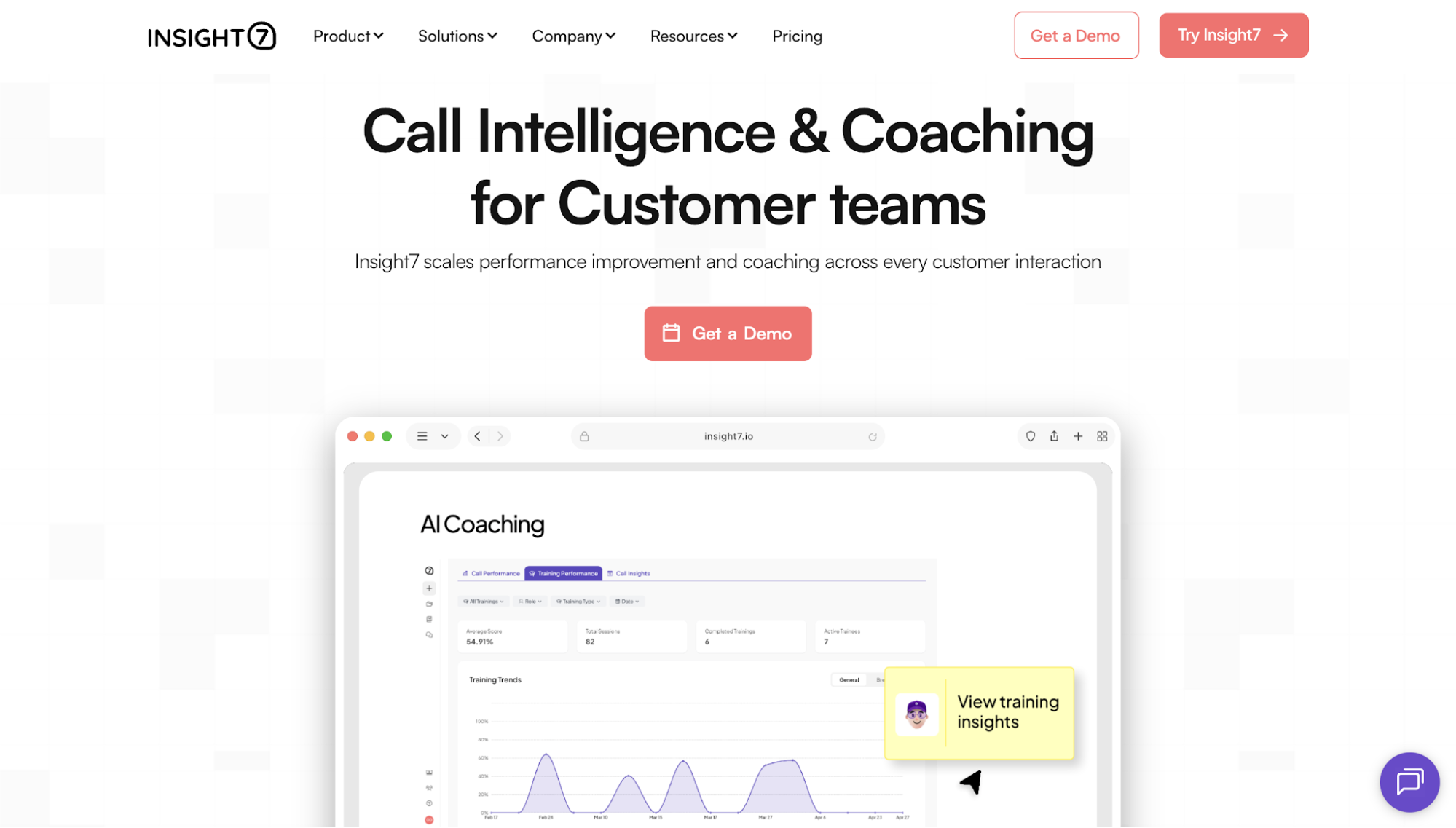
Insight7 is an AI call intelligence and coaching platform that analyzes customer conversations and turns what it finds into measurable performance improvement.
It covers the whole arc of a conversation rather than one stage. Reps practice through AI roleplay before the call, get live assistance during it, and receive scoring and coaching after it, with voice of the customer and revenue insights drawn from the same conversation data.
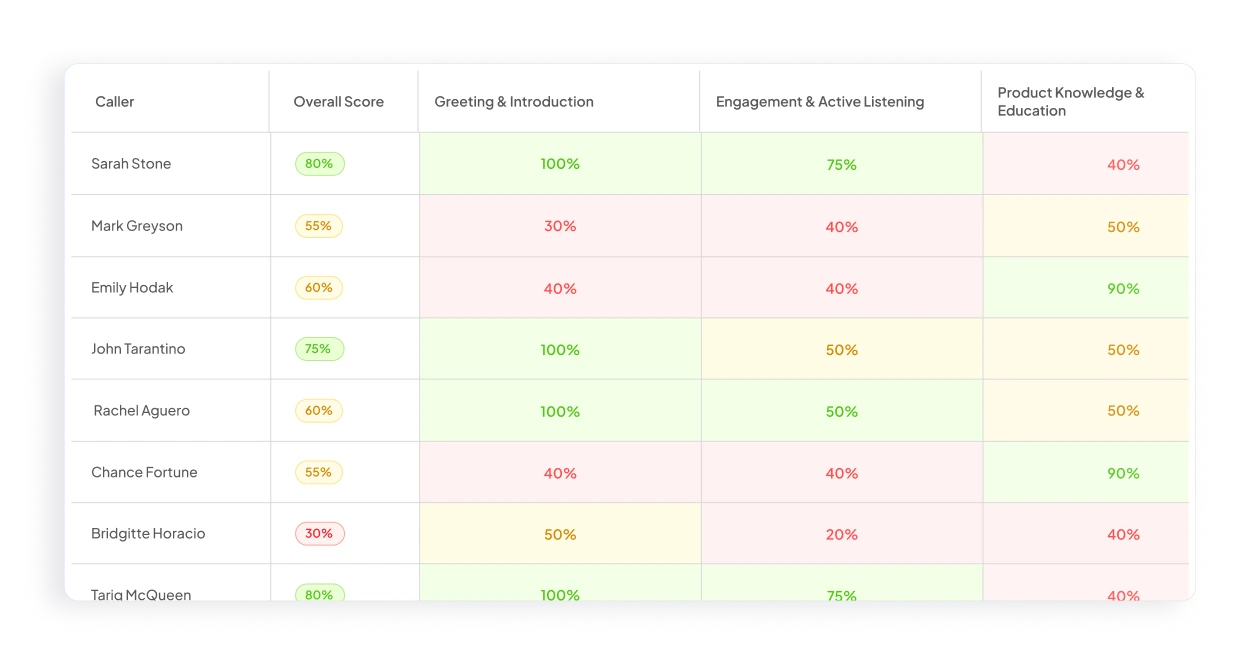
The differentiator is the combination. AI roleplay before calls, live assist during them, scoring and coaching after them, and VoC and revenue insights from the same conversations, all in one system.
That removes the gap where findings usually die. The platform that spots a rep struggling with pricing objections is the same one that assigns the practice scenario and tracks whether the next calls improve, so insight becomes behavior change without an export step.
It is built for mid-market companies with high conversation volume, and it handles customer data to enterprise standards: SOC 2 Type II-certified, HIPAA- and GDPR-compliant, PII and PHI redaction, and no model training on your data.
That combination is why more than 1,000+ high-growth businesses use it, and why it holds a 4.7 rating on G2.
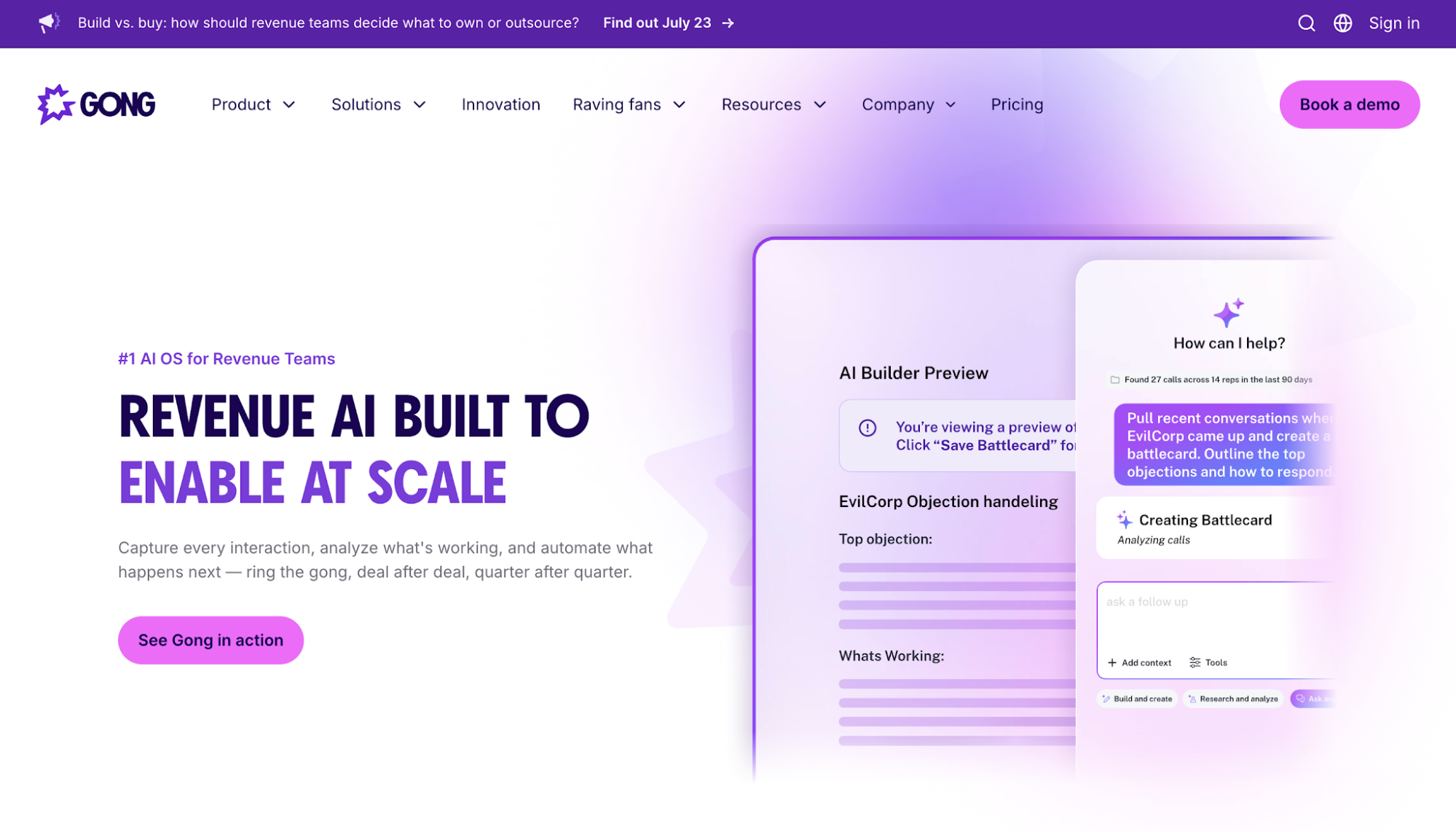
Gong is a revenue intelligence platform built for enterprise sales organizations. It captures sales calls, meetings, and emails, then connects that conversation data with deal management, pipeline visibility, and forecasting.
The pitch is conversation, deal, and pipeline intelligence together, so leaders see both what was said and what it means for revenue. In practice that makes it as much a revenue operations tool as a call review tool, which is exactly what its enterprise buyers want it to be.
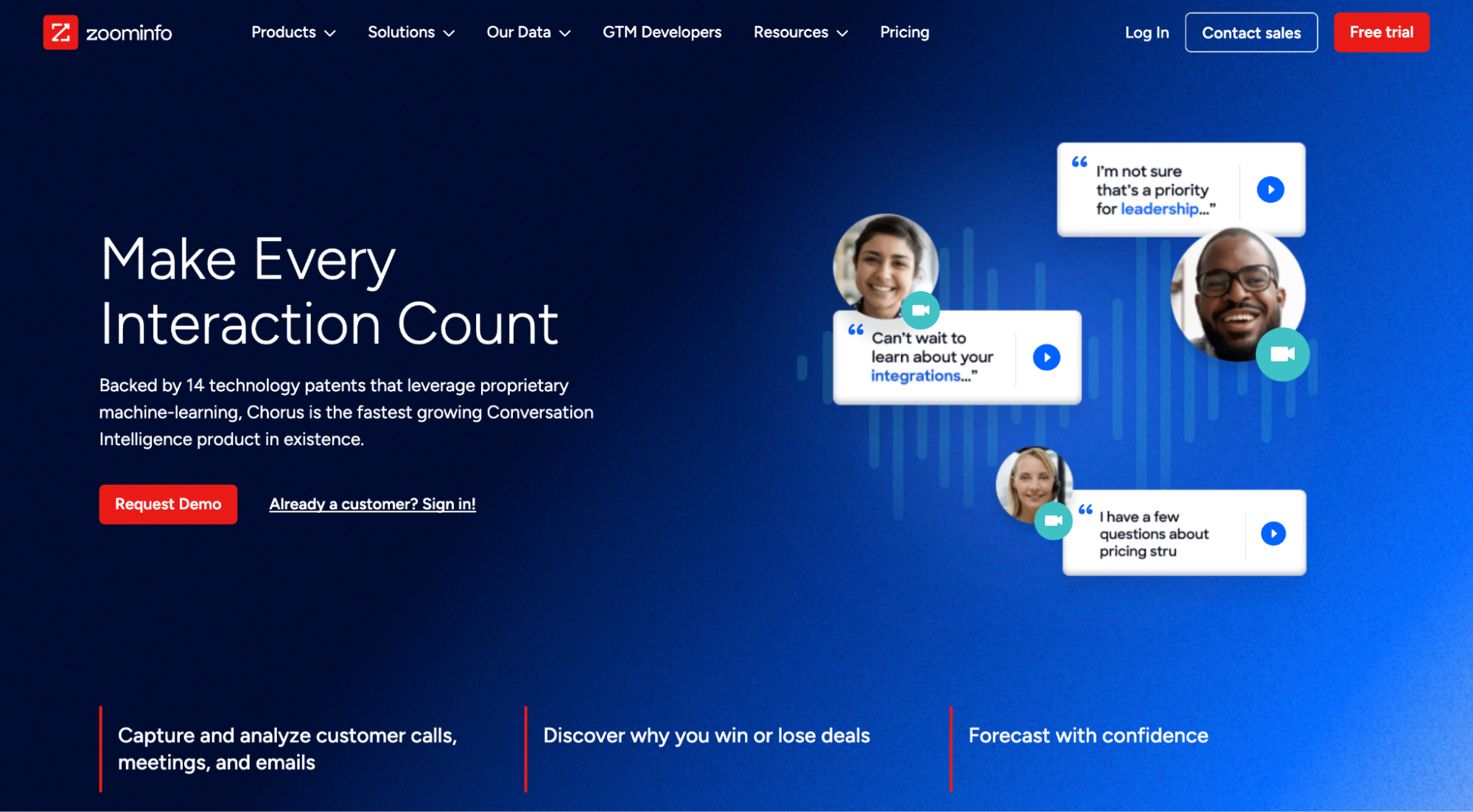
Chorus is a conversation intelligence product that records, transcribes, and analyzes customer conversations, and it is owned by ZoomInfo and tightly integrated with the wider ZoomInfo ecosystem.
That context is the buying decision. For teams already using ZoomInfo data and go-to-market products, Chorus adds conversation analysis with participant enrichment from the same ecosystem, and conversation history lands on the records reps already work in.
A separate Chorus Platform Access subscription is still listed through ZoomInfo’s marketplace integrations, so a standalone purchase remains possible, but the value case is strongest where the wider stack is already in use.
Clari Copilot is the conversation intelligence product within the combined Clari and Salesloft platform.
Its signature is live guidance. When a competitor comes up or a pricing objection lands, a battlecard appears on the rep’s screen while the customer is still talking, which makes it one of the most real-time-focused sales entries on this list.
Avoma is a conversation intelligence platform aimed at mid-market companies that want meeting intelligence, AI scorecards, and live answer assistance.
It runs the full meeting lifecycle. Agenda preparation, recording, AI-generated call summaries, automated scoring, and coaching recommendations sit in one product, and its live answer cards surface suggested responses to objections and questions while the call is still running.
It is a practical step up for mid-market teams moving beyond a basic AI notetaker.
Jiminny is a coaching-led conversation intelligence platform positioned toward mid-market sales teams, including teams in roughly the five-to-fifty rep range.
Its center of gravity is development rather than reporting. Call capture, AI summaries, conversation analysis, and scoring all feed a coaching workflow designed to help managers coach reps consistently instead of occasionally.
Observe.AI is the contact center entry on this list, built for enterprise contact centers rather than B2B pipeline work.
It combines automated and manual QA, personalized coaching, real-time agent guidance, and interaction analytics, and extends into voice AI agents that take routine contacts entirely. For contact center operations, that combination covers quality, compliance, and assistance in one platform.
Demos in this category converge fast. These are the questions that separate the right conversation intelligence software for your team from a platform that merely impressed in the meeting.
Start with what share of your conversations will actually be analyzed, and whether that includes every channel your team uses. A platform that analyzes sales calls but not the customer interactions running through chat or your contact center leaves part of the picture dark.
Broader coverage makes patterns more representative than manual sampling, provided transcription, categorization, and scoring stay accurate and get calibrated regularly.
Signals drawn from a sample inherit the sample’s bias, which is usually toward the calls that were already flagged, and a pattern built on flagged calls describes your escalations rather than your team.
Ask the coverage question per channel, not once. Voice, video meetings, chat, and email are separate integrations on most platforms, and the marketing page rarely says which ones are mature.
Ask what the conversation analysis actually detects.
Topics, questions, objections, competitor mentions, and customer sentiment are table stakes, and most sentiment analysis tools read tone well while struggling with sarcasm. Structural signals such as turn balance and engagement shifts vary more between platforms.
Natural language processing quality also differs by language and vocabulary, and the technology behind speech analytics varies more between vendors than the marketing suggests. If your calls carry industry terminology, test on your own recordings rather than the vendor’s demo set.
Decide before the shortlist whether you need help during calls or after them. Real-time insights put guidance on screen at the key moments, when an objection lands or a competitor comes up, while post-call analysis builds the patterns that improve the next hundred calls.
Newer reps gain most from live help with objection handling, though prompts work best alongside deliberate coaching techniques for rebuttals rather than in place of them.
Experienced teams often prefer clean post-call analysis over prompts in the corner of the screen, since live cards can pull attention away from listening.
The two approaches also fail differently. A bad live prompt disrupts an in-progress call, while a bad post-call insight wastes a coaching session, so weigh which mistake your team can better afford.
For revenue teams, the connective layer matters as much as the analysis. Deal intelligence links what happened in conversations to deal stage, activity, and risk, which is what turns call data into business insights leaders act on.
CRM integration should run both directions. Conversation summaries, fields, and next steps flow into records, and account context flows back into call preparation, with workflow automation removing the manual entry between them.
Some platforms stop at conversation metrics, others connect them to pipeline and revenue outcomes. If sales leaders will judge the tool by forecast accuracy and revenue insights, the second group earns its cost faster.
Reporting depth cuts both ways. Enterprise revenue analytics reward dedicated operations teams, and can bury a small team that just wanted to know why deals stall.
The gap between finding a problem and fixing it is where most value leaks. Check whether the platform turns findings into coaching opportunities, practice, and tracked improvement, or hands you a dashboard and wishes you luck.
Scorecards should reflect your criteria rather than a generic framework. A collections line in financial services might score whether the rep read the required disclosure on every call, while a healthcare scheduling desk scores whether the agent offered the earliest available slot.
Those are the behaviors tied to the outcomes each team is measured on, which is why platforms like Insight7 let teams build scorecards around their own criteria instead of forcing every operation into one rubric.
How your team defines a good call is not a settings detail, it is the product, and regular calibration sessions are what keep automated scores credible with the people they describe.
Everything downstream inherits transcription errors. Test how well a platform can analyze calls carrying your accents, audio conditions, and industry vocabulary, since accuracy varies sharply between vendors, and diarization mistakes corrupt talk ratios and attribution silently.
If your recordings are noisy to begin with, check how the platform handles it, because poor audio quality is where the gap between vendors widens most.
Multilingual teams should also confirm language coverage, since it ranges widely: Insight7, for example, transcribes in 60+ languages.
Conversation platforms hold customer data at its most candid, so security review belongs at the start of evaluation. Ask where recordings live, how PII is redacted, and whether your conversations train the vendor’s models.
Regulated teams should map requirements early, from HIPAA in healthcare to the GDPR for anyone handling EU customer data, and confirm how recording consent is supported in every region you operate in.
Get this reviewed before the shortlist rather than after it. Security teams reject platforms late in the process more often than buyers expect, and the rework costs weeks.
Compare Insight7 with your current review process on the calls you already have.
The same conversation intelligence tools serve different jobs depending on who is holding them.
Sales leaders use conversation data to see the pipeline as it is rather than as the CRM describes it. For sales managers, the daily value is evidence-based coaching, since knowing which behaviors separate strong performers makes sales coaching specific rather than general.
The result is a shorter path from observation to improvement. Managers coach reps on the exact gap their calls show, and win more deals from the same headcount.
Revenue operations teams use conversation intelligence to fill the gap between CRM activity data and reality. Conversation signals feed cleaner forecasts, earlier warnings on deal risks, and better sales analytics than logged activities alone can support.
Enablement builds training from real calls rather than hypotheticals. Strong discovery calls and clean closes become a library, and AI roleplay turns that library into practice scenarios reps can run before the situations occur live.
Success teams listen for churn before it reaches a renewal forecast. Frustration, repeated unresolved issues, and fading engagement can appear in conversations before a renewal forecast moves, and may explain shifts that usage data alone cannot.
Recurring objections, feature requests, and competitor comparisons are customer feedback arriving in volume.
Marketing and product teams mine the same conversation data for positioning, messaging, and roadmap evidence that surveys would take months to gather, which is a faster way to analyze customer feedback than waiting for a survey cycle.
Contact centers use the same technology for quality assurance at scale, scoring captured and eligible interactions against consistent criteria and pairing it with call coaching for agents
The goal is consistent service quality and better customer outcomes at volumes no manual review can cover.
Several platforms here connect conversation analysis with coaching.
Insight7‘s clearest distinction is how it combines AI roleplay before calls, live assist during them, and scoring and coaching afterward, so reps practise the specific gaps their real conversations revealed without moving the finding into a separate training system.
That loop compounds. Reps rehearse real scenarios, get help at the moments that decide calls, and see their scores move as behavior changes, while leaders watch conversation quality connect to revenue instead of guessing at the link.
“For the cost of a project manager in the United States, we cover over 6000 calls on Insight7 every month.”
Elise Dietrich, CPO, Tripleten
It is built for mid-market sales, customer service, and customer success teams in financial services, healthcare, and manufacturing, where conversation volume is high and every unreviewed call is a cost. Turn sales calls your team is already having into the training data for winning more of them.
