


Applied Materials leadership interviews evaluate candidates on their ability to make technology investment decisions with billion-dollar implications, develop technical talent in a market where process expertise is scarce and competitive, and maintain strategic direction across semiconductor equipment business cycles that can compress revenues by thirty percent or more in a single year. Interviewers assess whether leadership candidates combine technical credibility with commercial judgment and can operate effectively across a global organization that spans research, manufacturing, field service, and customer-facing functions.
Start your free Applied Materials Leadership practice session.
What interviewers actually evaluate
Decision-Making, Team Development & Strategic Thinking
Applied Materials leadership interviewers probe whether your strategic decisions account for semiconductor industry dynamics rather than generic business logic, how you develop and retain technical talent that cannot be replaced quickly, and whether you can maintain organizational performance through the cycle volatility that defines this market. Candidates who cannot discuss technology roadmap strategy alongside people strategy do not advance to senior leadership roles.
Technology investment strategy, technical talent development, cycle-resilient organizational design, cross-functional leadership in a global technical organization, customer relationship stewardship at the executive level, long-horizon R&D vision
What gets scored in every session
Specific, sentence-level feedback.
| Dimension | What it measures | How to answer |
|---|---|---|
| Strategic depth | Whether your strategy is grounded in semiconductor industry dynamics, not generic business logic | Connect your strategic choices to technology generation transitions or competitive capability gaps |
| Talent development specificity | How precisely you describe your approach to developing scarce technical expertise | Name the individual development challenge and the non-standard intervention you designed |
| Cycle management | Whether your organizational decisions account for industry cyclicality | Describe how you built or maintained capability during a downturn or managed rapid growth during an upcycle |
| Cross-functional leadership | How you align engineering, commercial, and operations teams around shared technology goals | Describe the alignment mechanism, not just the outcome |
How a session works
Step 1: Get your Applied Materials Leadership question
You receive a realistic Applied Materials Leadership prompt drawn from current themes: technology node investment strategy, technical talent retention during competitive hiring cycles, organizational design for a global R&D and manufacturing operation, customer executive relationship management, and leading through semiconductor market downturns without losing strategic momentum. No generic leadership filler.
Step 2: Answer by voice
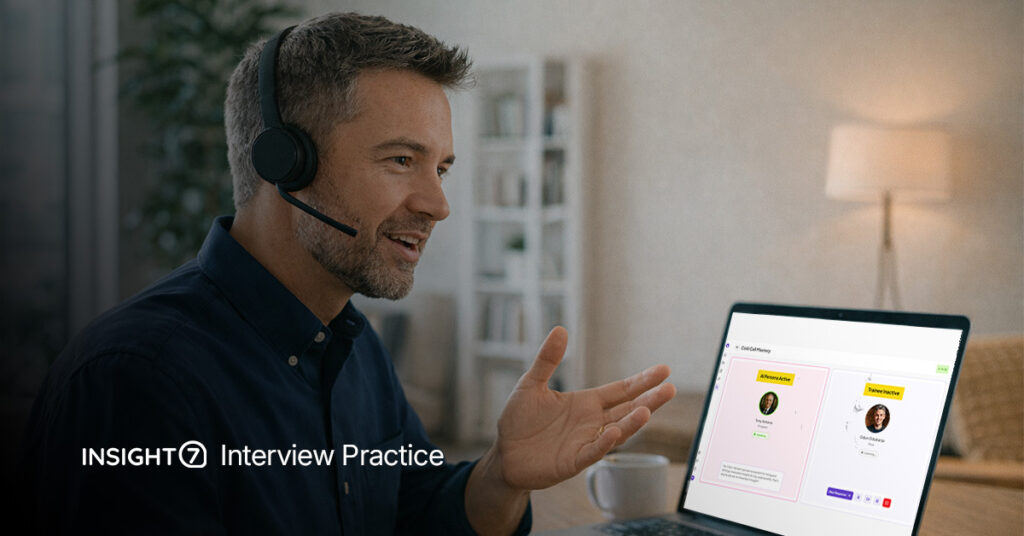
You speak your answer out loud, the way you would in a live leadership panel. The session captures strategic depth, talent specificity, and cycle management judgment.
Step 3: Get scored dimension by dimension
Each of the four dimensions above receives a separate score with sentence-level feedback showing exactly which line lost points and why.
Step 4: Re-answer and track improvement
You re-answer with the feedback in hand and track score improvement across attempts. Strategic answers that connect internal decisions to semiconductor industry dynamics take preparation to deliver without sounding rehearsed.
Frequently Asked Questions
What does Applied Materials look for in senior leadership candidates across its divisions?
Applied Materials prioritizes leaders who combine deep functional expertise with the commercial judgment to make technology investment decisions that align with where the semiconductor industry is going rather than where it has been. Experience managing through cyclical markets, developing scarce technical talent, and maintaining customer executive relationships through multi-year equipment programs distinguishes strong candidates.
How does semiconductor industry experience affect leadership evaluation at Applied Materials?
It significantly improves performance in interviews. Candidates without semiconductor backgrounds are evaluated more heavily on their ability to learn a technical domain and their judgment in analogous capital equipment or industrial technology contexts. They must demonstrate that their leadership model applies to an engineering-driven, cyclical, globally dispersed business.
What technology investment decisions should leadership candidates be prepared to discuss at Applied Materials?
Prepare for questions about how you have allocated R&D resources across competing technology programs, how you decided to invest in a new capability when the market adoption timeline was uncertain, and how you maintained investment in a technology program through a period of reduced demand. These questions test long-horizon strategic judgment.
How does Applied Materials evaluate how leaders manage through semiconductor down cycles?
Interviewers probe whether you have made workforce and investment decisions during downturns that preserved technical capability rather than cutting indiscriminately, and whether you can describe the tradeoff between short-term cost management and long-term competitive positioning. Leaders who cut capability in downturns and then could not execute during recoveries are a known failure mode in this industry.
What are the most common failure modes in Applied Materials Leadership interviews?
Common failures include strategic answers that apply generic business logic without semiconductor industry grounding, talent development stories that describe motivation and coaching without measurable outcomes, cycle management examples that emphasize cost cutting without discussing capability preservation, and cross-functional leadership descriptions that focus on communication rather than alignment mechanisms.
Also practice
All nine Applied Materials role interview practice pages.
- Sales
- Customer Service
- Product Management
- Marketing
- Finance
- Operations
- People & HR
- Legal & Compliance
One full session free. No account required. Real, specific feedback.








