


Sit with a Nigerian contact centre team for a week and you will hear the same four or five problems circulating. Failed transfers, unauthorised debits, disputes over charges. Your agents resolve them properly and the tickets close cleanly.
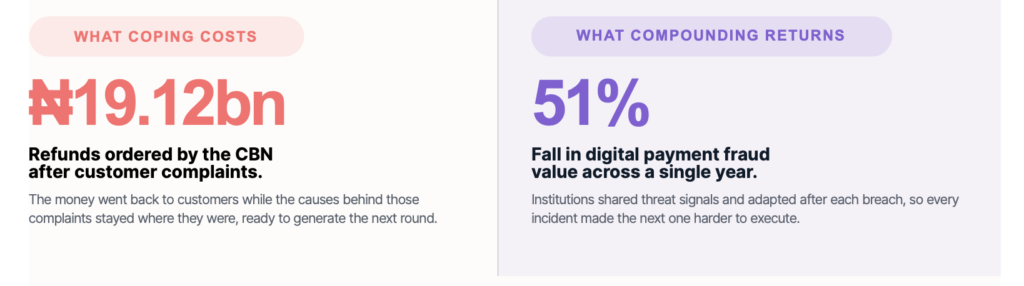
Then the identical issue arrives the following month and lands on somebody solving it for the first time, because nothing in your operation retained how it was fixed before. That gap has a price, and last year, the Central Bank put a number on it. Nigerian banks refunded ₦19.12 billion to customers.
When your support system lacks knowledge retention, simple service glitches cascade into severe compliance penalties and mandatory payouts. So, how do you prevent these multi-million-Naira mistakes month after month?
Why Nigerian financial institutions refunded ₦19.12 billion to customers in 2025
The Central Bank of Nigeria resolved 18,824 consumer complaints last year, and institutions refunded ₦19.12 billion alongside $329.3 million as a result. Several also paid penalties for taking too long to resolve them.
The naira figure nearly doubled from ₦9.66 billion the year before. Claims lodged in local currency climbed to ₦40.61 billion from ₦17.13 billion, which tells you the pool of disputed money is growing faster than the refunds settling it.
The CBN reads the rise as evidence that more Nigerians now know they can escalate, and that interpretation is fair.
Consumer protection awareness is healthy for the market. But it doesn’t change is the mechanics inside your contact centre, where every one of those complaints arrived without any record of how the last identical one was handled.
Why bank customer complaints in Nigeria keep recurring month after month
The striking thing about complaint volume across Nigerian financial services is how little the underlying list changes.
Failed transfers, unauthorised debits, disputes over charges, airtime that never landed. Whether you run customer operations at a commercial bank, a fintech, a microfinance institution or an insurer, you already know your top five and could probably recite them in order without checking a dashboard.
What changes is which agent picks up and that agent is usually meeting the problem for the first time. So the unit cost of resolution never falls. You pay once when the customer calls, then again when the same issue returns wearing a different reference number.
That pattern has a name worth borrowing from finance.
An operation that copes handles each complaint properly and retains nothing, so the cost of solving it stays flat forever. An operation that COMPOUNDS gets a little cheaper to run every month, because each resolution feeds something that reduces the next one.
Odun Odubanjo, Chief Executive Officer at Insight7, sees the gap as a memory problem:
“Institutional forgetting costs more than any refund. Nigerian institutions pay twice for the same problem, once at resolution and again when it returns the following month.”
None of this stays inside the building. Customers experience it as the same problem coming back, and the industry research has been recording that for years now.
KPMG’s West Africa research on customer experience in banking placed Resolution, meaning proactive correction of the customer’s problem, at the bottom of its six experience pillars for Nigerian retail banking across successive editions.
Reading that as a scoring quirk would be a mistake. It describes an operating model where each ticket functions as a closed loop with nothing downstream of it, repeated across an industry.
The scale of what gets discarded in the process is genuinely striking. Nigeria processed ₦1.07 quadrillion in electronic payments in 2024, across active bank accounts that rose to 311.6 million.
Your institution holds the richest behavioural dataset in the Nigerian economy yet most of it evaporates the moment somebody marks a ticket resolved.
How Nigeria’s fraud teams built a system that learns from every incident
The proof that this can work already exists inside your industry, one department over.
Fraud case volumes fell from 123,918 in 2021 to 67,518 in 2025. Loss values dropped 51% in the most recent year, from ₦52.26 billion to ₦25.85 billion, though that particular comparison is flattered by a single ₦31.1 billion incident inflating the 2024 baseline.
The case-count trend is the honest evidence, and the mechanism behind it is worth studying. Institutions shared threat signals with each other, tightened controls after every incident, and adapted so that each attempt became harder to execute than the one before it.
That is an ecosystem with a memory. Customer complaints arrive in far higher volume than fraud attempts ever have, and nobody has pointed the same engine at them, though a handful of operations elsewhere have tried something close.
Three operations that read every conversation before changing anything
These attempts below share a sequence: coverage came first, then whatever the reading turned up got spent on making people better.
- Entel Connect Center in Peru handles more than 600,000 calls a month, and analysts could review fewer than 1 percent of them, so supervisors coached on individual interactions without any view of how a floor was performing overall.
Working with McKinsey and Google Cloud, the centre moved to analysing every call daily, and service sales climbed 40% inside ten weeks. Coverage was the input, though the returns came from what supervisors did with it week after week.
- Deutsche Telekom pointed the same principle at coaching rather than sales.
Instead of leaving development to whichever supervisor an agent happened to report to, the company built a personalised engine with QuantumBlack that reads conversations and feeds training into daily workflow, so an agent struggling with eSIM activation gets prompted with a short video that afternoon.
First-time resolution rose 10 percent and transferred calls fell 2 percent.
- A global bank went the diagnostic route, running voice analytics across its contact centre to establish why customers were calling before deciding what to automate. Handle time dropped 15% within 100 days, and the same exercise mapped a route to a 45% reduction in operating cost.
Nobody in these groups bought a tool and waited for it to work. They read the conversations first, then acted on what the reading exposed, which is the part that transfers to a Nigerian operation regardless of budget.
Four questions that reveal whether your CX operation is compounding or coping
Run these past your leadership team and count the yeses.
- Does last month’s leading complaint reach product as a written specification? Or sits in a monthly report that nobody opens?
- Can a new agent inherit your best agent’s resolution playbook on day one? Or do they learn it by getting things wrong for a quarter?
- Do you measure whether an issue recurs after somebody marks the ticket resolved?
- Does dispute and fraud language reach compliance automatically? Or does it depend on a human remembering to forward it?
Four nos describes an operation that is well run and going nowhere.
CX expert, Ubong Nkata, points at what usually sits behind those four nos:
“Effort is not a service improvement strategy.”
Ubong Nkata, Customer Experience Leader
His argument is that growth exposes whatever an organisation has been managing informally.
Unclear responsibilities turn into missed actions, weak processes turn into delays, and when critical knowledge lives with one capable person, even your most committed employee becomes a bottleneck.
Pushing the team to try harder does nothing about any of that, because the constraint has moved from the people to the operating system around them.
What one failed USSD transfer should tell five teams inside your bank
Say a customer whose USSD transfer failed calls, your agent sorts it out, the ticket closes cleanly. Everybody involved did their job properly. That single interaction carried usable information for five different parts of your institution but in practice it reached one.
Product gets the drop-off point
The exact step in the USSD path where customers fall out. Fixing it once removes the next several hundred complaints before anybody has to make them.
Compliance gets the dispute language
Wording from that conversation, arriving early enough to tighten a process while there is still time to act, rather than after a regulator has cause to order anything.
Coaching gets the script that worked
Whatever your fastest resolver said on that call is the standard the rest of the floor should be practising against. At the moment it sits inside a recording that nobody will ever open.
Self-service gets the recurring edge case
Convert it into a bot flow and the next wave of identical calls never reaches a human at all.
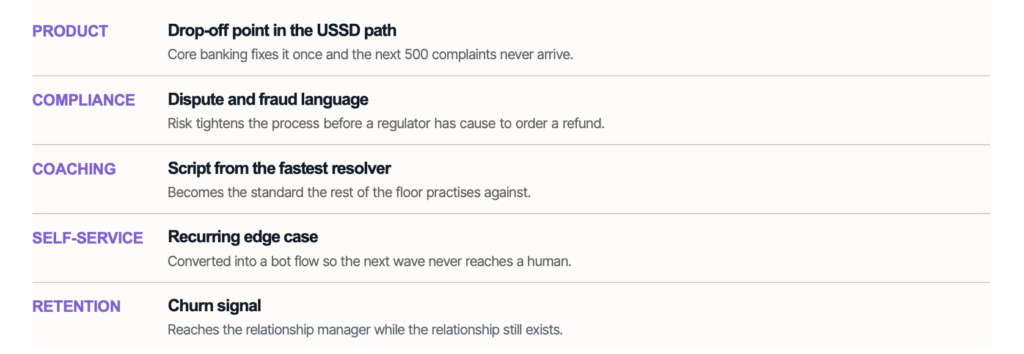
Retention gets the churn signal
Buried in her tone is the information a relationship manager needed while she was still your customer, rather than after she moved her salary account elsewhere.
One interaction, five destinations. Strategy sets the target and tooling makes the loop possible, though governance is what decides whether either of them gets used.
Why complaint recurrence rate matters more than CSAT and handle time
Add complaint recurrence rate to your executive dashboard, and rank it above your satisfaction scores.
It answers the question of whether the same issue keeps resurfacing, which is the clearest available signal of an operation that learns.
CSAT captures how one customer felt about one interaction. Handle time captures how efficiently your floor processes volume. Neither of them tells you whether your institution is getting better at the underlying problem.
Tracking it properly means reading conversations rather than counting tickets, because the same root cause arrives under three different categories depending on which agent logged it. Category counts will understate the real frequency every single time.
This is where customer complaint analytics earns its place.
Conversation intelligence reads what was said instead of how it was filed, which is how voice of customer signals surface at all. Pattern detection across thousands of unstructured conversations is the part humans cannot do at volume, and it is also the part contact centre quality assurance teams across Nigeria are asked to do with a sample of around two percent.
Pro tip: Try this in your next executive review. Pull your top complaint category from six months ago and check whether it is still sitting in your top five today. If it is, you have your first candidate for a proper root cause analysis.
When AI customer service should handle a conversation, and when to route to a person
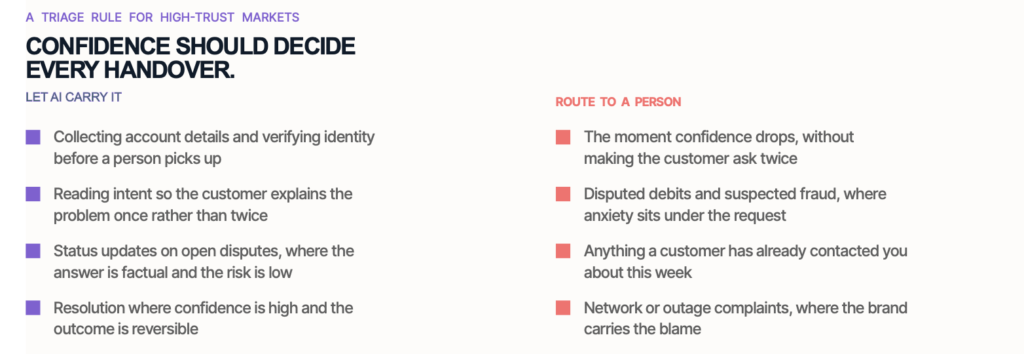
Confidence should decide every handover, and getting that judgement wrong is expensive in a market where trust is already thin.
Where AI earns its place in the journey
| Task | Why automation works here |
|---|---|
| Collecting account details and verifying identity | The customer avoids repeating themselves to a human later |
| Reading intent before routing | The conversation reaches the right desk the first time |
| Status updates on open disputes | The answer is factual and requires no judgement |
| Resolution where confidence is high | Provided the outcome remains reversible |
Where a person should take over immediately
The moment confidence drops, a human needs to step in without the customer having to ask twice. Disputed debits and suspected fraud belong with people because anxiety sits underneath the request, and a bot mishandling that costs you the relationship rather than the ticket.
The same reasoning covers anyone contacting you a second time in one week about something still unresolved, along with network or outage complaints, where your brand absorbs the blame for a partner’s failure whether that is fair or not.
Important: Price this in before you budget. Gartner projects the cost per GenAI resolution passing $3 by 2030, above what many offshore human agents cost, and expects “right to speak to a human” rules to lift assisted-service volumes 30% before 2028.
Automation bought purely to remove headcount runs into a ceiling and a rising unit price, while money spent making the people you keep measurably better carries on compounding.
A 90-day plan to close your first complaint loop
Thankfully, you do not need a transformation programme te reap the benefits of compounding. Here’s one journey, followed the whole way through:
- Days 1 to 30, Baseline it: Get goal clarity with your executive team, isolate your single highest-volume complaint journey, and baseline its recurrence rate with finance in the room so the numbers are agreed before anything changes. Complaint resolution across Nigerian banks and fintechs is usually measured by speed, so expect this first conversation to be uncomfortable.
- Days 31 to 60, Close one loop: Run it from the frontline conversation through to a permanent product or process fix. A single loop that ships will teach you more than a five-workstream plan sitting on a slide.
- Days 61 to 90, Take the number to the board: Measure the drop in recurrence, quantify the handle cost saved, and present that before you request further budget.
One proven loop is a far easier thing to fund than a grand plan nobody has seen work.
Analyse every customer conversation you’re already having
Doing this by hand does not scale, and the arithmetic gets worse as your volume grows. A research team at Credit Acceptance, a financial services firm with over 2,000 employees, was spending upwards of 40 hours extracting themes from participant transcripts.
Moving that work onto Insight7 returned the same analysis in seconds, with output matching what the team had reached by hand.
Insight7 scores every call, chat and dispute conversation against criteria you define through AI call scoring, surfaces the patterns behind recurring complaints via revenue intelligence, and routes what it finds to the teams who can fix the cause.
Redaction runs automatically and the platform carries SOC 2 Type II, HIPAA and GDPR compliance.
Take five recorded complaint calls from last week and run them through the free Call Quality Monitor. You will find out fairly quickly what your operation has been forgetting.








