
See how Insight7 turns every customer conversation into data your team can act on. Book a demo.
Analytics is usually split into four levels of maturity. Conversation data supports all four, and knowing which one you are doing keeps expectations realistic.
Descriptive analytics answers what happened. Applied to conversations, that means volumes by topic, sentiment distribution, and which issues came up most often last month.
This is where most teams start and where many stop. It is genuinely useful, but it is a report rather than a decision.
Diagnostic analytics answers why it happened. Delivery complaints climb, and the conversations show a single courier region behind most of them.
This is the level where conversation data outperforms almost every other source, because the explanation is sitting in the customer’s own words.
Predictive analytics answers what is likely to happen next. Machine learning models trained on historical data can flag which conversations carry churn risk, or which issues are trending toward a spike.
Accuracy depends on the quantity, quality, and representativeness of the training data, and on how clearly the predicted outcome is defined. A model trained on well-labeled examples can beat one trained on far more noisy ones.
Prescriptive analytics answers what to do about it. That might mean routing a detected intent to a specialist queue, triggering a retention offer, or flagging a knowledge base article that needs rewriting.
Many platforms surface the recommendation and leave execution to a person or a connected workflow. Worth checking during evaluation rather than assuming.
Conversation data answers a different set of questions than product usage or CRM records. Customer service and sales teams read it for different reasons, but these are the questions it answers best.
Every complaint is a data point, and repeated customer concerns form a pattern no individual agent would spot. Analyzing customer conversations at volume lets you identify customer pain points by frequency rather than by whoever complained most loudly.
Ranking those pain points by volume and sentiment tells you which to fix first. That is a materially better input to a roadmap than a handful of escalations.
Platforms like Insight7 attach the call count to each recurring theme as it extracts it, whether that is a complaint or an objection, so the size of a problem arrives with the finding rather than as a separate counting exercise.
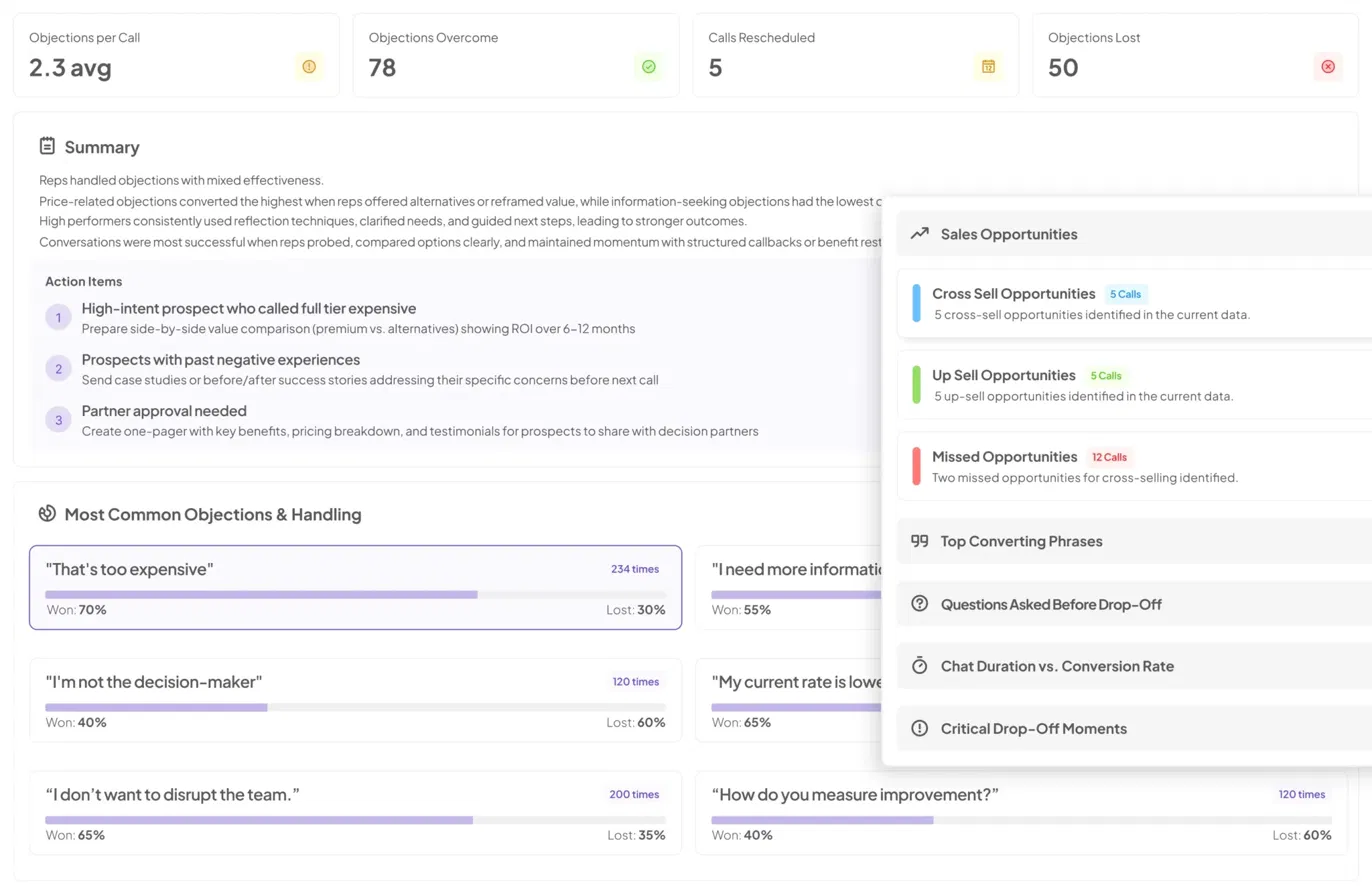
Customer intent is what the person actually wants, which is not always what they say first. Someone asking about cancellation terms may be shopping, negotiating, or already gone.
Intent detection lets teams respond to the real customer needs rather than the surface question. Patterns in those requests also expose customer preferences, including which channels people choose for which kinds of problem.
Sentiment analysis tracks emotional tone through a conversation. The useful signal is usually movement rather than the average, because a customer who arrives frustrated and leaves satisfied represents a very different outcome from the one who does the reverse.
Read sentiment in aggregate. Negative sentiment on a single call proves nothing about a trend, though that conversation may still need urgent attention if it involves a compliance failure or an account about to leave. Negative sentiment concentrated on one product line is the finding.
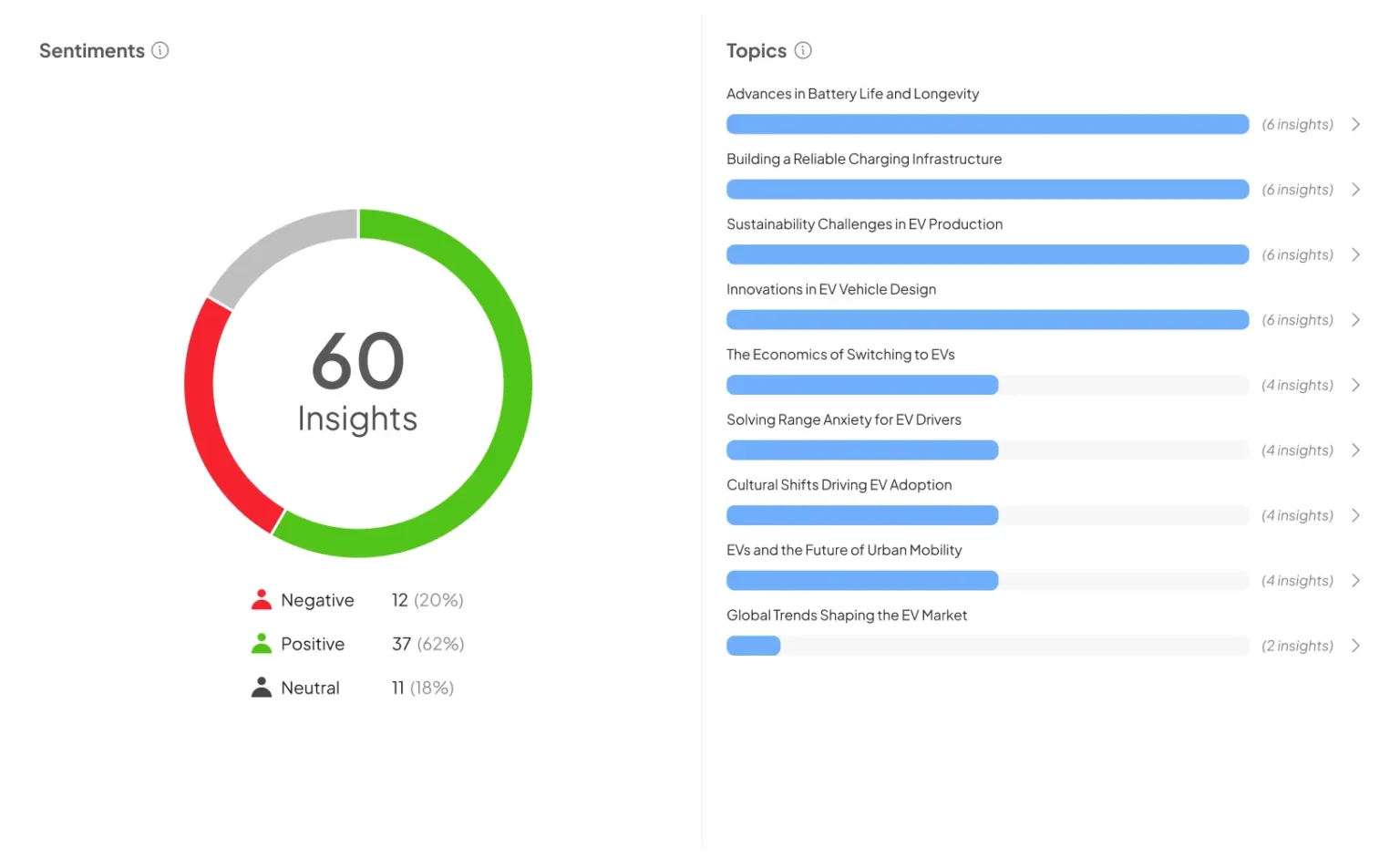
I was able to analyze customer calls I had using Insight7, and I did find it valuable! I loved how it showed the sentiment behind each comment that the client made.
Tobi Oluwole, Co-founder, 3skillz
Customers rarely announce that they are leaving. They mention a competitor, ask what happens at renewal, or raise the same unresolved issue for the third time.
Those signals often reach a conversation before they reach a renewal forecast, and they explain shifts that usage data alone cannot. Catching them early is what gives teams a window to act before customer relationships are past saving.
New issues show up as small clusters before they become volume. A handful of confused questions about a changed policy this week can become a queue-flooding topic next month.
Trend detection is the argument for analyzing conversations continuously rather than reviewing them quarterly. The value is in the early warning, and early warning has a short shelf life.
Surveys mostly return answers within the structure you designed. Open-ended questions can surface something unexpected, but they draw fewer and less consistent responses, so most of what you learn is shaped by what you thought to ask.
Conversation analytics collects unsolicited feedback instead. The customer raised the topic themselves, in their own words, without a scale or a multiple-choice list shaping the answer.
There is also a self-selection problem. A survey captures whoever chose to answer, and those people may differ systematically from those who did not.
Conversation data has its own limit. It captures the customers who got in touch, which skews toward people with a problem or a purchase in mind, so it is naturalistic rather than automatically representative.
It also costs the customer nothing. Nobody is pulled out of their customer journey to rate anything, because the feedback is a by-product of a conversation they already chose to have.
None of this makes surveys pointless. Solicited customer feedback is better for measuring specific things over time, and metrics like customer satisfaction scores remain useful benchmarks.
Running both gives a deeper understanding than either source alone, and the most valuable insights often come from comparing them.
The point is that they answer different questions. Surveys measure how customers feel about what you asked. Conversation analytics reveals what they wanted to talk about.
Contact center operations is where this technology has the longest history and the clearest returns for customer experience.
Manual quality assurance reviews a sample, which means most interactions are never scored. Analyzing interactions automatically removes that ceiling.
Conversation analytics tools apply the same criteria to every conversation, so agent performance stops depending on which calls a reviewer happened to pick.
Consistent scoring also makes coaching fairer. Call center agents can see the evidence behind their feedback rather than taking a supervisor’s word for it, which is the difference between coaching that lands and coaching that gets resented.
Automated scoring still needs calibration. Models misread context, accents, and unusual call types, so the better platforms let managers override a rating and feed the correction back. Treat the score as a first pass rather than a verdict.
Insight7 works this way by design. Scores are traceable back to the moment in the conversation that produced them, so a disputed rating gets settled by listening rather than by argument, and the correction feeds the criteria rather than sitting in a spreadsheet.
Analytics data surfaces the process problems creating volume in the first place. Repeated calls about the same policy usually point to unclear documentation rather than difficult customers.
Fixing the cause reduces or removes repeat contacts about that issue, which does more for operational efficiency than shaving seconds off handle time. Improving customer service usually follows, because the friction disappears rather than being handled faster.
Contact drivers ranked by volume are one of the highest-value outputs in the whole discipline, and one of the easiest to act on.
Real-time conversation analytics runs while the interaction is still happening. It can surface a knowledge base article as the topic comes up, or alert a supervisor when a conversation is escalating.
Real-time insights and post-conversation analysis serve different purposes. One rescues the interaction in front of you, while the other improves the next thousand.
Bring your channel list to Insight7 to find out how your conversations can actually be scored.
Implementation fails more often through vagueness than through technology. These steps keep the project pointed at something specific.
Decide what you actually want to know before you switch anything on. Why repeat contacts are rising, or which issues drive the most negative sentiment, are answerable questions. “Understanding our customers better” is not.
A specific question also gives you a way to tell whether the project worked, which matters when the renewal comes up.
Partial coverage produces misleading conclusions. If phone is analyzed and chat is not, every finding is skewed toward whichever customers prefer to call.
Map your channels before implementation and confirm the analytics platform handles all of them properly, not just nominally. Support for a channel and good performance on that channel are different claims.
The tagging structure determines what you can learn. Categories that are too broad tell you nothing, and categories that are too narrow fragment the same issue into a dozen labels.
Build it with the people who handle the conversations. Agents know which distinctions matter and which are artificial, and they will spot a useless category faster than any analyst.
Customer conversations contain personal and sometimes sensitive information, so data security belongs in the plan from the start rather than the compliance review at the end.
Confirm where recordings are stored, whether customer data trains the vendor’s models, and how personal information is redacted.
Consent is the part that varies most by region: under the GDPR, recording and analyzing a conversation needs a documented lawful basis, and US states split between one-party and all-party consent rules.
Analysis creates a report. Acting on it changes something, and most platforms stop at the first.
Insight7 scores 100% of your connected conversations, surfaces the themes and sentiment inside them, then turns those findings into coaching your team can use. Managers get specific priorities for each agent rather than a dashboard to interpret on their own.
That combination matters for teams doing both jobs at once. Understanding customers and improving the people who talk to them are usually handled by two separate tools, which is why findings so often stall between them.
Insight7 holds a 4.7 rating on G2, where reviewers describe exactly that shift from reading conversations to acting on them.
Insight7 also handles conversation data to enterprise standards.
It is SOC 2 Type II-certified, HIPAA- and GDPR-compliant, redacts PII and PHI, and never trains models on your data, which makes it ideal for the mid-market sales, service, success, and enablement teams it serves in financial services, healthcare, and manufacturing.
