
TL;DR
- Rank affected customers by impact. Call the worst hit first.
- Say what happened, what you are doing and when the next update comes.
- Update until the all-clear. Log replies as feedback.
Segment affected customers before you dial
Start by mapping the outage to accounts. Match the failed system to customers by site, area or plan, so you call only people who are affected. Calling everyone teaches customers to ignore you.
Next, rank them on three scores: severity, duration and customer type (business, vulnerable, high value). Take an operations lead at a regional internet provider who loses one fibre node:
- Wave 1: business and medical-alert accounts that are fully offline.
- Wave 2: homes that are fully offline.
- Wave 3: homes with slow speeds.
The wave sets the call order.
Then pick the channel. Some customers prefer a message to a call, so send them an SMS and keep your voice minutes for everyone else.
Clean the list before launch. Remove wrong numbers, honour the do-not-contact list and set calling hours. Consent and disclosure rules differ by region:
- US: the FCC's 2024 ruling puts AI voices under the TCPA's "artificial voice" rules, which require prior express consent unless an exception applies.
- EU: Article 50 of the AI Act says people must be told when they talk to an AI system, unless that is obvious.
- Colorado, US: the Chatbot Safety Act requires operators of conversational AI to disclose that users are talking to AI. It takes effect on 1 Jan 2027.
Check your own market with counsel.
Insight7's voice campaigns, in beta, can support this setup. You add contacts by CSV upload or type them in. The beta campaign spec lists consent marking, calling hours, retry rules and a do-not-call list, so check these in the app before you rely on them. Outage notification is our own adaptation of the campaign tool. A manager sets the goal, audience, AI caller and rules, and each call is held as a real conversation and scored when it ends. Duplicating a campaign copies its contacts, and anyone added to the do-not-contact list since the original is left out. Keep one outage campaign as your starting copy for the next incident.
Plan for volume too. Incidents are unpredictable, and one bad day can need several campaigns.
Write a short message that answers three questions
A good outage call answers three questions: what is wrong, what does it mean for me, and when will I hear more? Build the script in this order:
- Disclose first. Say "this is an AI assistant calling for your provider" in the opening line, before any outage detail.
- State what is down. Use plain words, such as "your internet in the north district is offline."
- Give the impact on this customer. Use the account data from your segment, such as "your office line is affected."
- Say what you are doing. One sentence is enough: "Engineers are on site."
- Name the next update time. Give a clock time, not "soon."
- Offer a human or a callback.
The human route is not optional. A Gartner survey of 3,566 customers found that 87% say a company using GenAI for service must offer a way to reach a human. Design the handoff before launch. Buyers ask whether it is polite, what happens to a disputed amount, and who chases a missed handover. Send angry callers, safety issues and billing disputes to a person straight away.
Voice quality decides whether people listen. Buyers fear AI that sounds scripted. Match the customer's language and accent. Insight7 Voice, in beta, offers campaign languages that include Yoruba and Igbo, and the manager picks the language before the voice.
Before you launch, talk to the agent in the browser. No phone number is needed. Try interruptions and the "I want a person" request.
Launch the first wave and keep calls honest
Launch the top segment first, then widen the list once the first calls look right. Start with Wave 1, check a handful of transcripts, then add Waves 2 and 3. A bad script then reaches a small group instead of the whole list.
Two rules in the beta voice campaigns keep your numbers honest. A carrier's temporary refusal does not use up one of the contact's retry attempts. A call where only the AI spoke does not count as reached.
Watch the live dashboard while the wave runs. It shows calls in progress, and a reviewer can read each transcript when the call ends. Yes/no answers and call outcomes are pulled from the transcript. Your support lead can read transcripts as calls end and see whether customers are hearing the message or hanging up.
Borrow the fail-safe pattern from network operations. When a site alarm fires, a common manual routine is to call the responsible engineer, escalate to a second-level contact if unanswered, log a ticket and refresh a tracker on a short fixed cycle until the site clears. Copy that shape for customers:
| Step | Action |
|---|---|
| 1 | Call the contact |
| 2 | Escalate to a second contact or a person if there is no answer |
| 3 | Open a ticket |
| 4 | Record each outcome where your team already looks |
Send updates until the all-clear
Promise a next-update time on every call, then keep it, even when there is no news. A short call that says "still working, next update at 3 p.m." gives a customer something to plan around. Silence sends them to your inbound line.
Also update on state changes, not only on the clock. A new restoration estimate, a partial restore and full restoration each deserve a call.
Build each update as a copy of the first campaign. Duplicate it, edit the script with the new facts and refresh the contact list. The copy keeps the contacts, and anyone added to the do-not-contact list since the original is left out. Remove restored segments before launch. A customer who is back online should never get a "still down" call. A call where only the AI spoke does not count as reached, so you can see who still has not heard the news.
Set the gap between updates by your own judgement. Severe outages for business accounts need short gaps. Degraded service can wait longer. Tie the gap to the restoration estimate, and never promise a time you cannot meet.
End with a closing call. Confirm that service is restored and ask whether it works on their side. Offer a credit or a ticket route if it does not.
Finally, tie updates to the tools your team already uses. Buyers want a voice tool to sit alongside their CRM or helpdesk. Ask your vendor whether call outcomes can open or update a ticket by API.
Collect feedback and tune the next call
Ask one or two short questions on the call, then read the transcript. Try "Is your service back?" and "Was this call useful?", plus an open prompt such as "Anything else we should know?" Yes/no answers and call outcomes are pulled from the transcript.
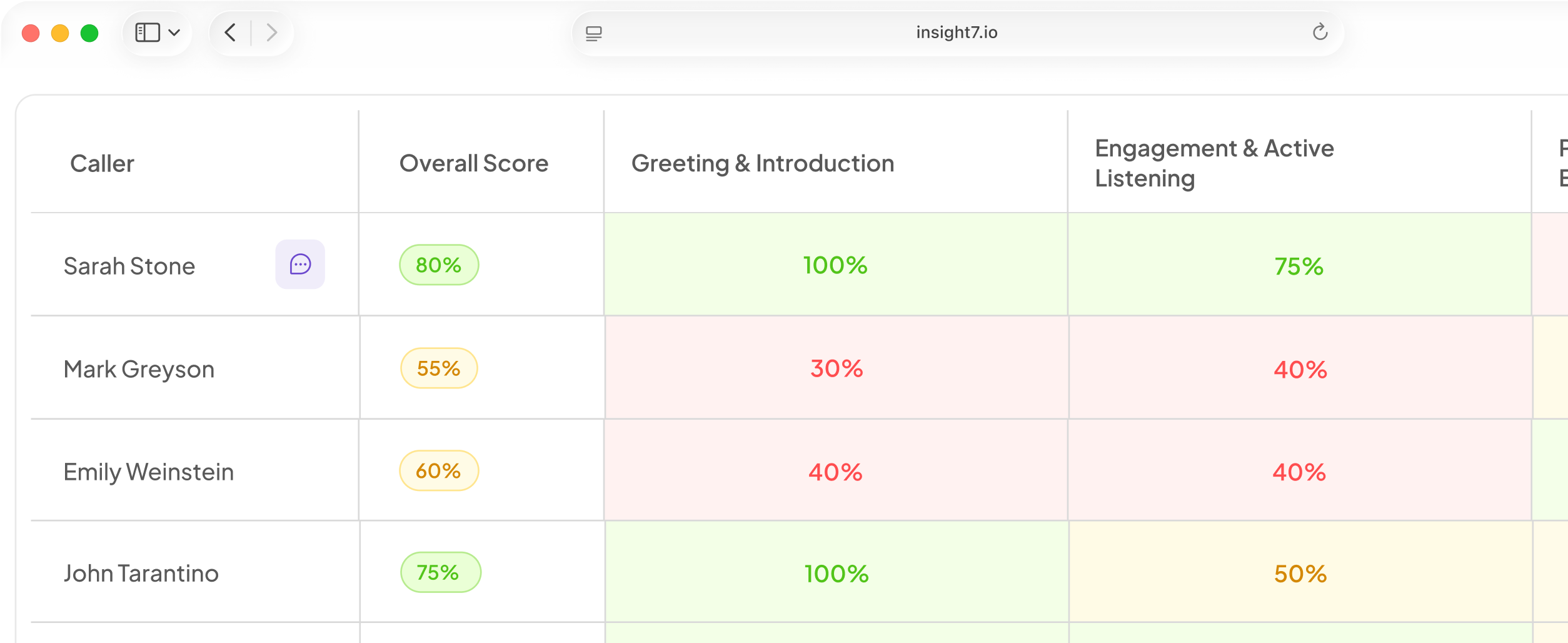
Score every outage call, not a sample. Insight7 scores calls against a weighted scorecard your team owns, and scores roll up to the person, the project and the organisation. Build one for outage calls with three checks: did the agent say it was an AI, did it state the next update time, and did it hand off correctly when asked.
Set alerts so a bad call finds you. Alerts can watch keywords and low scores and notify by email or Slack. Your support lead is then notified of a "cancel my contract" call by email or Slack.
Track five numbers: answer rate, completed-message rate, handoff rate, complaints in the following 24 hours, and inbound call volume against a baseline. Set baselines before the first outage, because you cannot prove a drop without a "before." Gartner's review of 432 AI customer-service use cases found only a quarter show positive ROI, and 42% cannot be measured. A baseline is what keeps your outage calls out of the unmeasured group, so you can show the calls cut inbound volume.
Finish with a short post-incident review. Read the lowest-scoring calls, then fix the segment rules and the script.
Related reading: Amazon Connect, Twilio Flex and Five9 Outbound Calling Compared With Specialist Voice AI Platforms, Outbound Dialers vs AI Voice Agents Compared for High-Volume Customer Campaigns and How to Use AI Voice Agents for First Contact and Pass Interested Customers to Sales Reps.
Questions people also ask
What is a proactive outage notification call?
It is an outbound call you place to customers when a service fails, before they contact you. An AI voice agent can make it.
Should I call or text customers during an outage?
Call business, vulnerable and high-value customers, because a voice call is hard to miss. Text everyone else. Use a text as the follow-up too, carrying the restoration time.
Do AI voice agents have to say they are AI on outage calls?
Put the disclosure in the first sentence, before any outage detail, so nobody hears the news without knowing who is speaking. Write the line once and reuse it in every campaign and every update call.
What should an outage notification call say?
Say what is down, what it means for this customer, what you are doing and when the next update comes. Keep it short. Repeat the update time at the end, since that is the part people write down.
How often should I update customers during an outage?
Match the gap to the severity and to the restoration estimate. Business accounts that are fully offline need shorter gaps than homes with slow speeds. Never promise a time you cannot meet.
How do I let customers reach a human from an AI outage call?
Offer a plain spoken phrase, such as "say agent", and transfer to a staffed line during working hours. Outside those hours, book a callback slot. Pass the call summary along so the customer does not repeat the story.
How do I measure whether outage notification calls work?
Compare each outage with a baseline: inbound calls, complaints and ticket volume in the following 24 hours. Count a customer as reached only when they spoke, since calls where only the AI spoke are not counted as reached.
Build it before the outage
Write your segments, script and update schedule before the next outage, so the first call goes out in minutes. Who would call your top 100 customers?