There’s a hard truth rattling corporate leaders that “most coaching programs don’t produce measurable improvement (if they do at all).”
More often than not, managers listen to a few calls. Give generic advice. Months later, nothing has changed. Reps repeat mistakes. Customer satisfaction drops. Revenue suffers. And yet, executives often blame motivation or skill, missing the real problem entirely. And the cycle continues
I don’t think the issue is with the people. It’s with the system itself.
Traditional coaching is inherently reactive, low-coverage, and subjective.
If your team still relies on manual, anecdotal feedback, it’s not underperforming by accident; it’s obviously structurally broken.
AI roleplay isn’t just a new tool. It’s a system-level solution that converts every real interaction into repeatable, measurable skill-building exercises.
Why Traditional Coaching Fails: Evidence & Patterns
I have taken a look at key industry benchmarks and corporate patterns, and three systemic failures emerge:
- Low coverage – Observational studies of call center and sales teams show managers hear only 5–10% of calls. Most interactions never inform coaching decisions.
- Delayed feedback – Research in learning science indicates feedback is 70% less effective if delayed beyond one week. Traditional coaching often delivers critiques weeks after the interaction.
- Subjective judgment – A Harvard study found inter-rater reliability on call quality among managers hovers around 0.4 (moderate at best). Biases skew recommendations.
The result: coaching is guesswork, not guidance. Companies lose months of potential skill growth and measurable business outcomes.
The Systemic Solution: Conversation-Driven Roleplay
AI roleplay flips this model. The system transforms every real interaction into actionable learning:
- Immediate feedback: Skills gaps are surfaced in near real time.
- Repeatable practice: Roleplay drills reflect actual failure points, not hypothetical scenarios.
- Evidence-based coaching: Managers get objective insights tied to measurable outcomes.
Let me give an example: A sales rep loses deals at pricing discussions. Traditional coaching says, “handle objections better.” AI roleplay drills the exact phrases and pacing errors that caused the loss, dramatically accelerating improvement.
Now, this is a category-level transformation, not an incremental change.
The Pillars of Effective AI Roleplay
To operationalize AI roleplay, five pillars are essential:
- Real Conversation Analysis – AI must ingest actual calls, chats, and meetings, not rely solely on scripted simulations. Companies using conversation-driven analytics reduce repeated failures by 30–50%.
- Objective Scoring & Metrics – Measure empathy, clarity, compliance, and resolution without human bias. Teams with objective scoring see coaching adoption rates increase by 2–3x versus subjective evaluation.
- Coaching-Ready Outputs – Identify what, who, and why for every coaching intervention. Managers spend 40% less time guessing what to coach.
- Scenario-Based Roleplay – Convert failure patterns into realistic, repeatable exercises.
- Playbook insight: Roleplay scenarios drawn from actual failures improve skill retention 50–70% faster than generic scripts.
- Enterprise Trust Layer – Security, compliance, and reliability for sensitive interactions.
- Companies with enterprise-grade compliance see 25% faster adoption across global teams.
Top AI Roleplay Platforms in 2026
| Tool | Best For | Core Strength | Tactical Use Case |
|---|---|---|---|
| Insight7 | Customer-facing teams | Real conversation analytics + coaching insights | Improve sales & support outcomes with measurable results |
| Retorio | Scenario designers | Adaptive roleplay simulations | General skill development, repeated practice |
| Coached.ai | Individual coaching | Personalized feedback | Self-guided learning for reps and leaders |
| Gong.io | Revenue teams | Conversation intelligence + coaching cues | Deal-linked coaching and pipeline acceleration |
| Chorus.ai | Large teams | Integrated coaching workflows | Standardizing coaching cadence and consistency |
Insight7 is the System-Level Solution
Insight7 exemplifies conversation-driven coaching at scale. You will find out how and why.
Insight7 offers powerful features that have helped over a thousand firms scale their role-play.
- AI Call Evaluation – Scores 100% of calls and chats.
- Example: Reps losing deals on pricing objections are flagged automatically. Roleplay drills these failure points, not generic scripts.
- Coaching Intelligence – Detects recurring skill gaps across teams.
- Example: Feedback specifies: “Reps interrupt customers in the first 60 seconds.” Roleplay exercises train listening and pacing.
- CX Intelligence – Surfaces recurring customer pain points and emotional triggers.
- Example: Billing confusion triggers targeted roleplay on clear explanations under pressure.
- Performance Dashboards – Tracks coaching impact in real time. After 4 weeks of targeted objection-handling roleplay, dropped calls decreased 35%, and resolution scores rose 22%.
- Multilingual Analysis – Maintains global consistency. It has been observed that global teams see a 30% reduction in skill variance across regions.
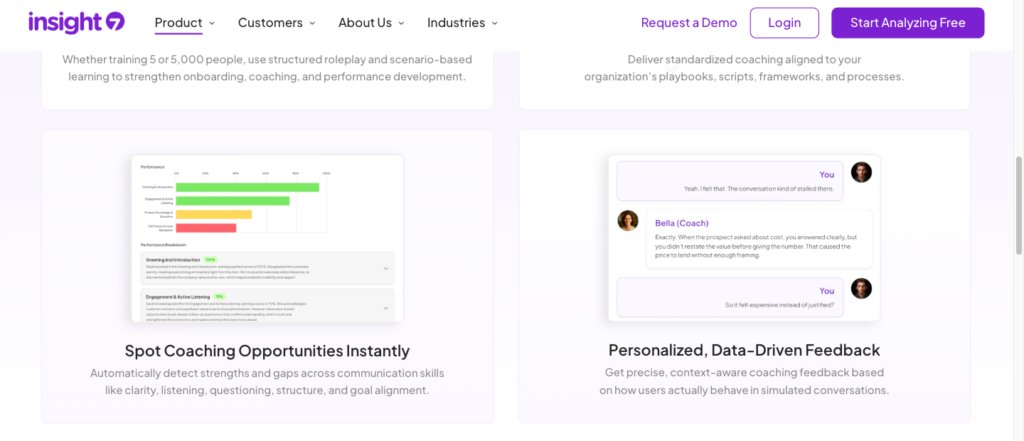
The 5-Step Playbook for AI Roleplay
- Define measurable coaching goals – E.g., reduce escalations, improve objection handling, increase CSAT.
- Ingest real conversations – Calls, emails, and chat transcripts become raw data for AI analysis.
- Identify recurring skill gaps – Let patterns in performance data dictate what to coach.
- Convert gaps into roleplay scenarios – Practice failure points, not hypotheticals.
- Coach with objective evidence – Use scores and snippets. Measure improvement continuously.
This playbook transforms coaching into a repeatable, data-driven system that reliably moves the needle.
When AI Roleplay Delivers Maximum ROI
Evidence from enterprise deployments shows AI roleplay is most effective when:
- Call volume is high (>500 interactions/week).
- Rep performance varies widely (top vs bottom quartile performance gaps >20%).
- Customer experience directly impacts revenue.
- Compliance errors are costly.
- Managers cannot manually review every interaction.
In these conditions, every conversation becomes a training opportunity with measurable impact.
Choosing the Right AI Roleplay Tool
I would ask you to ask these three critical questions when planning to choose:
- What is our Primary coaching need?
- Do we need analytics tied to business outcomes?
- Do we coach globally?
The right choice should align your coaching strategy with measurable improvement, not vendor marketing.
Frequently Asked Questions About AI Roleplay Tools
1. What are AI roleplay tools for corporate training?
They convert real interactions into repeatable practice scenarios, delivering actionable, data-driven coaching insights.
2. How do I pick the right AI roleplay tool?
Align goals with strengths: conversation intelligence, adaptive practice, personalized feedback, deal-linked coaching, or workflow integration.
3. Can AI roleplay replace human coaches?
No. It amplifies coaching, making it scalable, objective, and measurable while uncovering patterns humans might miss.
4. Are AI roleplay tools secure for enterprise use?
Yes. Leading platforms enforce enterprise-grade security and compliance standards.
5. Which teams benefit most from AI roleplay?
Sales, support, CX, and QA teams, especially where performance is inconsistent, and customer experience affects revenue.