
Choosing between inbound and outbound for a first bank voice agent depends on how routine the call is, what customer context the agent can read, and how cleanly it hands over to a person.
Ground rules every script below follows
All eight scripts share one opening:
- Disclosure: "This is the bank's AI assistant."
- Identity check: "Before I share anything about your account, I need to confirm who I'm speaking with."
- Handover offer: "You can ask for a person at any time."
Disclosure is a legal duty in a growing number of places:
- EU: Article 50 has applied since 2 Aug 2026, so automated phone systems must say they are AI at first contact.
- US: AI-voice calls already need consent under the TCPA, per the FCC's 2024 ruling.
- Colorado: Public-facing conversational AI must disclose itself from 1 Jan 2027.
Gartner found that 87% of 3,566 customers want a human option. Never make callers fight for one.
Four inbound scripts for bank calls
Buyers feel the pain on inbound, but we advise starting with outbound. If you start inbound, begin with the narrowest slice: FAQ and complaint capture. Inbound needs deep CRM and knowledge base links.
Every script below runs after the shared opening. The agent should answer only from the bank's own knowledge base. Your setup must also let it read the caller's record. If it does not know, it says so and routes to a person.
1. FAQ and product questions
- Caller: "What is the fee on my savings account?"
- Agent: "Your Standard Saver fee is [amount from fee guide]."
- Caller: "Can I add a joint holder?"
- Agent: "That is not in my guide, so I won't guess. I'll connect you to a colleague now and pass on your question."
Expected outcome: Watch containment on FAQ calls, meaning calls answered with no transfer.
2. Complaint capture and ticket logging
- Caller: "My transfer failed, but I was debited."
- Agent: "I'm sorry. I can log this now. What was the amount and date?"
- Caller: "[Amount], yesterday."
- Agent: "Logged as a failed transaction, reference [ticket number]. A specialist will contact you by [time]. Anything to add?"
The agent logs and routes the complaint. It does not resolve it. Regulators in many markets set complaint deadlines and fine slow handling. In one region, a central bank fined institutions N430M in 2025 for slow handling. The log timestamp helps prove how fast you started.
Expected outcome: Watch whether a ticket is created with the right category.
3. Stuck onboarding and KYC help
- Agent: "I see your ID check started Monday but isn't finished. Shall I help you finish?"
- Caller: "The photo upload keeps failing."
- Agent: "Place the document flat in good light. I can text you a fresh link."
- Caller: "Yes, please."
- Agent: "Sent. I've noted this on your file."
People who start KYC and never finish are a common leak.
Expected outcome: Watch the KYC completion rate.
4. Pre-investment and pre-account inquiries
- Caller: "I'm thinking of investing. What do you offer?"
- Agent: "We offer [products from product guide]. Are you saving for a goal or growing money over years?"
- Caller: "Over years."
- Agent: "[Product] suits that. I can text the application link or book a call with an adviser. Which would you like?"
The agent informs and routes. It gives no personal advice.
Expected outcome: Watch the inquiry-to-account-opening rate.
Four outbound scripts for bank calls
Outbound calls are the simpler place to begin. The agent knows why it is calling, the customer record supplies the details, and you choose the audience. Each script below runs after the shared opening. Mark consent on every contact, and set calling hours and retry rules per campaign. Do not count calls where only the AI spoke as reached.
5. Pre-due-date loan repayment reminder
- Agent: "Your payment of [amount] is due on [date]. Will [account] have enough funds that day?"
- Caller: "I think so."
- Agent: "Good. If the debit fails, I'll call again with other ways to pay."
- After a failed debit: Agent: "The debit on [date] did not go through. You can fund the account for a retry, or pay by [alternate channel]."
Call before the due date, because automatic debits often fail then, and call again after a failure. A reminder is not a collection call. Keep the tone helpful, because a helped customer is more likely to pay.
Expected outcome: Watch failed debits avoided, and failed debits cured within a few days.
6. Post-disbursement loan verification
- Agent: "Am I speaking with [name]? Please confirm."
- Caller: "Yes, speaking."
- Agent: "You took a loan for [product] last week. Is that right?"
- Caller: "Yes."
- Agent: "Your instalment is [amount] for [months] months. The first payment is due on [date]."
Lenders can call the day after disbursement to confirm the loan, the instalment and the first due date. Confirm the right person first. If it is the wrong person, share nothing and end the call.
Expected outcome: Watch the verified-borrower rate and any mismatches with the application.
7. KYC or application drop-off re-engagement
- Agent: "You started opening an account on [date] but did not finish. Can I help you complete it?"
- Caller: "I got stuck on the ID step."
- Agent: "I can text a new link now. Shall I send it?"
- Caller: "Yes."
- Agent: "Sent. I'll check in tomorrow if it is still open."
Customers who sign up but never finish identity checks are a common leak for fintechs and lenders. An agent can call everyone on the drop-off list, which a small team cannot do by hand.
Expected outcome: Watch completed KYC among people called, against a similar group you did not call.
8. Post-service satisfaction survey or follow-up
- Agent: "You visited us on [date] about [service]. May I ask two quick questions?"
- Caller: "Sure."
- Agent: "Was your issue resolved? Would you like anyone to follow up?"
- Caller: "Not fully resolved."
- Agent: "I'm sorry. I've logged that and a colleague will contact you by [time]."
Proactive check-ins reach customers before they complain, though some prefer a message. Offer a text option on the call.
Expected outcome: Watch survey completion rate and real issues surfaced.
How to use and test these scripts
Pick one routine call, not all eight. Choose the one where the agent can read the customer record and hand over cleanly. Then follow these steps:
- Load the script and bank context. Add your fee guide, product guide and handover rules.
- Test it by talking to it. Role-play the caller yourself, including awkward cases like "let me speak to a person".
- Run a small pilot. Use a limited sample of customers. Banks want a short, low-risk pilot, with payment only after a measured lift.
- Score every call. Do not sample.
Define the metric before launch. Gartner's analysis of 432 AI customer-service use cases found about a quarter show positive ROI and a quarter negative. For 42% the value could not be measured. Use the metric named in each script's expected outcome.
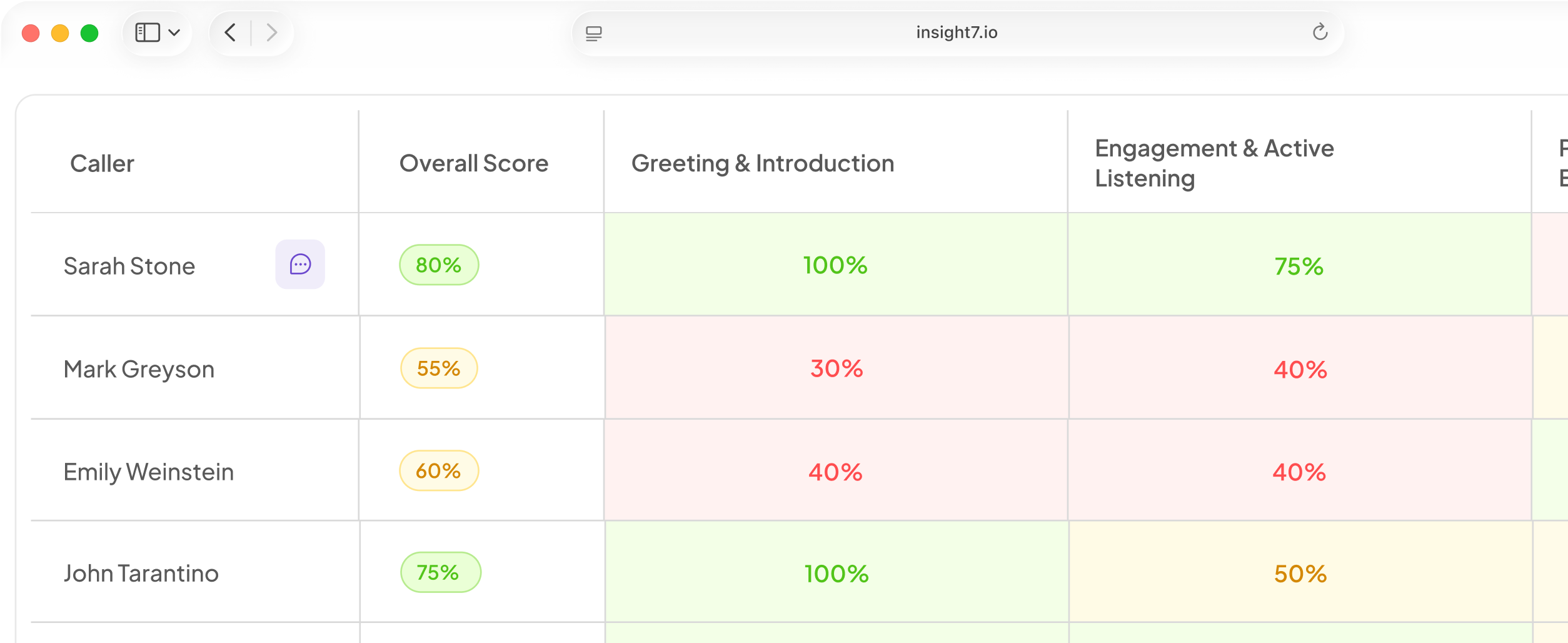
Insight7's voice agents answer inquiries and route calls from your knowledge base. Outbound campaigns are in beta. You can test the agent in the browser. A dashboard shows calls in progress and each transcript at call end. Every call can be scored against a weighted scorecard your team owns.
How to adapt the scripts to your bank
Start with the voice. Callers judge a bank by how its agent sounds, so test accents and wording with your own callers.
Next, rewrite the handover triggers. Buyers ask what happens with sensitive issues or a disputed amount, and whether anyone chases a handover nobody picked up. Write each trigger as a polite transfer with a short summary, so the customer never repeats the story. Test what the agent says when a caller goes off script.
Last, check the legal and data details:
- Disclosure: Edit the opening line to fit each region you serve.
- Data: Before go-live, ask where recordings live, which AI models touch them, and who owns them.
Related reading: How to Update a Live AI Voice Agent Script Without Breaking Compliance, How to Pause or Take Down an AI Voice Line Safely During an Incident and How to Run One AI Agent Across Phone, WhatsApp and Website Chat.
Questions people also ask
What can an AI voice agent do for a bank?
It can take routine calls end to end. Inbound, that means FAQs, complaint logging and KYC help. Outbound, it covers reminders, loan verification, drop-off follow-up and surveys. Sensitive or unknown issues go to a person.
How is AI used in banking customer calls?
Banks use it for repetitive first-level conversations where the agent can read the customer record. It answers from approved content and logs outcomes.
Should a bank start with inbound or outbound voice AI calls?
Start with the most routine call that has the cleanest handover. Outbound is usually simpler because the agent chooses the audience and the reason. Start inbound only with FAQ and complaint capture.
Do AI voice agents have to say they are AI on bank calls?
In a growing number of places, yes. The EU and Colorado both require it, and US rules add consent for AI-voice calls. Disclose in the first line anyway.
How does an AI voice agent hand a call to a human agent?
Set clear triggers: the caller asks for a person, the agent lacks the answer, or the issue is sensitive, such as a disputed amount. The transfer should pass a short summary.
How do you test an AI voice agent before it calls bank customers?
Talk to it yourself first. In beta, you can test in the browser with no phone number. Then call a real handset. Try the hard cases: a wrong person, a silent line, an unknown question and a demand for a human.
How do banks measure ROI from AI voice agents?
Pick one metric per use case before launch, such as containment or KYC completion. Compare it with a group the agent did not call. Leaders are spending more on service AI, so they need proof.
Start with one call
Which one routine call at your bank could an agent handle today, and how will you measure it?