
Should an AI voice agent own every callback and reschedule, or should people? Your answer depends on three checks. Each callback request needs a clear capture of who, when and why. The new time must fit your rules. Every callback must appear in a report.
A callback is a promise with a time
A callback request is a caller asking to be called later, or asking for a person. To count as a promise, it needs three recorded details: who asked, when they want the call, and why they want it. If any one is missing, the callback is only a loose note. A loose note is easy to forget, and the caller is left waiting for a call that never comes.
On outbound calls, the contact says "call me after 5" or "not now." A good agent repeats the time aloud and waits for a yes. Whatever tool you use, the time should then be pulled from the transcript into a structured field, so a scheduler can act on it.
On inbound calls, the caller rings a number and the AI agent answers. It can look the caller up, so it already knows who is asking. Callback requests then go to a queue. This is in beta.
Turning "tomorrow morning" into a time stamp
A scheduler needs a date, a time and a time zone. Three steps get there:
- Read the caller's time zone from their record, or ask for it.
- Convert the phrase into a precise time. "Morning" becomes a window, such as 9:00 to 11:00, and the agent offers a specific slot inside it.
- Read the result back: "So I will call you Thursday at 9:30, your time. Is that right?"
The read-back catches a wrong time zone or a mis-heard hour before it becomes a missed call.
A callback is not a hand-off
In a callback, the AI agent calls again later. In a hand-off, a person takes over. A caller who says "let me talk to someone" wants the second one. Logging that as a callback leaves them waiting for a robot to ring back. Keep both as separate labels from day one, because reports and retry rules depend on that split.
Schedule the retry inside calling hours
A requested time must pass the campaign rules before the agent dials. Those rules are calling hours, retry rules and a do-not-call list. Insight7 voice campaigns list all three as beta features, so confirm the detail in the app.
Say a contact asks for a call at 7:30 pm, but the campaign stops at 7:00 pm. The scheduler should not dial. It should offer the next open slot during the first call, or move the callback to the next window. It should also check the do-not-call list before every dial, because a contact may have opted out since they asked.
Two kinds of reschedule
- The contact asked for a time. Honour it if it fits calling hours and consent. Their time beats the default retry gap.
- The call failed: no answer, a busy line or a network error. Now the retry rules decide when to try again and how many times.
Count attempts fairly
A failed dial should not always cost the contact an attempt. A carrier's temporary refusal does not use up one of the contact's retry attempts. A call where only the AI spoke is not counted as reached, so that contact stays eligible for a retry. Without these rules, a network blip would burn a contact's tries, and a voicemail would look like a real conversation.
When you duplicate a campaign with its contacts, anyone added to the do-not-contact list since the original is left out.
Test the cadence, do not guess it
How many times to redial and what time of day works best depend on your list, your product and your market. Run a small pilot. Send a small batch in a few rounds, change one thing per round (the start time or the number of attempts), and compare answer rates.
Report each callback as a tracked outcome
A callback only counts as handled when you can see it in a report. Insight7's voice campaign tools are in beta, and they give a reviewer these views.
- Live view. A dashboard shows calls in progress.
- Per-call view. When a call ends, the reviewer can read its transcript. Yes/no answers and call outcomes are pulled from that transcript.
- Campaign view. A campaign scorecard is listed for when the campaign ends. Confirm the detail in the app.
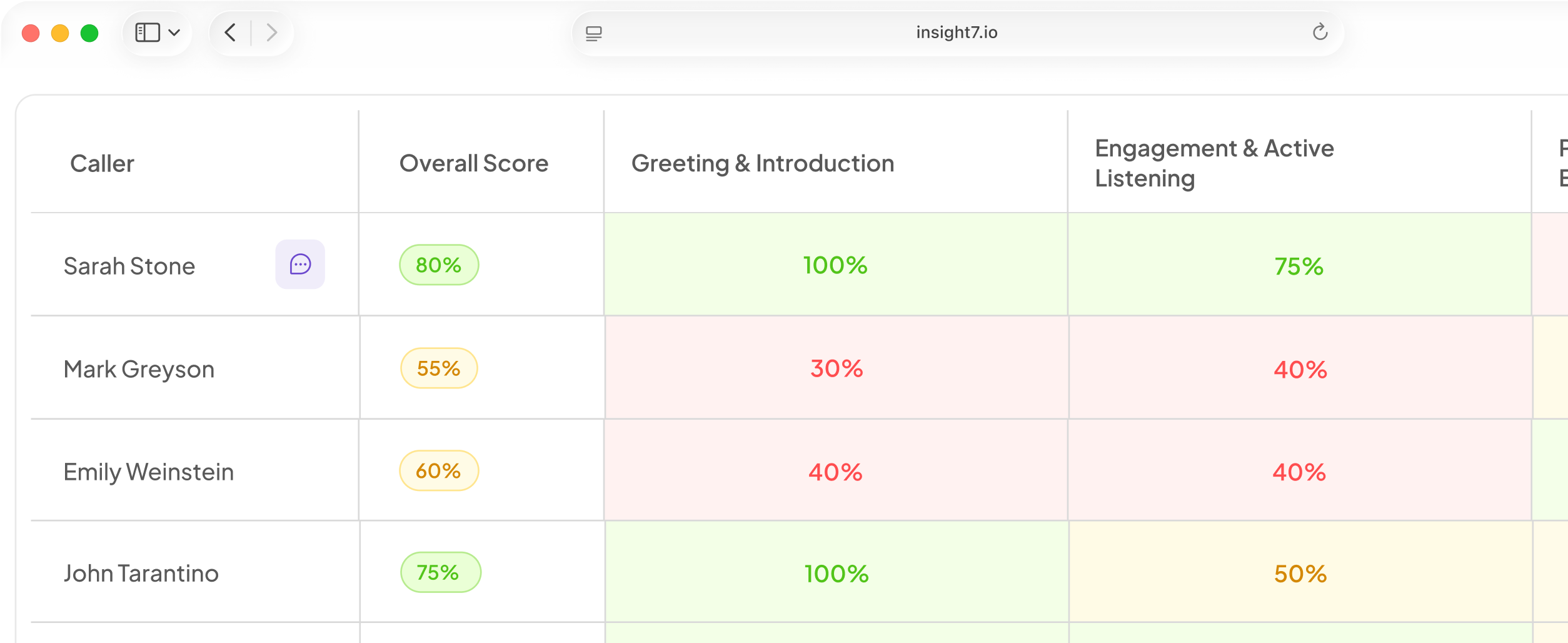
A scorecard shows the whole campaign. A callback needs its own record, or it hides inside the totals. Set up your reporting to hold five fields for every callback:
- Requested time, in the contact's time zone.
- Attempts made, so you can see how close a contact is to your retry cap.
- Final outcome. Use four states: reached, promised, completed or lapsed. "Promised" means a time was agreed but the call has not happened yet. "Lapsed" means the time passed with no completed call.
- Reason given, such as "in a meeting" or "wants a person". Grouped over a month, reasons show you where your script loses people.
- Type, either callback or hand-off, using the split from the first section.
Lapsed is the state to watch. Your lapsed count should fall toward zero each week. If it does not, look at the queue first, and make sure someone owns it.
Why an unreturned callback costs trust
When a callback is never returned, the caller has to chase the call and explain the issue again. Scheduling and reporting stop this. A promised time sits in the queue, and someone checks the "lapsed" count.
Callers also want a way out of the machine. Gartner found that 87% of 3,566 customers say a company using GenAI for service must offer a way to reach a human. A callback flow with no person behind it will fail them.
Design the hand-off before launch, because buyers raise it first. They ask whether it is polite, what happens to a sensitive issue or a disputed amount, and whether anyone chases a hand-off nobody picked up. Write the rules down: the wording of the offer, which topics go straight to a person, and who owns the queue.
Know where automatic rescheduling breaks
Automatic rescheduling fails in four places, and each one needs a rule. "Sometime next week" has no slot to book, so have the agent ask for a day and a window, or log it for a person. A shared phone means the person who answers may not be the person who asked, so confirm who is speaking before you discuss the account.
Background noise turns a mis-heard hour into a missed call, which is what the read-back is for. Polite yeses are the last trap, because "Sure, call me" can mean no. Stop after a second deferral.
Cap the retries, then hand off to a person. Pick the cap from your pilot results.
A callback never overrides a do-not-contact request. Rules differ by region:
- US: AI-voice calls need consent under the TCPA (FCC 2024 ruling).
- EU: Article 50 of the AI Act has applied since 2 Aug 2026. Automated phone systems must say they are AI from the first interaction.
Related reading: Warm Transfer vs Callback vs Ticket Handoff for AI Voice Agents Compared, How to Detect Voicemail and Avoid Wasted Minutes on AI Outbound Calls and Do Not Call List Management Guide for AI Outbound Campaigns Including Opt-Outs and Wrong Numbers.
Questions people also ask
How do AI voice agents handle callback requests?
In general, the agent hears the request, repeats the time aloud and saves who, when and why as fields. On Insight7 inbound lines, callback requests go to a queue. This is in beta.
Can an AI voice agent reschedule a call automatically?
Yes, if the new time passes your rules. Insight7 campaigns, in beta, list calling hours, retry rules and a do-not-call list. If a rule blocks the time, offer another slot or pass the contact to a person.
How does an AI voice agent know when to call back?
It uses the time the contact named, or the retry rules after a failed call. A named time wins, if it falls inside calling hours.
What happens if the customer does not answer the callback?
The retry rules decide the next try. A temporary carrier refusal does not use up an attempt. At the cap, mark the callback "lapsed" and pass it to a person.
How do I track callback requests from an AI voice agent?
Give each callback its own record, not just a line in the campaign totals. The beta dashboard shows calls in progress, and reviewers read each transcript after the call.
When should an AI voice agent hand a callback to a human?
Hand off when the caller asks for a person, raises a sensitive issue or disputes an amount. Give the person the transcript and the reason, so the caller does not have to repeat the story.
Do I need consent to call someone back with an AI voice agent?
In the US, yes. The FCC's 2024 ruling says calls that use AI technologies that generate human voices require the prior express consent of the called party. Check your consent records before every callback.
Automation needs capture, schedule and report
A callback is automated only when capture, schedule and report all work. If one is missing, a promise gets dropped. Before you start, confirm in the app that your campaign's calling hours are set, because every rescheduled time is checked against them.