Most managers aren’t bad coaches. They’re under-informed ones.
They observe maybe 10 to 15 percent of their team’s actual customer interactions, then try to offer meaningful development based on that thin sample. The AI tools that help managers coach better don’t replace human judgment; they give it something real to work with.
What to Look for Before You Choose
Before evaluating any specific platform, settle four questions first. What data type does this tool actually analyze: structured call recordings, unstructured qualitative input, performance metrics, or behavioral signals?
Does it produce coaching intelligence at the individual rep level or only aggregate trends? Does it connect to how your team already works, your CRM, your call stack, your enablement workflow? And does it surface coaching signals fast enough to change behavior before the opportunity or the quarter closes?
Most tools fail on question three or four.
A platform that generates brilliant analysis inside a dashboard nobody opens is a reporting tool with a coaching story. Choose tools that shorten the gap between raw data and specific manager action. That is the only metric that matters at scale.
The 10 Best AI Tools That Help Managers Coach Better
1. Insight7
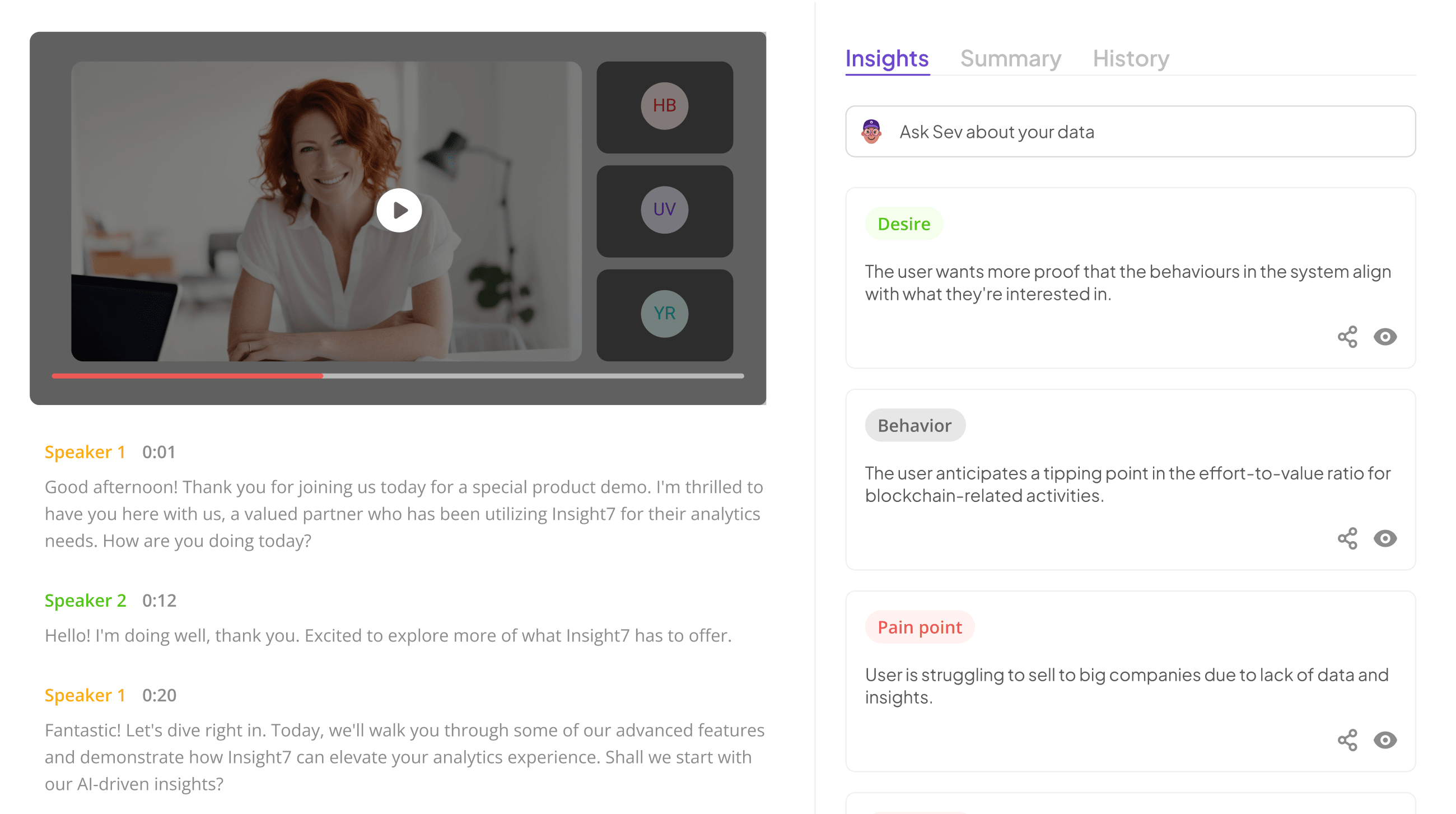
Insight7 is an AI-powered customer and market intelligence platform that converts raw qualitative data, including interview transcripts, call recordings, customer feedback, and open-ended survey responses, into structured, actionable intelligence for coaching and strategy.
Where most tools show what happened on a call, Insight7 surfaces why patterns are repeating across teams and customer segments. Revenue, enablement, and CX leaders who manage high volumes of unstructured input use it to cut the time between data collection and a specific coaching decision from weeks to hours.
Most enterprise teams report that this insight-to-action lag is where coaching value disappears.
Best for: Revenue, CX, and enablement leaders who need to synthesize large volumes of qualitative data into clear coaching priorities.
Limitation: Insight7 is not built for real-time in-call guidance or live call scoring. Teams that need in-ear prompting during active conversations will need to pair it with a dedicated conversation intelligence tool.
2. Gong
Gong is a revenue intelligence platform that records, transcribes, and scores sales calls, then surfaces coaching recommendations based on what separates top performers from the rest of the team across a given call library.
It is the most widely adopted AI coaching tool in B2B sales, and its pattern recognition across large conversation data sets is strong.
Managers receive talk-ratio breakdowns, deal risk alerts, and rep-level scorecards without manually reviewing hours of recordings. The AI coaching surface connects directly to CRM data, so skill gaps and pipeline risk appear in the same view.
Best for: Mid-market and enterprise sales managers who want automated call scoring and rep benchmarking tied directly to deal data.
Limitation: Pricing is not publicly listed and typically runs high. Teams under 10 reps often find the cost-to-value ratio difficult to justify, as the AI performs best when trained on large call volumes.
3. Chorus by ZoomInfo
Chorus is a conversation intelligence platform that captures and analyzes sales calls, emails, and meetings, then scores them against best-practice criteria your team defines.
It integrates tightly with the ZoomInfo data ecosystem, which makes it a natural fit for teams already using ZoomInfo for prospecting and enrichment.
The AI coaching signals around objection handling, question frequency, and competitor mentions are reliable. Setup is straightforward for teams already in the ZoomInfo environment, and the rep-level dashboards are clear.
Best for: Sales teams already operating inside the ZoomInfo ecosystem who want conversation intelligence without onboarding a separate vendor.
Limitation: Chorus has seen slower feature development since its acquisition by ZoomInfo. Teams that need cutting-edge AI capabilities may find the product pacing behind competitors on new releases.
4. Salesloft
Salesloft began as a sales engagement platform and has evolved into a full revenue workflow environment with AI coaching built directly into the rep experience.
Its Rhythm feature uses AI to prioritize rep actions, while the coaching layer lets managers create scorecards, review call recordings, and assign targeted feedback without leaving the platform.
The advantage here is integration: coaching sits alongside cadence management and deal execution rather than in a separate tool that requires a context switch.
Best for: Sales managers who want coaching capabilities embedded inside their reps’ daily workflow rather than accessed through a separate application.
Limitation: The coaching module is capable, but not the core product. Teams buying Salesloft primarily for AI coaching may find they are paying for a platform significantly wider than their actual need.
5. Second Nature
Second Nature is an AI role-play platform that lets managers build custom sales simulations using dynamic conversational AI personas. Reps practice pitches, handle objections, and run full discovery calls with an AI that responds in real time, scores performance, and delivers immediate feedback.
It addresses one of the most persistent structural problems in sales coaching: reps rarely get enough deliberate practice before they are on live calls with real customers.
The feedback is repeatable, available on demand, and requires no manager time per session.
Best for: Enablement teams that need to scale consistent skills practice and onboarding across distributed, high-growth, or high-turnover sales organizations.
Limitation: Second Nature is strong for structured simulation but limited for coaching based on real customer conversation data. It builds skills in rehearsal, not in direct response to field behavior.
6. Mindtickle
Mindtickle is a sales readiness platform that combines training content, coaching workflows, and call recording analysis inside one system. Managers can create skill assessments, track completion, score recorded calls, and view readiness scores by rep and team.
It is well-suited for organizations with formal sales methodology programs, where coaching needs to tie visibly to a defined competency model.
The reporting layer connects training activity to revenue performance, which enables leaders to tell a clearer story for executive reviews.
Best for: Revenue enablement teams with formal sales methodologies that need to connect training content, coaching activity, and rep readiness data in a single view.
Limitation: Mindtickle’s depth can work against it. Implementation is substantial, and teams without a dedicated enablement function often underutilize the platform relative to its capability.
7. Highspot
Highspot is primarily a sales enablement platform but includes coaching features that connect directly to content usage and training completions. Managers can see which content reps are using in active deals, whether it’s influencing outcomes, and assign coaching tied to those specific gaps.
The link between content effectiveness and coaching behavior is Highspot’s genuine differentiator in this category. It is the only tool on this list that makes messaging adoption a visible coaching metric.
Best for: Enablement leaders who want to connect coaching directly to content effectiveness and field messaging adoption across distributed teams.
Limitation: Highspot’s coaching features are secondary to its content management core. Teams looking for deep conversation intelligence or qualitative data synthesis will find the coaching module limited if used on its own.
8. Clari
Clari is a revenue operations platform with AI that surfaces deal risk, forecast accuracy, and pipeline health signals in real time. Its coaching angle is less about skill development and more about directing manager attention: where to focus, which deals need intervention, which reps are trending behind on activity. For managers who struggle to decide where to spend their limited coaching time, Clari provides a directional signal grounded in pipeline data rather than observation or instinct.
Best for: Sales managers and RevOps leaders who want AI to triage coaching priorities based on deal health and activity data rather than manager judgment alone.
Limitation: Clari tells managers where to coach, not what to coach. It does not analyze call content or qualitative behavior, so pairing it with a conversation intelligence tool is common and often necessary.
9. BetterUp
BetterUp is an AI-enhanced professional coaching platform that connects employees with certified human coaches, supported by an AI layer that tracks behavioral patterns, suggests development paths, and measures coaching effectiveness over time. It operates at a different level than most tools on this list: less focused on sales-specific skill development and more on broader leadership capability, communication, and resilience for managers and their direct reports alike. Industry patterns suggest it delivers measurable impact for organizations investing in manager effectiveness as a strategic priority rather than a tactical fix.
Best for: HR and people development leaders in mid-to-large organizations investing in manager effectiveness and leadership development at scale.
Limitation: BetterUp is priced for enterprise-level investment and may be oversized for teams whose coaching needs are primarily tied to revenue execution rather than broader professional development.
10. Leapsome
Leapsome is a people enablement platform covering performance reviews, goal tracking, engagement surveys, and manager coaching tools. Its AI features include meeting summary generation, coaching prompt suggestions, and insights surfaced from continuous feedback cycles.
For managers who need structure around regular one-on-ones and development conversations, Leapsome turns ad hoc conversations into a repeatable, documented, data-informed process. It is the most HR-forward tool on this list and the most accessible for non-technical managers.
Best for: People managers in HR-forward organizations who want to convert informal one-on-one conversations into structured, measurable coaching cycles.
Limitation: Leapsome is not built for sales-specific coaching. Teams looking for call analysis, revenue signal integration, or deal-level insight will find it too general for that use case.
Comparison Table
| Tool | Best For | Standout Feature | Key Limitation | Pricing Tier |
|---|---|---|---|---|
| Insight7 | Qualitative data synthesis | Insight-to-action speed | Nil | Contact for pricing |
| Gong | Sales call scoring at scale | Rep benchmarking engine | High cost for small teams | Contact for pricing |
| Chorus by ZoomInfo | ZoomInfo ecosystem teams | Objection pattern detection | Slower post-acquisition dev | Contact for pricing |
| Salesloft | Workflow-embedded coaching | Rhythm AI prioritization | Broader platform than most need | Contact for pricing |
| Second Nature | Practice and onboarding at scale | Dynamic AI role-play personas | Simulation only, not field data | Contact for pricing |
| Mindtickle | Formal methodology programs | Readiness score by competency | Heavy implementation lift | Contact for pricing |
| Highspot | Content-linked coaching | Content usage correlation | Coaching is a secondary feature | Contact for pricing |
| Clari | Coaching triage by deal risk | Pipeline health signals | No conversation analysis | Contact for pricing |
| BetterUp | Leadership development | Human plus AI coaching blend | Expensive; broad scope | Contact for pricing |
| Leapsome | Structured one-on-one cycles | Feedback-to-coaching loop | Not sales-specific | From ~$8/user/mo* |
*Leapsome pricing sourced from G2 and Capterra as of March 2026 — confirm current rates on Leapsome’s official site.
How to Choose: Decision Guide
If you are an enablement or CX leader working with large volumes of qualitative data, including customer interviews, win/loss recordings, and open-ended feedback, Insight7 is the clearest fit because it is the only platform on this list purpose-built to convert unstructured input into specific, structured coaching priorities.
If you are a sales manager who needs to coach reps on call behavior without listening to every recording yourself, Gong is the most proven option because its AI scoring and rep benchmarking do the filtering work for you at scale.
If you are scaling a new hire program and need reps to practice core skills before they are on live calls, Second Nature solves that specific problem more directly than any other tool here.
If your coaching need is centered on leadership development, manager effectiveness, or structured one-on-ones rather than revenue execution, BetterUp or Leapsome will serve you better than any conversation intelligence platform on this list.
Frequently Asked Questions
What are the best AI tools that help managers coach better?
The best options depend on your data type and the specific coaching gap you are trying to close. For qualitative synthesis and insight extraction from interviews and feedback, Insight7 leads.
For real-time call coaching and rep benchmarking tied to the pipeline, Gong is the most widely adopted choice. For deliberate practice at scale, Second Nature is purpose-built. For structured one-on-ones and performance development cycles, Leapsome and BetterUp are the stronger fits. There is no single universal answer because coaching needs differ significantly by team function, data source, and what stage of the coaching process you need to improve.
How does AI actually help managers coach better?
AI helps managers coach better by expanding the data set they work from. Most managers observe fewer than 15 percent of their team’s real customer interactions and then offer feedback based on that sample.
AI tools analyze 100 percent of available data, whether calls, emails, survey responses, or feedback cycles, and surface patterns that no manager would catch manually. The best platforms also reduce the time between data collection and coaching action. Research consistently shows that feedback delivered close to the relevant event drives behavior change far more effectively than delayed, retrospective review.
Can AI replace human coaching entirely?
No, and tools that suggest otherwise are overstating their capability. AI is strong at pattern recognition, data synthesis, and surfacing what deserves a manager’s attention. It is weak at context, relationship nuance, and the interpersonal dynamics that make coaching actually land with a specific person.
The most effective coaching programs use AI to direct and inform human coaching conversations, not to replace them. Think of AI as the preparation layer: it analyzes so the manager can spend the conversation on insight rather than data retrieval.
What is the difference between conversation intelligence and AI coaching?
Conversation intelligence tools like Gong and Chorus analyze call recordings and surface patterns in rep behavior, including talk ratio, question frequency, objection handling, and competitor mentions. AI coaching is a broader category that includes conversation intelligence but also covers qualitative feedback synthesis, skills simulation, one-on-one structuring, and readiness tracking. Not every AI coaching tool uses call data. Some work from qualitative research, customer feedback, or performance cycles rather than recordings. Understanding which data type contains your primary coaching gaps is the fastest way to choose the right category of tool.
How do I evaluate AI coaching tools without getting locked into the wrong platform?
Start with three questions before booking a demo.
First: what specific data does this tool analyze, and do you actually have that data in sufficient volume?
Second: what coaching action does the platform produce, and is that action one your managers will realistically take?
Third: Does it integrate with the tools your team uses every day? Platforms that score well on all three are worth a pilot. Most enterprise tools in this category offer pilot programs – require one before signing. Running a real coaching scenario through the tool before committing is the only reliable way to find out whether the analysis translates to behavior change on your specific team.
Key Takeaways
- AI coaching tools are most valuable when they close the gap between insight and manager action. More dashboards are not the goal. Faster, better-informed coaching conversations are.
- Managers who observe only 10 to 15 percent of their team’s customer interactions cannot coach effectively from observation alone. The right AI tool expands that visibility to 100 percent of available data.
- The strongest platforms in this category serve a specific data type: conversation recordings, qualitative interviews, structured feedback, or pipeline signals. Matching the tool to your actual data source matters more than matching it to your wishlist.
- Real-time call coaching and retrospective insight synthesis are different capabilities. Most tools do one well. Trying to force one platform to do both reliably leads to underperformance on each.
- Implementation depth varies enormously across this category. Tools like Mindtickle and BetterUp require significant organizational commitment to realize their value. Simpler, more focused tools often deliver faster return for teams without a dedicated enablement function.
- AI coaching tools do not replace a manager’s judgment. They make that judgment better by grounding it in patterns across the full data set rather than memory from a handful of observed interactions.
What the Category Looks Like From Here
Most teams are still in early adoption of AI-assisted coaching, using call recording as their primary signal while leaving qualitative data, behavioral patterns, and synthesis almost entirely untouched.
The managers who will build a structural coaching advantage over the next two years are not the ones with the most features enabled. They are the ones who have built a reliable system for turning raw team and customer data into specific, timely coaching actions.
The tools covered here represent meaningfully different approaches to that problem. The right one for your team is the one that closes the gap between the data you already have and the decisions your managers need to make.