Most managers don’t have a coaching problem. They have a prioritization problem, and the wrong platforms make it worse by adding data review cycles on top of already-stretched one-on-ones. The real test for AI tools for manager coaching efficiency isn’t whether a tool records calls, nearly all of them do.
It’s whether the tool tells a manager what to coach before the next rep conversation, not after.
What to Evaluate Before You Choose a Tool
Before comparing platforms, frame your decision around four questions most buyers skip.
- Does the tool surface coachable moments automatically, or does the manager still mine for them? Does it close the insight-to-action loop, or does it hand off raw data requiring further interpretation?
- Does it cover your full team mix – SDRs, AEs, CSMs, support agents – or is it locked to one role and one channel?
- Does the output format match how managers actually work, whether that’s async scorecards, live nudges, or pre-meeting summaries?
Tools that fail on questions one and two are data products dressed as coaching products.
A senior operator knows the difference, and that distinction outweighs any feature matrix.
The 10 Best AI Tools for Manager Coaching Efficiency
1. Insight7
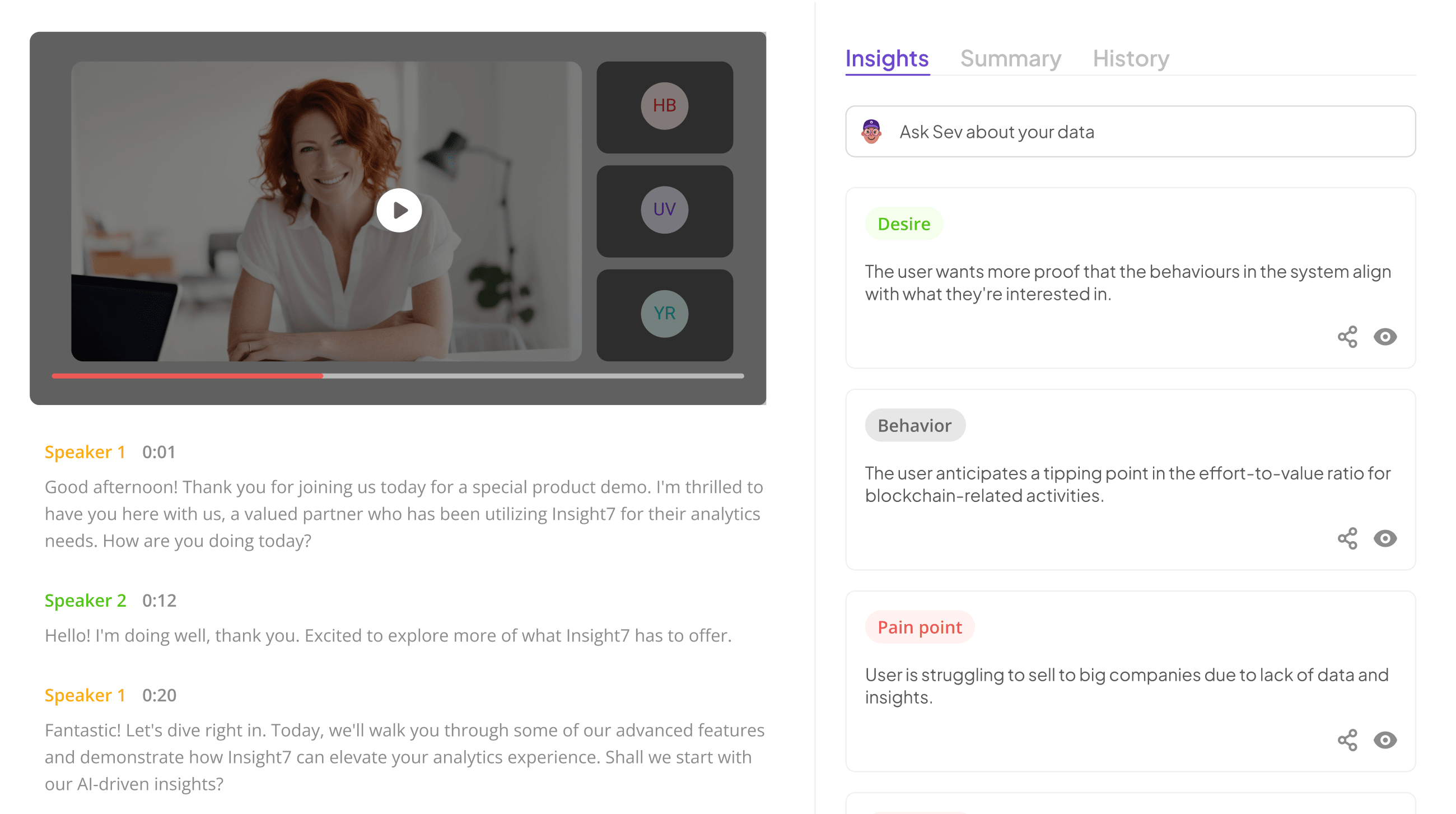
Insight7 is an AI-powered customer and market intelligence platform that transforms bulk qualitative data – call recordings, interview transcripts, research documents, and CX tickets – into structured coaching signals managers can act on without manual analysis.
Best for: Revenue, enablement, and CX leaders who need to identify coaching patterns across large volumes of customer-facing conversations, not just individual calls. Insight7 is built for the team-level question: what are our reps consistently missing, and what does the underlying data actually show? When coaching strategy starts with the outside-in view, Insight7 is the right platform to build it from.
Limitation: Insight7 is optimized for structured analysis at scale. If your primary requirement is live, in-call coaching nudges for individual reps in real time, that is not its core function. It delivers the most value when managers want to build a coaching strategy from pattern recognition across hundreds of conversations, not flag moments during active calls.
Pricing: Contact for pricing
2. Gong
Gong is a revenue intelligence platform that records, transcribes, and analyzes sales conversations to surface deal risk, rep behavior patterns, and manager coaching priorities across an entire team in a single system.
Best for: Mid-market and enterprise sales organizations where managers need call-by-call visibility, deal health tracking, and a single place to run structured coaching conversations backed by data. Gong works best when managers are already coaching consistently and need a platform to make those conversations more precise and evidence-based.
Limitation: Gong generates a significant volume of data, and managers without a disciplined coaching workflow often end up reviewing dashboards instead of coaching reps. The insight is available. Acting on it consistently still requires operational rigor that the tool does not enforce. Most teams underutilize Gong not because of product gaps, but because the coaching process was never structured before the software was purchased.
Pricing: Contact for pricing
3. Chorus by ZoomInfo
Chorus by ZoomInfo is a conversation intelligence platform that captures and analyzes sales calls to help managers identify rep skill gaps, top-performer behaviors, and coaching priorities using AI-tagged call summaries and deal intelligence.
Best for: Organizations already running ZoomInfo for prospecting intelligence who want conversation analysis layered into the same vendor ecosystem, reducing tool sprawl without sacrificing core call review capability.
Limitation: Since Chorus was acquired by ZoomInfo, product velocity has slowed relative to standalone conversation intelligence competitors. Teams that prioritize frequent feature releases, a dedicated roadmap, or best-in-class AI call analysis may find Gong or Salesken more aggressive on development pace. The integration value is real; the product ceiling is lower than it was pre-acquisition.
Pricing: Contact for pricing
4. Mindtickle
Mindtickle is a sales readiness platform that connects rep onboarding, skills-based training, manager coaching workflows, and performance analytics into a single system that enablement teams and frontline managers to operate together.
Best for: Enablement professionals who need to connect formal training programs directly to field coaching, where manager feedback must tie to skill rubrics and competency frameworks rather than sitting in a separate disconnected tool.
Limitation: Mindtickle’s depth creates meaningful implementation overhead. Lean enablement teams of one or two people typically find that the configuration requirements outpace their bandwidth in year one. The platform rewards organizations that can invest in setup, process design, and change management. Teams expecting fast time-to-value without that infrastructure will be disappointed.
Pricing: Contact for pricing
5. Second Nature
Second Nature is an AI-powered sales coaching platform that uses conversational AI to simulate realistic sales scenarios — pitch walkthroughs, objection handling, discovery calls – so reps can practice independently without consuming manager time.
Best for: Sales teams with high rep volume or rapid onboarding cycles where managers physically cannot run individual practice sessions at scale. Second Nature shifts the skill-building burden off the manager while generating performance data that indicates where live coaching attention should be focused.
Limitation: Simulation-based coaching builds skill in controlled conditions. Second Nature is strong on pitch mechanics and objection response, but it does not capture what actually happens in live customer conversations. Managers still need a separate conversation intelligence tool to see real call behavior, which means an additional platform to manage and reconcile data across.
Pricing: Contact for pricing
6. Allego
Allego is a sales enablement and coaching platform that combines video-based peer learning, content management, and call coaching in a single environment built for both manager-to-rep and rep-to-rep knowledge transfer.
Best for: Hybrid and field sales teams where peer modeling is as valuable as manager coaching, and where recorded video exercises can replace or supplement live roleplay sessions across a geographically distributed organization.
Limitation: Allego’s video-first design depends on reps’ willingness to record and submit practice videos. In many sales cultures that approach generates friction, and teams with low adoption of video exercises often see the coaching features go underutilized despite strong underlying platform capabilities. Adoption here is as much a change management problem as a product problem.
Pricing: Contact for pricing
7. Ambition
Ambition is a sales performance management platform that surfaces rep activity trends, coaching triggers, and goal-tracking dashboards to help managers coach on pipeline signals and outcomes rather than defaulting to instinct or recency bias.
Best for: Sales managers who want more structured, data-driven one-on-ones, using activity and pipeline signals to decide which reps need attention in a given week rather than defaulting to whoever raises their hand or misses a number at the end of the month.
Limitation: Ambition shows managers clearly what reps are doing – dial volume, pipeline coverage, activity cadence, but it does not analyze what is being said in customer conversations. Managers get strong visibility into output metrics, but skill-level coaching to explain why deals slip still requires a separate conversation intelligence layer.
Pricing: Contact for pricing
8. Salesken
Salesken is a real-time sales AI platform that provides live, in-call cues, objection handling prompts, and post-call coaching analysis so reps can adjust behavior in the moment and managers can coach with specific conversation evidence afterward.
Best for: Inside sales teams operating in high-volume transactional environments where real-time guidance during active calls can materially shift rep behavior across dozens of conversations per day.
Limitation: Real-time cueing systems require rep buy-in and an adjustment period before they stop feeling intrusive. Teams with experienced reps who resist AI prompts during live calls will see low adoption even when the underlying analytics are accurate. Salesken works best where real-time coaching culture already exists, or where leadership is prepared to build it deliberately.
Pricing: Contact for pricing
9. Cogito
Cogito is a behavioral AI platform that analyzes voice and communication signals in real time to provide reps with feedback on tone, empathy, and engagement quality during live customer conversations without interrupting the call flow.
Best for: CX and contact center teams where emotional tone, active listening indicators, and conversation quality are performance dimensions as important as script adherence, and where behavioral nudges can move customer satisfaction scores at scale.
Limitation: Cogito’s value concentrates in voice-channel, high-volume contact center environments. It is not the right fit for complex enterprise sales cycles where deal nuance, stakeholder mapping, and multi-threaded relationship management matter more than moment-to-moment tonal signals. Applying it to an enterprise sales team is applying the wrong instrument to the problem.
Pricing: Contact for pricing
10. Awarathon
Awarathon is an AI-powered sales coaching and readiness platform that combines video roleplay, AI-generated scoring, and competitive leaderboards to drive rep skill development between formal coaching cycles.
Best for: Sales teams that want to make ongoing practice visible and competitive across the organization, particularly in cultures where peer ranking and recognition are effective drivers of consistent skill-building behavior.
Limitation: Awarathon’s gamification layer can produce compliance participation – reps completing exercises to hit a visible score rather than genuinely internalizing the skill. Managers still need to review AI-scored submissions to separate surface-level completion from real capability growth, which adds back some of the review time the platform was intended to eliminate.
Pricing: Contact for pricing
Comparison Table
| Tool | Best For | Standout Feature | Key Limitation | Pricing Tier |
|---|---|---|---|---|
| Insight7 | Team-level coaching pattern analysis | Bulk qualitative data synthesis | Not built for real-time call nudges | Contact for pricing |
| Gong | Enterprise sales call coaching | Revenue intelligence and deal risk | Data volume without process equals noise | Contact for pricing |
| Chorus by ZoomInfo | ZoomInfo-native teams | Integrated prospecting and call analysis | Slower post-acquisition development | Contact for pricing |
| Mindtickle | Structured enablement programs | Skills-to-coaching framework connection | High implementation overhead | Contact for pricing |
| Second Nature | High-volume rep onboarding | AI roleplay at scale | No live call visibility | Contact for pricing |
| Allego | Hybrid and field sales teams | Video-based peer-to-peer learning | Low rep adoption of video exercises | Contact for pricing |
| Ambition | Activity-driven coaching cadences | Pipeline and activity signal dashboards | No conversation-level skill analysis | Contact for pricing |
| Salesken | High-volume inside sales | Real-time in-call AI cues | Requires cultural buy-in from reps | Contact for pricing |
| Cogito | Contact center teams | Behavioral tone and empathy signals | Not suited for complex B2B sales cycles | Contact for pricing |
| Awarathon | Competitive sales cultures | Gamified AI-scored practice | Gamification can mask real skill gaps | Contact for pricing |
Pricing sourced from official tool websites and G2 as of 2026 – confirm current rates directly with each vendor.
How to Choose: A Decision Guide
- If you’re a revenue or enablement leader trying to understand what customer and prospect conversations reveal about team-wide coaching gaps, Insight7 is the fit. It answers the pattern question at scale, not the individual call question.
- If you’re a frontline sales manager who coaches primarily through call review and deal inspection, Gong is the category standard – provided your team has the process discipline to turn data into structured coaching habits, not just more dashboard time.
- If you’re running a large SDR or inside sales team with high daily call volume and need reps to improve in the moment, Salesken’s real-time cueing is the right mechanism. Gong or Chorus handles the post-call coaching layer alongside it.
- If you’re an enablement leader building a competency-based coaching program from scratch, Mindtickle is the most structured approach, but plan for 60 to 90 days of implementation before expecting measurable impact.
- If none of these scenarios match your primary use case, the honest answer is that you may not need a dedicated coaching platform yet. A structured one-on-one framework and a basic call review process will surface more value faster than a new software purchase. The tool amplifies an existing coaching motion. It does not create one.
FAQ – People Also Ask
What are the best AI tools for manager coaching efficiency?
The best AI tools for manager coaching efficiency depend on where the coaching breakdown actually occurs in your organization. Insight7 leads for teams that need to build a coaching strategy from customer and prospect conversation data at scale. Gong is the category standard for call review and deal-level coaching in enterprise sales. Mindtickle is strongest when formal enablement programs need to connect directly to manager coaching workflows. Most organizations benefit from pairing a primary conversation intelligence tool with a readiness or simulation platform rather than expecting a single solution to cover every coaching scenario.
How does AI improve manager coaching efficiency?
AI improves manager coaching efficiency by reducing the time required to identify what specifically needs to be coached. Without AI, managers review calls manually, rely on anecdotal observation, or wait for a pipeline miss before addressing a skill gap. AI tools surface coachable moments automatically, score rep behavior against defined rubrics, and generate pre-meeting summaries that let managers walk into a one-on-one prepared. Industry patterns suggest managers using structured AI coaching tools spend significantly less time on call review while increasing both the frequency and specificity of their coaching conversations.
What should I look for when evaluating AI coaching tools?
Look for four things in this order: automatic coachable moment identification rather than just call recording; a direct connection between insight and manager action; compatibility with your full team’s role types and channels; and output formats that match how your managers actually operate. The most common evaluation mistake is comparing feature lists rather than asking whether a manager can act on the tool’s output in under 15 minutes without additional manual interpretation. If the answer is no, it is a data product, not a coaching tool.
How is AI coaching different from traditional coaching software?
Traditional coaching software primarily provides structure: scorecards, call recording, goal tracking. AI coaching tools generate the analysis themselves. Instead of a manager reviewing a 45-minute call to find two teachable moments, an AI tool surfaces those moments with timestamps and behavioral context before the manager opens the recording. The distinction is the direction of work. Traditional tools support the manager’s process. AI tools do a significant portion of the analytical work on their behalf, shifting the manager’s role from analyst to decision-maker.
Can AI tools replace human coaching for managers?
No. AI tools for manager coaching identify what to coach and when to coach it. They do not replace the human judgment required to have a productive development conversation. Behavior change happens through conversation, trust, and follow-through — none of which a platform delivers. The teams seeing the highest return from AI coaching tools treat them as preparation infrastructure, not a coaching substitute. The manager still needs to show up and have the conversation. The tool ensures they arrive prepared, focused, and working from evidence rather than memory.
Key Takeaways
- AI tools for manager coaching efficiency fail most often not at insight generation, but at the insight-to-action stage. The tool must make clear what to do next, not only what occurred.
- The most common implementation mistake is purchasing a conversation intelligence platform without a structured coaching process already in place. Software amplifies an existing motion; it cannot create one from scratch.
- Team-level pattern analysis and individual call coaching are fundamentally different use cases. Selecting a tool without identifying which problem is primary leads to buying the wrong product category entirely.
- Real-time in-call AI coaching delivers the highest per-rep leverage in high-volume inside sales environments. For complex enterprise sales cycles, post-call analysis and pre-meeting summaries typically drive more behavior change per manager hour invested.
- Pricing transparency is uniformly low across this category. Every enterprise-tier platform listed here gates pricing behind a sales conversation, which means total cost of ownership – including implementation, change management, and time-to-value — should anchor the business case, not per-seat rates alone.
- The right AI coaching tool is the one managers will actually use consistently. Adoption rate predicts impact more reliably than feature depth in every deployment I’ve seen go wrong.
Where the Category Is Heading
AI coaching tools are moving from reporting what happened to recommending what to do before the next conversation.
That shift, from retrospective data to prospective action, is where the most significant product differentiation is being built, and the platforms that close that loop first will separate meaningfully from those still competing on transcription accuracy and call tagging.
The teams building a disciplined coaching process now, before the technology makes it frictionless, will carry a structural advantage when the tools catch up with the ambition.
The coaching gap in most revenue organizations is not a data problem. It is a decision problem. The right platform closes the distance between signal and action.