Sales managers who rely on rep self-reporting to evaluate call quality are working with incomplete information. Reps describe their calls as better than they were. Managers don't have time to review every recording. The gap between what actually happened on a call and what gets reported leads to coaching decisions based on anecdote rather than evidence.
This guide covers how to evaluate sales call experience systematically, using AI transcription and analysis to convert raw recordings into structured performance data.
Why Traditional Sales Call Evaluation Misses Key Patterns
Spot-checking calls manually captures a small, non-representative sample. Most teams review fewer than 10% of calls, which means the coaching picture reflects whichever calls a manager happened to pull that week rather than how a rep actually performs across deal types, pipeline stages, and customer segments.
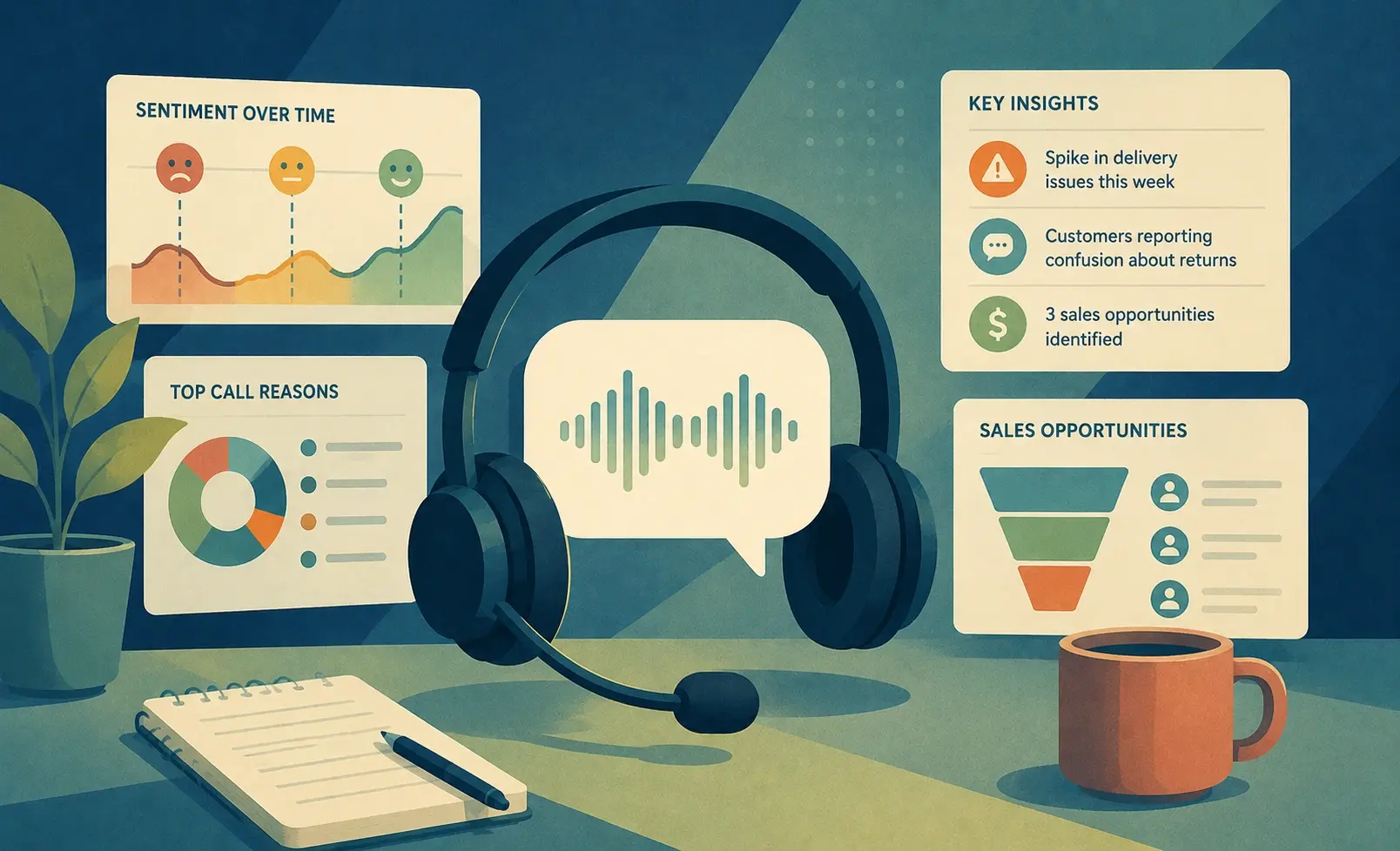
AI transcription changes this by making every call searchable and scorable. A 2-hour call processes in minutes. The transcript links to exact timestamps. Evaluation criteria get applied consistently across every call, not just the ones a manager had time to review.
How does AI transcription improve sales call analytics?
AI transcription converts audio to text with high accuracy, typically at 95% or better for standard accents, then applies evaluation logic to the full transcript rather than requiring a human to listen in real time. This enables analysis at scale: instead of a manager evaluating 5 calls this week, the platform evaluates 200, surfaces the 15 that need attention, and shows the manager exactly which moments to review in each.
The improvement isn't just efficiency. It's coverage. Patterns that only show up across 50 calls or more become visible when all calls are transcribed and scored consistently.
Step 1: Define Your Sales Call Evaluation Criteria
Before analyzing calls, specify what behaviors you're measuring. Generic categories like "call quality" or "professionalism" are too vague for consistent evaluation. Define criteria that reflect the specific sales methodology your team uses.
Common sales call evaluation criteria:
- Discovery quality: Did the rep ask at least two open-ended questions to understand buyer needs?
- Value alignment: Did the rep connect product benefits to the specific problems the buyer mentioned?
- Objection handling: How did the rep respond to price objections, competitor mentions, or timing resistance?
- Next step commitment: Did the rep secure a specific next step before ending the call?
- Talk-to-listen ratio: Was the rep listening enough or dominating the conversation?
Assign weights based on what drives conversion in your specific sales motion. For one-call-close environments, urgency and close technique deserve more weight. For complex B2B deals, discovery quality and qualification rigor matter more.
Step 2: Set Up Evaluation Criteria in Your Platform
Insight7's call analytics platform supports configurable evaluation criteria with a weighted scoring system. For each criterion, you can set the weight, specify whether you want script compliance checking or intent-based evaluation, and define behavioral anchors for what great and poor performance look like.
The behavioral anchors are critical. Without them, AI scoring diverges from what your managers would actually score. A criterion like "next step commitment" needs an exemplary anchor ("rep named a specific date and confirmed the next step on the call") and a deficient anchor ("rep ended the call without specifying what happens next") for the system to evaluate accurately.
Intent-based evaluation is generally better for sales calls than script compliance. Buyers respond differently across conversations. What matters is whether the rep communicated the intended message, not whether they used the exact words from the script.
What metrics matter most when evaluating a sales call?
The most predictive metrics for sales outcomes are discovery depth (number and quality of open-ended questions), objection handling approach (whether the rep addressed root concerns or gave surface-level responses), and next step commitment rate (percentage of calls that end with a confirmed follow-up). These three behaviors, measured consistently across all calls, give managers an objective picture of where each rep needs development.
Step 3: Build a Pre-Training Baseline
Run your evaluation criteria against 20 to 30 calls per rep before any coaching intervention. This baseline shows current performance per criterion and reveals the team-level patterns that should inform training priorities.
Look for criteria where multiple reps score low. If 70% of your reps are scoring under 50% on "value alignment," that's a training curriculum issue, not just an individual coaching issue. If one rep is an outlier on a specific criterion, that's targeted coaching work.
Insight7's per-agent scorecards cluster multiple calls into one view per rep, showing average performance with drill-down into individual calls. The revenue intelligence dashboard can also surface patterns like conversion rate by talk-listen ratio or close rate by objection handling approach, connecting individual call behaviors to actual outcomes.
Step 4: Identify Patterns, Not Just Exceptions
Most call evaluation programs focus on catching what went wrong on specific calls. The more valuable use is identifying behavioral patterns across many calls.
Common patterns that AI evaluation surfaces:
- Reps who score well on discovery but poorly on close suggest training on transition and urgency
- Reps who score well on close but poorly on discovery may be over-selling before understanding buyer needs
- A drop in scores across the full team after a product launch often indicates knowledge gaps, not skill gaps
The pattern view changes coaching from "I found a bad call this week" to "here's what your data says about where your development gap actually is."
Step 5: Connect Evaluation to Practice
Evaluation that doesn't connect to practice produces reports but not development. After identifying the criteria where a rep scores lowest, assign roleplay scenarios targeting those specific behaviors.
Insight7's AI coaching module generates practice scenarios from actual call transcripts. The hardest objection handling moments from a rep's own calls become practice templates. Reps retake scenarios until they hit passing thresholds, with scores tracked over time. The loop closes when those behaviors show improvement in the next batch of actual calls.
If/Then Decision Framework
| Situation | Action |
|---|---|
| Rep scores consistently low on discovery | Assign discovery-focused roleplay; review whether questioning habits changed in next call batch |
| Team-wide low scores on one criterion | Review training curriculum for that skill; may indicate a methodology gap not individual coaching issue |
| Scores vary widely on same rep across calls | Check whether call type or customer segment explains variance; refine criteria per scenario |
| Scores improved on practiced criteria but dropped elsewhere | Narrow coaching focus; too many simultaneous targets diffuse improvement |
Common Mistakes in Sales Call Evaluation
Evaluating without behavioral anchors. Criteria without anchors produce inconsistent scoring. A first-run score without context can diverge significantly from human judgment. Add "what great/poor looks like" descriptions for every criterion.
Reviewing only bad calls. Evaluating only low-scoring calls misses pattern identification. You need a representative sample of all calls, including high scorers, to understand what drives success on your team.
Delaying calibration. Don't rely on raw AI scores for performance decisions until the scoring model has been calibrated against human evaluation on your specific call types. Plan for four to six weeks of calibration before using scores as official performance data.
Insight7 supports the full sales call evaluation workflow, from transcript processing and criteria configuration to per-rep scorecards and AI-powered practice. See the Sales Call Scorecard Generator to build your evaluation criteria before setting up automated scoring.
FAQ
How many calls does AI transcription need to produce reliable sales analytics?
You need at least 20 to 30 calls per rep for meaningful trend analysis. Individual call scores can be noisy; patterns become reliable only at higher volumes. Automated scoring makes this achievable without adding manual review time.
Can AI evaluation identify if a rep is about to lose a deal?
Post-call AI analytics can identify deal risk patterns based on behavioral signals in recent calls, such as declining discovery depth or increasing buyer resistance language. This is different from real-time deal risk scoring, which requires live conversation analysis.