
TL;DR
- This AI contact center glossary defines 40 terms in plain words, A to Z.
- Each term is tied to what it does to your cost or your buying choice.
- Use it to read vendor quotes and decks without a translator.
Terms A to B: volume and coverage
1. Abandonment rate
The share of callers who hang up before reaching anyone. A high rate means you lose customers while paying for the lines. It is often the first sign you are short on capacity.
2. After-call work
The notes, tagging and follow-up an agent does once a call ends. It is paid time with no caller on the line. Auto-summaries cut it, so ask vendors to show the saving.
3. Agent assist
Software that helps a human agent during a live call with prompts, answers and next steps. Ask whether the prompts come from a playbook your manager controls.
4. AI agent
A voice or chat program that handles a conversation on its own. Vendors usually price it per minute or per conversation, so compare it with your cost per contact.
5. Average handle time (AHT)
The average time from call start to the end of follow-up work. It drives staffing, and under per-minute pricing it drives your bill. Shorter calls only help if the issue is solved.
6. Barge-in
When a caller talks over the AI and it stops to listen. Weak barge-in frustrates callers and stretches calls. Test it with a real interrupting speaker before you buy.
Terms C: cost, quality and risk
7. Calibration
Aligning scorers so the AI score and a human auditor agree on the same call. Review a shared batch, find the gaps, then adjust the criteria.
8. Call scoring
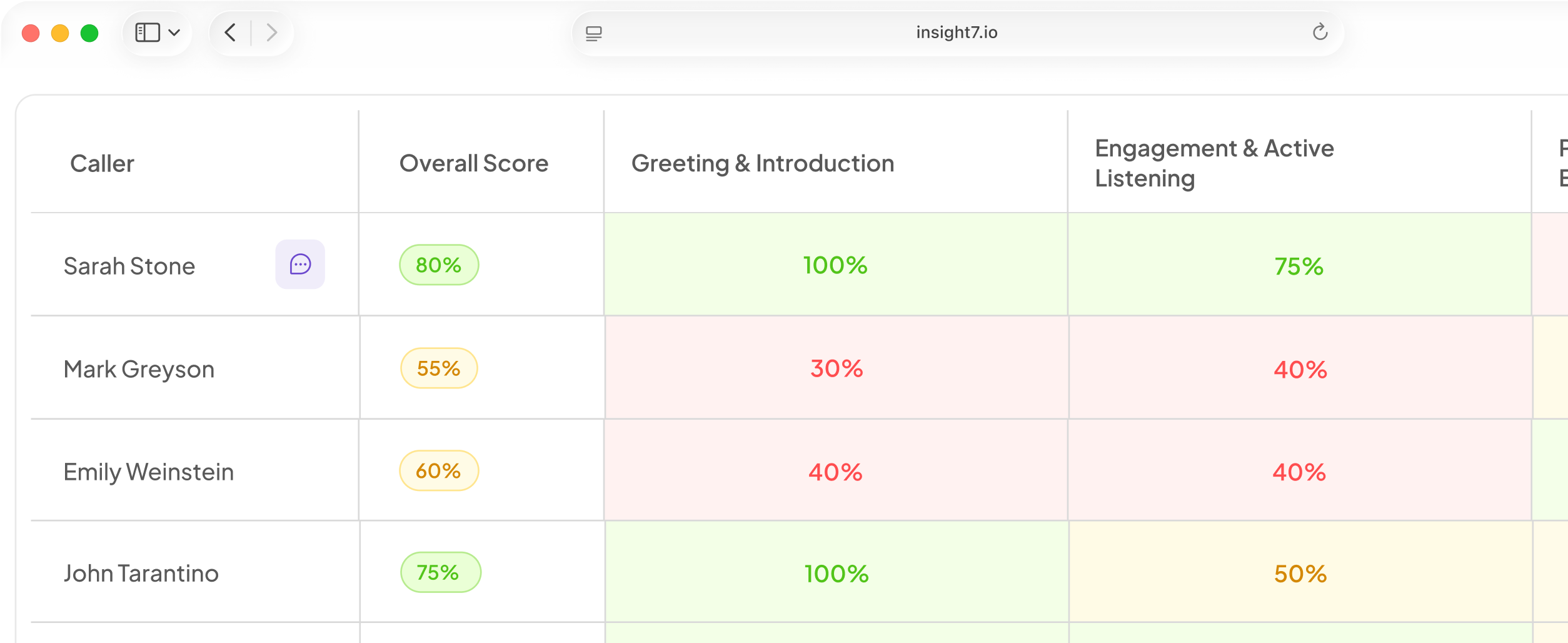
Grading calls against a scorecard. Manual QA usually samples 2% to 5% of calls. AI scoring can grade every call, with scores rolling up by person, team and organisation.
9. Concurrency
How many calls run at the same moment. It caps your capacity, so a vendor quote should state the limit.
10. Consent and AI disclosure
Rules on permission to call and on telling people they are talking to AI. They differ by region:
- US: AI-voice calls already need consent under the FCC's 2024 ruling.
- EU: Article 50 of the AI Act has applied since 2 August 2026.
- Colorado: the Chatbot Safety Act takes effect on 1 January 2027.
11. Containment rate
The share of contacts the AI finishes without a human. Vendors quote it first, so ask how they define "finished." A contact that ends in a hang-up should not count.
12. Cost per contact
Total contact center cost divided by contacts handled. Staff pay, software fees and telephony all feed it. Compare every vendor quote against it.
13. Critical error
One serious miss, such as skipping a required disclosure, that fails the whole call. A checklist score can look high while the customer leaves angry, so ask whether a vendor's scoring supports auto-fail.
14. CSAT
Customer satisfaction score, from a short post-contact survey. Few customers answer, so it misses quiet unhappy callers. Pair it with scored calls.
Terms D to F: data, handover and fixes
15. Deflection
A customer who solves the issue through self-service and never opens a ticket or call. Count only people who did not call back later.
16. Diarization
Splitting a transcript by speaker, so "agent said" and "customer said" are separate. Scoring depends on it. A mix-up can give the customer's words to the agent.
17. Disposition code
A label for how a contact ended, such as "resolved" or "callback". Clean codes make reports trustworthy and AI outcome tags checkable.
18. Escalation
Passing a contact to a human. Gartner's 2026 survey found 87% of 3,566 customers say a company using GenAI must offer a route to a human. Ask how a vendor's agent decides to hand over.
19. First contact resolution
The share of issues fixed in one contact. Repeat contacts raise your cost per contact, so this often matters more than speed.
Terms G to K: guardrails and knowledge
20. Guardrails
Rules that limit what an AI agent may say or do, such as topics it must refuse and when it must hand over. Regulated buyers, banks first, name an agent that "goes rogue" as their main blocker. Ask to see the rules written down.
21. Hallucination
When an AI states something false with confidence, such as a wrong fee or policy. Ask how the agent is kept to approved documents and how errors are caught.
22. Intent recognition
How software works out what a caller wants, such as "check my balance" or "dispute a charge." Wrong guesses send callers to the wrong place. Ask for the miss rate on your own calls.
23. IVR
Interactive voice response, the "press 1 for billing" menu. It sorts callers cheaply but can trap them in loops. Count callers who press zero for a human.
24. Knowledge base
The approved documents, guides and playbooks an agent or AI answers from. A tidy one keeps answers consistent and can cut handle time. Stale documents produce stale answers, so name an owner.
Terms L to P: buying and pilots
25. Latency
The pause between the caller finishing a sentence and the AI replying. Long pauses make callers repeat themselves or hang up. Judge it on a live call over a real phone line.
26. Omnichannel
Calls, email, chat and WhatsApp held under one customer record. Without it, customers repeat themselves. Ask whether a chat and a call really share one history.
27. Outbound campaign
A set of calls your team starts, such as a survey or a win-back. In Insight7's beta, a manager sets a goal, an audience, the AI caller and the rules. Rules cover calling hours, retries and a do-not-call list.
28. Per-minute pricing
A fee for every minute of conversation. A long, messy call costs more than a short one. Buyers want a price range in writing early, to compare vendors.
29. Pilot (proof of concept)
A short trial on a small sample of calls. Agree the success measure first, such as resolution rate. Banks tend to pay only after results show a measured lift.
Terms Q to S: quality, speech and proof
30. Quality assurance
Checking that calls meet your standards for compliance, script, tone and resolution. AI QA scores every call, so you can find problems before customers report them.
31. RAG
Retrieval-augmented generation. The AI first looks up passages in your approved documents, then writes its answer from them. This lowers made-up answers. Ask which documents it can pull from and how often they refresh.
32. Roleplay simulation
Practice against an AI persona by voice or chat, ending in a scorecard. It builds skill without risking live customers.
33. Sentiment analysis
Software that tags a call as positive, negative or neutral. Tags can miss sarcasm or a polite but angry caller. Check a sample of tags against how the call felt before you trust the dashboard.
34. Service level agreement
A written promise from the vendor on uptime, response times and fixes. Ask what you get back when they miss it, such as service credits. A promise with no remedy is only a hope.
35. Speech-to-text
Software that turns spoken audio into a written transcript. Scoring, search and summaries all read that transcript, so weak transcripts weaken everything built on them.
Terms T to W: voice and handover
36. Text-to-speech
Software that turns written words into a spoken voice. It sets how human your AI agent sounds. Listen to it in the accents your customers use.
37. Voicebot
An AI that talks with callers by phone. It is one kind of AI agent. Ask whether it can also look up a customer's record.
38. Voice of customer
Patterns pulled from thousands of calls, such as churn risk, complaints and feature requests. It turns calls you already pay for into product input.
39. Warm transfer
A handover where the AI passes the context along, so the customer does not repeat themselves. Buyers ask whether it is polite, how disputed issues are handled, and whether anyone chases an unanswered handover.
40. Word error rate
The share of words a transcript gets wrong, counting swapped, missed and added words. Accents and noisy lines raise it. Ask for the rate on your own recordings, not a clean demo file.
Related reading: 12 Best AI Call Center Software Platforms for Customer Service and Outbound Campaigns, What Is an AI Call Center Agent and How It Handles Inbound and Outbound Calls and Build vs Buy AI Voice Agents Decision Framework for Engineering and CX Leaders.
Questions people also ask
What are common contact center terms and abbreviations?
Beyond the 40 above, you will meet ACD (automatic call distributor, which routes calls to agents), WFM (workforce management, which plans staffing), ACW (after-call work) and SLA. Ask each vendor to spell out every abbreviation in its quote.
What is the difference between containment rate and deflection?
Containment counts contacts that started with the AI and ended without a human. Deflection counts customers who solved the issue by self-service before contacting you at all.
Which AI contact center terms matter most when comparing vendor prices?
Per-minute pricing, concurrency, containment rate and pilot terms matter most. Buyers want a price range in writing early. Ask how each vendor counts a "minute" and a "contained" contact.
Put your own numbers first
A clear definition of each term lets you compare quotes fairly. This week, pick the five terms that drive your cost: cost per contact, AHT, containment, per-minute pricing and pilot. Write your own number for each before the next vendor call.