
TL;DR
- Silos form because each team keeps its own calls, notes and tools.
- Pool every conversation, tag calls with shared themes, and send findings to each team on a schedule.
- Check that teams act on what they learn.
Map where each team hears the customer
Start with an audit, not a tool. List every place a customer speaks to your company, and note which team owns it.
- Sales: discovery calls, demos, follow-ups.
- Support: phone calls, chats, complaint tickets.
- Field and dealer teams: site visits, installer calls, dealer check-ins.
- Customer success: renewal and check-in calls.
- Surveys and CRM notes: scores and short written summaries.
Now look for the silo. It shows when the same customer tells sales one thing, support another, and a field visit a third. No one sees all three.
A solar financing firm worried that useful intel could sit in one team's silo, unseen by the others.
That worry is common. In most silos the data exists but has no path to the people who can act on it. A monthly NPS number does not carry a customer's objection from support to sales.
Finish this step with a one-page map: source, owner, tool, and who currently sees it.
Pull every conversation into one place
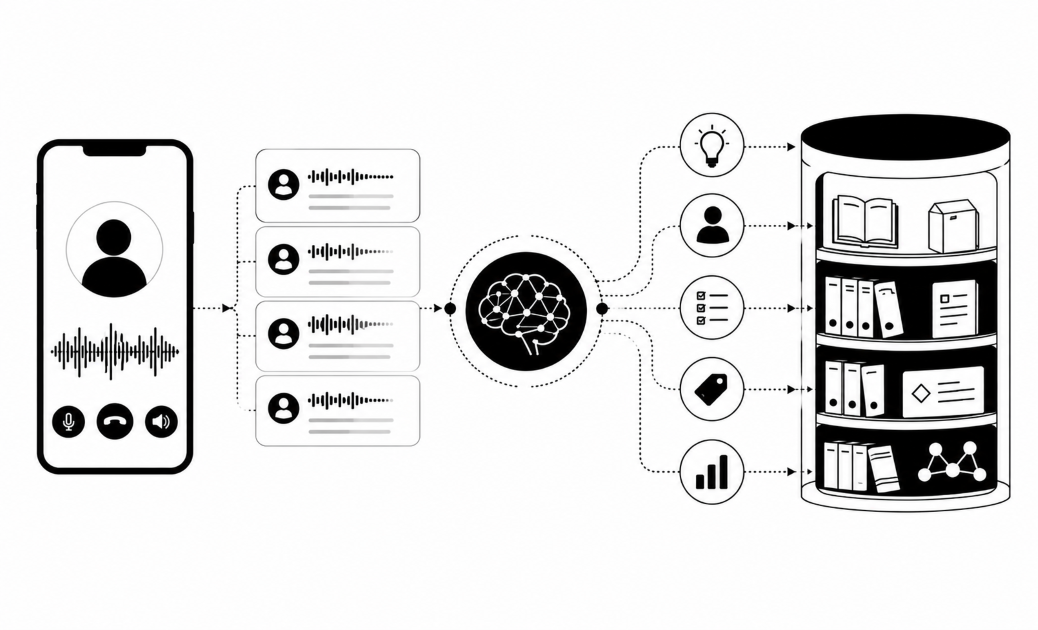
Connect every source to one pool, and keep your CRM as the record. Do this in six moves.
-
Pick your ingest routes from the map. Uploads from a computer, Google Drive and Zoom cover recordings that sit in files. Meeting platforms (Zoom, Teams, Google Meet) and phone systems (Dialpad, Aircall, RingCentral, Talkdesk, Five9) cover the live flow. Field and dealer audio can be uploaded in batches.
-
Plug in, don't replace. Every company with a working call centre first asks whether a new tool replaces its stack or plugs into it. Our advice is to plug in. Buyers want a tool that sits alongside the CRM or helpdesk and reads from it.
-
Write results back to the CRM. Transcripts, summaries and scores should return to Salesforce or HubSpot, so reps never retype notes.
-
Filter out noise. Exclude voicemail, one-sided, hold, internal and too-short calls. Dead air makes every theme count wrong.
-
Check transcription and speaker separation. Field and phone audio is noisy. Speaker separation (diarization) labels who said what. Without it, a customer's complaint can be scored as an agent's words. Test on your worst recordings: take a handful of noisy field calls and check by ear that each speaker label is right. Watch for speakerphone calls, vehicle cabs and moments when two people talk at once. If labels slip, fix the audio setup before you trust any theme count.
-
Key every call to one customer ID. Use the ID your CRM already holds for the customer, and attach it to phone, chat and field recordings as you load them. One customer's whole story then sits in one place.
Handle consent and privacy before analysis. Confirm you may record, and redact names and account numbers before text goes to any model. Review a sample of the redaction, because pattern matching can be too aggressive or too loose on proper nouns.
Tag every call with one shared language
Give every team the same theme list and the same scorecard. Without them, sales logs a problem as "pricing," support logs it as "billing confusion," and a field visit logs it as "contract surprise." Nobody can add those up.
Build the theme list in four moves:
- Start with five groups: pain points, objections, feature requests, churn risk and competitor mentions.
- Write a one-line definition and one example quote for each theme.
- Let each team add subthemes, but keep the top level fixed.
- Review the list each quarter, so it follows what customers say.
Here is how it pays off. A customer tells sales the price is too high. The same customer tells support the invoice is confusing, and tells a field visit the contract held surprises. Under one theme, "pricing clarity," these become one signal from three sources. The monthly review sees one problem with one owner.
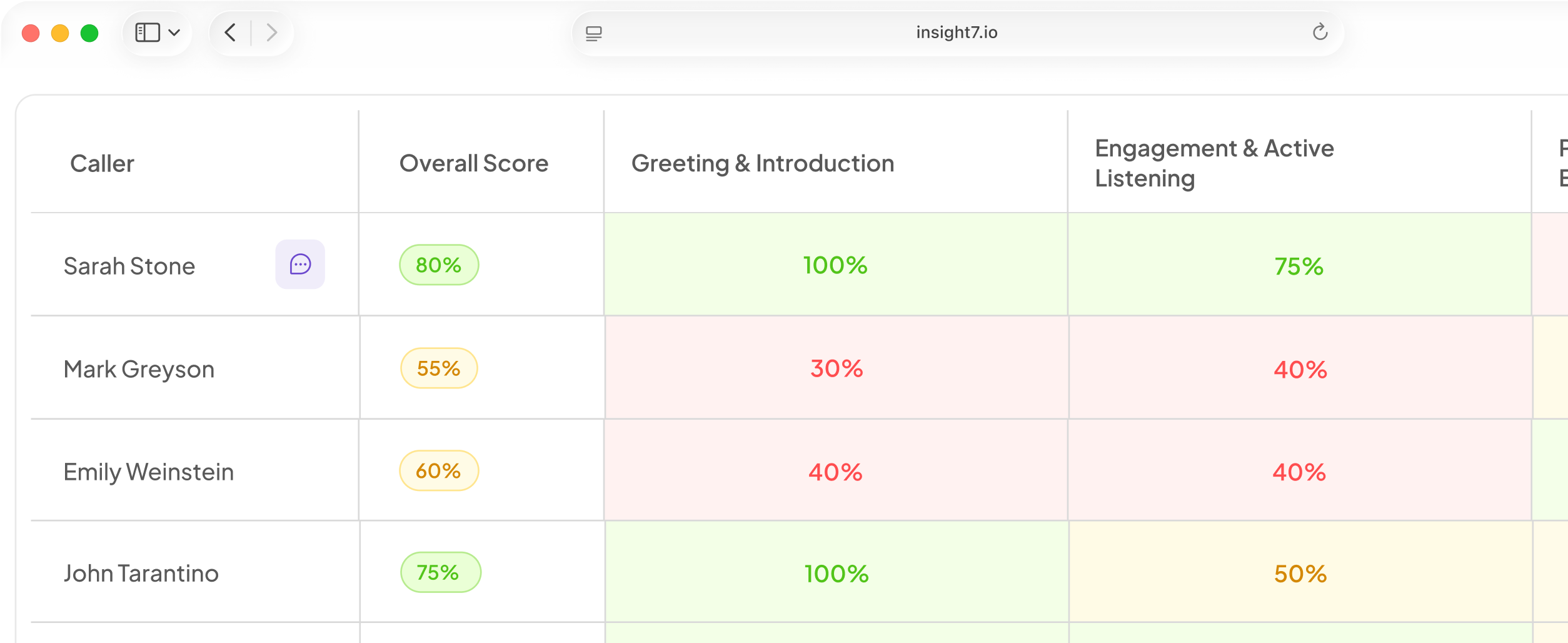
Next, score every call against one weighted scorecard your team owns, not a 2 to 5% sample. Starter rubrics give you a draft to edit. Score each stage on its own criteria. A welcome call and a renewal call should not share one rubric.
Add a critical-error rule. A checklist score can hide what matters, because a call can be perfect on procedure and still leave the customer angry. Let one critical error fail the whole call.
Insight7 scores 100% of conversations against scorecards you import or build. Its voice-of-customer analysis pulls churn risk, feature requests, competitor mentions and complaints out of transcripts. To test your theme list first, try the free VoC Feedback Analyzer and Journey Mapping Tool, which both take uploaded conversations.
Taylor Corporation used Insight7's AI qualitative analysis and thematic extraction to eliminate qualitative data silos across regional teams, and insight generation sped up 10x.
Run a monthly cross-team insight review
Hold one meeting a month where sales, support and field leads look at the same themes. Give it a single owner, such as your head of CX or revenue operations, and keep it to 45 minutes.
Run it the same way each time:
- Bring the top five themes from your shared list, ranked by call volume and change since last month.
- Make one decision per theme: fix, test, escalate or drop.
- Name one team and one date for each action.
Track four measures: share of calls covered, days from insight to action, repeat-issue rate, and whether coaching changed behaviour. Training buyers want proof that coaching changed behaviour. Compare a rep's scores before and after coaching on the gap you found.
Then close the loop through practice. A weak score on a real call can become a practice session, which stays hidden from the learner until a manager approves it.
Measurement is where programmes slip. In Gartner's analysis of 432 AI customer-service use cases, about a quarter showed positive ROI and 42% had unclear returns. An insight programme without measures will end up in that 42%.
Keep the review pointed at conversations. In our insurance sales research, top agents closed 65% of calls and bottom agents 0% under identical conditions. Small review samples keep that gap hidden. Across 6,209 sales conversations, the top 6.9% of performers asked 37% more questions per call.
Related reading: How to Personalize AI Outbound Calls With CRM and Product Usage Data, 18 Customer Data Fields to Include in AI Calling Lists for Personalized Conversations and AI Phone Surveys vs Online Surveys Compared by Response Rate, Cost and Insight Depth.
Questions people also ask
What are data silos and why are they bad?
A data silo is information that one team holds and others cannot see. It makes teams repeat work and argue over whose numbers are right. It also delays fixes for problems another team already spotted.
What causes data silos between sales and support?
Each team uses its own tools, goals and vocabulary. Sales tracks deals, and support tracks tickets. With no shared customer ID or theme list, one customer's complaint looks like two unrelated records.
How do you fix customer data silos?
Start small. Pick two teams and one customer theme, such as churn risk. Pool their calls, tag them together, and aim to show early results within a month.
How do you prevent data silos from coming back?
Give the shared pool a permanent owner. Require every new tool or channel to feed it before launch. Review the theme list each quarter, so new products and markets do not grow their own labels.
How do you share customer insights across departments?
Send insight where people already work. A weekly digest of the weakest calls can go out by email or Slack. Link to the exact call clip, so nobody needs a dashboard login.
What is the difference between a CRM and a conversation intelligence platform?
A CRM stores the fields people type in, such as stage, owner and notes. A conversation intelligence platform analyses what was said on the call. The best setups connect the two, with automated logging into the CRM.
How do you measure whether customer insight silos are gone?
Ask a sales lead, a support lead and a field lead for the top three customer complaints. If their lists match each other and the call data, the silo is closing. Then track how many themes have an owner.
Ask what sales has not heard
The customer already told your company the truth. It sits in conversations that no single team hears in full, so build one shared pool and one shared language, and give every theme an owner. Which complaint did support hear this month that sales has not?