
A support lead opens the queue on Monday and finds the same calls waiting: "Where is my order?" and "Why was I charged?" Each one was predictable. Proactive customer service calls stop them, and below are 8 scripts to copy.
1. Call before the outage hits them
Call affected customers as soon as your monitoring shows a fault. You know service is down before they do, so the first message should come from you. Much inbound volume exists because companies never send updates like this. Operators already ask for incident calls that land before a complaint does.
Sample dialogue:
- Agent: "Hi, this is Dana from [Company]. Your internet is down in your area right now."
- Agent: "An engineer found a damaged cable. We expect service back by 4 p.m."
- Customer: "Okay. Do I need to do anything?"
- Agent: "No. We'll text you the minute it's back. If it's still down at 5, reply and we'll credit today's charge."
Impact: Each customer you reach is one fewer "is it down?" call in your queue.
2. Warn about delays before they ask
Call as soon as a delivery, appointment or ticket slips past its promised time. The delay is in your system before the customer notices it. Calling first turns a "where is it?" call into a short, calm update. Operators ask for delay calls that land before a complaint does.
Sample dialogue:
- Agent: "Hi, this is Sam from [Company]. Your order is running late."
- Agent: "It will arrive tomorrow between 10 a.m. and 1 p.m."
- Customer: "I'm out tomorrow morning."
- Agent: "No problem. I can move it to the afternoon or Friday. Which is better?"
Impact: Fewer "where is it?" contacts and fewer complaints. Some customers prefer a text, so offer one.
3. Check in after install or onboarding
Call a few days after installation or signup, while the customer is still learning the product. Ask one open question, then one yes/no check. A small problem found now will not turn into a cancellation or a missed payment later.
Sample dialogue:
- Agent: "Hi, this is Maya from [Company]. I'm calling to check on your new system. It takes one minute."
- Agent: "How has it been working for you so far?"
- Customer: "Fine, but the app shows low output."
- Agent: "Thanks for telling me. Is the panel display lit right now, yes or no?"
Impact: You catch the fault before it becomes a complaint.
A solar financing company told us a customer whose system underperforms is far less willing to pay. So it puts check-ins before the first due date, ahead of collections calls.
4. Remind before the payment is due
Call two or three days before the due date, and ask the customer to fund the account. Automatic debits fail when the balance is short, and a reminder fixes that before it costs anyone anything.
Sample dialogue:
- Agent: "Hi, this is Lena from [Company]. Your payment of 120 is due this Friday."
- Agent: "Please make sure your account has enough money that day."
- Customer: "I might be short."
- Agent: "Thanks for telling me. You can also pay through our wallet or the app."
Impact: A funded account on the due date means no failed debit, so fewer collections calls and disputes follow.
A bank-affiliated consumer lender told us its repayment debits often fail on the due date. So it calls before the due date, then again after a failed debit to offer another payment channel.
5. Follow up fast on a failed payment
Call within hours of a failed debit, and open with the reason, not the blame. A reminder is not a collections call. One buyer put it plainly: a happy customer pays. A calm second call also fits the two-step pattern of reminding before the due date and calling again after a failed debit.
Sample dialogue:
- Agent: "Hi, this is Lena from [Company]. Today's payment of 120 didn't go through. It looks like the balance was short."
- Customer: "Oh, I forgot to top up."
- Agent: "That happens a lot. You can pay now through the app or our wallet. Which is easier?"
- Agent: "Done. You'll get a confirmation text soon."
Impact: You recover the payment while the customer still feels respected, and a quick fix stops a dispute.
6. Rescue customers who stall mid-signup
Call within minutes of the stall, while the customer is still thinking about it. Fintech, investment and lending teams leak customers at the same few points. People sign up but never fund, or start KYC and never finish.
Sample dialogue:
- Agent: "Hi, this is Ada from [Company]. You started opening your account a few minutes ago. It takes one minute."
- Agent: "What stopped you?"
- Customer: "The ID upload kept failing."
- Agent: "Sorry about that. I'll send a link that works on your phone. Can you finish it now, yes or no?"
Impact: The customer finishes while the problem is fresh, so fewer sign-ups sit unfunded.
Tip: track customer-caused and product-caused drop-off separately. Set interim win metrics, such as KYC to tier one, next to full conversion.
7. Win back quiet customers early
Call when usage dips, before the customer has fully left. Ask why usage dropped, and hold the discount back. A coupon offered first teaches customers to go quiet for a deal, and it hides the real reason. Start with who you are and why you are calling, because calls to lapsed customers get ignored when they do not recognise the caller.
Sample dialogue:
- Agent: "Hi, this is Tola from [Company]. I'm calling because you haven't used the app in a month."
- Agent: "Did something change for you?"
- Customer: "The offers stopped being useful."
- Agent: "Thanks. Which offers would you use?"
Impact: Asking first can surface the real reason while you can still fix it, before the customer is gone.
8. Close the loop after a complaint
Call a few days after a complaint is resolved, and check that the fix held. Ask one score question, then one "why". A clean headline number can hide real problems. A tidy NPS can sit beside objections that only show up in individual conversations.
Sample dialogue:
- Agent: "Hi, this is Ravi from [Company]. Last week we fixed your billing error. I'm calling to check it held."
- Agent: "Is the new bill correct, yes or no?"
- Customer: "Yes, but it took three calls."
- Agent: "Thanks for saying so. From 0 to 10, how likely are you to recommend us? And why that number?"
Impact: You find hidden problems behind a good score and can stop repeat complaints. Operators already ask for satisfaction surveys before a complaint arrives.
Check every call, not a sample
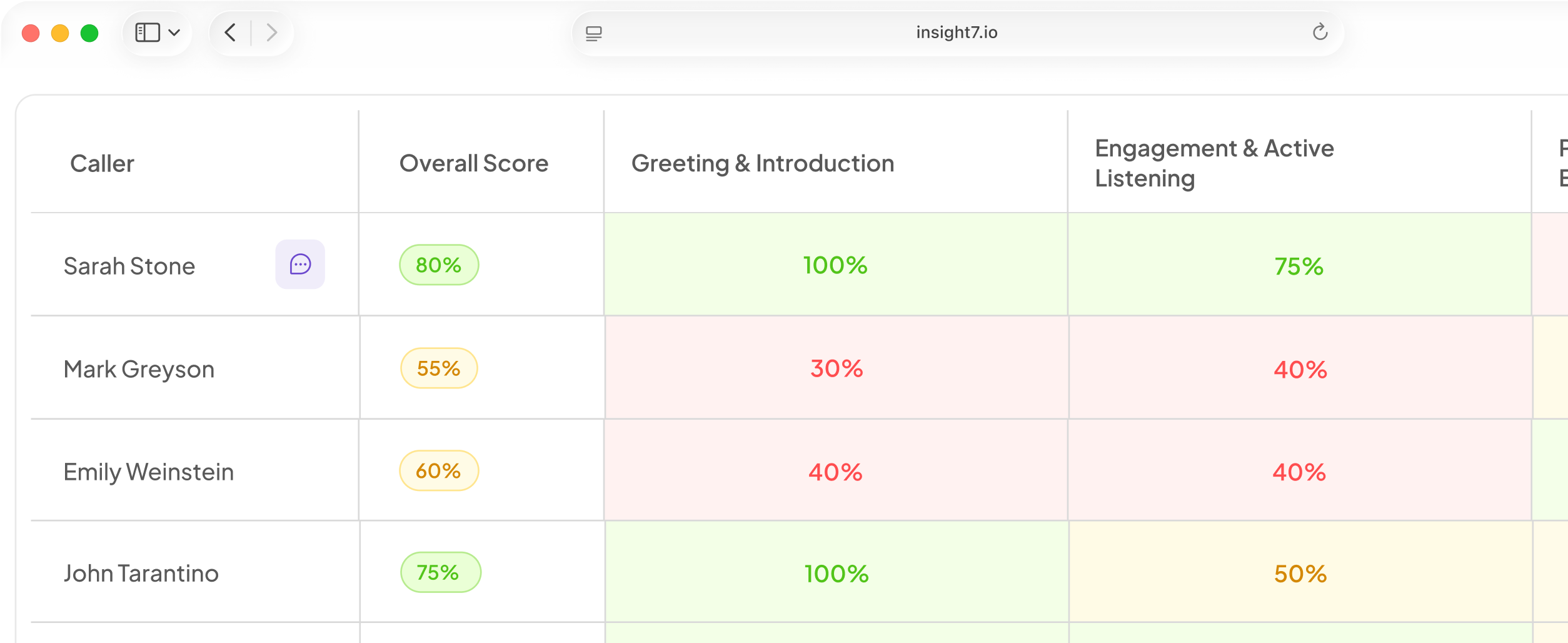
To see which scripts work, you need to hear all your calls. Insight7 scores every call against a weighted scorecard your team owns, not a sample. That lets a QA manager compare complaint-related calls before and after a new proactive script.
Adapt the scripts to your team
Change two things per scenario: the trigger and the one ask. Keep the opening line, which says who you are, why you are calling and how long it takes.
- Voicemail: Cut the script to the opening line plus one next step.
- Message-first customers: Some prefer a message to a call, so switch channel for them.
- Enterprise accounts: Keep them with a named human rep, because enterprise clients expect a dedicated person, not a bot.
- Accent and language: Staff and customers tune out foreign accents, so match the local voice.
- Critical-error rule: QA leaders say one critical error should fail the whole call. Asking for a PIN is one. Score it as a fail, even if the rest of the call followed the script.
Related reading: When to Use Human Agents Instead of AI Voice Agents With a Customer Call Decision Framework and How to Run Customer Research Interviews at Scale With AI Voice Agents.
Questions people also ask
What is proactive customer service?
Proactive customer service means reaching out before the customer has to ask. You use signals you already hold, such as an outage, a late parcel or a due date, to tell them, help them, or ask how it is going.
What are examples of proactive customer service calls?
Outage notices, delay warnings, post-install check-ins, pre-due-date reminders, failed-payment follow-ups, signup rescue calls, early win-back calls and post-complaint check-backs. Each starts from a trigger in your own data.
How can companies implement proactive customer service?
Start with one trigger already in your systems, such as a late order. Write a 30-second opening, test it on a small group, then compare complaint contacts before and after. Add scenarios once the first works.
What is the difference between proactive and reactive customer service?
Reactive service waits for the customer to raise a problem. Proactive service acts on a known signal first. To measure it, compare inbound contacts on one topic between customers you called and a similar group you did not.
What is the primary goal of proactive customer service?
The goal is to stop the problem becoming a complaint, a dispute or a cancellation. Every call should remove a future contact or save a relationship. Goodwill is a side effect, not the target.
Do proactive customer service calls need customer consent?
Often yes, especially for automated or AI-voiced calls. In the US, the FCC's 2024 ruling treats AI voices as artificial under the TCPA, so consent applies. Check the rules in each region you call.
Can AI make proactive customer service calls?
Yes, if you disclose it. Under EU AI Act Article 50, systems that talk to people must say they are AI from the first interaction. Offer an easy route to a human.
Start with one complaint reason
The cheapest complaint is the one nobody files. Insight7 can score your calls against your own scorecard, so you can see whether the new calls work. This week, pull last month's top complaint reasons, pick one with a known trigger, and write a 30-second opening that says who you are, why you are calling and the next step.