
AI call center companies all promise a human-sounding voice and a lower cost per call. After a dozen demos, nothing is fairly comparable. A weighted scorecard, a few hard fail rules and one shortlist sheet will pick the winner.
Know the four types of vendor
"AI call center companies" is a loose label. It covers four products, and each fixes a different problem.
| Type | Best for | What it replaces | Usual pricing model |
|---|---|---|---|
| AI voice agents (inbound and outbound) | Reminders, surveys, after-hours calls | Live agents on routine calls | Varies by vendor; ask |
| Conversation intelligence and QA | Scoring every call, finding risk | Manual call sampling | Varies by vendor; ask |
| Agent assist and coaching | Live prompts, practice, ramp time | Ride-alongs and generic training | Varies by vendor; ask |
| Contact center platform with AI add-ons | One vendor for routing, telephony and AI | Several separate tools | Platform license plus add-on fees |
The market is moving toward platforms. Insight7's review of 18 vendors found point tools consolidating, because several tools mean scattered data and high integration cost. Entry prices and minimum seats, often $60K or more, lock smaller teams out of enterprise point tools. Real-time assist is becoming table stakes, and QA tools must now score AI agent calls too.
Buying is risky. Gartner's review of 432 AI customer service use cases found only about a quarter with positive ROI. Another quarter were negative, and 42% could not be measured. Ask every vendor for a measurable pilot.
Start with your biggest pain: routine calls point to a voice agent, unseen risk to QA, slow ramp-up to coaching, and tool sprawl to a platform.
Score vendors on six weighted criteria
Set the weights before the first demo. That way the loudest pitch cannot set the rules. The six weights below add up to 100%.
| Criterion | Weight | What to ask | A good answer sounds like |
|---|---|---|---|
| 1. Use case fit and outcome proof | 25% | Show a result for my use case and call volume. | A reference call or pilot data with a measured number. |
| 2. Integration | 15% | Which CRM, dialer and telephony do you connect to? What are the API limits? Do you replace my stack or plug in? | Named connectors, written rate limits, no rip and replace. |
| 3. Data, security and hosting | 15% | Where do recordings live? Which models touch them? Who owns them? | Written answers, a SOC 2 report, data residency options. |
| 4. Compliance and disclosure | 15% | How does the AI say it is AI, log consent and hand off to a human? | A built-in disclosure line, consent flags, a warm handoff. |
| 5. Quality and control | 15% | How are calls scored and calibrated? What are transcription accuracy, latency, and language and accent coverage? | Scores that match a human auditor, a critical-error rule, accuracy tested on your audio. |
| 6. Total cost and pilot terms | 15% | Is pricing per minute or per seat? What are the minimums? Can I pay after a pilot shows results? | A price range in writing, a small paid-on-results pilot. |
Why data and handoff get real weight
Buyers ask about data early. They want to know where recordings live, which AI models touch them and who owns them. Score the written reply, not the sales call.
Disclosure rules differ by region, so ask each vendor how it covers yours:
- EU: Article 50 of the AI Act has applied since 2 Aug 2026. Any AI that talks to people, including automated phone systems, must say it is AI from the first interaction.
- US: AI-voice calls already need consent under the TCPA, following the 2024 FCC ruling.
- Colorado: From 1 Jan 2027, public-facing conversational AI must disclose that it is AI.
Handoff matters to callers too. In a 2026 Gartner survey of 3,566 customers, 87% said it is essential to offer a way to reach a human agent. Ask how polite the handoff is, what happens with a disputed amount, and who chases a missed handover.
QA leaders say one critical error should fail the whole call. Apply that to vendors: a great total score should not rescue one that fails on disclosure or handoff.
Score 0 to 3, then apply fail rules
Score every criterion on the same four-point scale:
- 0: no answer.
- 1: a claim only.
- 2: shown in a demo.
- 3: proven on your own data or on a reference call.
Then use this formula: weighted score = the sum of (score ÷ 3 × weight), out of 100. A vendor that scores 3 on everything gets 100.
Next, set gate rules that override the total. A vendor is out if it has:
- no AI disclosure
- no human handoff
- no written answer on data ownership
- no price range in writing
- no pilot on a small sample
Buyers want the price range in writing so they can compare vendors and brief their own teams. Banks want a short pilot on a small sample, with payment only after a measured lift. These rules follow the QA idea that one critical error fails the whole call.
Here is an illustrative example with made-up vendors.
| Vendor | Raw score (max 18) | Weighted score | Gate check | Result |
|---|---|---|---|---|
| A | 15 | 85 | Fail: no human handoff | Out |
| B | 14 | 76.7 | Pass | Advance |
Vendor A has the higher score and still loses.
Have two or three scorers (ops, IT or security, and compliance) score alone first. Then average the scores and discuss any gap of 2 points or more, as in call QA calibration.
Finish with a cost check. Compare the monthly price with your cost to serve one contact, because champions need a number to carry upstairs. Then multiply the per-minute price by your expected minutes at 2x volume. One buyer asked for this before a pilot.
Copy this vendor shortlist template
Fill in this header first:
- Use case:
- Monthly volume:
- Current stack (CRM, dialer, telephony):
- Budget range:
- Decision owner:
- Decision date:
Then copy one sheet per vendor, or use this side-by-side table. Enter a score from 0 to 3 and one evidence note in each cell.
| Criterion | Weight | Vendor 1 (score + evidence) | Vendor 2 (score + evidence) | Vendor 3 (score + evidence) |
|---|---|---|---|---|
| Use case fit and outcome proof | 25% | |||
| Integration | 15% | |||
| Data, security and hosting | 15% | |||
| Compliance and disclosure | 15% | |||
| Quality and control | 15% | |||
| Total cost and pilot terms | 15% | |||
| Gate rules check (disclosure, handoff, data ownership, price range, pilot) | Pass or fail | |||
| Weighted total (out of 100) | 100% | |||
| Pilot terms: sample size, length, success metric, payment trigger | n/a | |||
| Decision and owner | n/a |
How to use it
- Fill in the sheet during each demo, not after. Notes written a week later record the pitch, not the proof.
- Write the evidence note as a source: "SOC 2 report received" or "claim only, no document". This keeps a 1 apart from a 3.
- Set the pilot row to match the gate rule above: a small sample, a short run, and payment only after a measured lift.
- Put a name in the decision owner row before the first demo. Deals stall when the person in the room is neither the user nor the budget holder, so invite the budget holder early.
Match each option to your situation
- Voice agent vendor: Choose one when routine calls swamp your team and you can run a small outbound pilot first.
- QA and intelligence platform: Choose one when you review a few calls and cannot see the risk in the rest.
- Agent assist tool: Choose one when ramp time is long and reps need help mid-call.
- Contact center suite add-on: Choose one when your stack lives on one platform and you want fewer vendors.
Run every type through the same scorecard and gate rules.
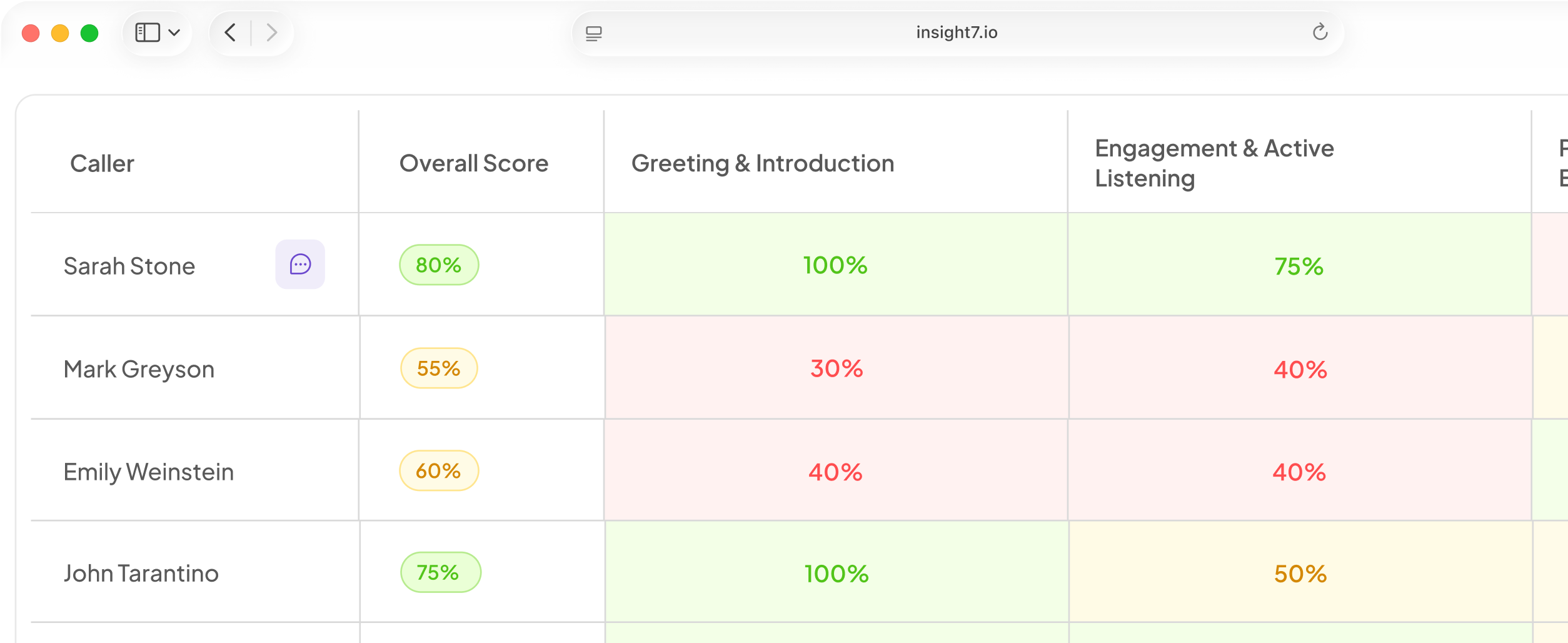
Insight7 belongs in the QA and coaching group. Its AI call scoring evaluates 100% of calls instead of a 2% sample. Built-in calibration lets managers override AI ratings. Live Assist prompts agents during the call. Roleplay lets reps practice before it. It connects to Zoom, Teams, Meet, Dialpad, Aircall and RingCentral. Test scoring with the Call Quality Monitor.
Related reading: Contact Center AI Pricing Compared Across Google, Amazon, Microsoft and Specialist Vendors, AI Voice Agent Pricing Guide With Per-Minute Cost Breakdowns and Hidden Fees to Watch For and Outbound Call Center Pricing Explained With Per-Hour and Per-Call Models Compared to AI Voice Agent Costs.
Questions people also ask
What are the top AI call center companies?
No single list fits every buyer, because four types solve different problems: voice agent builders, QA platforms, coaching tools and contact center suites. Pick the type first, then shortlist three vendors.
How do you choose AI call center software?
Name one outcome metric before the first demo, such as answer rate or share of calls scored. Test every claim on your own recordings, because demo audio is cleaner.
Will AI replace call centers?
Unlikely in full. 87% in Gartner's survey of 3,566 customers said access to a human is essential. Expect AI on routine calls and people on disputed or sensitive ones.
How much does AI call center software cost?
Pricing models vary, so ask each vendor how it charges. Buyers want a price range in writing early. Add setup work, minimum commitments and overage fees to every quote.
Which companies use AI for customer service?
Adoption spans banks, lenders, insurers, telecoms and delivery firms. Gartner reports that customer-service AI spending rose 38% while overall service budgets rose 2%.
What is the difference between AI call center and AI contact center solutions?
A call center handles voice. A contact center adds email, chat and messaging. Ask which channels the AI answers and whether quality scoring covers them.
Do AI call center vendors have to tell callers it is AI?
Yes, in the EU, and a growing number of US states require it. The EU AI Act's Article 50 applies to phone systems. In the US, the FCC's proposed "say it is AI" rule was not final in mid-2026. Ask vendors to log the disclosure line in each call record.
Pick the vendor you can verify
Proof matters more than pitch, so give a 3 only to what you tested yourself. This week, fill in the shortlist sheet header and send the same six questions in writing to your top three vendors.