
Choosing between outbound IVR vs conversational AI voice agents for customer notifications depends on three things. Must the customer reply in their own words? What does a mistake cost? Which rules cover the call? The table gives the short answer.
Side-by-side: IVR and voice agents compared
An outbound IVR plays a scripted message and reads keypad presses or a few set spoken answers. A conversational AI voice agent talks with a language model that has a goal and rules, so it can follow replies it was never scripted for.
| Row | Outbound IVR | Conversational AI voice agent |
|---|---|---|
| Call built as | Fixed tree | Model with goal and rules |
| Customer can say | Keypress or set words | Anything, in own words |
| Off-script question | Repeats menu or drops | Answers or hands over |
| CRM personalisation | Merge fields | Full context in conversation |
| Change effort | Re-record, re-map tree | Edit prompt and rules |
| Set-up speed | Fast for one message | Slower, needs testing |
| Cost model | Low per call | Higher per minute |
| Risk of mistakes | Low, wording is fixed | Higher, needs guardrails |
| Outcome data | Press counts, delivered | Transcript and outcome |
| Human handover | Often transfer key only | Triggered by what is said |
| Languages, accents | One recording each | Voice and language choice |
| Consent, disclosure | Consent needed | Consent plus AI disclosure |
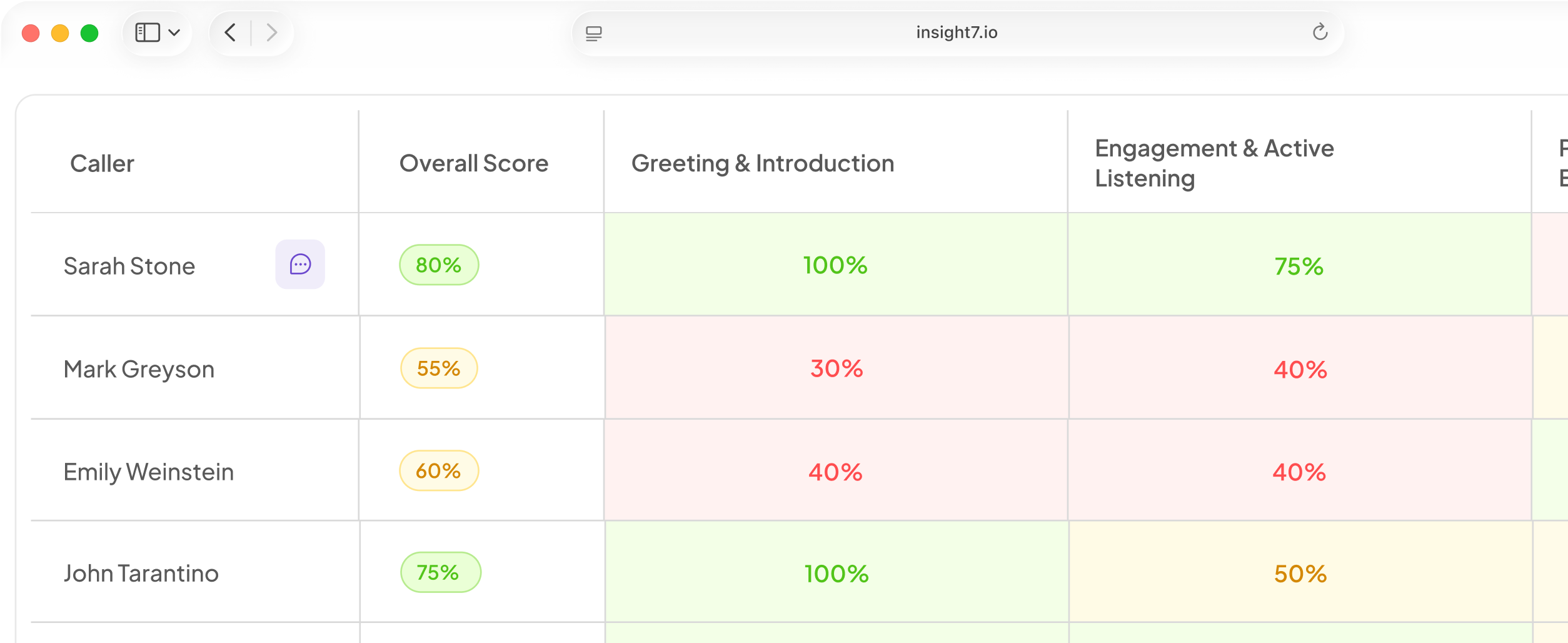
Insight7's voice campaigns, in beta, map onto several rows. Managers set a goal, an audience, the AI caller and the rules. A campaign has a type, consent marking, calling hours, retry rules and a test call to your own phone. A dashboard lets a reviewer read each transcript after the call, with outcomes pulled from it. Insight7's AI call scoring evaluates 100% of conversations instead of a 2% manual sample, so you can grade every pilot call.
Judge them by what the customer can say
Start with the customer's reply, because that is where the two tools split.
An IVR listens in narrow ways. It reads DTMF tones, which are keypad presses. Or it matches speech against a short list of expected words, called a grammar. "Press 1 to confirm" works. "I paid yesterday" matches nothing, so the call repeats the menu or hangs up.
A voice agent chains three steps: speech to text, a language model that picks the reply, and text to speech. Each step adds delay, so latency decides whether the call feels natural. A good agent also handles barge-in, so the customer can talk over it and it stops and listens.
Take a payment reminder. One customer says, "I paid yesterday." Another says, "Move it to Friday." The IVR cannot hear either one. The agent can flag the first for a payment check and record a new date for the second.
That freedom needs boundaries. Regulated buyers, banks first, name an AI that "goes rogue" as their main blocker. Set the allowed topics, the words it must never say, and the moments it must hand over to a person. Buyers also fear AI that sounds scripted or robotic, and they always ask what happens when the customer goes off script.
Test with real calls in the accents your customers use. Insight7 Voice campaigns, in beta, can run in Yoruba and Igbo, and the manager picks the language before the voice.
Weigh cost, change effort and set-up
An IVR is cheaper per call and quicker to launch for one message. A voice agent costs more per minute and needs testing before it goes live. The gap shows up later, when the message changes.
Changing an IVR means re-recording prompts and re-mapping the tree. Changing an agent means editing its prompt and rules, then re-testing. If your notices change often, such as new payment channels or new outage wording, the agent's edit cycle can be the cheaper path over a year.
Compare cost per resolved notification, because an agent may close in one call what an IVR leaves open. Ask your finance lead to price both the call and the follow-up work a failed notice creates.
Match the tool to the notification
Pick IVR when the wording is fixed and no reply changes what happens next. Pick a voice agent when the reply decides the outcome.
| Notification | Better fit | Why |
|---|---|---|
| Outage notice | IVR | One-way, same words for everyone |
| Delivery window | IVR | Fixed details, high volume |
| Appointment confirmation | IVR | One expected answer: press 1 |
| Emergency broadcast | IVR | Speed and reach matter most |
| Pre-due-date payment reminder | Voice agent | Replies vary: paid, late, need a new date |
| KYC or onboarding drop-off | Voice agent | You need to hear why they stalled |
| Satisfaction survey | Voice agent | Answers come in open words |
| Win-back, post-installation check-in, verification call | Voice agent | The customer's answer sets the next step |
Our calls show where buyers put their effort. Outside banking, operators want proactive calls about outages, delays, incidents, check-ins and satisfaction surveys before a complaint arrives. Lenders ask for payment reminders.
Here is one case. A consumer lender saw repayments often fail to debit on the due date. It calls customers beforehand to check funds are ready. It calls again after a failed debit to offer other ways to pay. Every one of those calls can end in a different reply, so a keypad menu would not cope.
The best setup is often mixed. Send pure alerts by IVR or SMS, since notes some customers prefer a message to a call. Send anything that invites a reply to the agent. In an outage, the IVR can announce it, and the agent can take the follow-up questions.
Start with outbound, not inbound. We advise this because much inbound volume exists when companies never send proactive updates. Treat a reminder as service. A happy customer pays.
Pilot before you choose, and check outcomes
Run a small pilot on one notification type before you pick a side. Banks usually want a short pilot on a small sample, with payment after a measured lift.
Build the pilot in three steps:
- Talk to the agent in the browser first. No phone number is needed.
- Place a test call to your own phone.
- Send a small live sample, and split it against your current IVR or SMS baseline.
Track five numbers: reached rate, answer rate, correct outcome captured, handover rate and complaints. Be strict about "reached". Calls where only the AI spoke do not count. Set calling hours and retry rules before launch. A carrier's temporary refusal should not use up a retry, so check your tool does this.
Your results then point to the answer:
- IVR fits fixed-wording alerts with no reply.
- A voice agent fits calls where the reply decides the outcome.
- Both fit when the IVR announces and the agent takes the follow-up.
Related reading: How to Add an AI Voice Agent to Your Existing IVR Without Replacing Your Phone System, How to Automate Network Outage Alert Calls and Escalations for NOC Teams and 12 Post-Call Automation Workflows That Create Tickets, Send SMS and Update Your CRM.
Questions people also ask
What is the difference between IVR and an AI voice agent?
An IVR follows a path its designer fixed in advance. A voice agent decides each reply during the call, within a goal and rules. So you check an IVR by reading its script, and an agent by reading its transcripts.
Is an AI voice agent better than traditional IVR for customer notifications?
Only where replies matter. For a fixed alert, an IVR is simpler and cheaper. Price the whole outcome, including the follow-up work an unanswered or misunderstood notice creates.
What is an outbound IVR call?
It is a call the system places from a contact list. It plays a recorded or synthetic message, then collects keypresses. Nobody monitors it live, so plan for voicemail and wrong numbers, and record every outcome.
Do AI voice agent calls need customer consent?
Usually, and the rule varies by region. In the US, AI-voice calls already need consent under the TCPA, following the FCC's 2024 ruling. Store consent per contact, and check local rules for every market you call.
Do I have to say that an outbound call is made by AI?
Often, yes. EU AI Act Article 50 has applied since 2 August 2026. Colorado's rule starts 1 January 2027. The FCC's proposed US rule was not final in mid-2026. Disclose in the first sentence anyway.
Can a voice agent replace IVR completely, or should I use both?
Usually use both. Move one notification type at a time to the agent, and keep the IVR as fallback until your outcome data shows the agent resolves more.
How do I stop customers from getting stuck on an automated outbound call?
Give every call an exit: a repeat limit, a silence timeout and a handover trigger. Gartner found 87% of customers expect a way to reach a human when a company uses GenAI for service. Test each exit path before launch.
Start with the reply
The right choice follows what the customer needs to say back. Before you start, check one thing: does this notification need a reply, and do you have consent and a human handover route for every call?