Once these roles are clear, buyers can evaluate platforms more effectively. The question now is no longer whether the software can score calls, but whether it produces valuable insights the team can trust and act on.
AI call scoring evaluates quality based on criteria defined by the organization rather than one universal standard. Each organization defines what a successful conversation should look like, then builds its scoring criteria around those expectations.
Those criteria are usually organized into custom QA scorecards. Depending on the team, they may focus on call quality, compliance, customer experience, or agent performance.
Call quality measures whether an agent handled the conversation according to the organization’s expectations.
This may include communication clarity, professionalism, and whether the agent followed the correct process. Applying the same criteria to more calls gives QA teams a more consistent quality basis for evaluation.
Insight7 allows teams to score every interaction against the standards they already use rather than replacing their existing QA framework. Leaders can bring in an established rubric or begin with an editable performance report template for sales, support, or compliance.
For a customer service director managing several teams, this means billing calls can be evaluated against one scorecard while retention or patient service calls use another. The teams remain inside one quality system without being forced into identical criteria.
A call can follow the correct process and still leave the customer dissatisfied. For that reason, many platforms like Insight7 also evaluate signals related to the customer’s experience.
These may include sentiment analysis, the customer’s tone, and how effectively the agent responded to their concern.
Insight7 applies conversation analysis to help teams find interactions where frustration, hesitation, or uncertainty may deserve closer review.
Daniel Patricio, CEO at Abra, particularly valued this platform capability from Insight7 because it allowed his team to see the sentiment behind each customer comment and use that context to better understand customer responses.
Book a demo now to see Insight7 in action.
Teams in regulated industries often need agents to follow specific scripts or verification procedures.
AI call scoring helps identify whether those required steps were completed. This gives QA teams a faster way to locate potential risks without manually reviewing every call.
Scorecards can also measure the behaviors managers want agents to demonstrate consistently.
Support teams may focus on active listening and resolution quality. Sales teams may evaluate discovery, objection handling, talk-to-listen ratio, or adherence to a sales methodology.
These scores give coaching conversations a clearer foundation by tying feedback to the specific behaviors that affect sales performance.
The most useful insight is often not one low score, but a pattern that appears among several calls.
Repeated scoring gaps show managers where an agent or team needs additional support. This makes coaching more focused by helping leaders prioritize and provide timely feedback on the behaviors most likely to improve future conversations.
The priority is not always the issue managers expect.
In Insight7’s insurance sales analysis, objection handling showed the smallest performance gap at 21%. The reason was not that weaker agents handled objections well. Many failed to progress far enough in the sales process to encounter a real objection.
The more urgent coaching need was funnel execution, with top agents creating a 204% gap compared to bottom agents. Agents needed to complete discovery and reach the quote before objection training could have an effect.
That is what scoring patterns can reveal. Managers can coach the point where performance begins to break down rather than spending time on a symptom that appears later.
AI call scoring does more than produce a quality score. It helps sales reps understand how calls are being handled and where performance begins to break down.
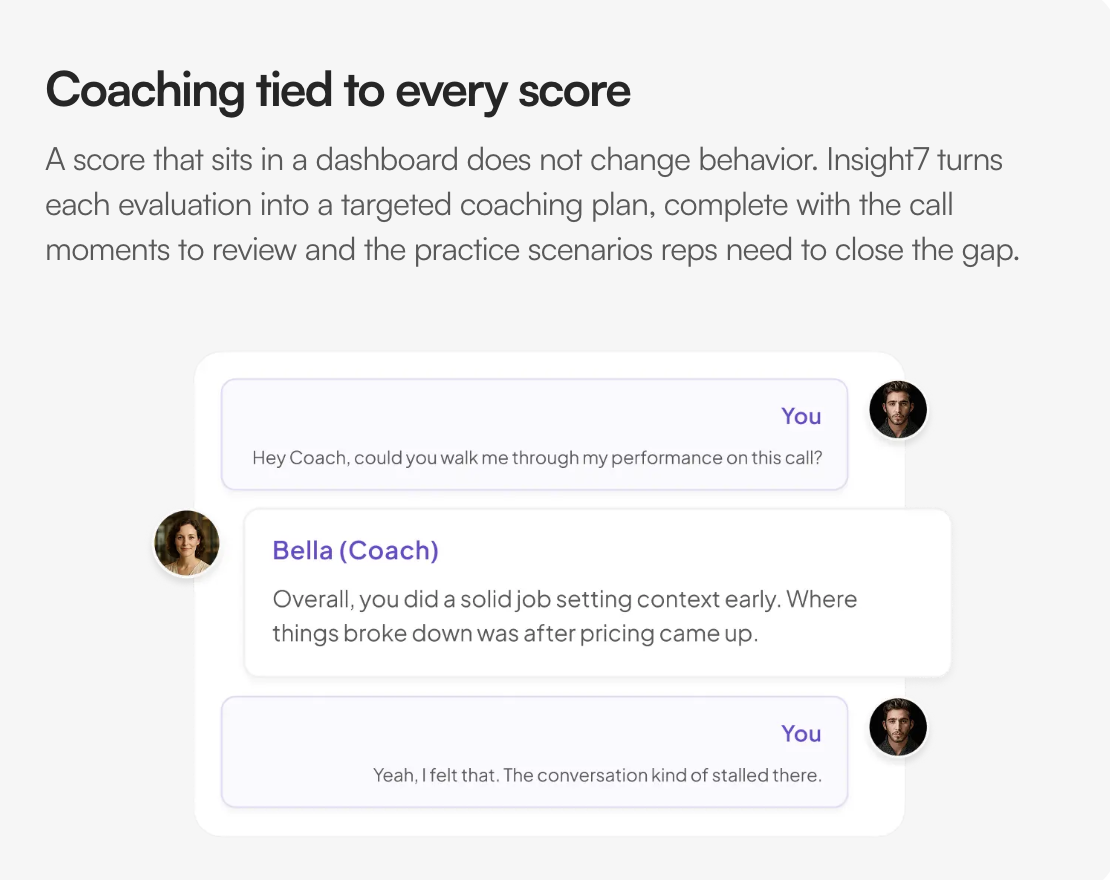
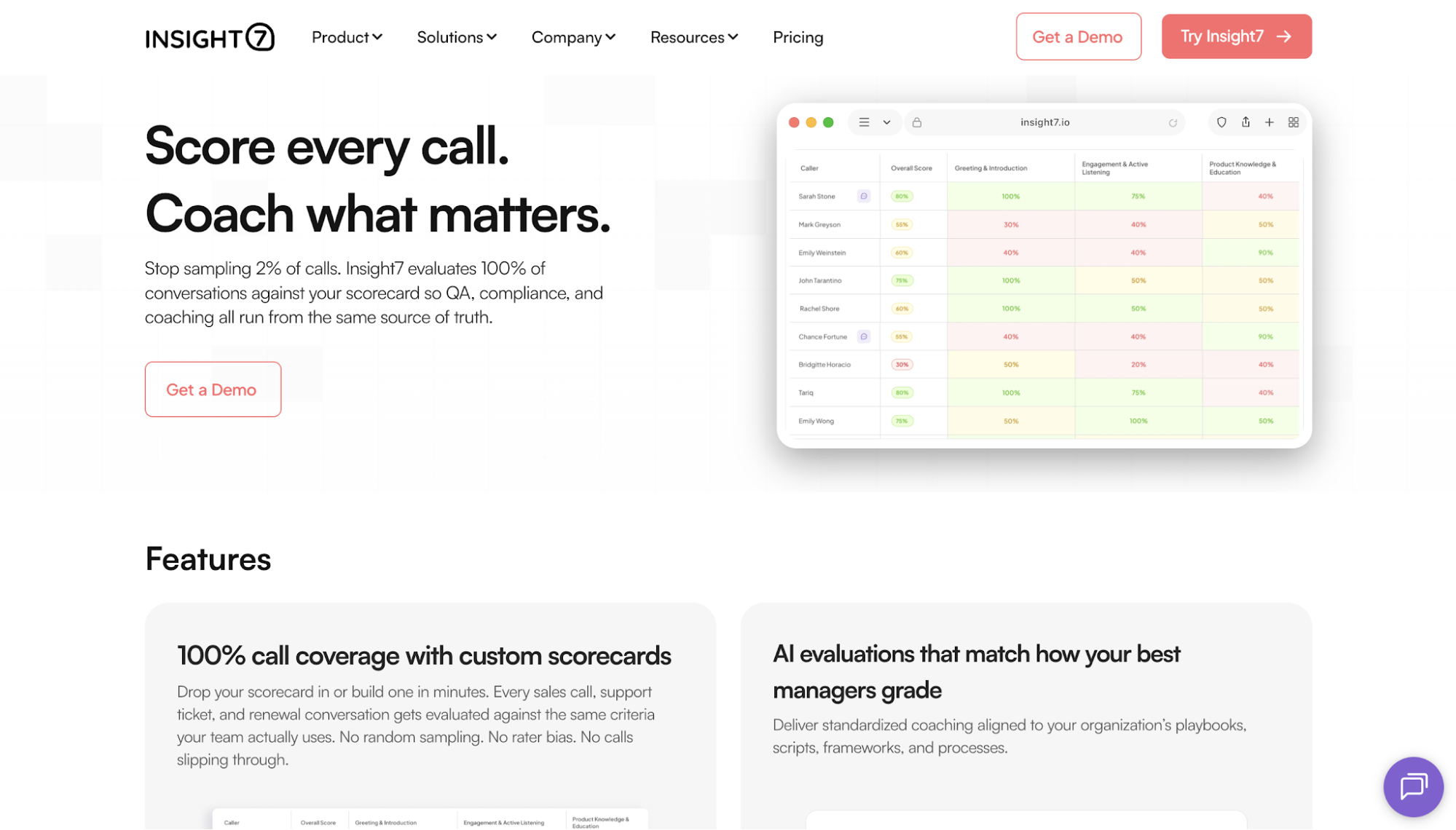
Insight7 helps contact centers evaluate every conversation against customizable QA scorecards, automatically score calls using AI, and highlight the exact moments that influenced each evaluation.
With Insight7, you can leverage AI to gain complete visibility into your agents’ performance on every call without manually reviewing conversations.
According to Santiago Villaronga, Associate Director at Fresh Prints, Insight7 is fast and accurate and saves his team hundreds of hours each week. That time saved has allowed the company to keep scaling without sacrificing quality or fairness.
This just goes to show that having the right tools to uncover the right insights from every scored call helps you quickly identify the coaching opportunities that matter most, making it easier to understand what needs to improve and how to coach your team more effectively, even as your operation scales.
Most AI call-scoring platforms promise greater coverage and more consistent evaluation. Those benefits matter, but they do not tell buyers whether a platform will work well in their actual QA process.
The right software should reflect how the organization defines call quality. It should also make scoring results clear enough for managers to use in coaching and performance decisions.
The following criteria help buyers distinguish a basic scoring tool from a platform that supports continuous improvement.
Every score depends on the accuracy of the platform’s call analysis and machine learning.
If the software misses important language or misinterprets who said what, the resulting score becomes difficult to trust. That weakens the value of the scorecard and creates more work for QA teams.
Buyers should test platforms using real calls rather than relying only on a controlled product demonstration.
The goal is not perfect transcription. The platform needs to capture enough context to evaluate the behaviors that matter to the organization.
Accuracy also depends on whether the software understands the purpose of the call. A phrase that suggests a negative sentiment or a shift in emotional tone that signals frustration in one conversation may have a different meaning in another.
That makes it important for managers to see the evidence behind each evaluation rather than rely on the score alone.
Insight7 connects each score to the relevant conversation moments, allowing QA leaders to inspect the evidence rather than accepting an unexplained result. Managers can also override ratings and use those corrections during calibration.
A G2 reviewer working in quality assurance had a better experience with Insight7 because it provided a more objective perspective on calls while still allowing notes to be left regarding areas where improvement is needed.
That combination is important because while automated analysis expands coverage, human reviewers still have control over interpretation and final decisions.
Try Insight7 for free and see how it can improve your call performance.
Every contact center has its own definition of a successful call.
A support team may focus on resolution quality, while teams handling outbound calls may place more weight on script adherence and required disclosures. A fixed scoring model will struggle to reflect both.
Building custom scorecards allows support and revenue teams to define evaluation criteria aligned with their processes and customer expectations. They also help different teams measure the behaviors most relevant to their work.
That flexibility is most valuable when teams can build on the standards they already use rather than recreate their QA process from scratch.
Insight7 allows teams to import an existing rubric from a PDF, spreadsheet, or Notion document. They can also begin with prebuilt templates for sales, support, or compliance and adapt them to their own workflow.
Aside from these features, you also need to consider whether the scorecards are editable and whether they have a user-friendly interface that makes it easy to add and update criteria as business needs change.
The platform should also support clear weighting. Critical compliance steps should not carry the same importance as minor conversational preferences.
Flexible scorecards make scoring more relevant, but they do not solve another common problem. Managers still need to understand how the platform reached each result.
A score has limited value when managers cannot see what influenced it.
Black-box scoring makes it difficult to validate evaluations or explain feedback to agents. It also reduces trust when a result does not match what a reviewer expected.
An effective platform like Insight7 connects each score to specific moments in the conversation. Managers should be able to see which behavior affected the result and review the supporting context.
Insight7 shows the call moments behind each score and lets QA leaders approve or override AI ratings. Agents can also receive access to their personal scores, coaching prompts, and performance trends when leaders choose to share them.
This makes the scoring process easier to audit. It also gives coaching conversations a clearer starting point because managers can discuss observable examples rather than a number alone.
Buyers should test whether explanations remain useful at scale. A platform may provide detailed call-level results yet still make it difficult to discern recurring patterns.
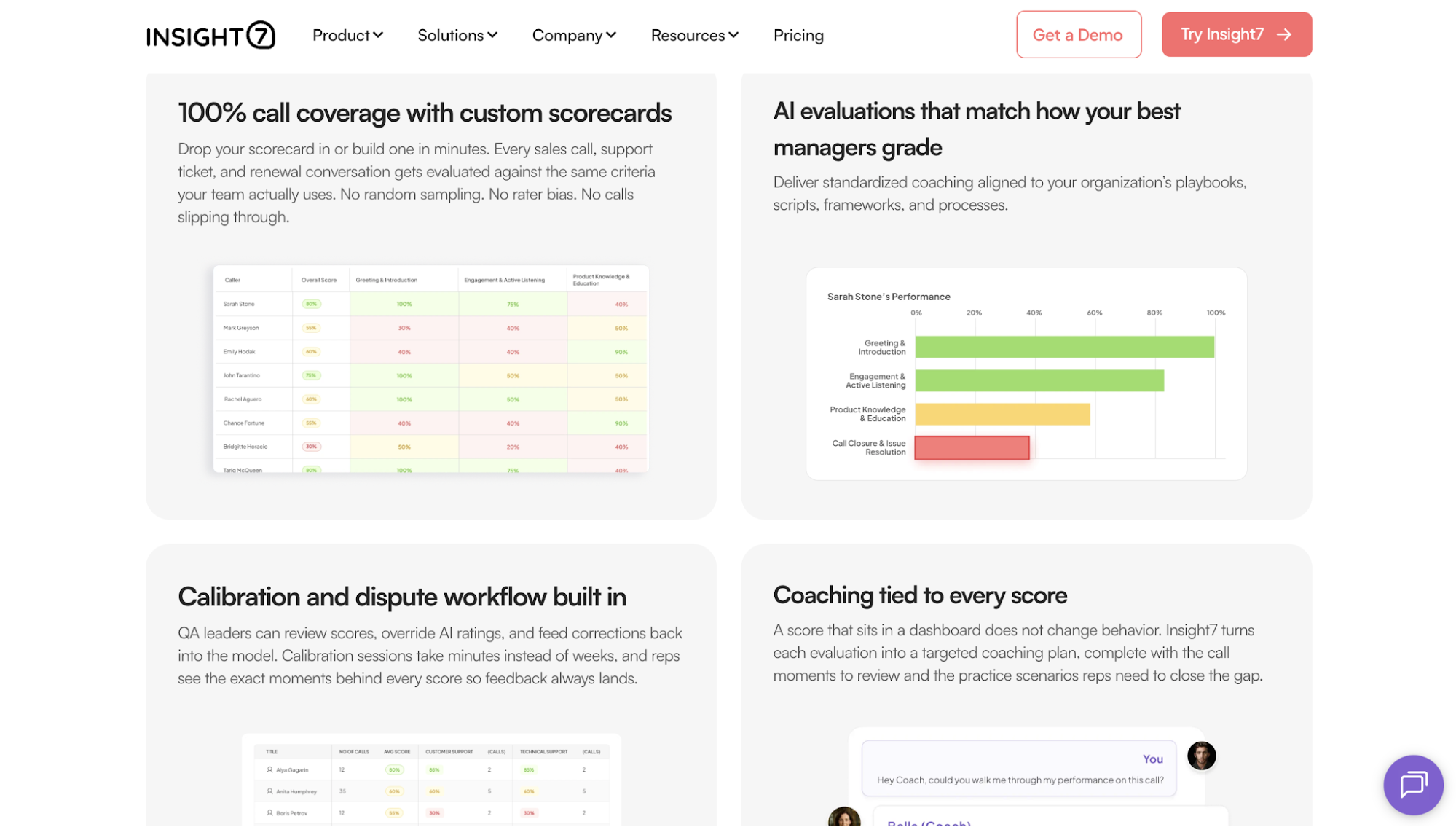
Call scores show where performance differs from expectations. Coaching insights help sales managers decide what to do next.
Without that connection, automated call scoring may increase evaluation coverage without improving agent performance. Teams receive more data, but managers still need to interpret it manually.
Insight7 connects each evaluation to targeted coaching points and the call moments managers should review. Its product workflow can also connect identified gaps to practice scenarios so agents can rehearse the behavior they need to improve.
This helps managers distinguish between an individual skill gap and a wider team issue. One agent may need support with active listening, while repeated scoring patterns may show that the entire team needs clearer process guidance.
With those priorities easier to see, managers can focus coaching sessions on the behaviors most likely to improve future calls.
Individual call scores are useful for reviewing specific conversations. They are less useful when leaders need to understand whether overall team performance is improving.
Reporting should help teams track scoring patterns and call outcomes over time. It should also make it easy to compare agents, teams, and evaluation criteria without manually combining scoring data.
Buyers should assess whether the call-scoring dashboard answers practical operational questions:
A repeated decline in one aspect may point to a training gap. It could also reveal that a process has become confusing or that a recent policy change may not have been communicated clearly.
The way this information is presented matters just as much as the amount of data available. Insight7 places equal importance on both. It gives managers trend lines and team-level visibility so they can monitor whether the behaviors being coached are improving in later conversations.
AI call scoring does not operate in isolation.
The platform needs access to recorded conversations and the context connected to them. Without the right integrations, teams may spend more time moving data or managing separate workflows.
Buyers should identify where live calls are recorded and where performance information is already reviewed. They can then evaluate whether the scoring platform connects with those systems in a practical way.
That starts with understanding which systems the platform already supports.
Insight7 integrates with Zoom, Microsoft Teams, Google Meet, Aircall, and other modern dialers and meeting platforms. Teams can also upload audio and video files directly.
Beyond the number of integrations it can support, the depth of integration matters just as much. A connection should support the actual workflow, not simply confirm that two systems can exchange limited data.
The goal is to make call scores accessible where managers and QA teams already work. That reduces friction and helps scoring become part of the normal coaching process.
Call recordings often contain sensitive customer information. Any platform analyzing those conversations should be evaluated with the same care as other systems handling customer data.
You should review how recordings and transcripts are stored. You also need to understand who can access them and how long the data is retained.
Requirements will vary by industry and region, so general security claims are not enough. The platform should give the organization enough control to meet its own internal policies and regulatory obligations.
One way to assess that is by looking at the security controls and certifications the platform provides.
Insight7 is SOC 2 Type II-certified, HIPAA- and GDPR-compliant, with PII and PHI redaction, encryption, and a policy against using customer conversations to train its AI.
Those protections are only one part of securing customer data. Organizations should also consider who can access that information once it’s in the platform, which is especially important for larger teams.
Managers may need visibility into their own agents without receiving access to every conversation in the organization.
Security should support the workflow without creating unnecessary exposure. Once buyers are satisfied with these controls, they are in a better position to assess the platform as a whole.
Choosing AI call scoring software is ultimately about more than evaluating more calls. The bigger goal is to understand why conversations receive certain scores and use those insights to improve future performance.
Better visibility leads to better coaching decisions, and better coaching decisions help teams improve customer satisfaction through more consistent experiences.

