What makes a customer ask for a supervisor? Rarely the issue itself. Usually it’s a specific phrase the agent used along the way, something that sounds harmless on a script but reads as dismissive or final to the person on the other end of the call.
Seven agent phrases account for most of these moments: lines like “that’s not my job” or “I don’t know” that shut a conversation down.
Below is each phrase, the specific reason it backfires, and the exact replacement to coach reps toward. Plus how to catch these phrases across every call instead of the handful a QA analyst happens to review.
These seven phrases backfire because each one takes something away from the customer mid-call, usually acknowledgment or a clear next step. Losing either tends to trigger what pyschology experts call the reactance effect, an instinctive pushback that shows up when someone feels their concerns are being dismissed or their options narrowed.
That’s a different mechanism than tone, which is why phrase-level coaching catches problems a “sound friendlier” note on a scorecard misses.
An agent can stay perfectly calm and polite while still saying something that reads as a wall. “That’s our policy,” delivered warmly, still removes the customer’s sense of control. The words are doing the damage, independent of delivery, and that makes them specific and repeatable to coach in a way tone never is.
For a QA program that already tracks tone shifts and sentiment drops, phrase-level detection is the missing layer: the exact words that predict an escalation before the sentiment score even moves.
Our articles on Identifying Red Flags in Support Calls Before They Escalate and 6 AI Tools That Detect Tone and Emotion in Customer Calls cover the tone side of that gap.
These seven phrases turn up most often in escalation transcripts. Each one below gets the phrase, the specific reason it backfires, and the replacement to coach reps toward instead. None of it requires a script rewrite.
This is deflection, and it’s the most common escalation trigger on this list. It tells the customer their problem exists on paper but not on this call, which reads as a decision to protect the agent’s convenience over the customer’s problem.
The fix isn’t a flat transfer. Coach reps to name the next step while staying present. “Here’s how I’ll get this handled” keeps ownership with the agent instead of handing it off.
Before: “That’s not something I handle, you’ll need to call billing.”
After: “This is a billing question. Let me get you connected, and I’ll stay on until they’ve picked it up.”
“Calm down” (or its cousins, “relax,” “just relax”) sounds harmless, but it directly triggers the reactance effect mentioned earlier. Telling someone how to feel doesn’t fix the original problem. It adds a second one.
Coach reps to validate before problem-solving. “That sounds really frustrating” does the same job “calm down” was trying to do, without the pushback.
Before: “Sir, I need you to calm down so I can help you.”
After: “That sounds incredibly frustrating. Let’s get this fixed.”
A bare policy citation, with no reasoning attached, tells the customer the rule matters more than their specific situation. It’s technically accurate and functionally useless, which makes it one of the clearest examples of call center QA negative language: a phrase that sounds like an answer but isn’t one.
Replace the citation with the boundary plus the option. Instead of naming the policy, state what’s possible.
Before: “That’s against company policy, I can’t waive the fee.”
After: “What I can do is apply a one-time courtesy credit here. Let me walk you through how that works.”
Correcting a customer directly, even when they’re genuinely mistaken, puts them on the defensive. They’re no longer just solving a problem but defending their own competence, and that shift turns a routine call into a request for a supervisor.
Reframe the correction as a shared review instead of a verdict. “Let’s look at this together” gets to the same clarification without assigning blame.
Before: “You misunderstood the terms when you signed up.”
After: “Let’s walk through what the terms actually cover, I want to make sure we’re both looking at the same thing.”
Absolute language removes the customer’s sense of control completely. There’s no path forward and nothing left to negotiate, which is exactly the moment most customers ask for someone with more authority.
Even a real, hard boundary reads better with a next step attached. Name what’s possible right now, and who can look at the rest.
Before: “There’s nothing I can do about that.”
After: “I can’t reverse that charge myself, but I can escalate it to our billing team today and follow up with you tomorrow.”
Pro Tip: Don’t just ban the phrase. Coach the replacement alongside it. A rep who drops “that’s our policy” but has nothing ready to say instead will freeze mid-call or default to something worse. Pair every phrase flagged with the exact swap reps should reach for.
Left on its own, “I don’t know” reads as a dead end no matter how honest it is. The customer just feels the call has stopped moving forward.
Pair the honesty with forward motion. “Let me find that out for you” keeps ownership with the agent instead of handing the problem back.
Before: “I don’t know why that happened.”
After: “I’m not sure yet. Let me pull up your account history and find out.”
A one-word refusal gives the customer zero information about why, so they fill the silence with the worst available interpretation: the agent doesn’t want to help, or the policy itself is unfair. Either read escalates faster than a “no” that comes with context.
Coach reps to attach the reason and the closest available option in the same breath, every time, not just on the calls that already feel tense.
Before: “No, we can’t do that.”
After: “We can’t extend the deadline past 30 days, but I can set up a payment plan that covers the difference.”
Catching these seven phrases across a whole team means scoring every call against a rubric that includes prohibited language, not just the calls a QA analyst has time to sample by hand.
Manual QA programs typically review just 3 to 10% of total call volume, which means a rep who leans on “that’s not my job” could say it a hundred times before a human reviewer happens to hear it.
Automated Call Analytics & QA solves this by scanning every single call as it happens. By configuring your QA rubric to catch the seven phrases above, you can instantly flag missed disclosures and compliance violations across your entire operation.
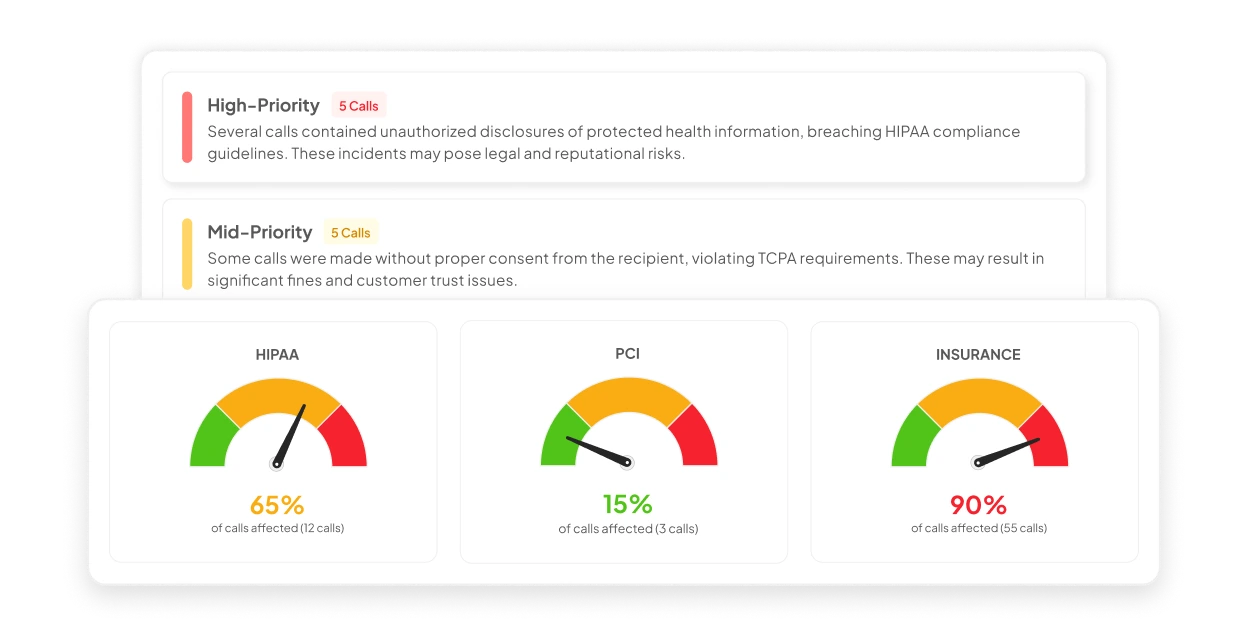
Not sure which of these phrases are already showing up on a team’s calls? Our free Call QA Scorecard Builder builds a starter rubric from calls uploaded directly, so the pattern shows up before committing to a full rollout.
But flagging the phrase is only half the loop. AI coaching & roleplays assigns practice scenarios tied to the exact gap a flagged call surfaced, so a rep who used “there’s nothing I can do” on Tuesday practices the replacement before Wednesday’s calls start.
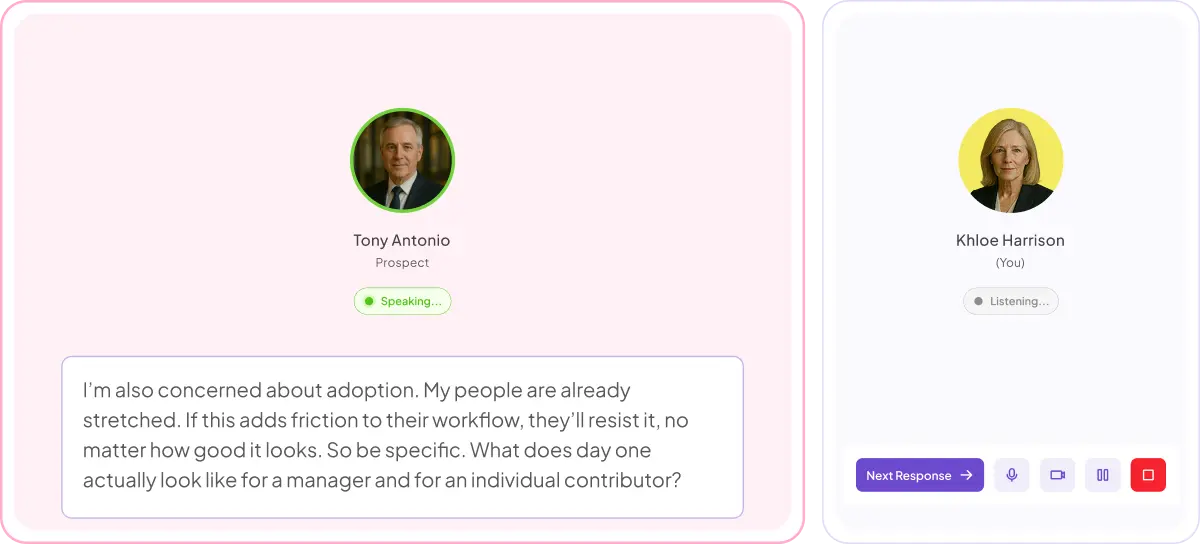
The alternative, raising it in a one-on-one scheduled for next month, means coaching the memory of a mistake instead of the moment it happened.
Automated rubric flagging also solves a separate problem: consistency. Two QA analysts scoring the same call by hand often disagree on whether a phrase crossed the line. A rubric-based flag holds the same standard every time, whichever analyst is scoring the call.
Tri-County Metals used this feature from Insight7 to grade inbound calls against customer service benchmarks instead of relying on manual spot checks; the same mechanism that catches these seven phrases before they become a pattern.

