
Best 5 AI Opportunity Solution Tree Generator for B2B
In the rapidly evolving world of business-to-business (B2B) commerce, the ability to identify and capitalize on emerging opportunities is paramount. A critical tool in the arsenal of product managers and strategists is the Opportunity Solution Tree (OST), a framework that helps teams systematically explore and prioritize potential solutions to business challenges. With the advent of artificial intelligence (AI), the potential for OSTs has been magnified, offering more sophisticated insights and streamlined processes. In this article, we will delve into the best five AI Opportunity Solution Tree generators that B2B organizations can leverage to enhance their strategic planning and decision-making processes. Understanding the Opportunity Solution Tree Before we explore the AI tools, it’s essential to understand what an OST is and why it’s invaluable for B2B entities. An OST is a visual representation that maps out an organization’s goals, opportunities, solutions, and experiments. It starts with a clear objective and branches out into opportunities that could lead to that goal, followed by specific solutions for each opportunity, and finally, experiments or tests to validate those solutions. The OST framework encourages a systematic and structured approach to problem-solving, ensuring that all potential avenues are explored before committing resources. It also fosters collaboration among team members, as it provides a shared understanding of the objectives and the path to achieve them. AI-Enhanced Opportunity Solution Trees AI has the power to transform the traditional OST by automating data analysis, uncovering hidden insights, and predicting outcomes with greater accuracy. AI-powered OST generators can process vast amounts of data, recognize patterns, and suggest opportunities that might not be immediately apparent to human analysts. This level of automation and insight can significantly accelerate the strategic planning process and lead to more innovative solutions. Top 5 AI Opportunity Solution Tree Generators for B2B Insight7 – This tool is renowned for its advanced data processing capabilities and intuitive interface. Insight7 can integrate with various data sources, providing a comprehensive overview of potential opportunities and solutions. Its predictive analytics feature helps to forecast the success of different solutions, enabling product managers to make data-driven decisions. SolutionTree AI – Designed with collaboration in mind, SolutionTree AI allows teams to work together in real-time to build and refine their OSTs. The platform’s AI algorithms offer suggestions for opportunities and solutions, streamlining the brainstorming process and ensuring that no stone is left unturned. InnoTree AI – InnoTree AI stands out for its focus on innovation. It not only generates OSTs but also provides insights into emerging market trends and customer needs. This tool is particularly useful for organizations looking to stay ahead of the curve in their industry. Strategizer AI – With its robust template library and customization options, Strategizer AI makes it easy to create OSTs tailored to specific business challenges. Its machine learning algorithms adapt to the organization’s unique context, continuously improving the quality of the generated solutions. OpportunityAI – This generator is celebrated for its simplicity and effectiveness. OpportunityAI is ideal for small to medium-sized businesses that require a straightforward approach to opportunity analysis. It offers a user-friendly platform with essential features to construct an OST without overwhelming users with complexity. Implementing AI Opportunity Solution Trees in B2B Organizations Adopting an AI-powered OST generator can be a game-changer for B2B companies. However, successful implementation requires a clear strategy and buy-in from all stakeholders. Organizations should start by defining their primary goals and aligning them with the capabilities of the chosen AI OST tool. Training and support are also crucial to ensure that teams can fully leverage the technology. Conclusion The integration of AI into the Opportunity Solution Tree framework offers B2B organizations a powerful means to navigate the complexities of modern business landscapes. By selecting the right AI OST generator, companies can enhance their strategic planning, foster innovation, and ultimately achieve their business objectives more efficiently. As we move further into the era of AI, embracing such tools will become increasingly essential for maintaining a competitive edge. Remember, the key to leveraging AI in creating OSTs is not to replace human judgment but to augment it with data-driven insights. The synergy between AI capabilities and human expertise can lead to more comprehensive and effective strategies. As you consider incorporating an AI OST generator into your processes, keep in mind the importance of aligning the tool with your organization’s specific needs and goals. With the right approach, AI can unlock new horizons for opportunity analysis and solution generation in the B2B sector.
Opportunity Solution Tree Template – 5 Ways To Visualize Product Opportunities
In the dynamic world of product management, the visualization of product opportunities is crucial. The Opportunity Solution Tree (OST) is a strategic tool that helps in identifying and structuring potential opportunities. It serves as a visual aid to align teams and stakeholders around the most promising avenues for product development and enhancement. For organizations looking to leverage this tool, here are five ways to visualize product opportunities using an Opportunity Solution Tree Template. 1. Define the Desired Outcome The first step in utilizing an OST template is to clearly define the desired outcome. This outcome should be customer-centric, focusing on what end-users ultimately need or want. By starting with the end in mind, product managers can work backward to map out the various paths to achieve that outcome. The OST template helps in articulating this outcome at the top of the tree, providing a clear goal for all subsequent ideas and solutions. 2. Identify Opportunities Furthermore, once the desired outcome is established, the next phase involves brainstorming and listing all possible opportunities that could lead to that result. Going forward, opportunities can be seen as needs or problems that customers face, which, when addressed, will move the product closer to the desired outcome. In essence, the OST template organizes these opportunities in a structured manner, allowing teams to explore multiple avenues without losing sight of the overarching goal. 3. Explore Solutions Moreover, for each identified opportunity, the OST template encourages the exploration of multiple solutions. Essentially, this is where creativity and innovation come into play. Teams can use the template to document various solution ideas, assess their feasibility, and determine their potential impact. In conclusion, the visual representation of solutions branching out from each opportunity ensures that no possible solution is overlooked. 4. Prioritize with Evidence Furthermore, with a myriad of solutions on the table, prioritization becomes essential. The OST template aids in this process by allowing teams to attach evidence and data to each solution. In essence, this evidence-based approach ensures that decisions are made on solid ground, focusing on solutions that are backed by customer research, market data, and competitive analysis. 5. Iterate and Refine Finally, the OST template is not a one-time use tool; it is designed for continuous iteration and refinement. As new information is gathered and market conditions change, the OST should be updated to reflect these dynamics. Lastly, this iterative process allows for the OST to remain relevant and for product opportunities to be visualized in real-time, ensuring that the product roadmap is always aligned with the most current data. Conclusion The Opportunity Solution Tree Template is a powerful visualization tool that helps product managers and teams systematically identify, explore, and prioritize product opportunities. Furthermore, by providing a structured approach to problem-solving, the OST fosters alignment, encourages evidence-based decision making, and supports a dynamic and iterative product development process. Lastly, for organizations aiming to stay ahead in the competitive B2B landscape, adopting an OST template is a step towards a more strategic and customer-focused product management approach.
How To Build Opportunity Solution Tree in 5 Simple Steps 2024
In today’s fast-paced business environment, innovation and problem-solving are at the heart of product management. One of the most effective tools to navigate the complex landscape of customer needs and market opportunities is the Opportunity Solution Tree (OST). This strategic framework helps organizations to systematically identify, prioritize, and tackle challenges by mapping out solutions that align with their business goals. In this article, we will guide you through the process of building an Opportunity Solution Tree in five simple steps, ensuring that you can visualize product opportunities and make informed decisions for your business in 2024. Step 1: Identify the Opportunity The first step in constructing an Opportunity Solution Tree is to pinpoint the core opportunity that your organization wants to address. This involves a deep understanding of your customers’ pain points, desires, and the market gap your product can fill. Begin by gathering qualitative and quantitative data through customer interviews, surveys, market research, and competitive analysis. By synthesizing this information, you can articulate a clear and compelling opportunity statement that acts as the foundation of your OST. Step 2: Generate Potential Solutions Once you have identified the opportunity, it’s time to brainstorm potential solutions. Encourage a diverse range of ideas from cross-functional teams, including product managers, designers, engineers, and marketers. Utilize AI-powered tools to augment your brainstorming sessions, ensuring that you consider innovative and data-driven solutions. During this phase, it’s crucial to maintain an open mind and welcome unconventional ideas that could lead to breakthrough products or services. Step 3: Create a Solution Tree With a list of potential solutions at hand, you can now start building your Opportunity Solution Tree. Begin by placing the opportunity statement at the root of the tree. From there, branch out to different solutions, categorizing them based on their feasibility, impact, and alignment with your business objectives. AI Opportunity Solution Tree Generators can assist in visualizing these branches, helping you to structure your thoughts and communicate the strategy effectively to stakeholders. Step 4: Prioritize and Select Solutions Not all solutions are created equal, and it’s important to prioritize them based on criteria such as potential return on investment, time to market, and resource availability. Use an Opportunity Solution Tree Template to evaluate and rank each solution. This will help you to focus on high-impact solutions that are most likely to succeed. Collaboration with your team is key during this phase to ensure that you have a well-rounded perspective on the prioritization process. Step 5: Plan and Execute The final step is to create a detailed plan for the implementation of the selected solutions. This involves setting clear goals, timelines, and metrics for success. Assign responsibilities to team members and establish a process for monitoring progress and making adjustments as necessary. By following a structured approach to execution, you can turn the opportunities identified in your OST into tangible results for your organization. In conclusion, building an Opportunity Solution Tree is a powerful way to approach problem-solving and innovation in product management. By following these five steps, you can create a clear roadmap for addressing opportunities and delivering solutions that resonate with your customers and drive business growth. Remember to leverage AI tools and templates to streamline the process and enhance your strategic planning. As you embark on this journey, keep in mind the principles of E-E-A-T to ensure that your decisions are experienced, expert, authoritative, and trustworthy.
Structuring Customer Segments in Your Opportunity Solution Tree: A Comprehensive Guide
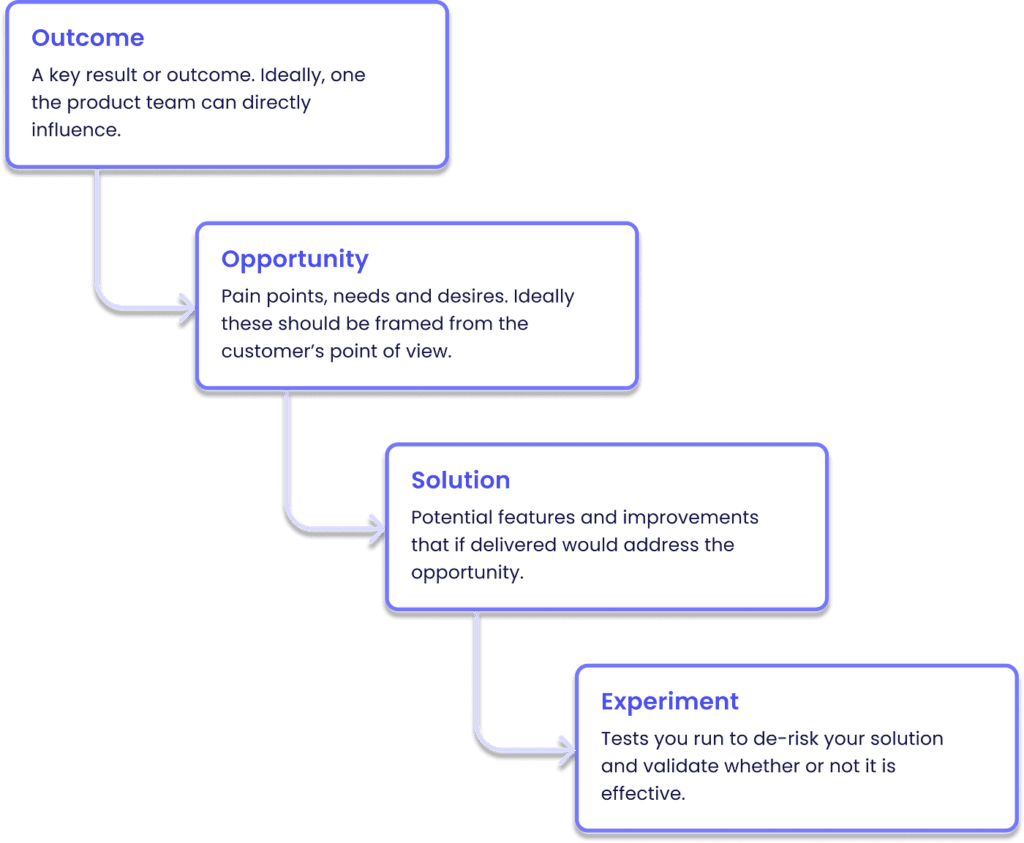
When it comes to creating an Opportunity Solution Tree (OST), many teams find the process of structuring the opportunity space challenging. It’s common to get overwhelmed, especially when dealing with the B2B space, different customer types, and various pain points; it’s common for teams to struggle with a simple question, “Who is our target customer?” But the difficulty in answering that question doesn’t mean we can just ignore it. In fact, it’s all the more reason to dig in deeper and do our best to answer it. Think of it this way: Being customer centric is held up as an ideal in many companies these days. But to be customer centric by definition implies that you know who those customers are and what their specific needs are. However, ignoring the importance of customer segments in your OST can lead to significant problems down the road. Being customer-centric necessitates knowing your customers and understanding their unique needs. In this article, we’ll explore how to incorporate customer segments into your OST, using detailed examples to illustrate the concepts. The Fundamentals: 5W Questions To begin, let’s revisit the basic principles of storytelling – the 5W (+1 H) Questions: Who? What? When? Where? Why? How? These questions are essential for structuring your OST effectively. While it might seem obvious, many OSTs often neglect the “who” aspect. We know the customers are crucial, but is the category “customers” specific enough? The answer depends on your context. Sometimes, working with the broad category of “customers” is acceptable if their needs remain consistent. However, it’s equally important to dive deeper into specific customer segments when necessary. 1: Uncovering Potential Customers Example: A SaaS Company Imagine you’re working for a Software as a Service (SaaS) company with the goal of increasing revenue. While broad customer categories may include individual users, small businesses, and enterprises, delving into segments can provide more clarity. One segment may be small businesses with specific needs, while another could be large enterprises seeking tailored solutions. Identifying these distinctions helps you make informed decisions about customer interviews and product development. 2: Realizing You Have Too Many Segments of Customers Example: Marketing Technology Company Consider a marketing technology company offering both free and paid product versions. The product team wants to convert free trial users into paid customers. Initially, they identified three customer segments – marketers at larger companies, digital marketing agencies, and small business owners. However, during discovery, they discovered that these segments had remarkably similar motivations and needs. In this case, creating separate segments on the OST didn’t add value, highlighting the importance of flexibility and adaptability in your approach. 3: Bringing More Clarity to Your Opportunities by Assigning Them to Specific Segments Example: Recruiting-related SaaS Company In this scenario, a recruiting-related SaaS company aims to increase revenue. To prioritize effectively, they needed to consider who would benefit from each solution and how it would contribute to revenue growth. Some opportunities might have a more significant impact on their desired outcome. Quantifying the potential size of each path to increased revenue allowed them to compare the relative contribution of focusing on different customer segments. Tying It All Together Incorporating customer segments into your Opportunity Solution Tree helps provide critical context. It allows you to answer the “who” question explicitly and assess, size, and prioritize among customer segments. This context is essential for influencing stakeholders and partners and ensuring your solutions have a substantial impact. By explicitly addressing the 5W questions in your OST, you equip yourself with the storytelling elements needed to persuade others about the importance of your chosen opportunities. You also gain a deeper understanding of the context in which your solutions will be used and their potential impact on your desired outcome. Conclusion Structuring your Opportunity Ssolution Tree with well-defined customer segments is a strategic approach that enhances your ability to address specific customer needs. It prevents you from making risky assumptions and allows you to focus your efforts where they will have the most significant impact. Remember that your OST is a dynamic tool that should evolve as your understanding of customer segments deepens and as you progress toward your desired outcomes.
