You finished a job interview that felt great. Good energy, solid rapport, you answered every question. Two days later, the rejection email arrives. No feedback beyond “we decided to move forward with another candidate.” You have no idea what went wrong because you do not know what the evaluation criteria were in the first place.
Most candidates prepare for interviews by rehearsing answers to common questions. That is the wrong unit of preparation. Hiring managers do not score your answers. They score you against interview evaluation criteria: specific behavioral dimensions like communication clarity, problem-solving approach, role-relevant knowledge, and cultural alignment. Every interviewer at a well-run company fills out a scorecard after your conversation, rating you on each criterion independently.
Understanding those criteria before you walk in changes how you prepare, how you answer, and how you perform under pressure.
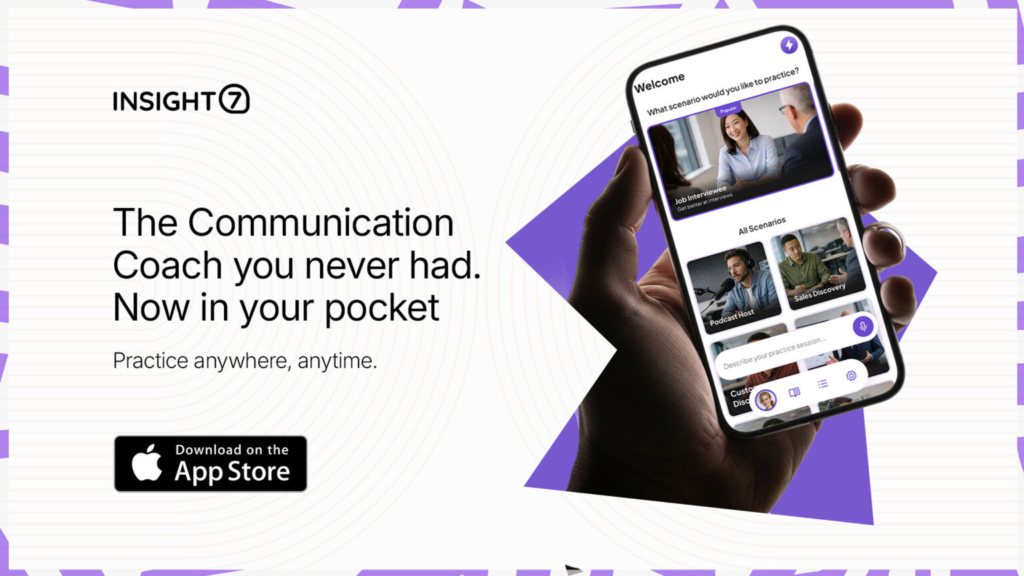
The Insight7 Coach mobile app lets you practice interviews against these exact criteria with AI-powered feedback on each dimension, so you know where you are strong and where you need work before the real thing.
Here are the interview evaluation criteria most companies use, what each one actually measures, and how to practice each one.
Communication Clarity
This criterion measures whether you express ideas in a way that is easy to follow, appropriately concise, and adapted to your audience. Interviewers score communication separately from content. You can give a technically correct answer that scores poorly on communication because it was disorganized, too long, or filled with jargon that the interviewer did not share.
What interviewers look for: structured responses that answer the question directly before elaborating, appropriate length (most interview answers should land between 60 and 120 seconds), and the ability to adjust complexity based on who is asking. A technical explanation to an engineering manager should sound different from the same explanation to an HR partner.
How to practice: Record yourself answering three common interview questions. Listen back and check whether you answered the actual question in the first sentence, whether any answer exceeded two minutes, and whether you used filler phrases (“um,” “like,” “you know”) more than three times per response.
The Insight7 Coach app scores communication clarity automatically during practice interviews and flags the specific moments where your delivery weakened.
Problem-Solving Approach
This criterion measures how you think through unfamiliar or ambiguous situations, not whether you arrive at the “right” answer. Behavioral and situational interview questions (“Tell me about a time you had to solve a problem with incomplete information”) are specifically designed to evaluate this dimension.
What interviewers look for: a logical framework for breaking down the problem, evidence that you considered multiple approaches before choosing one, acknowledgment of constraints and trade-offs, and the ability to explain your reasoning process, not just the outcome. Interviewers who score this criterion care more about how you thought than what you concluded.
How to practice: Use the STAR method (Situation, Task, Action, Result) as a structural scaffold, but focus your preparation on the “Action” section. That is where your reasoning process lives. For each story you prepare, be ready to explain why you chose that approach over the alternatives. Practice answering follow-up probes like “What would you have done differently?” and “What did you consider but decide against?” These probes test reasoning depth, and candidates who have not practiced them tend to stall.
Role-Relevant Knowledge
This criterion measures whether you have the foundational knowledge required for the role. For a sales position, that means an understanding of sales methodologies, pipeline management, and objection handling. For a support role, that means familiarity with customer service frameworks, escalation protocols, and resolution strategies. For a technical role, that means domain-specific expertise demonstrated through practical examples.
What interviewers look for: the ability to apply knowledge to realistic scenarios rather than recite definitions. A candidate who says “I use MEDDIC” scores lower than a candidate who describes how they used MEDDIC to qualify a deal that initially looked strong but turned out to lack economic buyer alignment. Applied knowledge demonstrated through a specific example scores higher than theoretical knowledge recited from a textbook.
How to practice: Research the company’s industry, products, and challenges before the interview. Prepare two to three examples from your experience that demonstrate applied knowledge relevant to this specific role, not generic accomplishments. Tailor each example to the company’s likely pain points.
Cultural and Team Alignment
This criterion measures whether your work style, values, and collaboration preferences fit the team you would be joining. This is not about personality. It is about how you prefer to work, which matches how the team actually operates. A candidate who thrives in autonomous, low-structure environments will struggle on a team with daily standups and heavy process. That is not a character flaw. It is a fit mismatch that a good interviewer tries to detect.
What interviewers look for: honest self-awareness about your work preferences, evidence of collaboration in past roles, and alignment between what energizes you and what the role actually requires day-to-day. The worst thing you can do on this criterion is guess what the interviewer wants to hear. Experienced interviewers detect rehearsed culture answers quickly, and misrepresenting your work style leads to a bad fit that hurts both parties.
How to practice: Before the interview, research the company’s working norms (remote vs. in-office, team size, meeting cadence, decision-making speed). Prepare honest answers about your preferred working style that either align naturally or name the gap honestly. “I have worked in highly structured environments and am looking for something more autonomous” is a stronger answer than pretending you love structure when you do not.
Composure and Adaptability
This criterion measures how you perform under pressure: when a question catches you off guard, when the interviewer pushes back on your answer, or when the conversation goes in an unexpected direction. Every interview includes at least one moment designed to test this, whether the interviewer is conscious of it or not.
What interviewers look for: the ability to pause and think rather than rushing to fill silence, graceful recovery from a weak answer rather than spiraling, and willingness to say “I do not know, but here is how I would figure it out” rather than bluffing. Composure under pressure is particularly heavily weighted for customer-facing, sales, and leadership roles where handling unexpected situations is a daily requirement.
How to practice: This criterion is the hardest to prepare for alone because the pressure comes from the unpredictability of another person’s questions. Insight7 Coach’s AI-powered interview roleplay simulates this by asking follow-up questions you did not anticipate, pushing back on your answers, and changing direction mid-conversation. Practicing against unpredictable AI probes builds the composure muscle that reading question lists cannot.
How Interview Scorecards Actually Work
Understanding how these criteria combine into a hiring decision demystifies the process. Most structured interview processes work as follows.
Each interviewer scores you independently on the criteria assigned to their interview round. A phone screen might evaluate communication clarity and role-relevant knowledge. A hiring manager round might evaluate problem-solving approach and team alignment. A panel round might evaluate composure and adaptability. Scores are typically on a 1 to 4 or 1 to 5 scale per criterion.
After all rounds, the hiring team meets for a debrief. They compare scores, discuss disagreements, and make a composite decision. A candidate who scores highly on every criterion except one will likely advance. A candidate who scores poorly on two or more criteria, even with a strong overall impression, will likely not.
The implication for preparation: you cannot afford to be strong on three criteria and weak on two. The evaluation is dimensional, not holistic. Practicing each criterion independently, rather than doing generic “mock interviews,” is the most efficient way to improve.
Building a Practice Plan Around Evaluation Criteria
The most effective interview preparation maps directly to the criteria you will be scored on.
Week one: identify the likely criteria for your target role. Customer-facing roles weigh communication, composure, and applied knowledge most heavily. Technical roles weigh problem-solving and domain expertise. Leadership roles weigh all five criteria roughly equally.
Week two: practice each criterion in isolation. Record yourself answering criterion-specific questions. Review the recordings against the “what interviewers look for” benchmarks above. Identify the one or two criteria where you are weakest.
Week three: run full practice interviews focused on your weak criteria. The Insight7 Coach app runs realistic interview simulations with AI-generated follow-ups and scores you on each criterion independently, so you can track improvement across practice sessions rather than guessing whether you got better.
If you have an interview coming up and want to practice against the criteria hiring managers actually score, download Insight7 Coach and run a practice session before the real thing.
Frequently Asked Questions
What are interview evaluation criteria?
Interview evaluation criteria are the specific behavioral dimensions interviewers score candidates on: communication clarity, problem-solving approach, role-relevant knowledge, cultural alignment, and composure under pressure. Most structured interviews use a scorecard where each criterion is rated independently on a numeric scale.
How many criteria do interviewers evaluate?
Most companies use four to six criteria per interview process, distributed across interview rounds. A phone screen might cover two criteria while a final round covers three. Each interviewer scores only the criteria assigned to their round, then the team combines scores during the debrief.
What is the most important interview evaluation criterion?
It varies by role. Customer-facing and sales roles weigh communication clarity and composure most heavily. Technical roles require problem-solving and domain knowledge. Leadership roles weigh all criteria roughly equally. Research the role type to prioritize your preparation.
Can you practice interview evaluation criteria?
Yes. Each criterion maps to specific, practicable behaviors. Communication clarity improves through timed answer rehearsal. Problem-solving improves through structured STAR practice with follow-up probes. Composure improves through unpredictable roleplay simulations. Practicing criteria individually is more effective than doing generic mock interviews.
Do all companies use interview scorecards?
Most mid-market and enterprise companies use structured scorecards. Smaller companies and startups may use less formal evaluation. Regardless of whether a formal scorecard exists, interviewers are evaluating the same underlying dimensions. Preparing against structured criteria helps in both environments.