
Should an AI agent talk to your real customers? If you lead risk or compliance, that call depends on test evidence, named sign-offs and rules that can stop a launch. A go-live approval gate makes that decision repeatable.
Write blocking rules before you test
A blocking rule is a failure that stops a launch, whatever the average score says. Write these rules first, so no one can bend them after seeing results.
Separate hard blocks from warnings. A warning is a weak score on one criterion that you fix in the next release. A hard block is one critical error that fails the whole call, even when the procedure score is high. QA leaders say a checklist can hide what matters.
Start your hard-block list with these:
- The agent does not say it is AI at the start of the call. The EU already requires this: any AI that talks to people, including automated phone systems, must say so from the first interaction. Colorado's rule starts 1 January 2027.
- The agent gives a wrong figure, such as a balance or a fee.
- No path to a human exists, or a handover waits with no owner. Buyers ask what happens with a disputed amount and who chases a missed handover.
- Personal data leaks into a script or a reply.
- A carrier connects the call but delivers silence.
Customers expect the human path. In a Gartner survey, 87% of customers said a company using GenAI for service must offer a way to reach a person. Treat a missing handover as a block.
Define how you will measure too. Gartner found only a quarter of AI service use cases show positive ROI, and 42% cannot be measured. Without a defined success measure, your business owner has nothing to sign. Regulated buyers worry most about an agent that "goes rogue" in public. Rules written before testing are your answer.
Run four test layers with pass marks
Test the agent in four layers, and set a pass mark for each before you start. A pass on one layer cannot offset a failure on another.
- Script and knowledge accuracy. Ask the agent every question your customers ask, plus questions it cannot answer. Score each answer against a source document. Any wrong figure is a hard block. The agent should also admit when it does not know.
- Disclosure and consent. Check the exact wording at the start of each call, and that consent is recorded before any sales or collection content. Pass mark: every test call, no exceptions.
- Escalation and handover. Ask for a human, dispute an amount, raise a sensitive issue. Check that the handover is polite and that someone picks it up. Pass mark: every handover reaches a named queue.
- Data handling and edge cases. Try callers who give wrong details, stay silent, interrupt or ask how you got their number. Check that no personal data leaks.
Score each layer on a weighted scorecard with a critical-error rule. Compare automated scores to a human auditor on the same calls, because the two must match. Have your QA lead set a pass mark for that agreement, such as the share of calls where both reach the same pass or fail result, and record it with the other pass marks.
Name a sign-off owner for each risk
Give every risk one named owner who can say no. The person who built the agent never approves it, because builders miss their own blind spots.
| Owner | Approves | Can veto |
|---|---|---|
| Compliance or legal | Disclosure, consent, scripts | Any weak or missing disclosure |
| Security or DPO | Data flow, hosting, models, recording ownership | Any unclear data location |
| QA lead | Test scores against pass marks | Any hard block or failed layer |
| Operations head | Handover path, staffing, queue owner | A launch with no human to catch handovers |
| Business owner | Outcome target and budget | A launch with no success measure |
Bring security in early. Regulated buyers ask first where data and recordings live, which AI models touch them, and who owns them. Location can also be a legal limit, and rules differ by region. The EU's GDPR limits transfers of personal data out of the EU, and Nigeria's central bank told banks and payment firms in June 2026 to keep payment transaction data on servers in Nigeria by 1 January 2027. Ask your DPO to list the rules for every region you call.
Ask an executive sponsor to join early and sign last. A senior sponsor can settle disputes between owners and clear blocks quickly, so bring them in before testing starts, not at the final meeting.
Finally, book a yearly independent review. Nigeria's central bank guidelines of March 2026 accept AI in compliance but demand transparency, governance and independent model validation at least yearly. Independent should mean someone outside the build team, such as internal audit or model risk.
Keep an evidence pack for every release
Build one evidence pack per agent version and store it where an auditor can find it. Regulators in many regions want transparency, explainability and governance. One central bank payments director said AI in finance needs transparency and explainability as it moves into decisions. The pack is how you show your working.
Put these items in every pack:
- The version of the prompt, script and knowledge base.
- Test results next to their pass marks, including every failed run.
- Call transcripts and recordings from the tests.
- The exact disclosure and consent wording.
- The sign-off record, with each name and date.
- A data flow map showing where data and recordings go.
- Open risks, and the named person who accepted each one.
A new prompt means a new pack. Link each pack to the live-call scores that follow launch. If scores drop in week three, you can see what was approved and what changed.
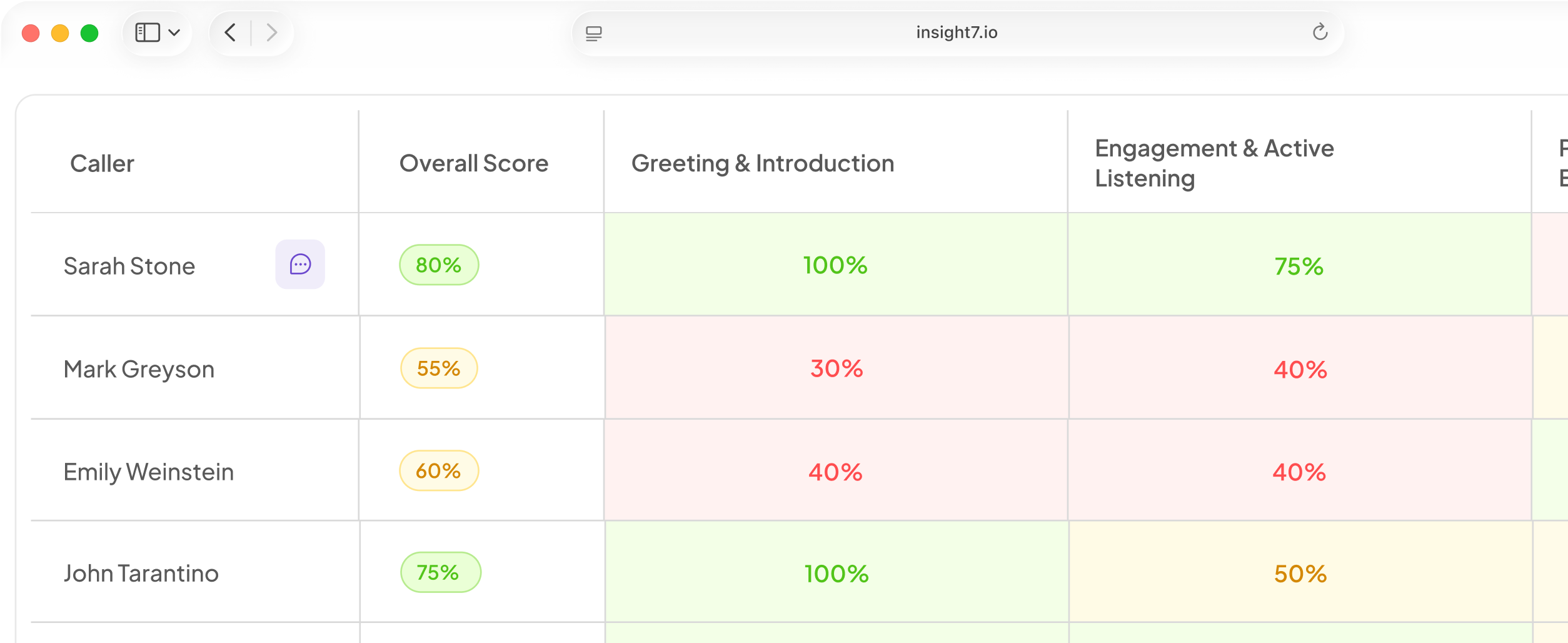
Insight7 scores every call against a weighted scorecard your team owns, not a sample. Alerts can watch keywords and low scores and notify by email or Slack. Compliance monitoring scans calls for mandatory disclosures and data privacy breaches, alerts QA and risk officers, and builds an audit trail. Voice agents are in beta. A campaign can have a test call to your own phone and a dashboard where a reviewer reads each transcript, so check both in the app before you plan around them. Those transcripts can go into the pack. In beta voice campaigns, calls where only the AI spoke are not counted as reached. Insight7 is also building an automatic pause for campaigns that connect but deliver silence.
Launch small, then re-run the gate
Start with a small pilot on a limited sample of calls. Banks do not want to pay to find out whether an agent works. They ask for a short, low-risk pilot, with payment only after results show a measured lift. Run the same hard-block rules from step one on every pilot call.
Go outbound before inbound. Inbound brings complaints and disputes, which are the riskiest conversations for a new agent. Much of that volume exists because companies never send proactive updates. Count a call as reached only when the customer spoke.
Set pause rules before day one. Decide who can stop the campaign and which signals trigger it, such as a hard block or a score below your floor. Name the person who owns the handover queue.
Re-open the gate when any of these change:
- A new prompt, model, language or script.
- A new regulation.
- A drop in live scores.
Weekly alerts on the weakest calls help you catch that drop.
Related reading: AI Voice Agent Test Case Template With 10 Scenarios Every Campaign Should Pass and Simulated Caller Testing vs Live Pilot Testing for AI Voice Agents Compared.
Questions people also ask
How to test voice AI agents before launch?
Talk to the agent in a browser first, then place a real test call to your own phone. Score both on a weighted scorecard with a critical-error rule. Insight7's browser test needs no phone number and is in beta.
What tests should an AI agent pass before go-live?
Test four layers: script and knowledge accuracy, disclosure and consent, escalation and handover, and data handling with edge cases. Set a pass mark for each. A pass on one layer cannot offset a failure on another.
Who should sign off on an AI agent launch?
Compliance, security, QA, operations and the business owner each sign for their own risk. Record sign-offs per agent version, so a new prompt needs new approvals. Require any veto to be answered in writing, with the fix and a re-test date.
What evidence should we keep for AI agent audits?
Keep one pack per agent version: prompt and script versions, test results, transcripts, disclosure wording, sign-offs and accepted risks. Ask legal how long your regulator requires you to keep it.
Does an AI agent have to say it is AI?
Often yes. In the US, AI-voice calls need consent under the TCPA. Disclose by default, since the EU and Colorado rules in step one already require it.
What should block an AI agent from going live?
Any critical error in testing, any failed test layer, a missing sign-off, or an open risk no named person has accepted. A good average score never overrides these.
How long should an AI agent pilot run before full rollout?
Run it until each call type has enough scored calls to show the lift your sponsor agreed, and review results weekly. Widen the rollout only when every call type clears its pass marks with no hard blocks.
Give the gate real power
A gate works only when a failed test can stop a launch and a named person owns that call. Ask in your next meeting: who can say no, and what would make them say it?