


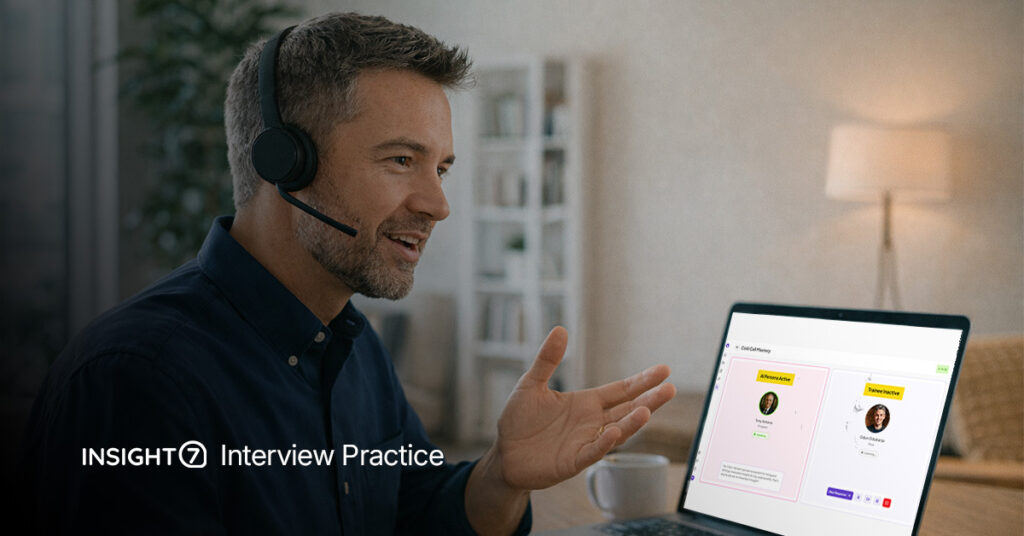
AT&T Customer Service interviews test whether you can handle complex billing, network, and device issues for wireless, fiber, and business customers on calls that affect NPS, churn, and retention. Panels look for associates who can de-escalate, resolve accurately, and stay inside regulated communications. The customer experience transformation focus rewards first call resolution with empathy.
Start your free AT&T Customer Service practice session.
What interviewers actually evaluate
De-escalation, billing and device accuracy, and retention awareness
AT&T Customer Service panels evaluate whether your handling would improve NPS and reduce churn. Strong answers name the issue, the resolution path, and the follow-through.
Signals scored: billing dispute handling, device and service troubleshooting, retention moves, regulated communications, empathy, first call resolution.
What gets scored in every session
Specific, sentence-level feedback.
| Dimension | What it measures | How to answer |
|---|---|---|
| De-escalation | Can you lower tension without overpromising? | Specific language |
| Accuracy | Do you resolve correctly on billing and device? | Name the fix |
| Retention Move | Do you recognize and act on churn risk? | Name the save |
| Follow-through | Do you close the loop? | Specific next action |
How a session works
Step 1: Get your AT&T Customer Service question
You receive a scenario rooted in real calls: a disputed bill, a device activation issue, a fiber install problem, or a churn-risk threat.
Step 2: Answer by voice
Speak your answer as you would to the customer. The system listens for language choice, accuracy, and retention judgment.
Step 3: Get scored dimension by dimension
You get a score across all four dimensions with one flagged weakness and a sentence-level rewrite.
Step 4: Re-answer and track improvement
Revise and answer again. Your score history tracks across De-escalation, Accuracy, Retention Move, and Follow-through.
Frequently Asked Questions
How to prepare for an AT&T customer service interview?
Review AT&T's product lineup (wireless, fiber, business services), read the customer-facing experience materials, and prepare two or three specific customer recovery stories with numbers. Practice explaining a billing or device issue in plain language.
What are the 5 C's of interviewing?
The 5 C's are Competence, Character, Communication, Culture fit, and Career direction. For AT&T Customer Service, Competence is product and billing fluency, Character is how you handled a difficult call, Communication is tone and clarity, Culture fit is customer experience transformation, and Career direction is why a carrier.
What are the 5 hardest interview questions?
The hardest AT&T Customer Service questions are: a customer you could not save, a bill you had to defend, a device issue you caused, a time you disagreed with a teammate in front of a customer, and a retention call that backfired.
What is your 3 strength best answer?
A strong answer names three specific strengths with evidence. For AT&T Customer Service, think de-escalation backed by a specific call example, product accuracy backed by a first call resolution metric, and ownership backed by a follow-through story. Avoid generic strengths without proof.
What are the most common failure modes in AT&T Customer Service interviews?
The most consistent failures are:
- Scripted empathy with no real words used
- Missing billing or device accuracy in resolution
- No retention or churn awareness
- Stories that end at the handoff
- Treating AT&T like a single-product brand rather than a multi-line carrier
Also practice
All nine AT&T role interview practice pages.
One full session free. No account required. Real, specific feedback.








