
It is 6 a.m., a storm has cut a feeder line, and the queue is full of "is my power back?" calls. These eight AI voice agent use cases for utilities and telecom providers give you a script and an outcome for each.
1. Tell customers about planned outages first
Trigger: a work-order date and a list of affected addresses.
Call before the crew arrives, not after the complaints. Some customers prefer a message, so the script offers SMS.
Sample script: "Hello, this is an AI assistant from [Utility]. Power on Oak Street will be off on 14 May, 9 a.m. to 1 p.m., for line repairs. Say yes to confirm you got this. Would you like a reminder text the evening before?"
Expected outcome: track three numbers. They are reached rate, confirmations, and inbound calls on the day. A call where only the AI spoke does not count as reached.
2. Answer "is my power back?" on inbound
Trigger: a customer rings the outage line.
Inbound is where storm pain shows up, but much of that volume exists because no one sent an update first. Your outage data and rules decide what the agent can say, so check each answer against them before launch.
Sample script: "This is an AI assistant from [Utility]. What is the address? … There is a known outage on your street. Crews expect power back by 3 p.m. Want a text when that changes? If it is new, I will log it."
Expected outcome: track repeat calls per address and queue length.
3. Alert engineers when a site drops
Trigger: a site-down alarm from the monitoring system.
A network operations team often handles this by hand. An operator sees the alarm, phones the engineer, rings a second contact if nobody answers, then writes the ticket. An agent can run those steps in order. A call only counts as reached when a person speaks, so an unanswered ring moves to the next contact.
Sample script: "This is an AI assistant from [Operator] network operations. Site 4471 has a power-loss alarm. Say 'acknowledged' to take it. … No answer: calling the next contact. … Noted: acknowledged at 02:14, ticket updated."
Expected outcome: faster acknowledgement and an automatic ticket trail.
4. Remind customers before the bill is due
Trigger: a bill due date, or a scheduled debit, three days out.
Frame this as a service call and keep the tone helpful, because customers who feel helped tend to pay. Direct debits often fail on the due date, so call earlier and give the customer time to add funds. Set calling hours, retry rules and a do-not-call list before launch.
Sample script: "Hello, this is an AI assistant from [Utility]. Is this the account holder? Your bill of [amount] is due on 20 May. Would you like a payment link by text?"
Expected outcome: fewer failed debits. Compare against a holdout group.
5. Follow up on failed payments with options
Trigger: a failed debit, or an invoice a few days overdue.
Stay neutral and never threaten. Name the failed debit, then offer another channel or a callback with a person. A carrier's temporary refusal does not use up a retry attempt. Debt-type calls need consent marking and a do-not-call list. In the US, the FCC's 2024 ruling treats AI-generated voices as artificial voices under the TCPA, so consent applies.
Sample script: "Hello, this is an AI assistant from [Utility]. Your payment of [amount] did not go through. You can pay by text link, or I can arrange a call from a team member."
Expected outcome: payments recovered, or promises-to-pay logged with the pay-by date.
6. Hand off billing disputes to a person
Trigger: a customer says a charge is wrong.
Do not let the agent judge a dispute. Let it collect the facts and pass them on. Buyers ask whether the handover is polite, what happens to the disputed amount, and whether anyone chases an unanswered handover. 87% of 3,566 customers surveyed by Gartner say a route to a human is essential.
Sample script: "This is an AI assistant from [Utility]. Which account is this? Which line item looks wrong? I'm passing you to a specialist now. If nobody is free, we will call you by 4 p.m."
Expected outcome: the specialist gets a full summary, so the customer never repeats the story.
7. Offer plan changes and renewals by call
Trigger: a renewal date or tariff change, with customers grouped by how soon theirs falls.
Keep the call to one yes or no question. Send price questions to a person. Read each transcript for the yes or no, and log it against the account.
Sample script: "Hello, this is an AI assistant from [Operator]. Your plan renews on 30 June at [new price]. Do you want to keep it? Say yes or no. For price questions, I can connect you to a person."
Expected outcome: every call ends as a yes, a no or a handover.
8. Check in after the repair or install
Trigger: a closed repair ticket or a completed installation.
Call the day after the job, before the customer has a reason to complain. Operators want check-ins and satisfaction surveys that arrive before a complaint does. Plan an SMS fallback for customers who do not pick up.
Sample script: "Hello, this is an AI assistant from [Operator]. Is your service working since yesterday's visit? How was the visit, from 1 to 5? If something is wrong, I will flag it to a team member today."
Expected outcome: problems surface early, and every job gets a score.
How to use these scripts in a campaign
Every script above follows four rules. Say it is an AI in the first sentence. Ask one question per turn. Offer a human exit on every call. Set calling hours so calls stay inside quiet hours.
Disclosure law is spreading. Examples by region:
- EU: Article 50 of the AI Act has applied since 2 August 2026. Automated phone systems must say they are AI from the first interaction.
- US: AI-voice calls need consent under the TCPA, and the FCC's proposed "say it is AI" rule was still not final as of mid-2026. Colorado's Chatbot Safety Act also requires AI disclosure from 1 January 2027.
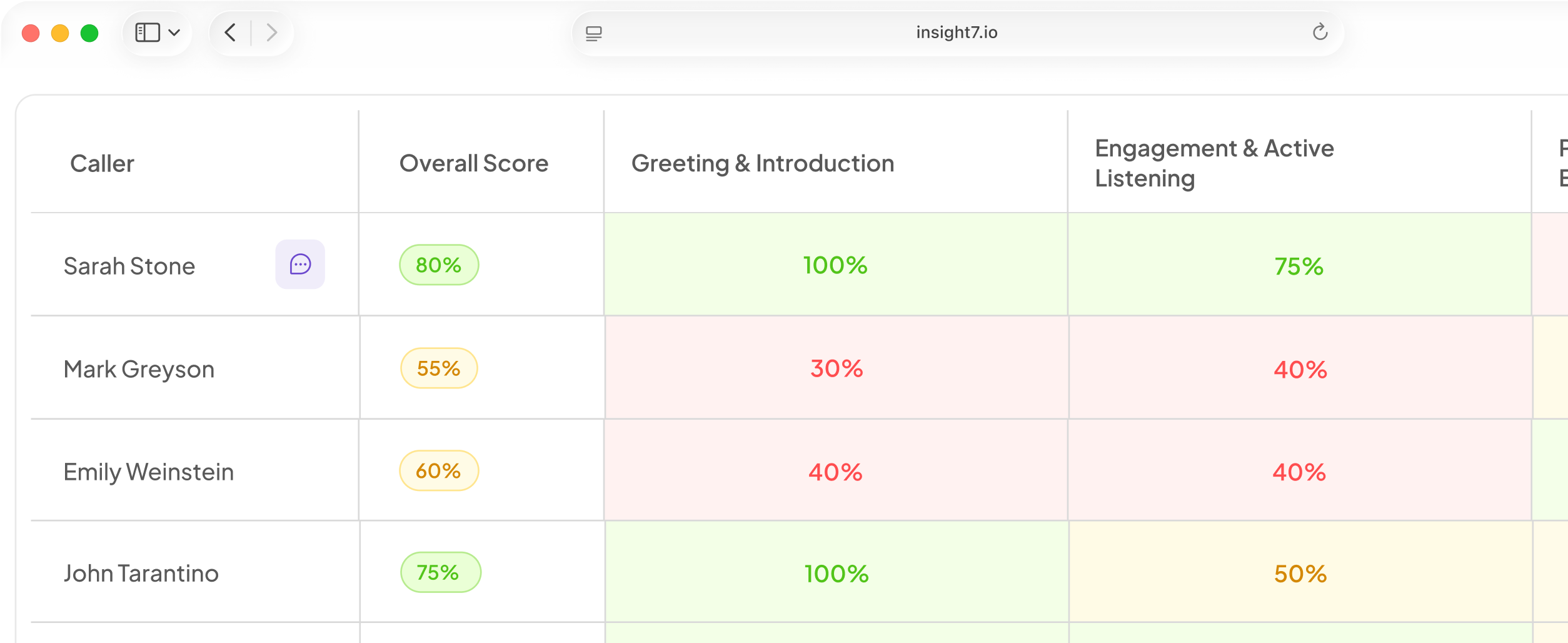
In Insight7, a manager can build an outbound campaign by setting a goal, an audience, the AI caller and the rules. Campaign types include customer survey, lead follow-up, cold outreach and win-back. Setup includes consent marking, calling hours, retry rules, a do-not-contact list and a test call to your own phone. You can also test the agent in the browser. A dashboard shows calls in progress and lets a reviewer read each transcript afterward, with yes/no answers and outcomes pulled from it. Inbound voice lines, where the AI answers and can look the caller up, are also in beta. All of this is in beta, so check it in the app before you plan around it.
To measure results, hold back a random group of customers who get no call. Compare both groups on the numbers each use case lists.
How to adapt them to your network
Swap the variables, and keep the structure. For power, the trigger is a feeder or work order. For water and gas, it is a valve or main repair. For mobile, fibre and ISP, it is a site alarm or a plan end date. The script, the human exit and the metrics stay the same.
Go voice first, with an SMS fallback, because some customers prefer a message to a call. Start with outbound, then add inbound.
Local languages and numbers matter in every region. As one example, voice campaigns on Insight7 Voice can run in Yoruba and Igbo, and the manager picks the language before the voice. Calls can also go out on local numbers, which are more likely to be answered.
Before you scale, read the first 20 to 30 transcripts. Look for places where customers got confused or asked for a person. Fix those lines, then widen the audience.
Related reading: AI Voice Agent Use Cases for Insurance Companies Covering Renewals, Claims Updates and Policy Questions and AI Voice Agents vs AI Chatbots Compared for Customer Service Teams.
Questions people also ask
What are the best AI voice agent use cases for telecom and utility providers?
Start with outbound calls that have a clear trigger and a list: planned outage notices, bill reminders and post-repair check-ins. Add inbound outage lookups and billing handovers after you read the first transcripts.
Can an AI voice agent handle outage calls during a storm?
It can take routine calls off your queue, such as address lookups and known-outage updates. Anything new or unusual should be logged or passed to a person. Test it with storm-day scenarios before you rely on it.
Do AI voice agents have to say they are AI on billing and outage calls?
In the EU, yes. Automated phone systems must say so from the first interaction. Colorado adds a duty in 2027. Disclose everywhere.
How do I test a voice AI agent before it calls customers?
Talk to the agent in the browser, then place a test call to your own phone. Script awkward cases: "I already paid," a wrong person, and "let me speak to someone."
What consent do I need for outbound AI calls about bills?
In the US, the FCC's 2024 ruling puts AI-generated voices under the TCPA. Record consent against each contact. Ask counsel which rules fit.
When should an AI voice agent hand a billing call to a human?
Hand over when a charge is disputed, the customer asks for a person, or the agent misunderstands twice. Pass the account and amount along.
How do I measure whether a voice agent is working?
Set a baseline before launch, then track one or two numbers per use case, such as repeat calls per address. Gartner found 42% of AI service use cases could not be measured.
Start with the call your agents dread
Pick the call your agents hate answering, script it, and keep a human exit on every line. Prove it on a small list first. Which of these eight calls costs you most on your worst storm day?