
A good AI voice agent test call checklist covers 20 checks in five areas: legal set-up, sound and speed, script and knowledge, human handover, and data capture. Run every check on a real phone line before any customer is dialled.
Check set-up and consent first
Rules differ by region, so test against where your contacts live. The EU requires AI that talks to people to say it is AI from the first interaction. In the US, AI-voice calls need TCPA consent under the FCC's 2024 ruling. Colorado adds a disclosure duty from 1 January 2027.
- 1. The agent says it is AI in the first seconds.
- 2. Consent is marked for every contact.
- 3. Calling hours match each contact's local time.
- 4. The do-not-contact list is honoured, including in copied campaigns.
- 5. The recording and data-storage notice is correct.
Insight7's beta campaigns have consent marking, calling hours and a do-not-call list. Copied campaigns skip anyone newly added to the do-not-contact list. Buyers ask where recordings live and which AI models touch them.
Check sound, speed and language
People answer each other fast. In a study of 10 languages, replies most often came within 200 milliseconds of a question ending (Stivers et al., PNAS). A slow agent feels broken.
- 6. The agent replies promptly after the caller stops talking.
- 7. The caller can interrupt, and the agent stops.
- 8. Names, amounts, dates and phone numbers are read correctly.
- 9. The call is tested on a real mobile line with noise and a weak signal.
A browser test needs no phone number. It cannot show weak signal, so use a handset too. Choose the language before the voice. Yoruba and Igbo campaigns are in beta, and Pidgin is new. Buyers reject foreign-sounding voices.
Check script, knowledge and edge cases
Regulated buyers worry most about an agent that "goes rogue" and makes a public mistake. They ask what happens when the customer goes off script. Test that on purpose.
- 10. The agent stays inside the script and facts it was given.
- 11. It says "I don't know" and does not invent an answer.
- 12. It handles off-topic and pressure questions without drifting.
- 13. It handles wrong person, voicemail, silence and "how did you get my number".
Buyers ask about the first and last of these. Insight7's beta does not count calls where only the AI spoke as reached. Check how your own tool counts voicemail.
Check the handover to a human
Test the exit as hard as the opening. Gartner's 2026 survey of 3,566 customers found 87% say a human option is essential when a company uses GenAI for service. Buyers ask if handover is polite and what happens to a disputed amount.
- 14. The customer can ask for a human at any point and gets one.
- 15. The handover is polite, and the summary travels with the call.
- 16. Sensitive topics, disputes and complaints trigger escalation.
- 17. A callback request lands in a queue someone owns.
Insight7's beta inbound lines are built to send callback requests to a queue. Name its owner before launch.
Check data, outcomes and stop rules
A call that cannot be measured cannot be defended. Gartner's review of 432 AI service use cases found a quarter with positive ROI and 42% with unclear ROI.
- 18. Call outcomes and yes/no answers land in the CRM or dashboard correctly.
- 19. The transcript and recording are readable and match what was said.
- 20. Retry rules and the pause or stop switch work. A carrier refusal must not use up a retry.
Insight7's beta dashboard shows calls in progress, then the transcript, and pulls outcomes from it. Campaigns have retry rules, and a carrier's temporary refusal does not use one. Buyers also ask whether the agent reads from their CRM and plugs into their stack.
Run the checklist in three passes
Run the 20 checks in three passes, each with a different tester. Each pass catches faults the one before it cannot.
Pass 1: the builder tests in the browser. The person who wrote the script talks to the agent with no phone number. This finds broken logic, wrong facts and missing answers fast. It cannot test weak signal or handset audio.
Pass 2: a stranger tests on a real phone. Pick someone who did not write the script, such as an operations clerk who has never seen the setup. Add one tester who plays an angry customer and one who plays a confused customer. They should interrupt, mumble, go silent and ask for a human. Record every call.
Pass 3: a small live sample. Dial a small group of real, consented contacts. Watch the first calls as they happen. Many regulated buyers want a short, low-risk pilot on a small sample. Stop at once if any hard blocker fails.
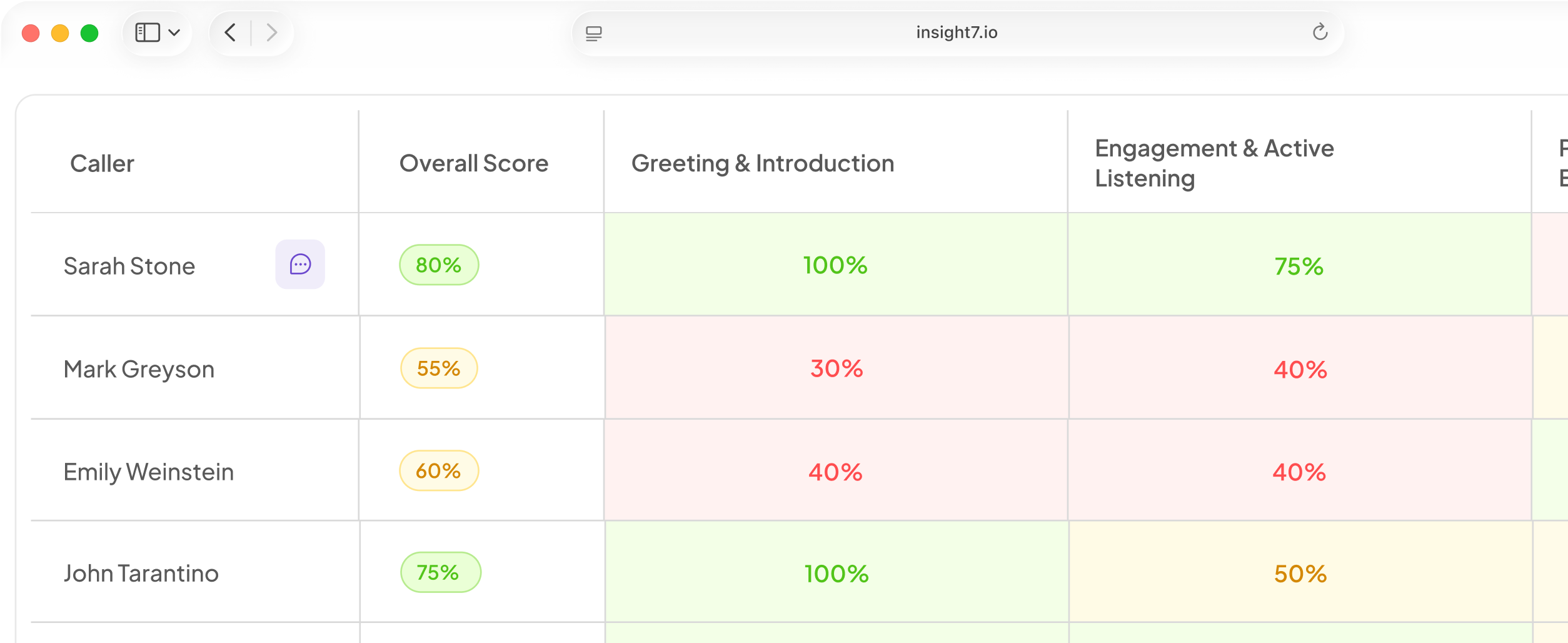
Insight7's beta campaigns can help with these passes. A manager sets the goal, audience, AI caller and rules, and each call is held as a real conversation and scored when it ends. A campaign can send a test call to your own phone, though that detail is spec only, so check it in the app. The dashboard transcript and outcomes help with items 18 and 19. You can also score recorded test calls with Insight7's free Call Quality Monitor. It turns uploaded audio or transcripts into automated scorecards.
Score each item pass or fail
Use one rule for the whole list:
- Hard blockers: items 1 to 5 (disclosure and consent set-up) and items 14 and 15 (reaching a human and a clean handover). One fail means no go-live.
- Scored by listening: the sound items, 6 to 9. Two testers each mark pass or fail. Any disagreement is a fail until you re-test.
- Everything else: fix every fail, then re-run the whole pass.
Keep the score sheet next to the recordings so anyone can see why you went live. Testers who spot the AI can still pass the call if they understand the agent and are understood. The agent must be clear and honest, and hand over well.
Adapt the list to your campaign
Weight the 20 checks by campaign type. Insight7's beta campaigns come in four types: customer survey, lead follow-up, cold outreach and win-back (check this in the app). Each type has a different weak spot.
- Cold outreach: Make items 1 to 5 your strictest gate. The contact never asked for this call, so disclosure and consent carry the most risk. Run "how did you get my number" in more than one test call.
- Collections and reminders: Add extra tests to items 14 to 16. The agent will meet disputed amounts and upset people. Reminders and collections need different tones. Test a polite tone before a firm one.
- Surveys: Weight items 18 and 19. A survey with no clean answers is wasted. Some customers prefer a message to a call. Test the reply "please text me instead".
- Win-back and lead follow-up: Weight items 10 to 12. Contacts often ask why they were called, and the agent must answer from facts it was given.
Add a critical-error rule for regulated sectors
QA leaders say a checklist score can hide what matters. They want one critical error to fail the whole call. In banking, insurance and healthcare, write that rule into your list. A wrong amount, a missed disclosure or a refused human fails the test.
Swap in region and language items
Replace items 1 to 5 with the rules of each region you dial. Then add a language item for each language you run. Have native speakers listen for accent and for how names and amounts sound. Re-run the full list after any change to the script, voice, language or carrier. Log the date, the change, the tester and the result.
Related reading: Multilingual AI Voice Agents Guide for Contact Centers Serving Customers in Several Languages and How to Choose an AI Voice for Your Brand Based on Accent, Gender and Tone.
Questions people also ask
How do you test AI voice agents?
Test in three passes. The builder talks to the agent in a browser, a stranger then calls it on a real phone, and a small live sample follows. Mark each of the 20 checks pass or fail, and record every call.
How many test calls should you make before going live?
No single number fits every campaign. Keep testing until every check has been hit more than once and one full pass has no failures. Include angry, confused, voicemail and wrong-person calls.
Does an AI voice agent have to say it is AI?
In the EU, any AI that talks to people, including automated phone systems, must say it is AI from the first interaction. Colorado adds a duty from 2027. Disclosing in every region is the safe default.
What are the consent requirements for AI outbound calls?
In the US, AI-voice calls already need consent under the TCPA, following the FCC's 2024 ruling. Keep consent on record for each contact, and check your own region's rules. Insight7's beta campaigns have consent marking.
What is a good response delay for a voice agent?
Aim for the shortest delay you can get. In human talk, replies most often arrive within about 200 milliseconds (Stivers et al., PNAS). If testers find the pause broken, fail the check.
Who should run the test calls?
Someone who did not build the script. Have your QA manager score the recordings.
What should you do if the agent fails a check after launch?
Pause the campaign first. Then fix the fault, re-run all 20 checks and log the change. Test the stop switch before launch, because item 20 depends on it.
Ready means a stranger is understood
A voice agent is ready when a stranger on a bad line is understood, can reach a human and leaves a clean record. Insight7's beta dashboard lets reviewers read each transcript at call end. Who owns the stop switch?