
The most common mistake with AI voice agent KPIs is reporting calls made and minutes handled instead of outcomes. Budgets get cut when nobody can show a payoff. Gartner found only a quarter of AI service use cases show positive ROI, and 42% can't be measured.
1. Measure answer rate per unique contact
Answer rate is contacts who picked up ÷ unique contacts dialled. Count each person once, however many times you rang.
Every range in this list is an illustrative starting point, not a published benchmark and not Insight7 data. Calibrate each one against your own baseline. For this KPI, start at 40 to 60% for existing customers and 10 to 25% for cold lists. Cold lists usually sit low because many people ignore unknown numbers. A 2020 US survey found eight in ten Americans don't generally answer calls from unknown numbers.
Attempts and timing move this number most. Test morning and evening windows against midday, and allow several dials per contact.
2. Count live conversations, not connected calls
Live-conversation rate is calls with customer speech ÷ answered calls. Voicemail, silence and a dead line all count as answers, yet none is a conversation.
In one consumer lender's test round, most contacts answered, and roughly half of those held a real conversation. Aim for 50 to 70% as a starting range, not a promise. A low figure points to voicemail, poor lines or an opening that loses people.
3. Measure attempts needed to reach a person
Attempts per reached contact is total dial attempts ÷ contacts reached. It sets your cost per reach, because every redial costs telephony money. Many people answer on the second or third try, and three to four attempts is a sound cap. A starting range is 2 to 3 for existing customers, not a promise. Don't charge a carrier's temporary refusal as an attempt, or the number will look worse than it is.
4. Watch mid-call drop-off by minute
Call completion rate is calls that reach the goal step or a planned end ÷ live conversations. Plot hang-ups by second. Spikes usually sit at the AI disclosure, the first ask or a transfer. Slow replies and a robotic tone cause early exits, and buyers raise that fear often. A starting range is 70 to 85%, not a promise.
5. Define one goal and score it
Goal completion rate is live conversations that end in the campaign goal ÷ live conversations. Pick one goal per campaign, such as a finished survey, a promise to pay, completed KYC or a booked callback. Take the outcome from each transcript, not from a rep's memory.
Starting ranges: surveys 30 to 50%, lead follow-up 15 to 30%, win-back 5 to 15%, cold outreach 2 to 8%. Match the goal to the audience. Reminders are not collections, and a happy customer pays.
6. Prove lift with a holdout group
Incremental conversion lift is (conversion in the called group − conversion in the holdout) ÷ conversion in the holdout. Hold back a random slice of contacts who get no voice call. You can also carve out a sublist that only voice can reach, so no other channel claims its conversions. Set this up before launch, because you can't rebuild a control group afterwards. If SMS runs in parallel, the same split shows which channel earned the result.
Aim for a lift that is positive and clearly larger than chance. Treat 10 to 30% as a starting range. For group size, use a rough rule of thumb: plan for at least 100 conversions per group. At a 5% baseline, 100 ÷ 0.05 gives about 2,000 contacts per group.
7. Calculate cost per successful outcome
Cost per successful outcome is (platform + telephony + review cost) ÷ goal completions. Count human review time, or the number flatters the agent. Divide by completions from KPI 5, never by calls.
Gartner reports that customer-service AI spending rose 38% while service budgets rose 2%. Finance will ask for this number. Set it against your own cost to acquire or serve a customer.
Set the target from your own human-handled cost per outcome. A sensible hypothesis to test is that the agent lands well below it. If the agent's cost is at or above the human cost, fix KPIs 1 to 5 first.
8. Keep handoff rate in a healthy band
Handoff rate is calls transferred or called back ÷ live conversations. A healthy starting range is 10 to 25%, not a promise. Zero is a warning sign. It usually means the agent traps people who want a person. Gartner's survey of 3,566 customers found 87% want a human option when a company uses GenAI.
Buyers ask if handoff is polite, what happens with a disputed amount, and who chases an unanswered handover. Design those three answers before launch.
9. Measure resolution, not containment
Resolution rate is issues closed with no repeat contact in 7 days ÷ issues handled by the agent. Containment only says the call stayed with the AI. Resolution says the problem is gone. A contained call that ends in a second call tomorrow is a failure. Aim for 60 to 80% as a starting range, not a promise. Also look at why people call back. Much inbound volume exists because companies never send proactive updates, so some repeats are avoidable.
10. Score critical-error rate on every call
Critical-error rate is calls with a critical error ÷ calls scored. Aim for near zero. A starting range is under 0.5%, and hard errors such as leaked data should be zero.
One critical error should fail the whole call, even when the checklist score is high. A call can be perfect on procedure and still leave the customer angry. Regulated buyers fear a rogue agent and want proof from real deployments.
Sampling cannot give that proof. Take an illustrative case of 10,000 calls with a 0.5% error rate, which is 50 bad calls. Manual sampling typically covers about 2% of calls. That would review 200 calls and find about one bad call.
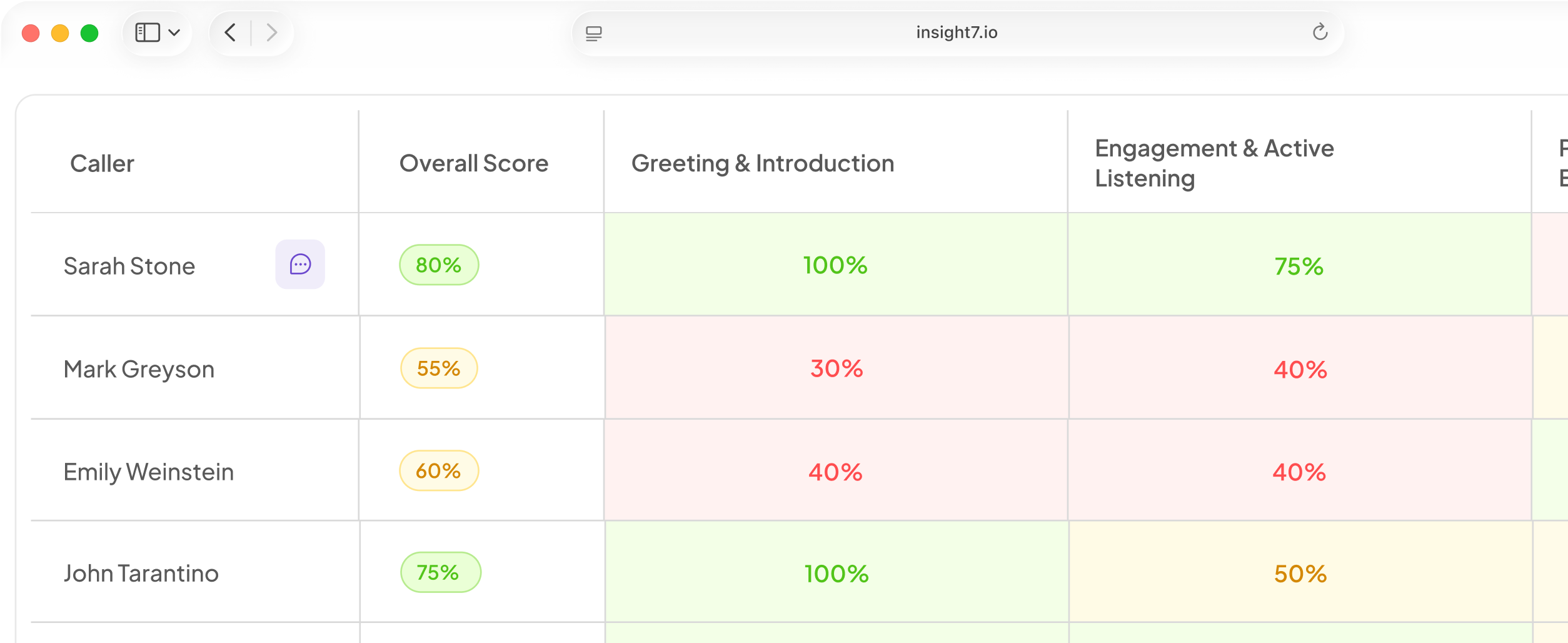
Insight7 can score every call against a weighted scorecard your team owns. Its voice campaigns, in beta, include a dashboard where a reviewer reads each transcript when the call ends.
11. Audit disclosure and consent adherence
Compliance adherence rate is calls with AI disclosure, consent mark and calling hours all met ÷ calls audited. For hard rules, the target is 100%. Any failed check counts as a miss. Rules differ by region:
- EU: Article 50 of the AI Act requires people to be told they are talking to AI. It has applied since 2 August 2026.
- US: AI-voice calls need consent under the TCPA, per the FCC's 2024 ruling. States are adding disclosure rules too. Colorado's Chatbot Safety Act requires disclosure from 1 January 2027.
Check the rules for every market you call. Give each check its own field in your campaign record, so an audit is a count, not a debate.
12. Track opt-outs, complaints and sentiment
Opt-out and complaint rate is (do-not-contact requests + complaints) ÷ calls connected. Aim for under 2% as a starting range, not a promise. Pair it with post-call sentiment from transcripts, or a one-question CSAT. Buyers fear AI that sounds scripted, so a rising opt-out rate is your early warning. Honour every request at once, and make sure copied or reused contact lists drop anyone who has opted out since.
Related reading: How to Define Success Criteria for an AI Voice Agent Pilot, Outbound Call Campaign Benchmarks for Answer Rate, Completion Rate and Conversion and How to Read AI Call Campaign Results and Pick Customers for a Follow-Up Campaign.
Questions people also ask
What are the most important AI voice agent KPIs?
Start with five: answer rate, live-conversation rate, goal completion rate, cost per successful outcome and critical-error rate. They follow a call from reach to result to cost to risk. Add the other seven as the campaign matures.
What is a good answer rate for an AI outbound calling campaign?
It depends on the list, so set one target for existing customers and a lower one for cold lists. Split results by hour and attempt number, and test morning and evening windows against midday.
How do you measure the ROI of an AI voice agent?
Subtract total cost from the value of incremental goal completions, then divide by total cost. Count only conversions above your holdout group. Include platform, telephony, human review time and the cost of errors.
What is containment rate in a voice AI agent?
Containment rate is calls the AI finished without a human, divided by calls it handled. Read it with handoff rate and seven-day repeat contacts. High containment plus many repeat calls means customers are being trapped.
How many times should an AI voice agent redial a customer?
Three to four attempts is a sound start. Space them across different times of day, because the first miss often reflects timing, not refusal. Use your platform's retry rules and calling hours to enforce the cap.
How often should you review AI voice agent KPIs?
Review answer rate, live-conversation rate, drop-off and handoff weekly. Review lift and cost per outcome monthly. Check critical errors and compliance on every call.
How do you know if an AI voice agent is hurting customer experience?
Look for rising opt-outs, hang-ups at the same moment each call, repeat contacts within seven days and handoff requests clustered at one step. Then read a weekly batch of transcripts to find the cause.
Count outcomes, not calls
Calls and minutes show activity. These 12 KPIs show whether the agent reached people, solved problems, stayed compliant and paid for itself. Keep the list short and review it on a schedule. Rule of thumb: if a KPI cannot change a decision, drop it.