
TL;DR
- One table covers trigger, owner, timing and fallback.
- Hand off fast on sensitive topics, repeated failure, anger or a request for a human.
- Every handoff needs a named owner.
The escalation rules template
Copy this table, then change the roles and times to fit your floor. The times are example starting values to tune against your own staffing, not benchmarks.
| Trigger | Agent says | Owner | Response time | Fallback if unanswered |
|---|---|---|---|---|
| Customer asks for a human | "Of course. I'm connecting you now." | Shift lead | Instant warm transfer | Callback queue, SMS confirming the callback |
| Disputed amount | "A person will review that with you." | Collections desk | Callback within 30 min | Supervisor alert, then same business day |
| Complaint | "I'm sorry. I'll pass this to a colleague." | Service supervisor | Callback within 1 hour | Email follow-up, supervisor alert |
| Legal threat | "I'll hand you to the right team." | Compliance officer | Instant, or callback within 15 min | Supervisor alert, stop all retries |
| Vulnerable customer | "Let me get someone to help you." | Shift lead | Instant warm transfer | Callback within 15 min, stop retries |
| Fraud claim | "I'm sending this to our security team." | Fraud or compliance desk | Instant, or callback within 15 min | Supervisor alert, no further outbound calls |
| Two failed answers or low confidence | "Let me get a colleague who can help." | Shift lead | Callback within 30 min | SMS or email with the open question |
| Anger or repeated interruption | "I hear you. I'll bring in a person." | Shift lead | Instant warm transfer | Supervisor alert, callback within 15 min |
| Silence or no customer speech | Short check-in, then a safe goodbye | QA manager | Review same business day | Retry later, pause the campaign if it repeats |
| Carrier refusal | None, the call never connects | Campaign owner | Same business day | Retry after the set gap, then SMS |
| Wrong person | "Sorry to bother you." | Campaign owner | Same business day | Remove the number, stop retrying |
| Do-not-call or consent withdrawal | "Understood. We won't call again." | Compliance officer | Mark at once, confirm same day | Stop all channels, log the request |
How the rows work
Disputes, legal threats and fraud claims are hard triggers. Our advice is that the agent should not attempt them at all. It hands the call to a human.
Buyers raise three questions on their own: is the handoff polite, what happens to a disputed amount, and does anyone chase an unanswered handoff. The "Agent says" and "Fallback" columns answer them.
Treat the sensitive rows as critical errors. QA leaders say one critical error should fail a whole call. If the agent argued a disputed bill, score that call as failed.
The fallback column covers the case where no human answers. Pair any callback queue with a supervisor alert so someone owns the wait.
Use roles, not names.
Set triggers that hand off early
Split your triggers into hard and soft. A hard trigger always hands off at once. Soft triggers hand off after a count. Two failed answers in a row is a good starting value. A fixed count beats judging confidence because you can see it, test it and audit it.
Customers expect a way out. A Gartner survey of 3,566 customers found 87% say companies using GenAI for service must offer a route to a human. So never gate "I want a person" behind a failure count.
The agent must also answer truthfully when asked if it is an AI. Disclosure law by region:
- EU: Article 50 of the AI Act has applied since 2 August 2026. AI that talks to people, including automated phone systems, must say it is AI from the first interaction.
- US: AI-voice calls need consent under the TCPA, per the FCC's 2024 ruling. A rule to announce AI at the start of a call was still not final in mid-2026. Colorado will require public-facing conversational AI to disclose it from 1 January 2027.
Give each handoff an owner and clock
Assign every handoff to a role, then add a backup role for each shift. The shift lead owns live transfers on the day shift. The service supervisor covers evenings. If the owner does not respond, the backup gets the alert. That answers the question buyers ask on their own: does anyone chase a handoff nobody picked up?
Pick warm transfer or callback by who is free.
- Warm transfer: use it when a live agent is on shift. The customer waits seconds, not minutes.
- Callback: use it after hours or during a campaign spike.
Start the clock when the trigger fires, not when someone sees it. Set an acknowledge time (a person has seen it) and a resolve time (the customer has been reached). As an example only, try a 5 minute acknowledge and a 30 minute resolve, then tune both against your staffing.
Send context with every handoff so the customer never repeats themselves:
- a short transcript summary
- a reason code, such as "disputed amount"
- what the customer already said
Your QA manager should review handoffs by reason code every week. If one code keeps firing, change the trigger or fix the script.
Write retry rules that stop in time
Set the retry rules when you build the campaign. Calling hours and consent are the outer limits. No retry may break them.
| Outcome | Attempts | Gap | Fallback |
|---|---|---|---|
| No answer | 3 | 3 hours | SMS, then stop |
| Busy | 3 | 30 min | Retry, then SMS |
| Voicemail | 1 | None | Safe message with no account details, then SMS |
| Carrier refusal | 3 | 1 hour | Email or SMS, then stop |
| Wrong person | 0 | None | Remove the number |
| Asked to call back | 1 | At their time | Human callback if missed |
| Do-not-call | 0 | None | Stop all channels |
These are example values to tune against your answer rates.
Two rules keep the count honest. A call where only the AI spoke should not count as reached. A carrier's temporary refusal should not use up a retry attempt. Without the first rule, a silent line looks like a success. Without the second, a network blip burns a real chance to reach the customer.
Switch to SMS or email after the last call attempt, or when the customer prefers it. Send to a human when the customer asks, or when a callback is missed.
Test the rules before go-live
Test every row of the table with a real call, not a read-through. Start in a browser or on your own phone. Trigger each row on purpose: ask for a human, dispute a bill, stay silent.
Mark each row pass or fail:
- The trigger fires on the right words or count.
- The reason code and summary reach the owner.
- The owner acknowledges within the stated time.
- The fallback runs when nobody answers.
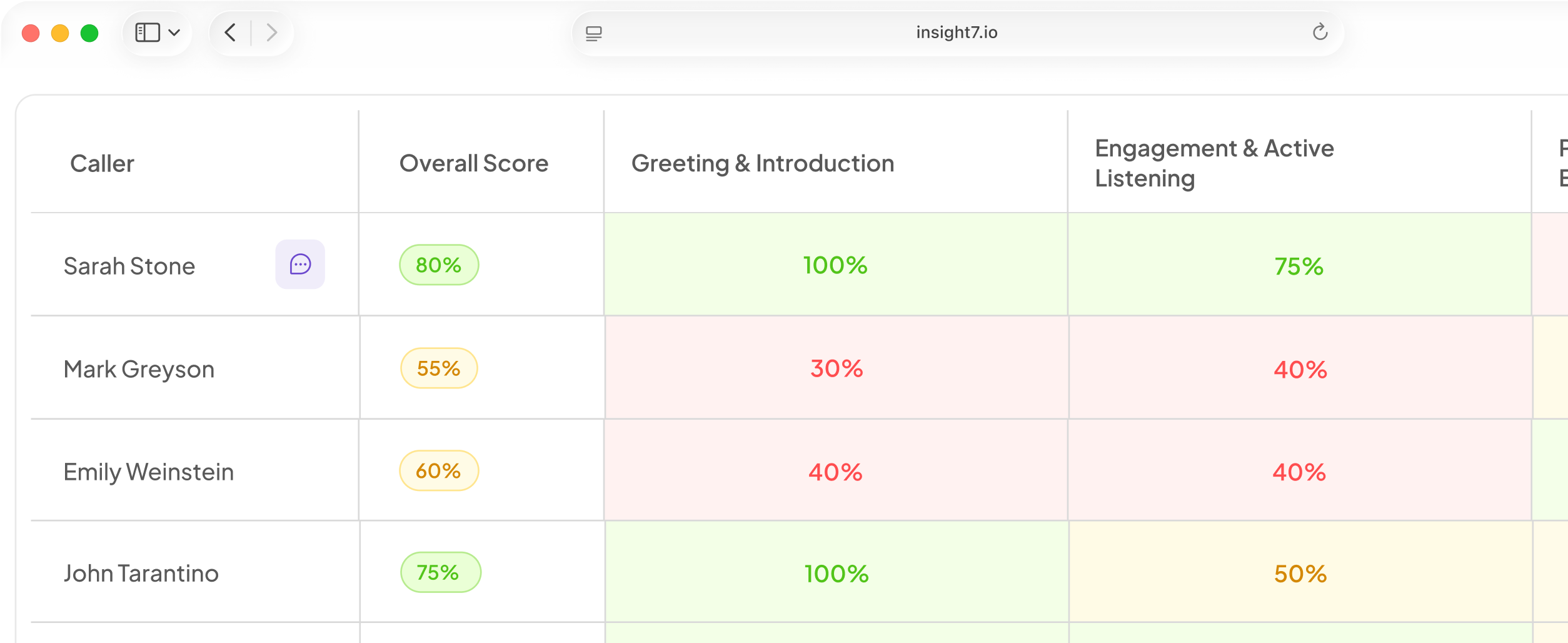
Insight7's voice campaigns, in beta, carry consent marking, calling hours, retry rules and a do-not-call list, plus a test call to your own phone. You can also talk to a campaign's agent in the browser with no phone number needed. A dashboard shows calls in progress and lets a reviewer read each transcript when the call ends. Calls where only the AI spoke are not counted as reached, and a carrier's temporary refusal does not use up a retry attempt. Duplicated campaigns leave out anyone added to the do-not-contact list since the original. Separately, every call can be scored against a weighted scorecard your team owns, which helps you find missed handoffs. Alerts can watch keywords and low scores and notify by email or Slack.
Keep measuring after launch. Gartner's review of 432 AI customer service use cases found that only a quarter show positive ROI, and 42% have unclear ROI. Track handoff rate and unanswered handoffs from day one.
Related reading: 8 Best Practices for Handing Off Calls From AI Voice Agents to Human Agents, 6 Fallback Designs for When an AI Voice Agent Can’t Answer a Customer’s Question and How to Set AI Outbound Call Retry Rules for Collections, Renewals and Feedback Campaigns.
Questions people also ask
When should an AI voice agent transfer to a human?
Transfer at once when the customer asks for a person or raises a dispute, legal threat, fraud claim or vulnerability. For softer signals, such as two failed answers, transfer after a count.
What should an AI voice agent do when it cannot answer a question?
It should say so plainly, stop guessing, and hand off with a reason code. If nobody is free, offer a callback with the open question attached, so the customer does not have to repeat it.
How many times should an AI voice agent retry a call?
Start with three attempts at different times of day, capped by calling hours and consent. Stop earlier for wrong numbers and do-not-call requests.
Who should own escalated calls from an AI voice agent?
Own each trigger by role: the shift lead for live transfers, the collections desk for disputes, the compliance officer for legal and consent issues. Your QA manager owns the weekly review.
How fast should a human respond to an AI voice agent handoff?
Match speed to risk. Sensitive and angry callers need an instant warm transfer or a callback within minutes. Routine questions can wait until the same business day.
Does an AI voice agent have to say it is an AI?
In several regions, yes. The EU AI Act requires disclosure of AI from the first interaction. Colorado will require it from 1 January 2027.
How do you measure whether AI voice agent escalation is working?
Track handoff rate, unanswered handoffs, time to acknowledge, and repeat contacts after a handoff. Then score calls on a weighted scorecard to find handoffs that should have fired.
Finish each rule before you ship it
A handoff rule is finished when it has an owner, a clock and a fallback. This week, fill one table row for each of your five riskiest call types. Then test every row with a call to your own phone.