
Your call list keeps growing, but your human callers don't. AI telemarketing promises cheaper volume, yet one consent mistake can cost more than a year of savings. Here is AI telemarketing vs traditional telemarketing on cost, compliance and conversion.
AI vs traditional telemarketing at a glance
Compare the rows that match your campaign. This table sets AI telemarketing against an in-house human team and an outsourced service.
| Factor | AI telemarketing | In-house human team | Outsourced service |
|---|---|---|---|
| Cost model | Per-minute or platform fee | Salary, benefits, training | Per-hour or per-lead fee, with agency margin |
| Scale and speed | Many calls at once | Limited by headcount and shifts | Limited by the agency's staffing |
| Compliance load | Consent, calling hours, retries and the do-not-call list must be set in the campaign | Rests on each caller's habits | Shared with the agency, but your brand carries the risk |
| Conversion and rapport | Strong on reach, weaker on nuance | Strong on rapport and complex sales | Varies by agency and script |
| Consistency and QA | Same script every call | Varies by caller | Varies, and you see less |
| Setup time | Script, list, test call | Hire, train, ramp up | Agency onboarding and script sign-off |
| Best fit | Big lists, simple script | High-value, high-touch sales | Short bursts without hiring |
For the human column, US telemarketers averaged $36,340 a year in May 2024. That is only the wage. Turnover, training and idle time sit on top.
Cost: compare cost per real conversation
Judge cost by the conversation. Use this formula: total campaign cost ÷ connected conversations. A connected conversation is one where the contact actually spoke to you.
Here is a hypothetical example, not a quote. Say $500 of platform and minute charges buys 1,000 dials, and 300 contacts speak. That is about $1.67 per conversation. If only 200 speak, the same $500 costs $2.50 each.
What drives the human number:
- Wages, which for US telemarketers averaged $36,340 a year in May 2024
- Turnover and retraining
- Idle time between answered calls
- Agency margin, if you outsource
What drives the AI number:
- Per-minute or platform pricing
- Retries
- Calls that connect but carry no human voice
Ask vendors whether calls with no human voice count as reached. Ask whether a carrier's temporary refusal uses up a contact's retries. Both change your per-conversation math.
Ask for pricing in writing. A range early lets you compare vendors and brief your own team. Per-minute pricing can scale in odd ways, so ask for the scaling curve before any pilot.
Then run a short pilot on a small sample, and agree to pay only after a measured lift. A pilot that costs little to try also costs little to stop.
Measure from day one. In a Gartner analysis of 432 AI customer service use cases, only a quarter produced a return. Another quarter lost money, and 42% had unclear ROI.
Every AI call is still a telemarketing call
Treat every AI call as a telemarketing call first. The FTC's Telemarketing Sales Rule applies whether you dial with low-tech equipment or the newest technology. It covers the seller and the telemarketer, so an agency does not take your risk away.
Rules both options share (see the FTC's guide to the rule):
- Do not call numbers on the National Do Not Call Registry or on your own list.
- Do not call before 8 a.m. or after 9 p.m.
- Keep the required business records for two years.
- State who you are and why you are calling before the pitch.
The AI layer on top:
- In the US, AI-voice calls already need consent under the TCPA, per the FCC's 2024 ruling. A proposed "say it is AI at the start" rule was still not final as of mid-2026.
- In the EU, Article 50 has applied since 2 August 2026. Any AI that talks to people, including automated phone systems, must say so from the first interaction.
- In Colorado, a chatbot law takes effect on 1 January 2027. Public-facing conversational AI must disclose it is AI.
Human callers carry risks too. Scripts drift, and call review is the only way to see it.
For AI, ask any vendor to show each control: consent marking, calling hours, retry rules, a do-not-call list and a test call to your own phone.
Regulated buyers name an agent that "goes rogue" as their main fear. Ask for the handover design and proof from real deployments, not a better demo. Ask how the handover stays polite and where sensitive issues go. This matters because 87% of 3,566 customers say a company using GenAI for service must offer a way to reach a human.
Conversion: where humans win and AI wins
Conversion splits into two jobs. Reach is answer rate, retries and timing. Persuasion is rapport and handling objections.
| Job | Better fit | Why |
|---|---|---|
| Reach | AI | Retries, calling windows, speed through a list |
| Simple offer, one next step | Either | A clear script carries it |
| Complex, high-value sale | Human | Quoting and judgment |
AI wins on reach. A consumer lender's pilot reached about 150 customers and got a positive response rate near one in five. Morning and evening windows were answered best, and three to four attempts worked best because many people picked up on a later dial. Few human teams have the hours to redial like that.
Humans win when the sale is high-touch or the quote is complex. Buyers also fear AI that sounds scripted. They ask what happens when the customer goes off script.
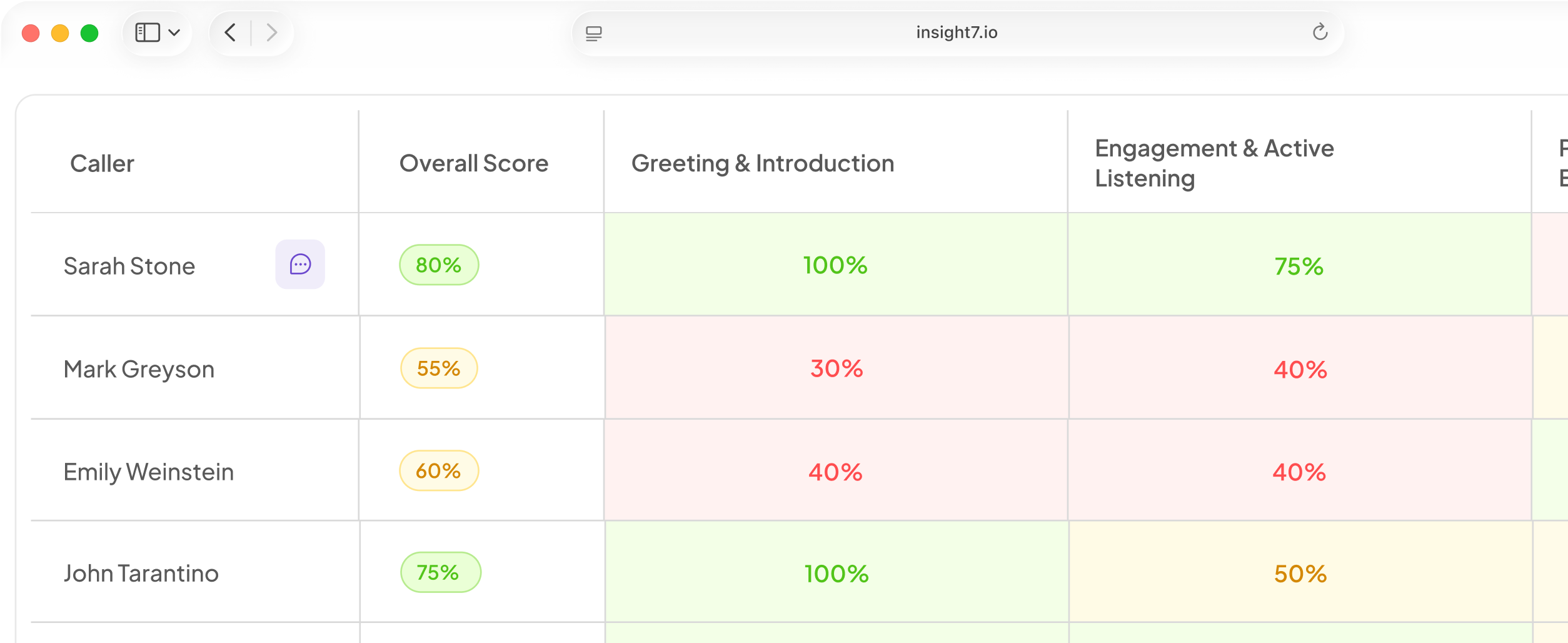
Weak callers lose the same way, whether human or AI. Insight7's analysis of 6,209 sales conversations found top performers ask 37% more questions per call. In high-ticket insurance, top agents closed 65% and bottom agents 0% under identical conditions. A script-bound bot that never follows up on an answer sits at the bottom. Only scoring every call shows who is where. A checklist score can also hide a critical error, so build the scorecard to fail the call on one.
In Insight7's outbound campaigns, in beta, a manager sets a goal, an audience, the AI caller and the rules. A dashboard shows calls in progress and transcripts, and pulls outcomes from them. You can talk to the agent in your browser before any number is dialled, a fast check for a robotic tone. Calls where only the AI spoke are not counted as reached, and a carrier's temporary refusal does not use up a retry. Separately, Insight7's call scoring grades calls against a scorecard your team owns. That scoring covers 100% of calls instead of the traditional 2 to 5% manual sample.
When each fits, and a hybrid that works
Use AI when the script is simple and the next step is clear. Use people when the call needs judgment.
AI fits:
- Payment reminders and win-backs
- Surveys and lead follow-up
- Dormant customer reactivation
- Any big list with one clear ask
Traditional fits:
- Complex or high-value sales
- Emotional or sensitive conversations, and disputes
- Small lists where rapport pays for itself
Quoting is a good example. When a price depends on many variables, a person can weigh them and answer follow-up questions on the spot. Reminders are a safer first target than collections. Reminders keep a happy customer paying, while collections are a harder, more sensitive conversation.
The hybrid: AI makes first contact and qualifies. A person takes the warm handoff. This matches the dominant framing of "humans supervise, AI acts."
Design the handover before launch. It should be polite, route disputed amounts and sensitive issues to people, and make sure someone chases a handoff nobody picked up.
Start with outbound, because much inbound volume exists only because companies never send proactive updates. Pick a small sample and the calls where a mistake is cheap.
Related reading: How to Use AI Voice Agents for Payment Reminders Without Hurting Customer Relationships, How to Use AI Check-In Calls After Purchase or Installation to Improve Retention and Repayment and Proactive Customer Service Call Examples That Reduce Churn and Complaints.
Questions people also ask
Is AI telemarketing legal?
Yes, if it follows the same telemarketing rules as human calling, plus the AI rules on top. The FTC's safe harbor allows no more than 3% abandoned calls, measured on calls answered by a live person, so track your abandonment rate.
Can AI do telemarketing?
Yes, on simple outbound calls such as reminders, surveys and follow-up. The agent dials, speaks and logs the outcome. Complex quotes still need a person.
Is telemarketing still effective?
It pays when the list is warm, the offer is clear and the caller listens to the answers. A cold, untargeted list wastes dials whoever makes the call. Measure results per connected conversation, not per dial.
Does AI telemarketing need consent from the person called?
Yes. In the US, the FCC's 2024 ruling puts AI voices under the TCPA's consent rules. Keep a record of when and how each contact agreed. The FTC also requires an automated opt-out on prerecorded telemarketing messages.
Does AI have to say it is a robot on a sales call?
In the EU, yes, from the first interaction. Colorado requires it from 1 January 2027. The US federal rule is still a proposal. Disclose in your opening line everywhere, so one script works in every region.
Is AI telemarketing cheaper than a call center?
Often per dial, but check per connected conversation. Gartner reports customer-service AI spending rose 38% while overall service budgets rose 2%. AI spend is growing fast, so demand proof of savings per connected conversation.
What is AI outbound telemarketing software?
It places sales or service calls with an AI voice agent instead of a person. In Insight7's beta, you add contacts by CSV upload or by typing names and numbers. A reviewer reads each transcript when the call ends.
Score every conversation
Dials count activity. Scored conversations show which option earns its cost, so score AI and human calls on one scorecard with Insight7. Rule of thumb: AI for the simple, repeatable call, people for the call you can't lose.