
Repayments fail on the due date again, and your collections team is short of callers. An AI debt collection call script can fill the gap. These five scripts keep the agent from sounding like a chaser.
Script 1: Pre-due reminder call
Call a few days before the due date. Automatic debits often fail on the day itself, so an early call gives the customer time to add funds. Call again after a failed debit and offer other ways to pay.
"Hello, this is an AI assistant calling for [Lender name]. Am I speaking with [Customer name]? I'm calling about your [Amount] payment due on [Due date]. Will the money be in your [Account type] account by then? If you'd like to talk to a person, just say so and I'll connect you."
Script 2: Missed payment call
Ask what happened before you ask for money. A failed debit is often a bank or channel problem, not a refusal to pay. Then offer another way to pay, and send hardship and disputes to a person.
"Hello, this is an AI assistant calling for [Lender name]. Am I speaking with [Customer name]? Your [Amount] payment due on [Due date] didn't go through. Can you tell me what happened? … You can pay by [Channel 1] or [Channel 2]. Would you like the details now? If there's a problem with this debt, or money is tight, I'll connect you to a person."
Script 3: Payment plan call
Offer two plans, both inside limits your lender sets, and let the customer pick. Then ask them to say the amount and date back in their own words. That check catches mishearing before it becomes a broken promise. Buyers ask what happens to a disputed amount or a sensitive issue, and whether anyone follows up a handover nobody picked up. Build the trigger and follow-up into the script.
"Thanks for telling me. I can offer two options: [Amount 1] on [Date 1], or [Amount 2] each [Frequency] starting [Date 2]. Which works better? … Could you tell me the amount and date you've agreed to, so I know I have it right? … I'll send a confirmation by [Channel]. Your next reminder will come on [Date]. If you dispute this debt, or you're facing hardship, I'll connect you to a person now."
Script 4: Service check-in call
Call before the payment is due, and ask about the product first. A customer whose product is failing is less willing to pay, so a check-in ahead of the due date protects the relationship and the payment. Offer a message to customers who prefer one.
"Hello, this is an AI assistant calling for [Lender name]. Am I speaking with [Customer name]? I'm checking in on your [Product]. How has it been working? … I'm sorry to hear that. I'll send this to [Team] today. If you'd like a person, just say so."
Script 5: Final notice call
State the facts and stop. Give the amount, the deadline and one consequence your lender has approved. Rules differ by region. In the US, Regulation F says a collector must not threaten action that cannot legally be taken or is not intended. The UK, the EU and other regions have their own conduct rules for collectors, so check the rules where your customers live. Never add a consequence outside the policy.
"Hello, this is an AI assistant calling for [Lender name]. Am I speaking with [Customer name]? Your [Amount] payment from [Original due date] is unpaid. To avoid [Approved consequence], we need payment by [Deadline date]. You can pay by [Channel]. To talk to a person, say so now, or call [Phone number]."
Score every call, not a sample
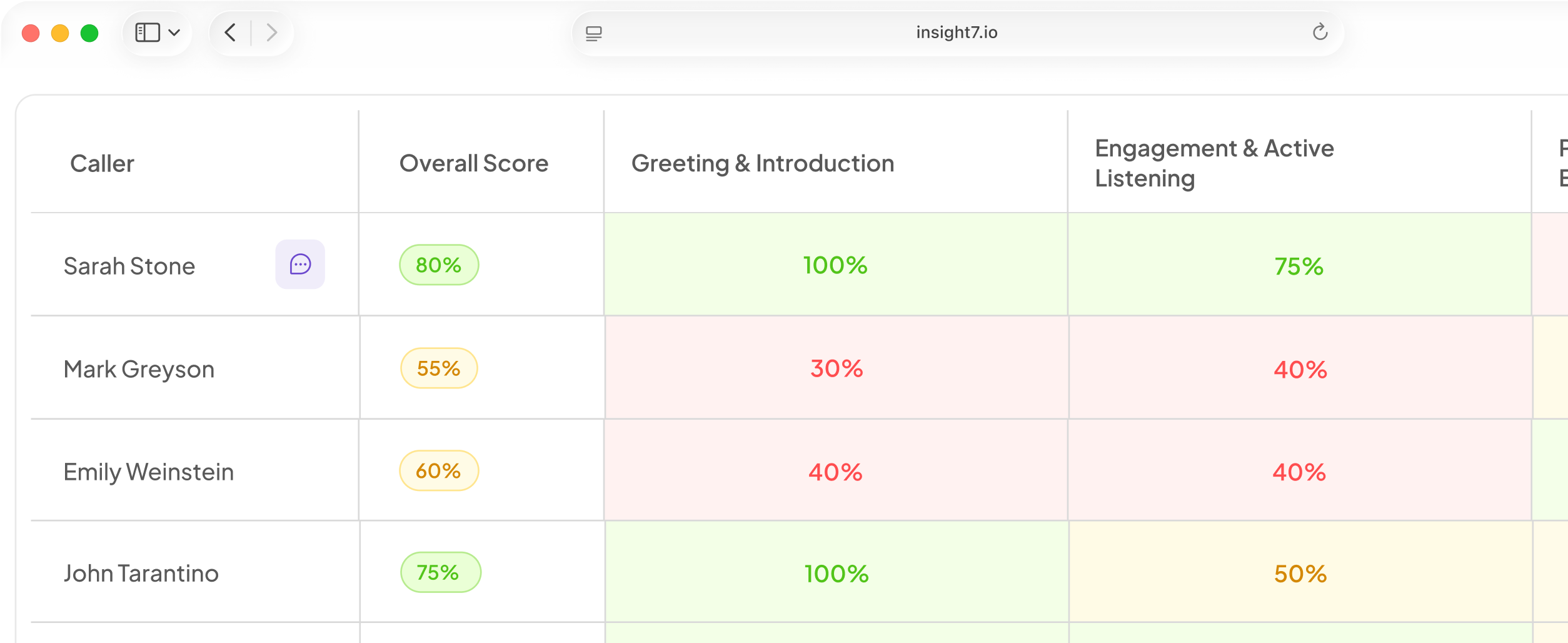
Insight7 can score every call against a weighted scorecard your team owns, not a sample. Build criteria from the key lines of the five scripts, such as "gave AI disclosure" and "offered a human". Then you can see which script lines work across the whole book.
Adapt the scripts to your book
Change one thing at a time, and change it for a reason. Start with the customer segment, then tone, then language.
- First-time late payer: Keep Script 2 as written. A single missed debit is usually a bank or channel problem.
- Repeat late payer: Move to Script 3 sooner. Offer plans that fit the pattern, such as a payment date right after payday.
- High-balance account: Add a human step early. Let the agent confirm the details, then offer a call from a named person.
- Older customers worried about phishing: Say the lender's name in the first sentence. Offer a number they can call back on their own. Never ask for a full card number or PIN on the call.
Keep the agent calm and short. A reminder should sound like a service, because reminders are not collections, and a happy customer pays. Soften the wording in Scripts 1 and 4. Keep Script 5 plain and factual.
Voice matters. Customers respond better to a voice in their own language and accent, and staff tune out training voiced in foreign accents. Insight7 Voice campaigns can run in several languages, with examples such as Yoruba and Igbo, and the manager picks the language before the voice. This is in beta. For training, voice personas can speak languages such as Yoruba, Igbo or Hausa, so callers can practise the same scripts in the language they will hear.
Run one script on a small sample first. Regulated buyers often want a short, low-risk pilot, with payment only after a measured lift. Test call windows too, since the best time differs by book.
Track three numbers per script: promises kept, payments made and complaint rate. Then read the scored calls to find the line where customers hang up or ask for a person. Rewrite that line first.
A checklist score can hide what matters. One critical error should fail the whole call, such as a false threat or a missed handover request. A call can also be perfect on procedure and still leave the customer angry. Check that the automated score agrees with your human auditor before you trust it.
Related reading: Subscription Renewal Call Scripts for AI Voice Agents With Objection Handling, How to Run AI Cross-Sell Calls to Existing Customers Without Sounding Like Telemarketing and 9 Best AI Debt Collection Software Platforms for Lenders and Subscription Businesses.
Questions people also ask
What should an AI debt collection call script include?
Include an AI disclosure, the lender's name, the purpose of the call, one clear question, a payment channel and a way to reach a person. Write each variable as a bracketed field.
Can AI make debt collection calls legally?
Often yes, with conditions. In the US, AI-voice calls already need consent under the TCPA, following the FCC's 2024 ruling. Other regions set their own consent and collector conduct rules, so check each with counsel.
Does an AI collections agent have to say it is AI?
Increasingly yes. EU AI Act Article 50 has applied since 2 August 2026, and it covers automated phone systems. Colorado's disclosure law takes effect on 1 January 2027. Disclose in the first sentence.
How many times can you call a customer about a debt?
Legal caps vary by region and sometimes by debt. Find the strictest rule that applies to your customers, such as the call frequency limits in Regulation F, and set your attempt limit below it. Then test the limit on your book.
What time of day is best for debt collection calls?
Test it on your own book, since answer rates differ by customer group. Try several windows and compare results. Keep every call inside the legal calling hours for the customer's location.
How do you collect a debt without sounding aggressive?
Ask what happened before you ask for money. Give the facts, offer easy ways to pay, and make no threats. Reminders should sound like a service, because a happy customer pays.
When should an AI collections call hand over to a human?
Hand over when the customer disputes the debt, reports hardship, sounds upset or asks for a person. 87% of customers say a company using GenAI for service must offer a human. A missed handover request should fail the call.
Pick one script and pilot it
Start with the pre-due call on a small sample, and score every call so you can see what customers say and where they drop off. Before you start, check that a customer can reach a human in one step, at any point in the call.