
Deciding how much of your call volume to give an AI agent depends on whether it still sounds natural when callers go off script, wait, or ask for a person. These nine design principles cover disclosure, timing, wording, handoff and scoring.
1. Say it is AI up front
Open every call by naming the AI and the purpose. Article 50 of the EU AI Act says any AI that talks to people, including automated phone systems, must say it is AI from the first interaction. The FCC's 2024 ruling puts AI-voice calls under TCPA consent rules in the US.
Here is a sample opening line: "Hi, this is Ada, an AI assistant calling from Northwind Credit. I'm calling about your payment due Friday. Is now a good time?"
In our judgement, disclosure builds trust with wary clients. The caller learns who is speaking and why.
2. Keep reply delay under a natural pause
Measure the gap between the caller's last word and the agent's first word, then cut it. In a PNAS study of 10 languages by Stivers and colleagues, the most common gap between turns fell between 0 and 200 milliseconds in every language. People expect a near-instant reply, so a long gap reads as a bot.
Delay stacks up in four places: speech-to-text, the language model, text-to-speech, and the phone network. Trim each stage, and stream audio instead of waiting for a full sentence.
When a CRM lookup can't be made faster, cover it with a short bridge: "Let me pull up your account. One moment." The caller hears a person working, not dead air.
3. Let callers interrupt the agent
Turn on barge-in, so the agent stops talking the moment a caller speaks. People cut in all the time in real conversation. An agent that talks over them sounds like a recording.
Barge-in depends on voice activity detection, which listens to the audio stream for human speech. The hard part is false stops. Echo from the agent's own voice, a TV, or street noise can cut the agent off for no reason. Three fixes help: echo cancellation, a short minimum speech length before the agent stops, and a check that the sound is words, not noise.
A good interruption looks like this:
- Agent: "I have your account ending in 4, 7, and…"
- Caller: "No, it's 4, 7, 2, 9."
- Agent: "Thanks, 4, 7, 2, 9. Let me check that one."
The agent drops its sentence, takes the fix, and moves on.
4. Write replies the way people speak
Write every line for the ear. Use short sentences, contractions, and one question per turn. Read numbers in chunks, such as "4, 7, 2, 9". Buyers fear AI that sounds scripted, and they ask what happens when a customer goes off script. Never let the agent open by reciting its prompt, because a natural greeting sets the tone for the whole call. Test by reading each line aloud.
Here is a payment reminder, before and after:
- Stiff: "Your scheduled repayment of $45 is due on 14 October. Please ensure sufficient funds are available in your account."
- Spoken: "Your payment of $45 comes out Friday. Will the money be in your account by then?"
The second version is shorter and asks one question. A reminder like this also gives the customer time to fix a failed debit before it happens.
5. Match voice, accent and language to callers
Pick a voice that sounds like your callers' own region, and a language they think in. A forced or exaggerated accent sounds fake within seconds, and callers stop trusting the call. Staff and customers tune out foreign accents, so buyers ask for regional accents and local languages. Judge any accent by listening live, not from a demo clip.
Picture a lender calling customers in Lagos, Nairobi or Mumbai about repayments. A greeting in the local language will be understood faster than formal English.
Insight7's AI voice agents run across phone and web, and they show what regional-language support looks like. In beta, voice campaigns can run in Yoruba and Igbo, and the manager picks the language before the voice. Nigerian Pidgin is being added as a campaign language in beta testing, with no accuracy claim. You can test the agent in the browser, with no phone number needed. Calls where only the AI spoke are not counted as reached, and a carrier's temporary refusal does not use up a retry, so voicemail can't inflate your results.
6. Ground answers in approved company knowledge
Let the agent answer only from approved documents, and teach it to say "I don't know." A model that guesses will state a wrong fee in a calm, confident voice. Banks and other regulated buyers fear most that an AI agent will go rogue or make a public mistake. Accuracy also protects your return. Gartner's review of 432 service AI use cases found only a quarter with positive ROI, and 42% could not be measured.
A grounded exchange sounds like this:
- Caller: "What's the late fee?"
- Agent: "It's $5 after a three-day grace period."
- Caller: "And if I'm in hardship?"
- Agent: "I don't have that answer. I'll connect you to a colleague."
Set one rule: if the knowledge base has no answer, the agent hands off.
7. Design the handoff to a human
Set the handoff triggers before launch, and make every transfer warm. Gartner's 2026 survey of 3,566 customers found that 87% say a company using GenAI for service must offer a way to reach a human.
Hand off when the caller asks for a person, sounds angry, disputes an amount, raises a sensitive issue, or fails twice. Then pass the context along: "I'm connecting you to Tunde. He can see your disputed fee, so you won't need to repeat it."
Buyers raise the handoff on their own: how to keep it polite, and who chases a handover nobody picked up. Say why you are transferring, and keep your tone warm. If no one picks up, offer a callback and log it in a queue.
8. Handle silence, noise and off-script talk
Plan a short repair path for every failure: re-prompt once, rephrase, confirm, then hand off.
After about five seconds of silence, ask once: "Are you still there?" If the caller is quiet again, say a polite goodbye and offer a callback. After a mishear, don't repeat the same words. Rephrase: "Sorry, I missed that. Could you say the last four digits again?" Then read the digits back to confirm them.
Callers wander off script all the time. Give the agent a graceful exit after two failed repairs. It should say why it is handing off.
9. Score every call and tune the agent
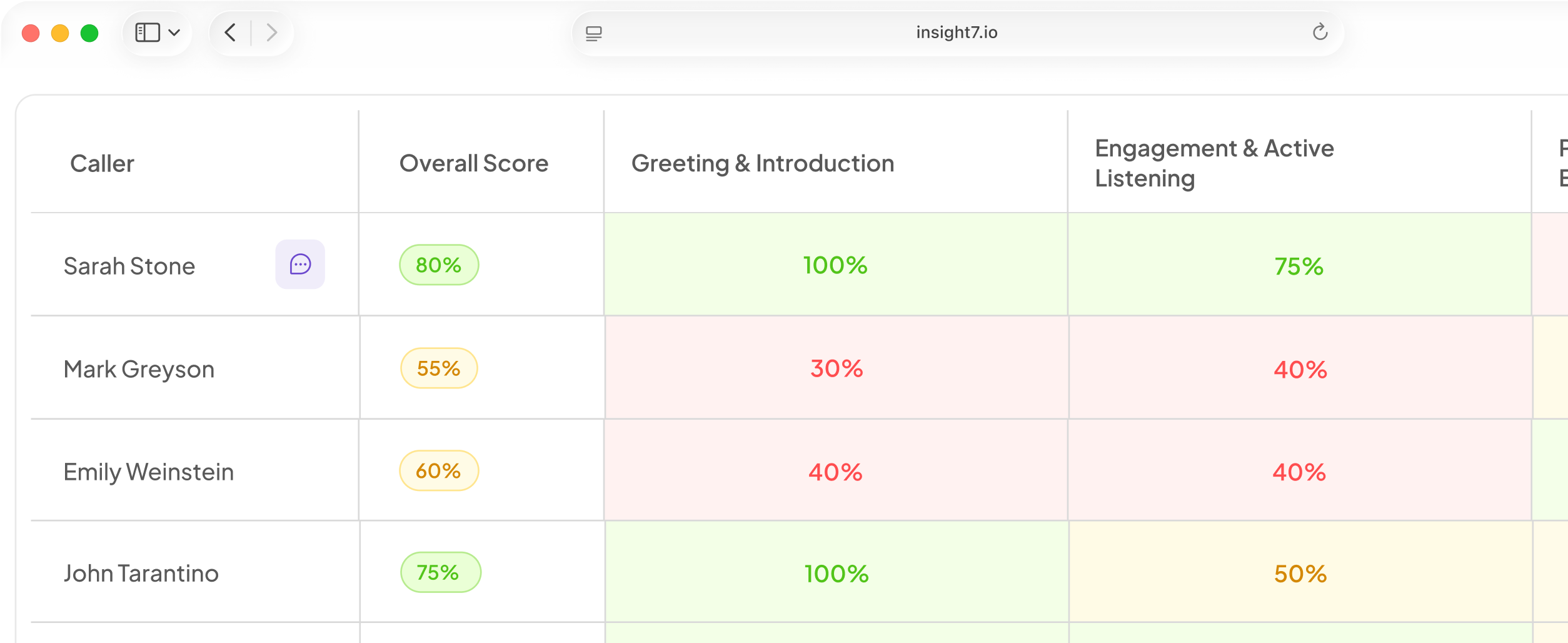
Score every AI call, then change the agent based on what the scores show. Insight7's call QA is positioned as scoring 100% of calls instead of the traditional 2% to 5% manual sample, so robotic moments don't hide in the unreviewed rest. Build a weighted scorecard your team owns, and roll scores up by agent version, campaign and team.
Add naturalness criteria: interruptions handled, pauses over two seconds, repeated questions, and handoff quality. Add one critical-error rule. A call can be perfect on procedure and still leave the customer angry, so one critical error, such as a wrong fee quoted, should fail the whole call.
Then set alerts on low scores and keywords, so the worst calls reach you early.
Related reading: AI Voice Agent Latency Explained and the Response Times Customers Will Tolerate, How to Clone a Team Member's Voice for AI Calls Safely and With Consent and How to Answer "Where Did You Get My Number?" on AI Outbound Calls With Example Responses.
Questions people also ask
What is conversational design?
Conversational design is the craft of planning how a voice or chat agent talks. It covers wording, turn-taking, pauses, repair after mishears, and handoff. You write it as flows and sample lines, then test it on real callers.
How does conversational AI work in a contact center?
Speech-to-text turns the caller's words into text. A language model picks a reply, often from approved documents or a CRM lookup. Text-to-speech says it aloud over the phone line. Each stage adds delay, so the design has to manage all of them.
Should an AI voice agent say it is AI?
Yes, in the first sentence. The EU AI Act's Article 50 has applied since 2 August 2026, and it covers automated phone systems. Even where no law applies, a plain early disclosure keeps callers from feeling tricked.
How do you make an AI voice agent sound more human?
Shorten the sentences, use contractions, and ask one question per turn. Allow interruptions, and keep replies fast. Choose a voice that matches your callers' region. Then listen to live test calls, because demo clips hide flaws.
What causes the awkward pause on AI phone calls?
Pauses come from the four stages stacking up, plus end-of-speech detection. The agent waits through a moment of silence to confirm the caller has finished. If that wait is too long, it adds dead air to every turn.
When should conversational AI hand a call to a human agent?
Hand off when the caller asks for a person, sounds angry, disputes an amount, or raises a sensitive issue. Also hand off after two failed repairs, or when the knowledge base has no answer. Pass a summary along.
How do you measure whether conversational AI sounds natural?
Score every call on observable things: reply gaps, interruptions handled, repeated questions, and handoff quality. Track weekly averages. Add a critical-error rule, and listen to the lowest-scoring calls yourself.
Fix the three worst failures first
Natural sound comes from design choices you can check on real calls. This week, pull 20 recent AI calls and score each against these nine principles. List the three worst failures, then fix those first.