
Finding drop-off points in your customer journey means locating the step where most customers quietly leave. Do it before launching AI calls. Then aim your first campaign at the biggest leak, because emails alone rarely fix it.
Map every step from sign-up to value
Start by listing every stage a customer passes through, in order. For a fintech, lender or investment app, a common list is sign-up, KYC (identity check), first funding or first purchase, onboarding, first use, repeat use and dormant. Customers tend to leave at the same few points: sign-up without funding, KYC started but not finished, onboarding, and dormancy. Adjust the list to your product, but keep the order customers actually move in.
Next, give each stage one event that your CRM or product database can record. Use "KYC submitted" or "first deposit", not "customer engaged". Then add a time limit to each stage, such as 7 days to finish KYC. A customer who passes the limit without the event counts as dropped.
Do not skip the unfinished stages. A customer who signs up and funds but never completes KYC can end up blocked from transacting. That can produce a spike in support tickets when they complain.
Finally, mark each stage by who causes the exit.
- Customer-caused: the person got busy, lost interest or did not trust the step.
- Product-caused: a form breaks, a feature is missing or a check fails.
A call can win back the first kind but cannot fix the second. One lender kept small "win" events separate from full conversion, so product gaps did not hide customer behaviour. Copy that setup by adding one column to your stage list labelled "customer or product".
Pull drop-off data for each step
Count unique customers at each stage over one cohort window, such as the last 90 days. Take everyone who signed up in that window and ask how many reached each event you defined. Step conversion is the customers who reached a stage divided by the customers who reached the one before it. Also compute the median time between steps. A long median gap often shows where people stall before they leave.
A small example for 1,000 sign-ups (all numbers are illustrative only):
| Stage | Reached | Step conversion | Median time from last step |
|---|---|---|---|
| Sign-up | 1,000 | n/a | n/a |
| KYC submitted | 600 | 60% | 2 days |
| First deposit | 300 | 50% | 5 days |
The worst step here is KYC to first deposit, because half of the people who cleared identity checks never funded.
Cut the cohort by sign-up date, so customers who joined yesterday are not counted as dropped. Wait until a stage's time limit has passed before you judge it.
Your data probably sits in several places: CRM, product analytics, the KYC provider, the payments or loan system and support tickets. Join them on one customer ID. If you have no shared ID, start with the two systems that cover your worst step.
Then add the reasons. Read ticket tags and call recordings for people who stalled.
Be careful with small numbers. Many buyers say their data sits in silos or their customer base is small. In that case, use a longer window and judge only the biggest gaps. A small swing on a small base is noise.
Rank gaps by size, fixability and callability
Score every gap on five checks, then call the winner. Put your gaps in rows and give each check 0 to 2 points.
| Check | Question to ask |
|---|---|
| Volume | How many customers did we lose here? |
| Value | What is each customer worth if they finish? |
| Voice fix | Would a human voice change the outcome? |
| Callable | Do we hold a valid number and consent on file? |
| Cause | Is the cause the customer, not the product? |
Two rules override the score.
First, drop any gap you marked product-caused in Step 1. A call cannot fix a broken form. It only sends frustrated people back to the same broken step.
Second, pick a gap where the customer has already shown intent and the next action is small. Someone who started KYC and needs to upload one document is a better call than someone who only browsed.
Apply this to the 1,000 sign-up example. KYC to first deposit loses 300 customers, and every one of them cleared identity checks. The next action is a single deposit. If those 300 have valid numbers and consent, this is your first campaign.
Start with outbound, even if inbound hurts more. Much inbound volume exists because companies never send proactive updates. You also choose who gets called, when and why, so the result is easy to measure.
Check consent, hours and disclosure first
Run four checks before any call goes out: consent, calling hours, AI disclosure and a human handover. A campaign that fails one should not launch.
Rules differ by region:
- US: AI-voice calls already need consent under the TCPA, following the FCC's 2024 ruling. A proposed rule to say "this is AI" at the start of the call was still not final in mid-2026. States are adding their own rules. Colorado's Chatbot Safety Act, effective 1 January 2027, requires public-facing conversational AI to disclose that it is AI.
- EU: Article 50 of the AI Act has applied since 2 August 2026. Any AI that talks to people, including automated phone systems, must say it is AI from the first interaction.
Disclosing is also good design. In a Gartner survey of 3,566 customers, 87% said companies using GenAI for service must offer a way to reach a human. Build that path in from day one.
Turn the rules into campaign settings:
- Call only consented contacts.
- Set calling hours for each contact's time zone.
- Open every call by saying it is AI.
- Write a handover rule, such as "transfer on request or on a disputed charge".
- Cap retries.
Ask your legal team to confirm the rules for each region.
Launch one small campaign and measure it
Pick one campaign type that matches your chosen gap, and write one success metric before you dial. The metric is the step conversion from Step 2, such as KYC to first deposit. Calls made is not a result. A campaign type is one of customer survey, lead follow-up, cold outreach or win-back. For the 300 customers who cleared KYC but never funded, lead follow-up fits best.
Run a pilot on a small sample and hold back a group that gets no call. The gap between the two groups is your lift. Without a holdout, you cannot tell whether the calls worked. Buyers in banking ask for this shape: a short, low-risk pilot, with payment only after a measured lift. A finance lead can carry that number upstairs.
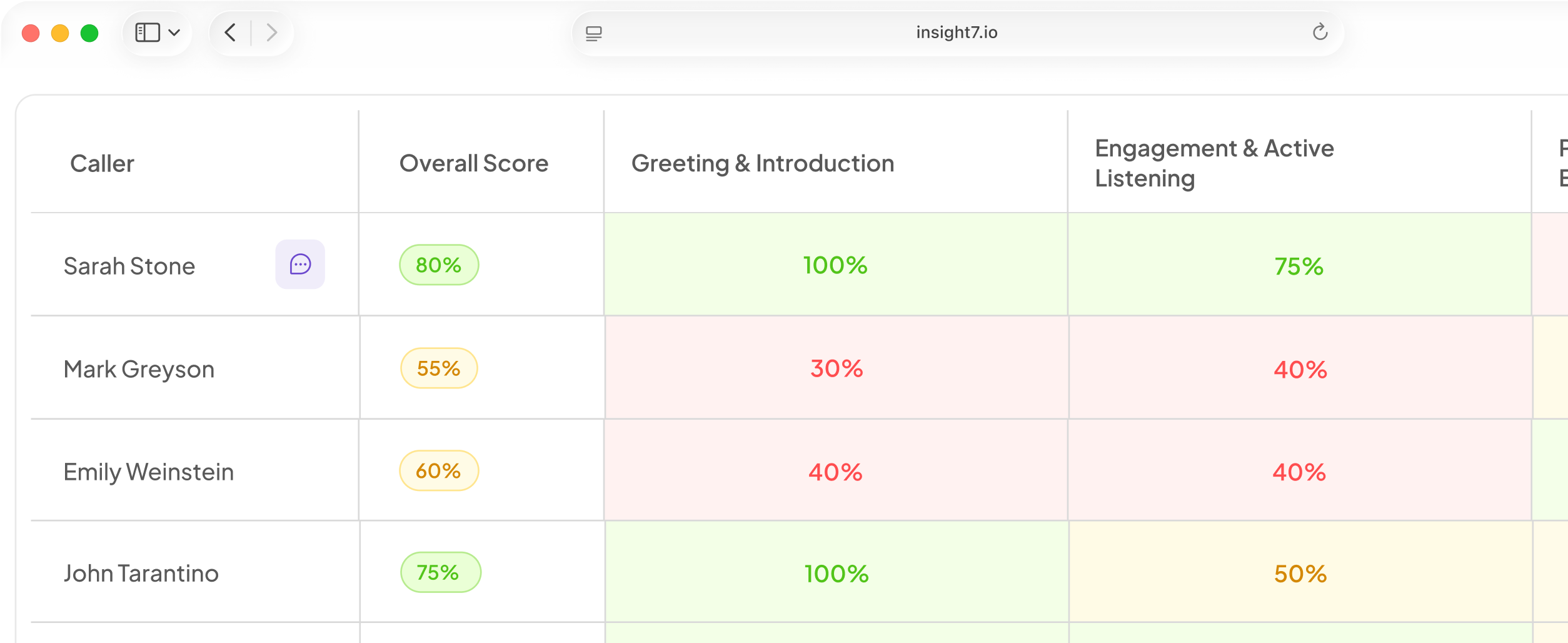
Insight7 can help at both ends of this work. Its AI call scoring evaluates 100% of conversations, and scores roll up by person, project and organisation. It also offers voice-of-customer insights from calls.
Its voice campaigns are in beta and switched on per organisation. A manager sets a goal, an audience, the AI caller and the rules. Campaigns are designed with consent marking, calling hours and retry rules, so check the detail in the app. You can also test the agent in the browser, with no phone number needed. Calls where only the AI spoke are not counted as reached, and a carrier's temporary refusal does not use up a retry. That keeps your reach figure honest. Insight7 also offers AI voice and chat agents, which are autonomous agents across phone and web.
Review transcripts every week. A reviewer can read each transcript once the call ends. Look for the reasons people give for not finishing. Widen the pilot only if the called group converts better than the holdout.
Related reading: 12 Customer Lifecycle Moments Where Automated Outbound Calls Get Better Results Than Email, How to Use AI Voice Agents to Recover Customers Who Drop Off During Onboarding and How to Reduce Support Tickets Caused by Incomplete KYC With Automated Outbound Calls.
Questions people also ask
What is funnel drop-off analysis?
It counts how many customers reach each stage of your journey and how many leave before the next one. The biggest loss shows where to act. It also shows whether the customer or the product caused the exit.
How do you calculate drop-off rate in a funnel?
Divide the customers who reached a stage but not the next one by the customers who reached that stage. This is 100% minus step conversion. Use one cohort window, and judge a step only after its time limit has passed.
What is a good drop-off rate for a customer onboarding funnel?
No single number fits every product. Compare each step with your own earlier cohorts and with the other steps. The step losing far more than the rest is the problem.
Which outbound calls should you automate first with AI?
Automate calls to customers who already showed intent and need one small action. Good candidates are unfinished KYC, unfunded accounts and reminders before a due date. Skip any gap caused by the product.
Do you need consent before making AI voice calls?
In many regions, yes. The US requires consent for AI-voice calls under the TCPA, and the EU and some US states add AI disclosure rules. Record when and how each contact agreed, and check each region with your legal team.
How many customers do you need before AI calls make sense?
There is no fixed number. You need enough customers at the stalled step to split them into a called group and a holdout group. With a very small base, results are noisy, so judge only large gaps.
How do you measure whether an AI call campaign reduced drop-off?
Compare step conversion of the called group with the holdout group over the same window. The gap is the lift. Count only calls where the customer actually spoke as reached.
Start with one leak
Fix the biggest leak with one small, consented call campaign and a holdout group. Before you start, name the exact event in your own data that marks a drop-off.